Continuing our tour, we go north to Capitol Hill, one of the most interesting, in my opinion, of Seattle’s varied neighborhoods. It is the center of the gay, lesbian, and transgender population of Seattle. Punk hipsters with tattoos, pink mohawks, and multiple piercings are commonplace, sharing the streets and sidewalks with men wearing business suits and carrying briefcases.
Capitol Hill has the steepest streets in Seattle, a few plummeting as much as 21% grade, and some swanky residences line Millionaire’s Row. The Row is a National Historic Landmark District with homes built at the turn of the 20th Century.

It is the home of grunge music and my favorite movie house, the Harvard Exit. The Harvard Exit was formerly The Women’s Century Club. The century referred to is the 19th Century. It was opened during the last decade of that century by Carrie Chapman Catt, a suffragist who succeeded Susan B. Anthony as leader of the national organization. The building was sold to a theater operator in the 1960s who converted it to a two-screen movie house. It became a favorite place for movie aficionados who like eclectic, off-beat movies. When the movie house closed, long after I left, the Mexican Consulate leased the building. The Exit was allegedly haunted by a woman who hung herself in the upstairs theater. I never met the ghost personally, but the possibility was titillating. The other great old theater nearby was once a Masonic lodge that became the Egyptian Theater. These two theaters put on the Seattle Film Festival every year, screening weird and wonderful films. I never missed it. There was a wonderful bakery on Capitol Hill called Bella Dolce. I used to order cakes for special occasions there, and they are incredible – yum. I haven’t checked to see if it is still there.
Capitol Hill is the location of Lakeview Cemetery, where Bruce and Brandon Lee are buried. An inscription at their grave site is one that I like, “The key to immortality is first living a life worth remembering”.
Our eldest daughter called Capitol Hill home for a year after she moved out of our house in the mid-80s. It was near her work, and there was a dance group that she joined. She moved away from Capitol Hill because the constant day and night activity, including gun shots, made it hard for her to sleep.
Capitol Hill has several aged Catholic churches and was once the center of Seattle’s Catholic population. It is also where St. Mark’s Episcopal Cathedral stands regally on a hilltop, a cliff actually. It is a massive and beautiful old cathedral with a rose window on its east wall that makes the interior glow during the day, even in light-challenged Seattle. As a child, my family went to our neighborhood Episcopal Church in Bellevue each week, but we attended Christmas services every year at St. Mark’s Cathedral. Their Compline Choir is world famous. I felt so holy in that place. Many years later, our daughter performed in the Christmas service at St. Mark’s with the Seattle Girl Choir. The annual Christmas service is televised in Seattle.
This neighborhood is where our son, age eight at the time, learned what a prostitute was. Our daughters were members of the Seattle Girl Choir in the 70s. We took our younger daughter for a choir rehearsal at St. Mark’s. While she rehearsed, my husband, son and I walked down a couple of blocks to get dinner. On a corner, we encountered a very obvious prostitute looking for her next customer. Under his breath, my husband made a comment about her choice of business location, only a block from St. Mark’s, and our son overheard.
“What does she do?” Casey asked.
“She’s a hooker,” said my husband.
“What’s that?” Casey needed more information.
“She sells her body for a price.” I enlightened our son.
“Oh.”
And that was the end of the conversation. When we returned to the Cathedral after dinner, we walked down the same street. I totally forgot our before-dinner conversation.
“She must have gotten her price,” said Casey when we passed the corner.
“What are you talking about?” asked Ken.
“The hooker. She must have gotten her price because she’s not here anymore.” A brief lesson in Capitalism on Capitol Hill.
Tucked in just south of Capitol Hill is First Hill, referred to as Pill Hill because of the number of hospitals and medical facilities housed there. My only connection to it was the times I spent visiting family members in hospital. Not the best memories.
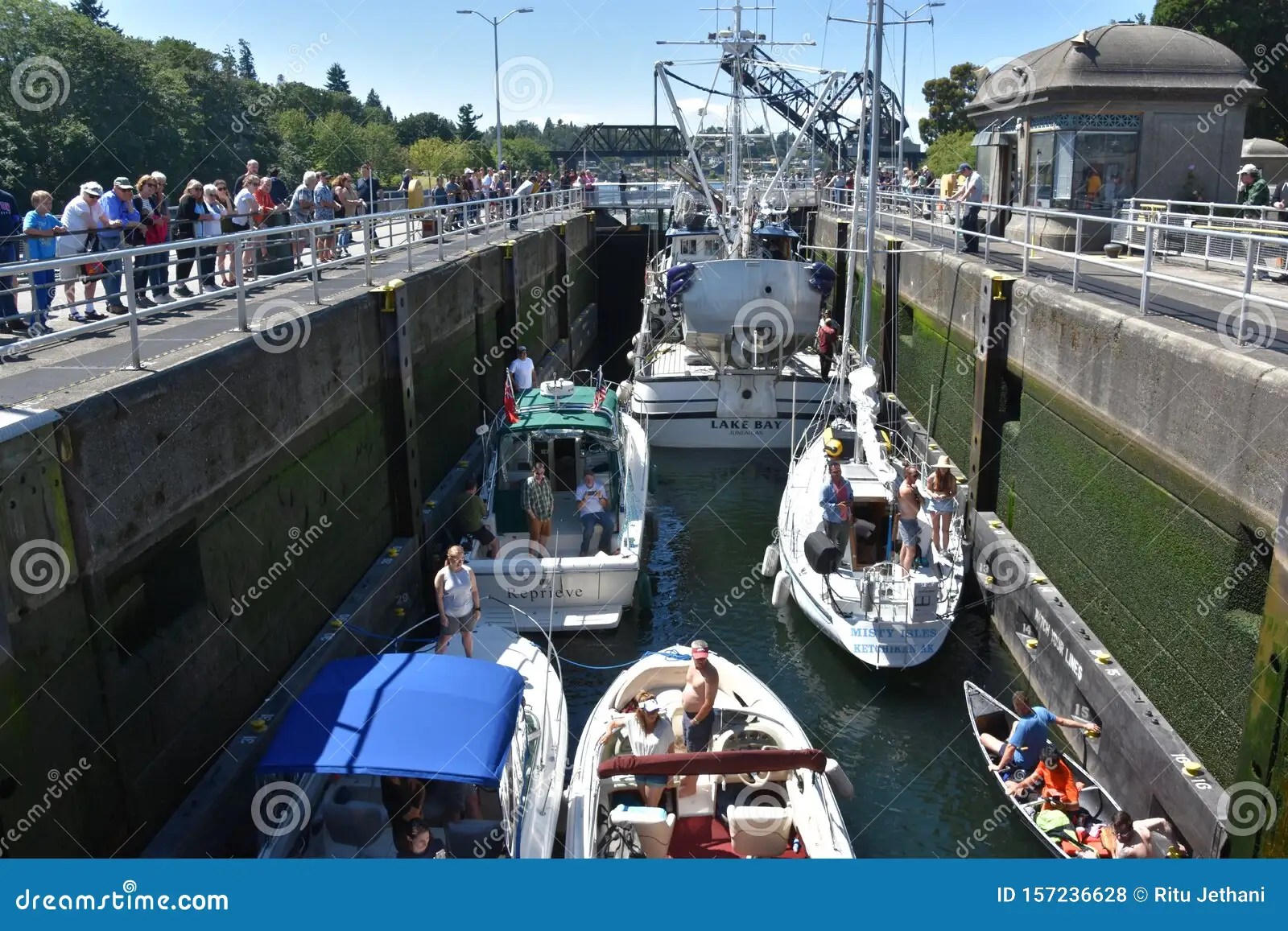
After Capitol Hill, we go north and a little west to Fremont, another of my favorite places. It is bordered on the south by the ship canal that was dug in 1911 to connect Lake Union and Lake Washington to Puget Sound. West of Fremont in the Ballard area are Chittenden canal locks that you have to take your boat through to get from the fresh water lake to the salt water Sound and visa versa. We took our sailboat through a few times. It is an interesting but nerve-racking experience.
Most interesting at the locks is the fish ladder. Salmon are hatched in freshwater lakes and rivers then make their way to the open sea. When it is time to lay their eggs, they return home. The fish ladder has twenty-one “steps” to help the salmon migrate from sea level to the higher level of Lake Washington. Local sea lions can be seen supervising the gates to the fish ladder, looking for a quick meal. We loved to take a Sunday afternoon to watch the boats go through the locks, walk the surrounding park, and, from the underground viewing room, watch the fish swim up the ladder.
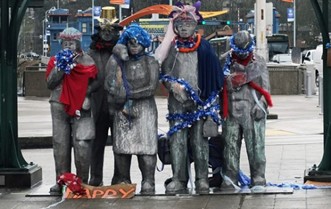
Fremont is the artist community of Seattle. It is sometimes called the People’s Republic of Fremont, and their motto is “De Libertas Quirkas,” which means, loosely translated, “the freedom to be quirky”, I think. A sixteen-foot statue of Lenin was bought by a resident of Fremont after the fall of the communist government in Czechoslovakia. It was installed in the Fremont neighborhood in the 1990s. Another sculpture called “Waiting for the Interurban” stands in the middle of a thoroughfare near the Fremont Bridge, where no public buses pass. It is six people and a dog with a human face waiting for public transportation. The people of Fremont dress the sculpture inhabitants appropriately for the seasons – Hawaiian shirts or scarves and mufflers.
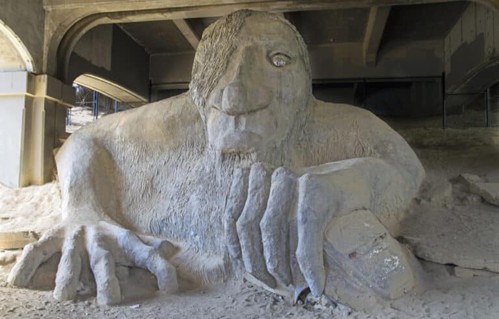
Another sculpture in Fremont is under the Aurora Bridge. It is the Fremont Troll. There was a legend of the troll under the Aurora Bridge, similar to the old Norwegian Fairy Tale about the three Billy Goats Gruff. As a result of an art competition and to keep random drug paraphernalia away from the bridge, an eighteen-foot-tall concrete sculpture of the troll appeared. He is crushing a Volkswagen Beetle that he grabbed from the bridge above in his left hand. The car in his left hand is an actual VW bug encased in cement. It contains a time capsule.
Fremont is an eccentric mix of businesses, shops, and residences, very free form. They have a Summer Solstice Pageant every year with nude cyclists. I go to Fremont just for fun. Other than fun, my Fremont connection is negligible. I took a one-semester off-campus Seattle University class in that neighborhood in the 70s; and my husband and I went to a Fremont hypnotist to lose weight one summer.
 wonkagranny