We live amidst a variety of birds that visit our yard daily. Some are seasonal visitors, and some stick it out through hot or cold, sweltering sun, monsoon rain, or winter snow. The doves are the latter. They are always here.
Our yard backs to a nature preserve that used to be a golf course. Substantial old mesquite trees line the edge of the preserve. Rising above the other trees and brush, they are lookout posts for birds. Doves wait patiently in the top branches for me to put birdseed on top of five block fence pillars each morning. Then they swoop down, and the seeds disappear within minutes. If the doves are slow, smaller birds will start their feast.
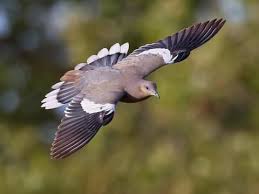
The gentle cooing of the Mourning Dove is soothing. We hear the more aggressive sounds of the White Wing Dove – still a coo but stronger with an emphasis on the beginning sound. The White Winged dove is slightly larger and more decorous than the mourning dove. White Winged Doves have light gray bodies with white stripes on their wings and, when they fly, rounded tails sport white feathered fans. The smaller mourning doves are drab gray-brown with black spots and have narrow black tails, but their wistful call is so much sweeter.
We enjoy the gleeful cheeps and tweets of other birds, most of which I have not identified. Harris Hawk sounds like the beginning of a baby cry that stops abruptly. She is the dark presence of a predator in our benign assemblage. She is beautiful, however, and oh so clever.
My favorite of all time is the Mockingbird. Their chatter is a symphony of sounds, sometimes a birdy twitter, sometimes a hammer, then a barking dog. When our mockingbird visits, we are entertained for as long as he wants to stay. I never leave the backyard as long as he is around. He used to visit often, but it has been over a year since we’ve seen or heard him in the backyard. I heard him this morning, as I walked through the Preserve, so I know he and his cohorts are still around.
We are blessed with little hummers too. I believe they are the variety called Anna’s Hummingbird. They are mostly green and gray, but some have a reddish head. The females are gray-brown with a bit of white on them. They are attracted to anything red. When Ken wears his red ball cap outside, they come to investigate his head. They hang around the lemon tree when it is in bloom. They rise and dive through the air in a birdy ballet.
Doves signify peace, hope, and spiritual purity in many cultures worldwide. To the Greeks, they were holy animals of Aphrodite. To the Jews, they represent God’s holy spirit after the flood. The Cheyenne people of North America had a saying, “If a man is as wise as a serpent, he can afford to be as harmless as a dove,” the equivalent of “speak softly but carry a big stick.” In Hinduism, the Inca Dove represents love and spiritual peace. Doves are used as a universal symbol of peace at international gatherings.
Those folks have not met Lefty.
Lefty is a white wing dove. He is at our back fence nearly every day. We sit on the patio with our morning coffee to watch the coming and going of our bird neighbors. We identified Lefty because he is arguably the major antithesis of a peaceful bird. When he flies in to join other birds, he shoos them off by lifting his left wing and pushing at them until they move or fly away. Mourning doves and small birds skitter when he lands. Even our cardinals who are more his size, leave after he knocks them with his wing a couple of times. The only bird I’ve seen stand up to Lefty is a Gambel Quail. They are roughly half again his size. He doesn’t back down readily but if push comes to shove, their shove is mightier.
The Cactus Wrens are chatty birds, and they are here year-round. They don’t fight, but they are active, flitting from pillar to pillar, staying out of Lefty’s way. They raise their bold voices to scold the other birds, but they don’t get physical. I love to watch them scale the side of the block fence. When other birds are landing on the top, the cactus wren will hop up the wall sideways.
When a local Harris Hawk comes to visit, Lefty along with ALL the birds disappears in a furious burst of winged agitation.
Every now and then, Harris sits on our fence waiting for her breakfast. She knows a dove will eventually come out of hiding. Doves, not known for their smarts, are very low on the food chain. They are the perfect size for a hawk’s meal. Harris has to work harder to get a quail, but I’ve witnessed one being devoured by her.
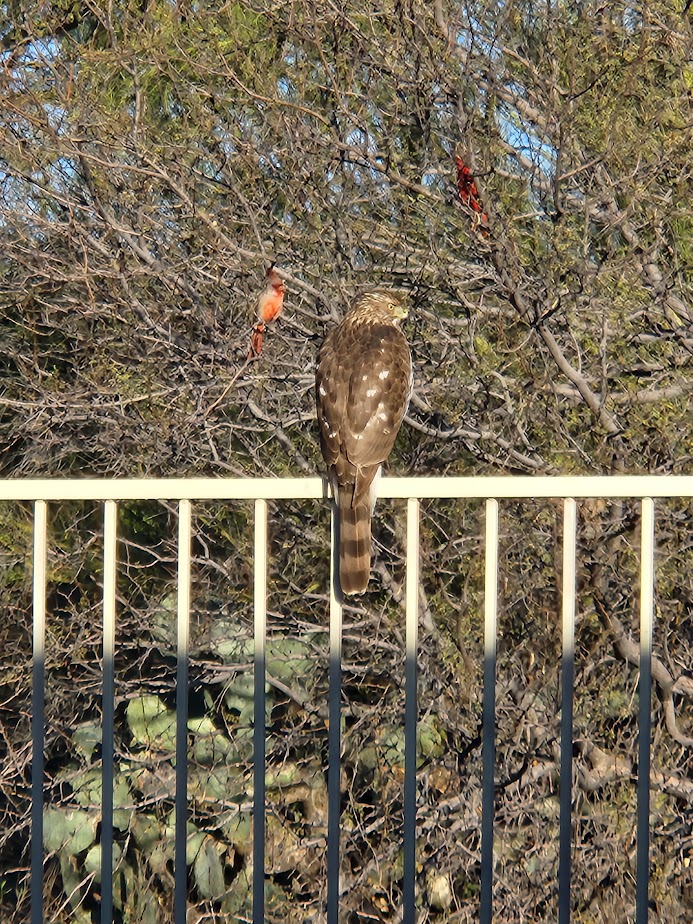
As I watched one day, Harris patiently observed the Preserve from our back fence. She was waiting for the right morsel to break her nighttime fast. She watched the trees, then cocked her head, looking to the ground. I think she was ready for anything feathered or furred to move. After fifteen minutes, several of the smallest birds came out of hiding, flashing their feathered finery and darting through the branches of trees right in front of her. Instinctively, they knew they were safe because they weren’t even a mouthful for the predator. They acted like a motley crew of comedians, skipping, fluttering and dipping through the tree limbs as if putting on a show. They sat directly in her line of sight as if to say, “ha-ha, catch me if you can.” Of course, it would have been easy for Harris to pick off one of those jeering birds, but the nourishment acquired would not compensate for the energy expended. Harris is no fool. Harris turned her head to look at me as I videoed the scene from my patio, off and on for over an hour, as if to say, “I’m the star of this flick, right?” Finally, a furry creature, I think was a mouse, possibly a pack rat, darted through the underbrush and swoop went Harris. When she flew away, I could see the small meaty creature in her talons, destined to be her morning repast.
We don’t have to leave home to find amusement. We have an endless display of nature to enchant us, especially the charming members of the bird kingdom.
 wonkagranny
How cool! I love watching birds.
LikeLike