

The early 20th Century, after reconstruction and before the First World War, was something of a golden era in the United States. The country was expanding economically as was optimism for the future. The first transcontinental railroad opened the West to more settlement. My grandmother born in 1888, was the youngest in the John Lambie family of seven girls and eight boys. Her mother was Danish and her father, Scottish. They lived in Wisconsin, on a farm near Kaukauna.
In the buoyant spirit of optimism, my grandmother, Bessie Caroline, and her sister Bea set out for adventure in the wild wild West. They signed on to be Harvey House Girls.

In 1913 a prominent New York food critic, Henry Finck, named Mr. Fred Harvey, “the food missionary” to an underserved population in the West. Mr. Harvey placed restaurants and hotels along the routes of the Atcheson, Topeka, and Santa Fe Railroad and the Gulf, Colorado, and Santa Fe Railroad among others. He is credited with “civilizing the West, one meal at a time.” He is acknowledged to have started the first restaurant chain of eighty-four (at its peak) Harvey House Restaurants extending through twelve states from Chicago to San Diego.
Harvey House Girls had strict rules governing their conduct and living arrangements. The Harvey Company policy was to employ single, well-mannered, and educated American ladies. In newspapers throughout the East Coast and Midwest, their ads specified “white, young women, 18–30 years of age, of good character, attractive and intelligent”. The women were paid $18.50 a month, plus room and board. That was considered a very handsome salary in those days. The opportunity to leave their homes, enjoy travel, have new experiences, and work outside the home was very liberating for thousands of young women.

The women lived in a common dormitory much like a sorority house with a strict 10 p.m. curfew. A Harvey Girl with seniority assumed the role and responsibilities of house mother. The official starched black and white uniform was designed to diminish the female physique. It consisted of a shirt waist dress with a skirt that hung no more than eight inches off the floor, and a high pointed collar with a black bow tie. They wore opaque black stockings and black shoes. Their hair was contained in a net and tied with a regulation white ribbon. Makeup of any sort was absolutely prohibited. Marriage was the most common reason for a girl to terminate her employment.
Harvey Company restrictions maintained the clean-cut reputation of the Harvey House Girls and made them even more marriageable. Cowboy philosopher Will Rogers once said, “In the early days the traveler fed on the buffalo. For doing so, the buffalo got his picture on the nickel. Well, Fred Harvey should have his picture on one side of the dime, and one of his waitresses with her arms full of delicious ham and eggs on the other side, ‘cause they have kept the West supplied with food and wives.”
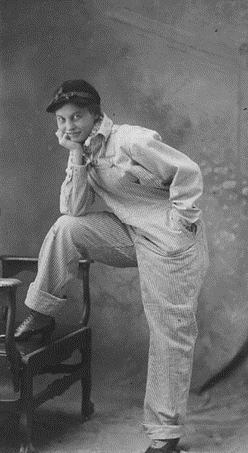
Judging from a few photos in family albums, my grandmother made the most of her twenties. There are pictures dated between 1908-1915 of her hiking in the mountains, picnicking at a lake, cruising in a 1906 convertible Pope Toledo, Type XII gas-powered, chain-driven automobile with five other young men and women, and in the arms of various “boy-friends” and generally having a grand time. Besides photos of her in Wisconsin, she was in Mojave, San Diego, San Fransico, and Bakersfield, California, at the Grand Canyon, in Trinidad, Colorado, at Starvation Peak in New Mexico, and at the home of a Mexican family in New Mexico, among many other places over those years. Bessie and Bea are shown in one photo standing atop a train wreck. It was taken at the 1913 California State Fair in Sacramento. Two trains were intentionally run toward each other at 90 mph as entertainment at the Fair.

In 1916, Bessie met Ed Henry, a trainman naturally. They married in 1917 and she settled into a life of domesticity. They had three children of which my mother was the eldest. My grandfather was one of the lucky ones who kept his job during the hard times of the Depression so the family did not suffer as much as some families during that time. My mother did tell stories of hobos knocking on their kitchen door asking for food and Grandmother making a meal for them.
I just wish I had known of Grandmother’s early days when I was a child spending whole summers with my grandparents in Colorado. I can think of so many questions I would have asked her. My grandfather was still a brakeman for the Union Pacific Railroad. I remember him coming home after a two-day round-trip from Denver to Green River, Wyoming. His big embrace when he picked me up upon arriving home smelling of wool, tobacco, and shaving cream is with me to this day. I can conjure it when I close my eyes and think of him. He was a tall man and a loving man. He must have been something to have wooed my grandmother’s adventuring spirit into marriage.
Once when I was six years old, my grandmother and I rode on Grandpa’s train to Green River and back so I could know what Grandpa did when he was gone. I remember being so proud when he came into our car in his uniform and hugged me. Everyone could see my handsome grandpa loved me. I remember how much I loved being on the train. A ten-hour ride each way went swiftly. Grandma and I stayed overnight at the home of their friends in Green River.
Back home at their house in Longmont, Colorado, Grandma was the domestic goddess. She kept a beautiful flower garden with sweet peas, honeysuckle, nasturtiums, roses, and chrysanthemums out back as well as a vegetable garden. I can still recall the sweet earthy smells. She canned peas, beans, tomatoes, peaches, and made jam. They had raspberry vines along the fence. She washed clothes with a wringer washing machine. I got my fingers caught once in the wringer when I tried to “help” her. She made delicious meals. Grandma had a sweet tooth and most everything had sugar in or on it. I had bread and butter with sugar as a snack and fresh garden tomatoes with sugar sprinkled on them. She claimed it was her Danish heritage that made everything sweet.
When Grandpa was home we often went fishing at Estes Park in the mountains. Grandma filled a huge picnic basket with scrumptious food – cold fried chicken, potato salad, chicken sandwiches, tomatoes, carrots, berries, and of course dessert – cookies or cake. Grandpa baited my hook with squirmy worms. I’d watch the bobber closely until it disappeared and I knew I had a rainbow trout on the line. Grandpa would take it off and put it in the woven basket that dangled in the water to keep them fresh. Grandpa would sometimes cook them right there on the little camp stove we brought. We always had more to take home for a dinner or two. Grandpa especially liked trout for breakfast with Grandma’s big fluffy biscuits dripping with butter and homemade jam.
I have great memories of my grandparents and wish I could have learned more of their stories in the years I had with them. In times past, each generation was tasked with passing on family stories from generation to generation. I think we lost that tradition in our hustle-bustle world and it saddens me. Every life is a series of stories and we should keep them alive in the family. I’m sure a semi-fictionalized (creative non-fiction) version of my grandparents’ story will start pestering my crowded brain at some point.
I noticed online that there is a Harvey House in Madison, Wisconsin. It is not the old one but a new version. Wish I lived near there. Maybe a road trip is in the future.
 wonkagranny
What a history your grandmother left for family. If only we all had asked the questions sooner than being too late.
LikeLike
Interesting history.
LikeLike
Diana, What a wonderful story. I’d watched a story about the Harvy girls and that history. You are right about losing our family history. I often wished I knew more about my grand and great grandparents. I was too young (and maybe self-centered) to ask about their lives when they were young and full of hope and dreams and disappointments. To me, at that time, they were just “old”. My loss. Thanks for sharing! Hope you have a great weekend! Hugs, Gail
LikeLike
Love this, Dianna! She was a very special grandma. Wish I would have known of her escapades before she passed away.
LikeLike
Yes. We all could have enjoyed those stories. Even Mom didn’t know them.
LikeLike