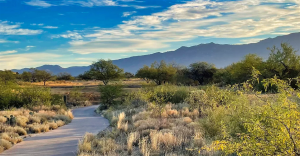
Saturday started in the usual way, up at 5 am as dawn cracked the horizon, then a walk through Vistoso Trails Nature Preserve, a 202-acre former golf course that backs to our property and connects with other open spaces in our town.
A rambling six-mile trail (former cart path) winds through open areas and trees offering beautiful vistas of the Catalina Mountains as well as local wildlife. Birds of all kinds chatter in the trees declaring the news of the day as we walk along. Roadrunners and rabbits skitter across the paths in a hurry to go to breakfast. Animals and humans stay a respectful distance from one another. The wildlife does not seem frightened or threatened by people passing through their home.
Yes, it is hot in southern Arizona in July, but not so hot that nature cannot be enjoyed in the early hours. We are lucky to live in this amazing environment. The trails are busy with walkers and a few bikers until about 9 am when temps start to climb and everyone retreats to air conditions homes. Monsoons are on the agenda for this month yet none have arrived. They will certainly be welcomed when they do. They bring drama to our Sonoran Desert and much needed rain.
Later in the morning, Sally and I met at our town’s newest bookshop, Stacks Book Club, a long-awaited addition to the Oro Valley Marketplace. Wow! We were impressed. The owners, Crispin and Lizzy, have done a great job creating a comfy ambiance, a gathering place. They are open from 7 am to 8 pm every day and offer a variety of coffee drinks, teas, energy drinks, beer, and wine – something for every time of day – plus an assortment of pastries and sandwiches, and BOOKS. Their opening weekend drew over 1,000 people. Crispin said it seriously reduced their inventory of books which they are busy upgrading. The bookshop is a real bonus for our community. I’m sure they will do very well. We plan to visit often. It is a great place for a writers’ group to meet to discuss individual projects and have a cuppa.
That was my day – from bobcats to books to baseball (on TV). Dodgers beat the Mets, Angels beat the Astros, and Tigers beat the Mariners. Then a happy hour hosted by our neighbors, Joyce and Rick. Perfect!
Several days before July 4th we were invited by dear neighbors to attend a showing of the movie, The Sound of Freedom, with them on our nation’s birthday. It is not a movie I considered attending had Suzanne not extended the offer. I avoid TV shows and movies with violent topics in order to save my peace of mind. It is not that I am unaware of the terrible scourge of human trafficking, it’s that I feel helpless to do anything so prefer to bury my head in my pillow and dream sweet dreams. This movie gave me hope and a way to help. It is well done with no gratuitous scenes that make you turn your head away.
I did not know that the movie is the true story of an American hero. It is a genuine heart-thumping thriller, the story of a necklace that connects two children with their rescuer. I am so very glad I went and extremely happy to tell everyone I meet to see the movie. It is an amazing story and one that should be shouted from the mountaintops.
The movie was written and directed by Alejandro Monteverde. I read that it surpassed Indiana Jones on July 4th at the box office, with $14.2 million for Freedom vs $11.6 million for Indie. It was an uphill battle to get the movie made and distributed. It was dropped by 20th Century Fox and Disney Studios and finally taken up by Angel Studios. It took more than ten years to get the movie to the public. It has been virtually ignored by the press and main media outlets.
Quote from Jim Caviezel who portrays Tim Ballard in The Sound of Freedom.
“I want this to be so huge that they’re forced to look at this. I lost my agents over this. Yep, 17 years, 15 years. I lost my lawyer over this, and now I understand why all these actors didn’t want to do the movie because of this. Listen, you do Schindler’s List fifty years later, you’re a hero. Try doing Schindler’s List when the real Nazis are right there. Understand how that becomes more dangerous? I don’t understand why people are willing to let children be hurt, but in this time, Hollywood says, ‘No, no, let’s kick that down fifty years from now and then [see where we’re at]. That’s crap.”
The Nitty Gritty. There are 40.3 million trafficked persons globally today and 25% of them are children. * Sources: Child Liberation Foundation, International Labour Organization. Every year approximately 350,000 children are reported missing and an estimated 100,000 of them are being trafficked; reported in all 50 states. *Source: National Center for Missing and Exploited Children. According to the 2021 Human Trafficking Report, 57% of human trafficked victims are minors. The U.S. is one of the top destinations for human trafficking and among the largest consumers of child sexploitation. Human trafficking is a $150 billion-per-year business, more than the NFL, NBA, MLB, and NHL combined. It has overwhelmed the illegal arms trade. The U.S. current border situation makes it even easier for children to be trafficked. God’s children are NOT for sale.
Tim says that he would not have been able to start O.U.R. if it wasn’t for the unwavering support of his wife Katherine. Actors Jim Caviezel and Mira Sorvino portray the couple in the movie.
Tim Ballard initially worked for the CIA for a year, then for twelve years as a special agent working at the border for the newly formed Department of Homeland Security. At one point he quit his job in order to complete his mission to save children. Without giving away the beautiful, tearful ending to the movie, I just want to say Tim Ballard is an American hero. At the time the movie was made, Tim and his wife Katherine were the parents of six children. Now they have nine, two of whom were adopted after Tim helped in their rescue. He and his wife founded an organization called O.U.R. – Operation Underground Railroad, a non-profit organization to search out and rescue children who are victims of this vicious global business that turns innocent children into commodities. If you go to their website, linked below, it tells how you can help. Stay until the very end of the movie to see photos of the real heroes and to download a QR code to participate in “pay-it-forward”, an opportunity to pay for someone who cannot afford to go to the movie. This movie needs to be seen by as many people as possible. It is a cautionary tale for parents and children. Not all their stories have happy endings as this one does (spoiler alert).
Our life is ruled by our three fur babies. As all animal lovers know, every animal has a soul and personality unique to themselves. It is said, dogs have masters, but cats have servants. We happily serve Nunny Catch (named after a street and café south of Bath England), big brother Oliver, and Sadie, the baby.
Nunny taking a snooze
Nunny is a rescue special-needs cat. We acquired her when she was three (although our vet says she was more likely five or six and had given birth to many litters). She is now eleven or twelve and shakes off her old lady ways occasionally to chase Oliver and Sadie around the house. She has arthritis and breathing issues that are controlled by a small amount of medication given every other day. Nunny is very small. She still has her cat skills and can jump to the top of the cat tree in the family room. Nunny is a love sponge. She likes to lay on the top back of chairs and sofas, so she is at the right height to be petted when someone passes by. She never gets enough. She sits on our lap whenever a lap appears. She taps me on the shoulder if I’m sitting to let me know it’s mealtime, sometime between three and four o’clock in the afternoon; or walks around and around the kitchen island meowing that it is dinnertime. She purrs so loudly she can be heard over the TV. In her mom role, she grooms the other two cats if they hold still long enough. She is rarely out of sight. She curls up in whichever room we are in so she can keep an eye on us. Nunny insists on going into the library/office at night. She taps me on the shoulder if I’m sitting, just as she does at mealtime, to remind me it is eight o’clock. Her internal clock is infallible. If I don’t take her in there she meows loudly and walks back and forth until she gets me to put her to bed and close the door. Occasionally one of the other cats joins her, but not often. She likes her quiet nights alone.
Oliver on vanity
Oliver, also a rescue, was three when we brought him home a year or so after Nunny. He is now seven. It took him three years to let Ken touch him. He tolerated me but wouldn’t come on my lap or allow me to pet him for months after we got him. He is very suspicious and stays far away from company. If someone stays with us for a few days, he may make an appearance just to see what’s going on but disappears quickly. There are times we look high and low and cannot find him. He has a peculiar habit around mealtime. He comes to the kitchen when he knows I’m fixing their food. He’ll even stretch up at the cabinet like he’s reaching for his dish but when it is put down, he smells it, possibly tastes a bite, then shakes his right paw as if to say “this is not to my liking”, tosses his head and leaves the room. Oliver will eat his food only when no other cat is around late at night. Sometimes I feed him in another room by himself if I want to make sure he gets his food early. Oliver is also the only cat I’ve met who doesn’t like treats. We’ve tempted him with all kinds but he will not eat them. They will lay where we give them to him until one of the other cats eats them. He will lay on my lap late at night when Nunny is not around. He now loves to be petted – on his terms. He hates being picked up, makes his body rigid, and fights. Needless to say, he doesn’t get picked up very often. He usually responds when he is called so we don’t have to corral him. He loves to be admired and photographed. He poses like a prince.
Sadie’s work rearranging dining room picture
Sadie on the file cabinet at age one
Sadie is the charmer, the clown, the scamp. She was a kitten of a few months when we brought her home. Tiny and cute then, she is now, at the age of three, the biggest of them all. She loves people and is immediately everyone’s best friend when they come to visit. We have to close her in the library when guests come who don’t appreciate feline company. Sadie is everywhere all the time. Unlike the other two cats who do the cat thing and sleep most of the day, Sadie is busy, busy, busy all day long. She rarely stops. If you find her sleeping, it is a fluke. She climbs to the top of everything. She flies from chair to chair to table to piano to bookcase to sofa, never touching the ground. She plays with toys, bottle caps, coins, whatever she can find, shooting goals under the refrigerator, sofa and closet doors. She has broken lamps, pulled pictures askew on the walls and pulled books and bric-a-brac off shelves. I don’t know how she gets books off library shelves when they are wedged in but I know she works at it. Sometimes books are pulled into the middle of the room. She is also a thief. Well, that is harsh. She is a trader. Once when Sally was visiting, she took Sally’s keys from her purse, but she put a cloth toy mouse in its place. The keys she took back to the closet and put in my shoe. We had quite a time finding keys so Sally could go home. Another time I found a lipstick that was not mine on the floor in the bedroom. I called a friend who had visited earlier in the day to ask if she was missing a lipstick. Sure enough when she looked in her purse she found a cat toy and was missing a lipstick. I do not know how Sadie came by the idea of trading but now I caution women to close purses tightly. It is impossible to put purses where Sadie cannot reach them because she can get anywhere. She is also extremely good at disappearing. We have searched and searched at times and she stays well hidden until a treat is offered.
Our three darlings are our companions and entertainment. We love them because of their quirks not in spite of them. This is a short essay about the unique personalities of our cats. I can spend hours writing all kinds of stories about their antics. I’m sure you have stories about your loved pets also. Take some moments to write them down.
Last October I wrote a blog post called “Writers Need Wingmen” about the importance of writers’ groups. Writing is a solitary task but a writer’s mission is to connect with other people through their creative calling. Our book, Telling Tales and Sharing Secretsis a collaborative memoir of our group as we learned from a variety of writers how to craft prose and poetry to make it an enjoyable experience for readers. After all, readers are the consumers of all our efforts to communicate. In the last year since our book was published, I made the acquaintance of more writers, some have created their own critique groups. Our Oro Valley Library hosts a forum twice a month with up to twenty-five or thirty authors and would-be authors. We talk about our experiences with the writing, editing, and publication processes. It is a valuable asset for writers.
Before you get an agent, before you get an editor, before you find a publisher, you need to produce a novel, short story, memoir, or poem that showcases your talent at its best. A strong support for a writer, especially one that is starting out, is a small critique group with four to six people; other writers who take your endeavors seriously and comment on what works and doesn’t work when you send your creative emissaries out into the world. Writers’ groups develop over time as you learn to trust someone else’s opinion. Others in the group are not there to change your story, poem or essay or rewrite it, but to help you give it the best polish, to make a great impression.
One of the publishers we interviewed before we published our book gave us very valuable insight. He said we were writing to each other, not the world at large. Our group has been together for over twenty-four years so we know each other very well and understand how we each work. He said some of our memoir left out details that WE knew but to which readers were not privy, the important backstory. In other words, we weren’t telling the whole tale. A wake-up call. We got busy filling in the details to make our story more accessible.
A writers’ group is designed to do that for each member. Our book has suggestions for creating a group and general rules that make it work. We wrote together, learning how to create story and build characters, even in memoir writing. We held each other accountable to do their best work, to communicate fully.
One of the writers I came to know this last year is Debra VanDeventer. She wrote an engaging book with humor about the transition from thirty-seven years as a devoted teacher to joining the real world, Out of the Crayon Box – Thoughts on Teaching, Retirement and Life. She has a blog site, Seams Like a Story. As the title of her blog hints, she is a seamstress and weaves bits and pieces of her other creative endeavors into her writing posts. Yesterday, she wrote in her blog about her critique group and what it means to her and her writing. I recommend you read it and then, if you are interested in furthering your writing, get a copy of our book to start your own group.
I have written about memories of my dad. Although dead for over five decades, he is a constant in my life. As I contemplated what to write about this week, I read an essay and poem by Tom Chester. The essay was published yesterday on Father’s Day in the Arizona Daily Star. The poem is published on Tom’s website. I found both to be very moving and a fitting tribute to fathers on their special day.
Tom Chester
A Father’s Letter
On Father’s Day, people often write letters and essays about their own fathers. In contrast, I want to offer a father’s perspective in this letter to my two daughters.
To my daughters,
On this Father’s Day, I want to tell you how proud I am to be your father. While there is often a close relationship between fathers and daughters, I write this letter to tell you about ours, for after all, ours is special. There is much to say, but I want to avoid any temptation toward sentimentality. Our connection is better than that.
As I compose this letter, I think about my own father, dead now for three decades. I still have a letter from him, likely the only one he ever wrote to me. It is from the summer I turned 19 when I was working away from home for the first time. The letter is mundane, advice on the best route to take when I drove back after my job ended. Yet, it is one of the most intimate connections I still have with him. He exists now only in a few mementos like that letter, some occasional memories that arrive unexpectedly into my conscience, and glimpses of him when I look into a mirror.
Just as I see traces of my father in my features and my personality, so I see reflections of me in both of you. The similarities have been refracted enough by genetics, though, so that we are different in many ways. I wonder what memories you will have of me thirty years on. I am sure there will be brief scenes of family events and I hope thoughts about my values, my views on life, and my ideas on how to engage the world.
Perhaps those things matter little, however. Rather than consider my legacy to you, it seems more fitting to think about what you have given me and the ways you have changed me as a person. I am much different than I would have been had you two not come into my life. You have taught me much about myself, too much to describe in a short letter like this. You also have taught me about life itself. When you were born, you were totally dependent on me (and on your mom as well, of course). As you grew, you began to separate yourself from me, becoming your own persons until you finally broke away and started your own lives independent from mine. I increasingly realize that the process continues and will evolve until our roles will have completely reversed, and in my old age, I will likely become dependent upon you. Already I often seek your advice and help on things.
Being your father has been damned hard — not because of you but because of my emotional connection to you. Someone once wrote that having children means becoming a hostage to fate. Even though you are adults I am still a hostage because I understand clearly that well-being is tenuous and that the vagaries of fate swirl around to intrude without warning.
I know I have made many mistakes in raising you, as with all parents, but I did my best. Fortunately, you are resilient and have not suffered too much from the experience. Despite the temptations, I mostly have avoided giving you advice. I have come to realize that you know more about yourselves and your world than I, and that much of my advice would not apply. Moreover, I have made many errors by following my own advice, enough so that I want to avoid causing you to make mistakes in yours. Finally, I have tried to raise you to think for yourself, so my giving advice would be hypocritical.
It is common for a parent to say to a child, “I love you,” and I certainly feel that way toward you two. Just as important, though, is that I like you. I respect you and admire your character. I trust you with my wellbeing. I trust you with my life, too. As I age, I am comforted by the agreement I have with each of you that at the end of my life you will treat me like a beloved dog—keep me comfortable and if necessary when the time comes, have me put down. I know that either of you would do that without compunction or regret. You understand.
I am proud that our relationship is one of mutual respect and admiration, but also one that accepts that we all three suffer from the foibles and imperfections of our species. I have tried to imbue in you a sense of living intently and intentionally. I hope you will carry a memory of that. I hope also that your memories of me will be touched by laughter and that you will have many stories to tell about your Old Man.
Once upon a time I had an uncle named Bobby. Well, his name was Robert, and everyone called him Bob, except me. My mother was his big sister. She called him by his childhood name. I learned as a tiny girl his name was Uncle Bobby. When I was in my fifties and he in his seventies he told me I was the only person allowed to call him Bobby.
I got Bobby. He was the middle child and the renegade of the family. He went his own way. He wasn’t a bad guy at all. In fact, he was a very sweet guy, but he did have some complicated relationships except with his best friend, Dennis, and me. Bobby was a drinker, especially after his beloved wife, Jeannie died. He became a regular at his favorite bar swapping lies with the other old dudes there. We knew where to find him if he wasn’t home. I remember when he was in the hospital after a bad fall, his doctor told his daughter to bring him beer every day. He said, “Bob’s an alcoholic and we can’t detox him while we’re trying to heal him. That will have to come later.” Well, it never really did. But he did stop drinking straight vodka with beer chasers and stuck to just beer.
Bobby was in the Navy during WWII, but I never heard any of those stories. A many-talented restless sort of man, he had a successful car dealership and then a printing business. He told me stories about selling cars, people he met in the printing business, and about bow and arrow hunting with his pals. They hunted on horseback and camped for days at a time. I saw photos of them around the campfire. He also told me about his rodeo days, with his buddy Dennis, as a calf roping team. He was a cowboy in his forties and fifties.
The story of the hat came toward the end of his life. In 2006, he became too unsteady to continue living by himself and his daughter wanted him to move to California where she could look after him better. He was packing up to leave his home in Phoenix. I went up there from Tucson to help and say goodbye since I didn’t know if I’d get to see him again. (We did make a trip to see him a year later). As he was getting in the truck to leave, I noticed his favorite hat sitting on the porch. “Uncle Bobby don’t forget your hat,” I called picking it up to take to him. “You can keep it. Remember me,” he said. Tears sprang to my eyes. I had managed to get through the day without them. I knew exactly what I would do with that hat.
In 1996 we bought a wonderful, detailed pencil drawing from the artist Glen S. Powell at the Payson rodeo. It reminded me of Bobby. It depicted a calf roping team – not Bobby and Dennis, but two guys like them. Bobby was the fella ON the horse, Dennis did the leap to take down the calf. I took the hat home and placed it at the corner of the picture and there it remains. Every time I look at the picture, I remember Uncle Bobby with a smile.
As I’ve mentioned in other posts, we live at the edge of a nature preserve in Rancho Vistoso. One of the delights of living here is seeing animals in their environment whenever we walk through the neighborhood and preserve. Occasionally, wild things show up in our yard (both front and back) or at our fence. We live with bobcats, deer, coyotes, ground squirrels, geckos, and javelina as our neighbors. A mountain lion and black bear have been spotted in other areas of Vistoso but we have not seen them in our neighborhood. We also have snakes (I just saw a king snake at our patio door), tarantulas, and scorpions on occasion. The bird families are many and include road runners, Gamble quail, mockingbirds, redtail and Harris hawks, mourning doves, white wing doves, cardinals, cactus wrens, and smaller birds I haven’t identified. Sometimes it feels like we’re in the cage as animals peer at us through the fence. The deer especially look over at us as if to say “Ahh, poor humans, closed in by fences while we have the whole Sonoran Desert to roam.”
Ken and I sit on our back patio every morning with our coffee/tea and watch the birds. I put Desert Blend birdseed atop the fence posts and they greedily scarf it down scattering a goodly amount on the ground. The small birds come first, then the doves. White-wing doves are bullies shooing other birds away until a quail shows up, then they back off. Quails reign. When a hawk flies in all the birds scatter. Once in a while a hawk will catch a dove and sit on top of a fence post to have breakfast with us.
Just to say Hi
Last week as we sat with our morning beverage, we were visited by a javelina I dubbed Miss Piggy. She was so friendly. She came up to the fence and allowed me to take several pictures of her. I took videos of her, too. In one her snout is moving back and forth as she surveyed me and my camera. She snuffled a couple of times, I think in acceptance. (I posted a video below, I hope it works.) She scrounged around for leftover seed on the ground. After about twenty minutes she went on her way.
Miss Piggy
Two adults and two babies in the rocks
The next morning, she was back. She came right up to the fence and stuck her snout in to say, “Hi, I’m back”. I went over to see her and found she was accompanied by her family. I suspect she is a teenager and she brought along the parents who were both much bigger and two little brothers who were much smaller. The photo I have of them isn’t very clear. They were more standoffish. Only Miss Piggy came up to the fence again to say Hi. I am constantly in awe of the natural world that surrounds us.
We have great weather so we’re able to enjoy being outside in all seasons. I walk between three and seven miles daily depending on the heat and the time I get started. Every season brings its own delights with wildflowers, blooming cacti, and animals. I’m looking forward to monsoon season which is about to begin. The intoxicating smells of the desert during rainstorms cannot be equaled.
Can we ever say thanks enough for those brave souls who gave their lives for our country? Even in wars we may not believe were necessary, they showed patriotism in their defense of our ideals.
Dad is 3rd from rt, back row
My father was a veteran of WWII. He joined the Army Air Corps as it was then known in 1942 after Pearl Harbor and served as a tail gunner and waist gunner on B-24 bombers until after D-Day. Dad, a farm boy from Kansas, was part of the 446th Bombardment Group that was activated in Tucson in April 1943. The group transferred to Lowry AAF Base in Colorado for training and in October 1943 was equipped with B-24H Liberator planes and sent to Flixton Air Base in Bungay, England. He flew a total of thirty missions on several planes, among them was Plastered Bastard, Bomberang, Lady Luck, and the Red Ass.
Twenty-eight of his missions were with the same crew piloted by Lt. C.W. Ryan of Nacogdoches, Tx from December 1943 to July 1944 mostly over Germany but some over German installations in Holland and France. His last recorded mission was July 18, 1944.
He made notes in a small 3 x 5 notepad. An example of his journal notes is “Cognac Air Field Dec. 31 ‘43. Plenty flak and accurate as hell, but no one shot down by it. Fighters galore attacking all stragglers – several planes observed going down. We saw one blow up and one shot down by five fighters using the new merry-go-round tactics fashioned from our own 47 type. ROUGH. An hour hanging around target – escort forced home – no gas. Two planes lost. S/Sgt Louis Phillips W.G. and Lt. Allen, K.I.A.
Another entry was “Berlin – April 29 ’44. Straight in and out – and flak all the way and brother what flak over target it was walkable and we got thru and past before I got hit by burst in tail (he was a tail gunner on this flight) and another one was ruined. Those guys are mad at me. Fighters beat the hell out of 448th and got a couple of our planes.”
As a tail gunner (the most important defensive position), Dad crouched in a cramped bubble under the tail of the plane with his machine gun to defend the rear. As a waist gunner (the most vulnerable position), he stood at an unshielded opening on the side of the plane to shoot enemy fighters that strafed their B-24 bomber. He was injured on several flights by bullets or shrapnel. He witnessed the deaths and injuries of crew mates.
His crew and plane, the Red Ass, led the entire Eighth Air Force on invasion day over the Normandy coast of France, June 6, 1944. He was the tail gunner. His journal states “Ah boy, this was the one. Twenty miles east of Le Havre. Lt. J.T. Goss C.F. volunteered for an extra mission to be in on it. Zero hour for the troops to land was 6:30 and we bombed at 6:00 – 400 yds ahead of ‘em. It was overcast but through the clouds we could see jillions of ships in the water just offshore waiting to attack. Could see ships firing into coastal defenses and returning fire. We led the Group, the Group led the Wing, the Wing led the Division, and the Division led the Eighth. Quite an Honor!” They carried twelve five-hundred-pound bombs and their target was coastal installations on the beach southeast of LeHavre. Colonel Brogger “the big boy” was on board as was Lt. McKenna along with their usual crew.
S/Sgt J.D. Davis
Dad never talked about his experiences in the war. Never, ever. My mother told me he had shock treatments after he came home due to depression and trauma suffered during the war but she never talked about his experiences either. I didn’t find out about his part in the D-Day invasion until many years after his death. He died at the age of 52. Mom claimed he never really recovered from the war. Damage done in war cannot be assessed only by battlefield injury. It is the violence to the soul that lingers. My brother talked with two of his crew mates decades after his and their service and they were surprised he had been hospitalized for depression. They said he was the guy who kept everyone’s spirits up during grim times with his humor and positive talk. Dad’s eyes would glisten tearily when he heard the Air Force Anthem or the song Oh Danny Boy. Those two songs refreshed memories of his war experiences. The only times I believe he was thinking of the friends he lost.
The dark side of Dad was evidenced by alcoholism. He was a functioning alcoholic. I never saw him drunk, but I rarely remember him without a drink in his hand. He drank Old Stagg from the time he got home from work until he fell asleep and, on weekends, it was morning til night. He never missed work and took pride in his job at Boeing as they ushered in new flight and space technology. He loved having people over for barbeque and always entertained them. I don’t think any of our friends suspected how much he drank. My mom, to her dying day, refused to acknowledge he was an alcoholic because she said he was never drunk. He was also a two-pack-a-day smoker, a Camel cigarette in hand at all times. All that contributed to his early death.
My memory of Dad is of a gentle man. He was extremely witty and could capture a room with his stories and jokes. A man who loved literature and history, he always had one, two, or three books and a dictionary on the table next to his favorite chair. I remember him talking to me about Shakespeare when I was six or seven, in reverential tones. He read everything from the classics to Rex Stout and Dashiell Hammett.
Mom was the hammer and Dad the velvet anvil. When she pronounced a penalty for my transgressions, he found ways to soften the blow. He’d cajole her to a lesser or no penalty. The story goes that once when I was two years old, too young to remember, I ran across the street to play with the little girl who lived there. I had been warned to never cross without Mom or Dad, but I didn’t heed the warning. Dad came marching across the street to retrieve me and at home took me over his knee to deliver a paddling. Mom said he cried much harder than I did and that was the last time he tried to enforce a penance.
Mom said he wrote the most incredible letters to her when he was overseas. He had an Irishman’s way with words. She kept the letters in a box in our basement. They were destroyed when our basement flooded during a storm in the 50s. I never saw those letters, but my aunts, uncle, and grandmother also talked about his eloquence. I don’t think he ever wrote a letter after he returned.
Thank you to all the veterans who served. Most of all, thank you Dad for being my Dad
From the time I can remember I wanted a horse. It was my request for birthdays, Christmas, and every occasion when a gift was offered. In my earliest years, we lived in a city, Wichita, Kansas. No place to put a horse. The pelt of my Dad’s old paint horse Knobby was slung over a folded rollaway bed we had in the basement and I’d climb up on Knobby’s pelt with the head of a broom stuck in the fold of the bed, a rope for reins and pretend I was riding the range. Later we moved to the suburbs of Bellevue Washington – still no place for a horse and Knobby’s pelt didn’t even make the trip.
When I was little my father promised he would get me a horse – someday. I was given riding lessons and horses were rented for me to ride at stables and arenas but for the entire time I lived with my parents, nary a living horse of my own. I had plastic and ceramic statues of horses, read books about horses and horse magazines, played with farm sets with horses; pretended I had a horse in our garage that I groomed daily. I lived in hope that a horse would materialize if I kept the faith. But alas, no horse happened. Then my teen years erupted, and my obsession changed to Elvis, music, and boys. I still took riding lessons, but the glow was off the dream of owning a horse.
In the spring of 1967, my dad called and said he had a horse for me. A real horse. I was married with an eight-month-old daughter. We lived on the edge of town on an acre or so and we did have a little room for a little horse. Lucky me, it was a little horse. Periodically the State of Washington would round up wild Palouse ponies and put them up for auction to manage the wild herds. The Buick car dealer purchased some as giveaways with their new cars. My dad was buddies with our local Buick dealer. His friend told him about the giveaway and my dad immediately went down to buy a new car and voilà I got a horse. He had Dandy delivered to our house and we quickly put up a fence to keep him on the back acre of property.
Dandy was feral but I knew with time and love he could be a good riding horse for our daughter. I set about breaking him to saddle. It was slow and bumpy, but we got along pretty well. Then I found out I was pregnant again. Done was the riding. Fortunately, Dandy was a gentle sweet-natured fellow, so training continued. He followed me around like a big dog and I was able to continue working with him. I was confident enough in him to put our daughter on his back and lead him around the yard. A thrill for her. But I knew we couldn’t keep him. We were moving to a new house for our growing family and had to find a home for him. I put notices in the paper and called around, but no takers. Then I called a riding stable that gave lessons to kids. They came out to meet him and agreed he would be perfect for their beginning riders. Dandy found a new home.
Dad fulfilled his promise to me. Little did we know he would be dead in less than a year from a sudden explosive heart attack. Thank you, Dad, for my horse.
Being a mother is a tricky business and there are no operating manuals to tell us how to do it. It’s seat-of-the-pants, learn-as-you-go with each child presenting a different set of idiosyncrasies and personal preferences. It is the single most important title I’ve ever had in my life and the job I love the best. I was privileged to be a stay-at-home mom to my three kiddos (now all in their 50s). I will follow that statement up with how eternally tired I felt having all the little ones within four years. I’m amazed that mothers of twins, triplets, etc. can survive. There were days when I wondered if I’d EVER not be washing diapers. Yes, that is how long ago I had little ones. Disposables were just beginning to become the fashion, but they were ill-fitting. I had a diaper service for the first few months of each baby but after that, I was on my own. I ADORE babies and toddlers so I was in heaven – a kind of sleep deprived euphoria. There were days when my husband would come home from work and I’d still be in my nightgown never having a minute to take a shower and get dressed. It was a three ring circus for many many years. I loved watching them learn, watching their personalities develop, watching their joy as they came to know the world around them. I would have been happy having twelve babies, but my husband said three was enough. He worked hard to support our little brood. Those were my glory days. Then they grew up. I still love them all to pieces as wonderful independent, self-sufficient, adults, but their childhoods are the diamonds and gold in my treasure chest of memories – even if somewhat blured by my lack of sleep.
I didn’t appreciate my mother until I became an older adult and could understand her. She was not the mother I thought I needed or wanted. She and I had very different world views and clashed often as I grew up. She was a dedicated career woman, and I don’t think she particularly wanted to be a mother. My father came home from WWII with a fierce need to have a family. I was raised by a series of nannies most of my youth. To her credit, Mom hired sweet, nurturing women, but I yearned for a mother who stayed home as all my friends had. She needed the challenge and feedback from the adult business world. She was a classy lady, very smart, and actually excelled at two jobs – her career plus that of being a wife and mother. She did both at a very high level and much better than I would have been able to do. She was widowed at the age of forty-nine. My brother was fourteen and she had to be mother, father, and head of the family through his teen years. I’m sure those years were very difficult. I was married with a young family of my own by then. Mom continued working a full-time job that she loved until she was seventy-five. She never complained and always expressed a positive outlook.
She and I were able to heal our relationship when she was in her 60s and I in my 30s. We took a trip to Europe together and got to know one another on an adult level as we traveled from country to country. One of our stops in Italy, was the Vatican. As we walked through St. Peter’s Square, a pigeon flew overhead and pooped on Mom’s head. Locals told us It was a good luck sign. Decades later and a few weeks after she died, I saw the movie Under the Tuscan Sun with Diane Lane. In the movie, a bird flew over and pooped on the heroine’s head. I laughed so hard and thought, ‘Oh, Mom must see this. She’ll get a big kick out of it.’ When the movie was over, I had a strong desire to call her and tell her I’d take her to the show. Suddenly I realized she wasn’t here anymore. I felt my heart crack, tears welled up. A memory we shared was now only mine. I miss her and I am so grateful we had her last twenty plus years to strengthen our relationship. Some children and parents don’t have that blessing of connection. Thank you, Mom, for being you and a strong role model. I love you.
Children are our legacy and the reason we are put on this earth. Happy Mother’s Day.



 wonkagranny