Timeblindness

At a recent writing workshop, I heard the term time blindness for the first time. The facilitator set alarms on her phone at intervals to remind her to move the topics forward. She said she tended to get absorbed in a discussion and lose track of the limited time we had.

Elderly woman writing at a wooden desk with hanging clocks and a cat resting on books
Time Blindness

I have had this chronic condition my entire life, but didn’t know it had a name. It is being lost in time. My sense of time is limitless. Time as shown on clocks and calendars doesn’t mean much to me. This condition leads to chronic lateness and procrastination. It also leads to constant nagging on the part of people who live with or around me. I’m a champ at ignoring nagging. My mother handed the job over to Ken when we married, and he’s taken the challenge seriously.

I managed as an adult and a parent to overcome some of the effects of time blindness because of other lives involved. But it creeps up on me, like a first cocktail after a year of sobriety. If left on my own, I’d be lost down the rabbit hole of time. Fortunately, I have a life partner, my husband, who is acutely aware of time. He can pull me back onto the boat in the river of time if I get too lost on a far shore.

On one hand, I like being lost in time. I write for hours without sensing the passage of time. It’s heaven on earth. On the other hand, it can be damned inconvenient when I have to make a sudden return to reality and rush to meet a deadline or an appointment or even make dinner before 10:00 pm. I have a cat who wants her dinner at 2:00 and attempts to get my attention starting around 1:30. She doesn’t persist for more than a few minutes, so when I don’t respond, she finds my husband to ask for dinner. He always accedes promptly to her request.

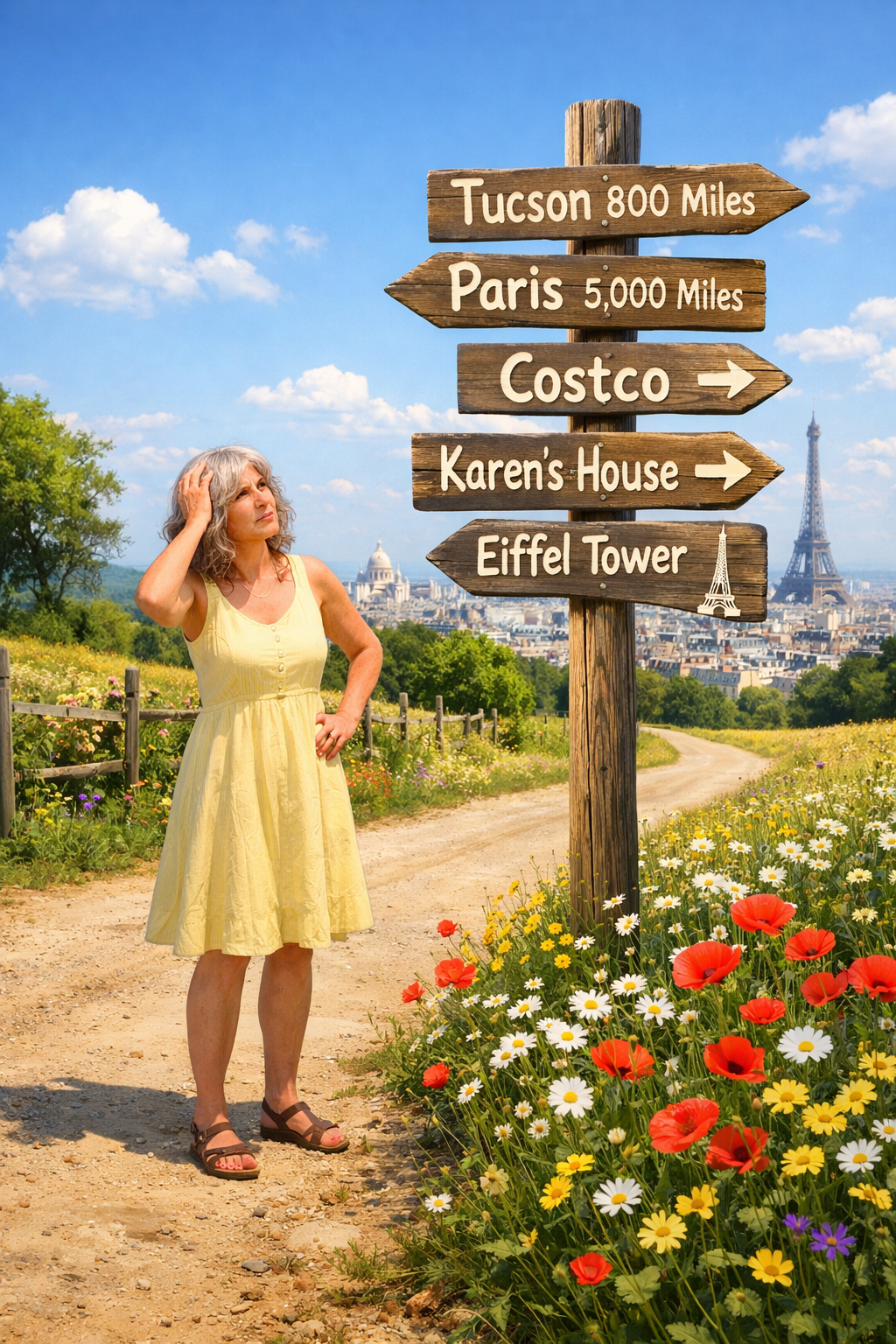
Time blindness has a sibling affliction. I am also directionally challenged or topographically disoriented. If I walk out my front door, there is a distinct possibility I will get lost. I can assert vehemently that something is to the right when everyone but me knows it is to the left. It happened once in Paris, when my friends and I left a restaurant after lunch to go to the Eiffel Tower and I turned left. I knew it was only a few blocks away – on the left. They stopped me. “We turn right,” they insisted. I was adamant that it was the opposite until they told me to look up and sure enough the Eiffel Tower loomed above the buildings on the right. My immediate response was, “When did they move it?”

On a different trip I was to meet up with friends at the Musée D’Orsay for lunch at the cafe. They were going to spend the morning at the Rodin museum, but I wanted to go to a workshop at the Fragonard Perfumery to learn how perfumes were made. I took the Metro from our apartment to the Perfumery in the Opera District and spent a couple of hours there. Then I decided to take a train back across town to the Left Bank, a really short ride, I thought. Well, you can guess what happened. I read the train route completely wrong. It didn’t go anywhere near the Left Bank, and when I realized my error, I was halfway to Versailles, about twenty minutes in the wrong direction. I got back to Musée D’Orsay just as they finished lunch. It is a good thing that being lost in a foreign city is one of my favorite things to do.

Even in my hometown, I frequently go off in a direction I am certain is correct, only to find I’ve traveled a few miles out of my way and must reverse course. This is a topic of amusement for my friends. Whenever I am the designated driver, there needs to be a designated navigator. I never know where I am. I can usually picture my destination if it is a place I travel to routinely, but how to get there is a mystery no matter how many times I’ve done it. Thank goodness for GPS. If we get to talking and my navigator is not paying close attention, it is a crap shoot where we end up – but it always ends in laughter. With my phone at the ready, I can stay relatively on course or at least arrive in the vicinity of my destination and eventually reach the goal.

My husband, as luck would have it, is the opposite. He can go somewhere once, and a map to that place is etched forever on his brain. He never makes a wrong turn. Even if we are in a faraway state that we once traveled through, he can find the restaurant we stopped at or the hotel we stayed in without a second’s hesitation. He can find my cousin’s farm in the middle of nowhere Kansas, without prompting. I’m always amazed. He is on time wherever he goes. That takes a special commitment when he is going somewhere with ‘always tardy’ me.

As they say, opposites attract. I would be floating in an ethereal void without Ken to tether me to the earth, a gentle but firm tether.

Now, I must stop writing, because I have to be at a meeting in thirty minutes and I need to get ready.

Witness to History – A Personal Journey

I know empirically that the days are not getting shorter. Twenty-four hours are still twenty-four hours, no matter what time zone you are in or daylight you are saving. The weeks still contain seven days, although every Friday seems like it happened only two days ago. And don’t get me started on Christmas. I remember when it seemed like decades between Christmas’, hence the old saying, “as slow as Christmas”. Now it seems like just a month or two separates this Christmas from last Christmas and next Christmas. Has the Earth sped up? Or is it something else?

I don’t feel older, but if I look at the date of my birth, it becomes more and more like ancient history. I’m remembering agonizing years of struggle for women’s rights, civil rights and wars that nowadays may get one or two paragraphs in a high school textbook (are there such things as textbooks?).  I remember a time when I could not have a bank account, a credit card, or make a major purchase without my husband’s accompanying signature. My name was Mrs., instead of my given name. If I hadn’t been married, it meant that my father would have had to sign for me. I don’t know what happened to the females who had neither a father nor husband. As late as the 1950s, women could involutarily be committed to mental institutions by fathers or husbands without medical or legal requirements.

For a time in the 1940s, women were a major factor in the workforce because so many men were fighting overseas, and military production was ramped up. After WWII, when the men returned, women lost their jobs. It was more important that a man, who was considered the head of the household, have a job. Women were sent back home to be homemakers to support their men and nurture their children. I remember even into the 1960s, when I worked in offices, I was considered like part of the furnishings or a minion to be ordered about at the behest of any male in the company. I did all the step-and-fetch-it jobs as well as my own as a purchasing agent in one company and a secretary in another. A male colleague could pat my butt or throw an arm around me at will. There was no HR to run to. I learned to negotiate my autonomy with humor and strategy so as not to offend but let men know I was neither property nor servant. It worked.

I remember a time when people of color, then called “coloreds”, not blacks or Hispanics,  were relegated to the back of the bus and entered and exited through the back door only – no questions asked. I remember a time when there were “separate but equal” schools, swimming pools, public washrooms, and water fountains. The signs said “Whites” and “Coloreds,” so there was no question. They lived on their side of town, we lived on ours. The only time we went to their side was for barbecue. Daddy took me with him to get barbecued smoked ribs from a man in colored town. The memory of those ribs lingers on my tongue, and I’ve never since had any as good as they were.

In 1948, the idea that a black man would be President or that a black woman would be Vice President or sit on the Supreme Court was as foreign a thought as man landing on the moon. Yes, there was a time when a moon landing was science FICTION. At that time, there were no black or female CEOs in major corporations in the U.S. The United States was run by white males.

As a small child, racism was just the way things were. I didn’t know any different. One quick story is about a time when my mother and I were going into downtown Wichita. I think I was about three. My mother told this story to me countless times. To her, it represented a time when I publicly humiliated her. Of course, I see it differently. We lived in the small community of Riverside in Wichita. We only had one car that my father used to go to work, so when Mom wanted to go to town, she and I took a short bus ride.  We waited for the bus at the corner of 18th and Burns. When it arrived, Mom helped me up the steps into the bus. She claims that as soon as I got on, I ran toward the back of the bus with my arms open wide yelling, “Grandpa, grandpa.” The back of the bus was for coloreds only. Evidently, an elderly gray-haired black man was sitting back there, whom I found appealing. He had a big smile on his face. He seemed like a grandpa to me. All the bus riders, including the unlucky black man I targeted, held their collective breaths. This was NOT accepted behavior, and I’m sure it caused no end of consternation. Mom grabbed me by the arm and yanked me back up the aisle and out the door as fast as she could. The bus doors were closed, and it continued its route. Heaven only knows what the “grandpa” on the bus thought or what those around him said. I wish I could have been there to witness. The point is, I didn’t see color. I saw a grandpa. I needed to be taught that those people were different – not our kind.

Mom clung to her nebulous racism her entire life. It was how she was raised. She didn’t openly criticize, disparage, or mock people who were not white, but the subtext in her body language was discernible – especially by me, because I was aware of her prejudices. I remember mom as a gracious, kind, but critical woman. She maintained friendships with people from her high school days and later, all of her workplaces. She was a generous friend to all. And yet, under the surface was an inability to accept people of other races as equals. I really blew her mind when, in 1960, I told her my social studies teacher was black, and I thought he was so cute I’d consider marrying a black man – cuteness being the major criteria for marriage at that point in my life.

I wrote a short story about my encounter with a black woman who lived in our neighborhood, yet was totally isolated. It was one of my ah-ha moments. It happened when I was seven and could form an opinion about it. I’ll post that story at a later date. To this day, I don’t know how or why she was in a segregated white neighborhood.

The bottom line is that I lived that dynamic history, including civil and military violence. I was a witness, a participant, as our country moved through huge social changes. Today it seems we are regressing back to some of those old disputes. As a country, we are not perfect, but we have genuinely progressed. I hope progression can continue without more violence and with respect for what has been accomplished.

According to statistics (which I don’t go according to very much), forty years ago, 80% of US citizens were white, and it is expected that by the middle of this century, white citizens will be a minority. I maintain that color will be less and less an issue as the world shrinks and people have children with people from other places, other ethnicities. Someday, we’ll all be the same lovely tan color, and discrimination will no longer be a factor based on color. I’m sure as flawed human beings, we’ll find other ways to discriminate.

Ho-hum. The cycle will be unbroken – just under new management and rules. So maybe that is why my days are getting shorter. I’ve seen it all before, and my soul is ready to move on to whatever is next. My mind and body, though, are not ready, so I will continue to observe the revolutionary evolution of our species with curiosity.

Happy Birthday RBG

It is Ruth Bader Ginsburg’s 93rd birthday. The Ides of March, 2026. In honor of one of the most iconic women in American history, I want to pass along some of her wisdom. She claims it came from her mother-in-law and pertained to the marital relationship. She broadened the sagacious advice to use during her life as a prestigious and honored member of the highest court in the United States.

I paraphrase here: “In every relationship in life, it helps to be a little deaf. This is not meant to be demeaning, belittling, or dismissive of the other person. It is a self-affirming way to achieve meaningful dialogue. Choose to be a little deaf towards thoughtless or unkind remarks. The type of remarks that are not backed by thought, but are rather reactive, emotional, and lacking reason or fact. Comments that do not serve the higher purpose of advancing an argument but rather attack the person and are derogatory or unkind in nature should fall on deaf ears. Reacting in anger will not advance your ability to persuade. Don’t raise your voice. Improve your argument. If the argument is sound and backed with logic, it should not have to be screamed. Its integrity should stand on its own.”

As it pertains to marriage, it is important to confront disrespectful, thoughtless words and behavior. No one should be a doormat to a partner’s demeaning, thoughtless words or actions. Sometimes the intention is to knock you off-balance, to make you give way. Don’t give anyone control over you. Even in the most loving relationship, emotion can overcome reason. As a long-term strategy, it is important to stay clear of an emotional, reactive response to make a counterpoint in a reasoned way and get to the heart of the matter that can be resolved without invective. Step away to clear your mind, then address the issue. Frame your response with the concept of strengthening your relationship. Speak with honesty, not hostility. Turn tensions to understanding. One way to do this is to write it down. Clarity comes with looking at your own words rather than trying to capture them in a swirling thought process.

As RBG would say, “get it right and keep it tight.”

While I may not agree with all of RBG’s views on the law and the Constitution, I do respect her thoughtful reasoning for her positions.

Poetry – What I Learned from Our Son

How the deep bond between a man and a boy, grandfather and grandson taught me about poetry.

Walter, my father-in-law suffered for five long years from Alzheimer’s disease.  His dependency over that time became the elephant in our midst. He lurched from anger, to sadness to confusion and back to anger at his cognitive losses.  During ever decreasing lucid moments, he would smile in fleeting  recognition even though he forgot our names only to plunge again into no mans land where we couldn’t reach him.  Day in and day out, he spent in front of the television even though he couldn’t understand what was going on.  He dozed and nibbled snacks.  He wouldn’t eat a full meal and forgot how to use a fork, so ate with his fingers.  He became a dependant baby animal and lost touch with everything that made him human.   Lost in the maze of a home in which he lived for over 20 years, his tortuous days and nights were filled with endless hours of not knowing who shared his world.  At times he wept because he was frightened by his image who he called the man in the mirror.

Walt, always an active man, was still well built and muscular into his late-60’s.  He initiated arm wrestling contests with his sons and grandsons and nearly always won.  In his youth he mined copper in the rough and tumble town of Butte, Montana.  He was proud of where he came from and what he achieved not only by his physical hardiness but also his strength of mind and character.  He built a two story home for his family from the ground up in Butte.  He built the family’s summer cabin at Georgetown Lake.  He was carpenter, plumber and electrician all in one.  As a true Finn, Walt felt it was necessary to add a sauna to every house they lived in as he moved his family from Butte to Anchorage to Seattle searching for a better life.  With less than a high school education he pulled himself up out of the mines and into the business community.  He always laughed when he said he went to the best university life had to offer, the school of hard knocks.  By the age of 35 he was a city councilman and owned a grocery store uptown in Butte.  He and his wife, Pearl, raised and college educated three children and delighted in their seven grandchildren.

            The effects of his illness devastated our family.  His physical death came three years later than the death of his soul.  Walt, the man we loved, disappeared long before he was buried.  The disease not only looted his mind, it took his spirit and left behind an infantile creature with dull eyes.  Physically he withered to barely 100 pounds.  Pearl, his wife of over 50 years, insisted on keeping him home to take care of him herself.  The last few months of feeding, bathing, changing diapers and being on constant call wore through even her relentless patience.  Her dejected face revealed the pain of watching her husband, lover, and companion grow ever more distant and helpless under her care.  Family members took turns spending three or four hours at a time with him to give her a break.  During those times he cried or snarled and mumbled incoherently because it took longer and longer to remember words to make phrases.  When he finally put a few words together he demanded, “Where did mommy go?” 

            When he was hospitalized after a slight heart attack, we took turns staying with him at the hospital because the strange surroundings terrified him. He wouldn’t stay in bed unless he was occupied or distracted by someone.  I took photograph albums and showed him pictures of his life in Butte, the only past he could recall.  Occasionally a glimmer of recollection came, and he would struggle to name a name or describe a place.  Since nurses couldn’t spend all their time with him my husband, Ken, stayed in his room all night every night because he awakened so often.

            When Walt died, Casey, our son, was 18, a freshman at Washington State University, and a typical teen.  Being both gregarious and shy, a charming, contradictory combination, made him popular with his peers.  Casey’s best friend in 7th grade was still his best friend twenty years later, even though they chose different colleges and paths in life.  He has a whole raft of friends who used our home and refrigerator as their own.  In self-defense, I learned to dress immediately upon arising when Casey was home because often I stumbled over sleeping bodies when I went downstairs to let the dog out.  I got caught a couple of times in my nighty by strangers who said Casey told them they could crash on our couch or family room floor after a late night or disagreement with parents.  Casey spent hours on the phone.  I believe he was the social secretary for his group since nothing was planned without his direct contact with each and every friend.  When he was away from home, the telephone was his only means of communication with us, most commonly, a request for money.  I was never totally positive that he even learned how to write.

Casey’s room resembled Nagasaki after the bomb.  Momentos from rock concerts and Japan were strewn among dirty clothes, heaps of clean clothes lay scattered on the floor among school papers, matchbox cars, and stuffed animals.  His walls were a collage of rock posters, sports souvenirs, photos of friends, and lists of the current top 100 rock tunes.  The built-in desk, which went the length of one wall, had an assortment of unusual beer bottles, more stuffed animals and games lying on it and no room for studying, which was generally done in front of the TV in the kitchen.  From his door to his stereo to his waterbed, there was a small, barely visible path amongst the rubble.

            Casey had a reverence for ear-splitting heavy metal music along with an appreciation of such classics as the Beach Boys and the Beatles.  He taught himself to play the piano, then learned guitar, which he refined daily in his room, hooked to his amplifier with his headphones so we couldn’t hear it.

            In his 15th year, Casey grew from five feet to six feet and added an inch each year for the next two years.  His weight never caught up.  He was unbelievably thin at eighteen, weighing only one hundred twenty-five pounds.  His shadow scrambled to stay visible when he turned sideways.  He liked his hair long, but his brown locks curled so that, even when grown well below his shoulders, they kinked up tightly at the base of his neck, natural dreads.  He wore a diamond stud in his ear, a personal affectation which gave his conservative father apoplexy.  They negotiated.  Casey didn’t wear his earring in his father’s presence.  That changed over time as Ken learned to accept Casey’s personal sense of style.

            Casey’s main passion, other than a current girlfriend, was and still is the University of Washington Husky football.  Actually, I believe Husky football has, on occasion, come first.  He played football and loved it at a younger age, but had the good sense to quit when his teammates got beefy while he stayed reedy.  He is probably the only kid to sit in the enemy student section at Washington State University during the Apple Cup rivalry game, cheering for his beloved Huskys to beat WSU …and live to tell about it.

            Casey’s second love was Japan, which he visited twice as a teen.  It was the focus of his degree program in International Studies.  Another of his diversions was magic.  His blue eyes gleamed when he mastered yet another illusion to baffle his poor mom.  All in all, Casey was a standard model for his generation, delightful and contrary.

            Fishing with Walt was a highlight of Casey’s youth.  He looked forward to annual trips to Westport with his dad and grandpa.  Casey enjoyed Walt’s company and would sometimes get off his school bus at an earlier stop to visit his grandparents.  Grandma fed him cookies, and then he’d go outside to help Grandpa in the yard or in his workshop.  We lived only 10 blocks away, and his grandpa would give him a ride the rest of the way home after their visit.

            During most of Walt’s final year, Casey was away at college.  We kept him informed of Grandpa’s condition.  The bond between Casey and his grandfather was long ago established in the mystical way that small boys and old men see themselves in each other.  When Walt’s health began to wane, their connection was apparent in the way Casey watched out for grandpa when we took him somewhere.   Before we were aware of his incipient illness, Walt and Pearl traveled to a Rose Bowl Game in Pasadena with us.   After the Rose Parade, we walked toward the stadium for the game.  In the mass of people at an intersection, Walt was somehow separated from us.  He stood in the middle of the intersection, confused about which way to go.   The traffic began to move and honk but he couldn’t find a direction.  We were several yards ahead along the sidewalk when we realized he wasn’t beside us and focused on the commotion behind.   Casey, then 12 years old, immediately ran to his side and didn’t let go of him for the rest of the day.  Walt laughed it off, but it was the first real indication that his problem was more than mere forgetfulness.  Casey appointed himself Grandpa’s guardian and protector for the remainder of that trip. 

As Walt’s condition worsened, Casey was less and less comfortable being around him for very long.  He refused to visit his grandparents.  When Casey’s presence was required for family celebrations he glued himself to the TV and wouldn’t get involved when we had to help Walt eat or go the bathroom.  The changes disturbed him.  It was obvious he didn’t want to see his grandfather in that helpless condition.

            What we didn’t know was that while away at school, Casey wrote poetry and sent it to his grandfather.  We were shown the letters after Walt’s death.  To say we were surprised is an understatement.  Casey, who never wrote so much as a postcard to us.  Casey’s phone bills were a testament to his inability to put pen to paper.  Casey was always so caught up in sports and social activities that we couldn’t imagine his spending enough quiet reflective time or sitting still long enough to put poetic phrases together.  But there was the proof.  One rhymed and clever composition was sent to wish his grandparents a happy Halloween. It was an “over-the-river-and-through-the-woods” kind of poem about ghosts, goblins, and grandparents.

            When we called with the news of Walt’s death, Casey made immediate arrangements to leave school.  He took an overnight bus for 15 hours to get home.  Pearl asked Casey to write a poem for the minister to read as part of the eulogy.  Casey readily agreed.   We were surprised because Casey didn’t like being put on the spot to perform, not even his music that he practiced day and night.

The day before the funeral, while everyone dithered about making arrangements and finding accommodations for visiting relatives, Casey slept.  He slept on the couch.  He slept on the floor.  He slept anywhere there was a level surface.  I begged him over and over to get busy writing his poem.  He told me not to worry, it would be ready for the funeral.

            The next morning, again I asked him if he had written his poem.  He said no with a “don’t bug me” look and returned to his room, where he strummed his guitar and listened to AC/DC blasting on his stereo.  I knew that he was going to disappoint his grandmother and add another sadness to the day, but the more I harassed him the more firmly he resisted.  Finally, about an hour before we planned to leave for church, Casey came into the kitchen.  As I prepared food for the reception to follow the funeral, Casey slumped his 6′ 2″ frame into a chair at the kitchen table.  He tore a scrap from an envelope and started writing in his tiny cramped printing.  When he finished he handed me two scraps of paper.  On them was the poem.  It was beautiful.  He hadn’t labored over the words or created draft after draft.  He slept and dreamed and played music and let the poem form in his heart.  When it was ready, it flowed onto the paper complete and perfect. The poem recalled Walt’s strength, hard work, and devotion to his family.  Casey urged us to be inspired by the kind of man his grandpa was.    He acknowledged that grandpa was quick to see the good things in him and bloated his head with praise.  He urged us to never forget what Walt tried to teach each of his grandkids – to try to be their best.  He recalled a float in the 1982 Rose Parade with an old man and boy on it fishing.  The float said “Gramps and Me”.  When it passed by he and Walt looked at each other and smiled.  He asked us all “to take some care and say a prayer and remember what’s been said”.

            At the funeral, Casey chose to read the poem to his grandfather himself instead of giving it to the minister.  All eyes welled with tears as he recited the love and respect that he felt for Grandpa.  It was a simple poem, not rooted in rules of cadence and meter but brimming with a spirit and eloquence from deep within his human soul.  In those moments, as Casey stood at the pulpit of the church, our son changed forever in my eyes.  He grew from a lively, loving boy to a thoughtful man with the ability and willingness to share his deepest feelings in his own words.  It was then, from our son, that I learned what poetry really was, not as I learned in school, but the unknowable stuff of Muses and spirit.
A Letter to My Mom

I just read an epistolary novel called The Correspondent by Virginia Evans. It reminded me of other novels of that genre that I read: 84 Charing Cross Road, Frankenstein, and The Guernsey Literary and Potato Peel Pie Society, among them. Letter writing is a long-neglected art of communication. I decided to write a letter to my mother. She died in 2004 and although I was with her almost daily for the last four years of her life, there are still memories to share and things left unsaid.

Dear Mom,

I love you, and I miss you. It’s been over two decades since you left, and I haven’t heard from you, not even a little tweak or shadow.

I remember going to the movie Under the Tuscan Sun about two months after you died. In the movie, Diane Lane walked through an old Italian house when a pigeon flew over and pooped on her head. It made me laugh because I was reminded of the time we were walking across St. Peter’s Square in Vatican City, and a pigeon flew over you and plopped its poop on your forehead. In both instances, everyone around said, “Don’t be upset. That’s a good omen.” I wanted to leave the theater to call you to tell you about it and make sure you saw the movie too. Then I remembered you died. I think that was when I really grasped that you were gone, and I couldn’t share that memory with you again. It hurt. Grief takes so many forms as it comes and goes long after death.

Mother dear, I regret that we had so many years of misunderstandings as I was growing up. I didn’t get you, and you didn’t get me. Fortunately for both of us, Daddy was there to referee. The two of you had different theories on child-rearing. Yours was to set standards and rules and make sure I didn’t deviate from them. Dad’s was to let me make mistakes, take responsibility, learn, and move on. He believed “I’m sorry” was better than “Mother, may I”. I learned from both of you, but of course, gravitated to Daddy’s way of thinking.

It wasn’t until we went to Europe together, I in my thirties and you, at age sixty, that we really talked and got to know each other as adults. I admit I dreaded going alone with you. I thought we’d fight the whole time. You wanted to make reservations in advance for accommodations in every place we stopped, and I wanted to play it by ear and see what turned up. No strings. We compromised; you made reservations in half the cities, and in the remainder, I was responsible for finding our hotel, hostel, or B&B when we arrived. Your choices were lovely hotels; mine were eclectic B&Bs and one very questionable hotel. I apologize once again for the bedbugs. I love being lost in a foreign place, talking with strangers, and finding my way around. You wanted everything planned out to the minute. You started packing a month before we left, with each item of clothing wrapped in its own tissue paper cocoon, and I threw things in a small suitcase the night before. We survived three weeks together and became friends.

As a child and teen, I was always pulling your chain, exploring the outer limits of the rules, as you tried hard to draw me back into line. I’m grateful we had twenty years to make it better, and I know we were great friends when you died. You left an indelible impression on my children. I’m glad they were adults by the time you died. They all have great memories of you. You are a wonderful grandmother.

Much love and gratitude, Diana

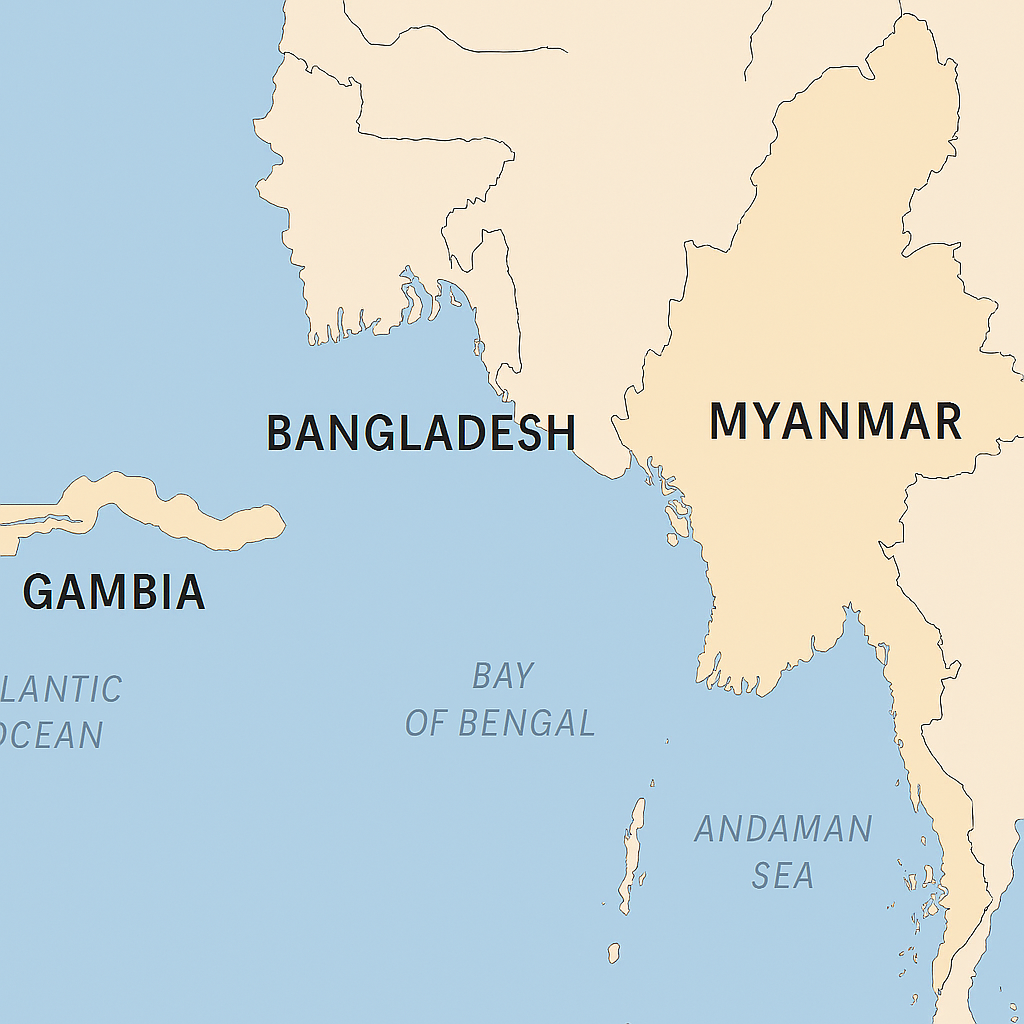
Headline: 1-13-26 Gambia vs Myanmar – UN lawsuit

This headline popped up on my phone and caught my attention.

The UN’s top court has opened a landmark case against Myanmar, accusing the country of committing genocide against its Rohingya (Muslim) minority. The case, filed by Gambia, alleges that Myanmar’s military launched a campaign of violence in 2017 that forced over 700,000 Rohingya to flee to neighboring Bangladesh. The population of Myanmar is predominantly Buddhist, with 90% Buddhist, 6% Christian, 4% Islam, and less than 1% Hindu. 

The International Court of Justice (ICJ) in The Hague has begun the hearings, marking the first full genocide case it has taken up in over a decade. The hearings will span three weeks and will include oral arguments, witness testimony, and expert examinations. Gambia alleges the Rohingya community has been subjected to horrific violence and destruction, including atrocities such as gang rape, sexual mutilation and infanticide. The case is significant as it could set precedents for how genocide is defined and proven, and how violations can be remedied. The outcome of the case is expected to have broader implications, including potential repercussions for other genocide cases, such as South Africa’s petition against Israel over its war in Gaza.

Usually, I avoid political news, domestic and international, because it is painfully negative. But this headline stopped me cold because Myanmar is a Buddhist country being charged with genocide. That seems like a huge oxymoron, incompatible, incongruous.  Buddhism is considered the most peaceful religion worldwide with its emphasis on non-violence, inner peace, kindness, and respect for nature. This doesn’t even seem real.

What is happening in our world? Riots in Persia, riots in Venezuela, riots in the U.S., riots in Uganda. Can’t we all get along? Give Peace a chance? I have a hard time believing the rioting is the fault of the religions because all the major religions preach peace. The scriptures of Islam, Christianity, and Judaism, all Abrahamic faiths, share messages that encourage unity and peace.

So, it means that bad actors in these countries are ginning up revolts based on criteria that they know will cause division within the population. I can’t say this is new news. It has happened over and over for centuries. Sometimes the issue is real, such as slavery in the U.S. Sometimes it is fabricated by lies like those that were the prelude to the hatred of Jews by a segment of the German population. How do we differentiate the real problems from those that are manufactured intentionally to cause internal strife within a country? What are the power struggles that motivate? Is it money, resources? I believe, more likely, it is an effort to consolidate power among the few to subjugate the many.

I don’t have answers. Just questions.

A Maxim for the New Year

“Out of clutter, find simplicity. From discord, find harmony. In the middle of difficulty lies opportunity.” — Albert Einstein.

A good maxim to begin the new year. The world is and always has been in chaos. Disorder and disharmony reign at all times, somewhere in our world. It is the human condition. Try as we might, we creatures, supposedly endowed with reason to think our way through adversity, instead use hard times and harsh words as a springboard to lash out with uncontrolled emotion. Emotion, it seems, is our human vice and virtue. Too often it overcomes rational thought, rational action. It is the catalyst for hate and anger, as well as for love and empathy.

I try to find peace from within and let madness straggle down its own path away from me. No, I’m not sticking my head in the sand. I am acutely aware of what is going on. I am also aware that I am powerless to make it stop, in the worldwide sense. No one has been able to in the millennia of human existence. Many have tried to lead toward peace and were rewarded with more hate and even death. Hateful words only engender more hate. “Holding onto anger is like drinking poison and expecting the other person to die.” – Buddha. I can only contribute to my little corner of the world with my own actions and words.

Celebrating the joy that comes with every day brings calm. On the darkest days, there is always a little gem, a glimmer of happiness, if you pay attention. Watch for it. “Deceit is in the hearts of those who plot evil, but those who promote peace have joy.” (Proverbs 12:20) The connection between peacemaking and joy is clear; those who work towards peace experience fulfillment and happiness.

It is my prayer every morning. Let me be an instrument of peace. Find my balance. Make at least one person smile and be happy we had an encounter, whether in person, by writing, or by phone. Be grateful for every living spirit, for they all have a place in our world, a reason for being. Remember, forgiveness is the portal to peace. Don’t let petty or ignorant words muddle my day. Be kind, it costs nothing and is a blessing to others and to myself. It is the source of peace.

I don’t always achieve that goal, but it is uppermost in my mind to start my day. Distractions, annoying tech issues, physical discomfort, negative media (when I allow it in), and my own higgledy-piggledy thought processes can derail me from being present and conscious moment by moment. Joy gets lost in the commotion, but it usually resurfaces when I stop to recenter myself. I realize my very good fortune, the love surrounding me, and I’m grateful. I pray and, in my own tiny way, strive to help others find peace and joy in their days.

How do you find fulfillment in your days?

Some inspiring quotes by wise people, the Old Testament, the Quran, and the Bhagavad Gita:

“Peace comes from within. Do not seek it without.” – Gautama Buddha.

“If we really want to love, we must learn how to forgive.” —Mother Teresa

“Let us forgive each other – only then will we live in peace.” – Leo Tolstoy.

“The weak can never forgive. Forgiveness is the attribute of the strong.” – Mahatma Gandhi

“Forgiveness is the fragrance that the violet sheds on the heel that has crushed it.” – Mark Twain

“We seek peace, knowing that peace is the climate of freedom.” – Dwight Eisenhower.

“You must be the change you wish to see in the world.” – Mahatma Gandhi.

“The world is not a mere reflection of our thoughts; it is a reflection of our actions.” – Albert Einstein.

“And the servants of the Most Merciful are those who walk upon the earth easily, and when the foolish address them harshly, they respond with peace..” (Quran 25:63) Be a messenger of peace, even in adversity.

“How beautiful on the mountains are the feet of those who bring good news, who proclaim peace, who bring good tidings…” (Isaiah 52:7)  Be a messenger of peace.

“We must come to see that at the end we seek is a society at peace with itself, a society that can live with its conscience.” – Dr. Martin Luther King Jr.

“But if you pardon, overlook, and forgive, then indeed, Allah is Forgiving and Merciful.” (Quran 64:14) Forgiveness is a divine trait and a means to achieve inner and outer peace.

“Turn from evil and do good; seek peace and pursue it.” (Psalm 34:14) Encourage an active pursuit of peace by making conscious choices to foster harmony.

“Delusion arises from anger. The mind is bewildered by delusion. Reasoning is destroyed when the mind is bewildered.”  Bhagavad Gita

“Hate cannot drive out hate; only love can do that.” – Dr. Martin Luther King Jr.

“Nonviolence is the answer to the crucial political and moral questions of our time; the need for mankind to overcome oppression and violence without resorting to oppression and violence.” – Dr. Martin Luther King Jr.

“The disunited mind is far from wise; how can it meditate? How can it be at peace? When you know no peace, how can you know joy?”  Bhagavad Gita

Namaste

A Most Memorable Christmas

Time to read: 5-7 minutes.

When Ken and I moved to southern Arizona to be full-time residents in 1997, we left behind our three kids, all adults, our two mothers, two brothers, and a sister, plus all their families. Throughout our forty years in Bellevue WA, as we established our family, we always spent the holidays with all of them, sharing meals and family traditions. Our first Christmas alone had a daunting, hollow feeling of abandonment, even though it was Ken and me who left the family for our Arizona life.

When we were first married, we spent Christmases just we two, and we didn’t miss anyone because we were so focused on each other and being together. However, after our first child arrived, we were always in the midst of our two families during the holiday season. I decided to find a way to shake the Arizona Christmas blues. I found an ad in the Arizona Star for volunteers to help make Christmas memories for children in Nogales. We signed up.

The patron of the volunteer operation was Jose Canchola, who owned several McDonald’s franchise restaurants. The volunteers all met at one in Nogales. Every year for thirty-one years until his death in 2008, Mr. Canchola hosted a Christmas party for underprivileged children from Nogales, Sonora, Mexico. Jose was born in Chicago to immigrant parents and rose by hard work and persistence to become a business and political leader in Southern Arizona. Besides owning restaurants, he was a part-owner of the Arizona Diamondbacks major league baseball team, and served as mayor in Nogales for a time. His philanthropy was legendary.

On Christmas day, we left for Nogales in the dark morning hours, arriving about 7:00 am. We loaded our backseat with toys and some clothing to add to the contributions of other volunteers and businesses. We were taught a few rudimentary sentences in Spanish to use to help guide them. We learned what our jobs were and waited for the first busload of kids to arrive at about 8:00. We were told the children were from the very poorest part of Nogales and the mountains around it. Buses went into Mexico, collected children in and around Nogales, Sonora, and brought them across the border to Nogales, Arizona, to Mr. Canchola’s McDonald’s restaurant. Bus load after bus load of kids were dropped off to be fed a McDonald’s lunch and receive gifts of clothes and toys.

One large room of the restaurant was heaped with gifts for kids. Toys on one side and clothing on the other side. Each child was greeted at the bus by a volunteer and either taken into the dining room for lunch or brought into the big room to choose clothing, a backpack, and a toy. Then they switched, and the lunch group went into the big room, and the other group went for lunch.

I worked in the toy/clothes room, and Ken worked in the restaurant serving lunch. It was timed perfectly and, as one bus load finished choosing gifts and eating lunch, another bus pulled in with another group of kids. There were about thirty minutes between buses.  One group was loaded back onto their bus, returning to Mexico as the next bus was greeted. It was rapid fire with no time between bus loads. I cannot tell you how many children were served that day, but we didn’t stop until after dark, at least nine hours, probably fifteen busloads of kids.

I marveled at the fact that the parents of all the children had faith to put their kids on a bus headed to the U.S., knowing they would be cared for by strangers and returned with gifts and a full tummy. The children were as young as two, on up to ten or twelve. Some kids came in family groups with the eldest looking after one, two or three siblings. A few of the children asked if they could take a gift to a sibling who wasn’t able to come on the bus. Some took a sack lunch of a hamburger and fries back with them to siblings who were left behind. The kindness and generosity of everyone involved was a heart-lifting experience. We were all there for the kids.

Very few of the children spoke English well, but most understood it a bit. My job was to take a child to the clothing area and find for them a shirt, jacket, pants, or coat that fit and that they liked. Shoes were available if they wanted a pair. Most picked out one item of clothing, but a few chose two or three items. Then I took the child to the toy side of the room, and they picked out a toy for themselves or sometimes one to take back to a sibling. Each child expressed their happiness at receiving the bounty they took home, some with words, most with their smiling, happy faces.

Ken told me about little ones with drippy noses that he had to wipe before they had their meals. None were obviously sick, but they were not in the best condition either. All were eager to dive into their yummy Mickey D’s. Hamburgers and fries disappeared in minutes.

One small boy sticks out in my mind. While several of the kids had been part of this gift program for a year or two, many were there for the first time. Their bright eyes grew enormous when they took in the stacks of toys and clothes. One little fellow named Luis was about six. He went into the restaurant first, and when he finished his lunch, he came to the big room. I took his hand and welcomed him, and asked what he wanted for clothes. I’ve since forgotten it all. He picked out a jacket, tried it on, and decided to keep it. Then we went to select a toy. I don’t remember what he chose, but his little arms were full. I walked him out to the bus, he got on, turning to smile at me. I watched other kids load and was about to go back inside when a bundle of love tackled me around the waist. It was Luis. He left his gifts on the bus and jumped off to give me a goodbye hug. He looked up at me with the most gorgeous, sweet smile and said, “Gracias, amable dama.” My heart melted. Tears come into my eyes now as I write this, nearly thirty years later, because I can still feel his hug and the look in his big brown eyes. Another volunteer translated his words, “Thank you, kind lady.”

Ken and I drove back to Oro Valley that night, exhausted but with full hearts. We experienced the essence of Christmas. GIVING and SERVICE to others. Our family now included all the children we met that day, even though we will never see them again. It was and is the very best Christmas I ever had.

Jazz Hands – an essay on six degrees of separation

I lived most of my life in Bellevue, Washington, a suburb of Seattle. I met my husband while still in high school. Ken was a senior at Bellevue HS, a rival high school. I went to Sammamish HS across town.

In the 1962 Senior Class at Bellevue, two men touched our lives in the six degrees of separation way. One was Peter Vall-Spinosa, whose father, Arthur, was one of the priests who officiated at my wedding to Ken in 1964.

Father Vall, as he was known to my family, was the priest at St. Thomas Episcopal Church, where my family attended from the time we moved to Bellevue in 1956. In the 60s, a new Episcopal church was founded in our neighborhood of Lake Hills on Bellevue’s east side. Our priest was Father MacMurtry, known as Father Mac. Father Mac and his family, a wife and two small daughters, lived across the street from us. On occasion, Father Mac would come to our house, where he and my dad would share a bourbon or two while discussing how to change the world.

I wanted to be married at St. Thomas, a beautiful Gothic-modern stone church, instead of the new church that was temporarily housed in an old school building until construction could be financed. Father Mac had to get permission from Father Vall, and both men officiated at our wedding.

The next connection was through Richard Reinking, a good friend of Peter Vall-Spinosa. Dick became a psychotherapist and treated Ken’s older sister during a troubling time in her life. In the 1970s, Dick’s sister, Ann, became famous on Broadway as an actor-dancer-choreographer. She came to the attention of Bob Fosse, a renowned theatrical choreographer and producer. She was his protege/lover. She was in productions of Pippin, A Chorus Line, Cabaret, and Chicago, among others. Ann then starred in the movie All That Jazz, based on Bob Fosse’s life, his marriage to Gwen Verdon, and his six-year affair with Ann. Ann and Gwen became good friends, and they collaborated in the development and production of the Tony Award-winning musical Fosse about his life and work. One of the dance moves used prevalently by and associated with Fosse is his stylized, energetic version of Jazz Hands.

Here are my six degrees of separation to Jazz Hands. I personally knew Arthur Vall-Spinosa, so it starts with him, then to his son Peter Vall-Spinosa, then to Peter’s friend and my sister-in-law’s therapist, Dick Reinking, then to Dick’s sister, Ann Reinking, then to Bob Fosse, who was known for Jazz Hands. TA_DA!

This is a fun exercise for a prompt – pick a person or thing and find a way to relate to them or it through six connections.

Thinning the Past

Most of us have décor in our homes: Tchotchkes, pictures, bits and baubles, generational curios, memory laden echoes of our time on earth. My house is full of them. They bring a smile of remembrance. Occasionally I endeavor to thin them out. Endeavor being the operative word in that sentence.

Why, oh why, do I need a 10” yellow ceramic duckling in my curio cabinet? Because it was once a treasured keepsake for my mother. It was given to her by a friend she loved and lost many, many years before Mom died. I remember that friend, and I remember how much my mother loved the duckling. How can I toss it? It is a piece of my mom.

Some of the artwork was given as gifts by friends and family. We have porcelain figurines by Lladro given to us by our niece in Spain that are dear to our hearts. There are carved wooden figurines that Mom brought back after our trip to Germany. We have crystal and glass that dates back to great-great-grandparents.

Most of my walls are filled with photos of friends and family from great-grandparents to our grandchild. I can go to any room and reconnect with those people. We love to take out-of-town visitors to Tombstone and have a photo taken in old west period clothes. Our visitors have endured our obsession. Those pictures reside in various rooms. I chuckle about the memories every time I look at them.

We have collected artwork over our sixty-plus years of marriage that has significance for us. We remember the why and where of each painting and print. A print of praying hands by Albrecht Düerer (1508) graced my great-grandparents living room from the time I remember as a small child. On the back is written 1896. I assume that was when they acquired it.

Among our eclectic collection, we have two prints by Michael Parks, a Salvador Dali, a Diego Rivera, a Renoir, an Edward Hopper, native American drawings, as well as original paintings by close friends who are amazing artists. NONE of which I would part with willingly. I love looking at them every day.

Is it living in the past? Well, maybe, but we have so much more past than future, why not? I’m willing to add new mementos as they arrive.

It is popular among my friends to talk about divesting themselves of those “things” that won’t mean anything to their children or grandchildren. Much of my wall art and shelf dwellers were acquired when our children still lived with us and may evoke a memory or two. I admit the things we collected have no monetary value and will probably not be passed along. They still bring me pleasure and will until I die or become catastrophically forgetful. I want to enjoy them for the remainder of my life, and then, I really don’t care what they choose to do. I will be on to bigger and better things.

One of my favorites is a print of The Juggler by Michael Parks that is on the wall of my office. Our writing critique group had a prompt to write about a piece of artwork or a photo in our house, and what it means to us. This is a poem about The Juggler.

The Innocence of Childhood

Believe.

Anything is possible.

She balances on the precipice of flight

Into the season of ripeness;

Into a world

That doesn’t remember the magic.

She watches once more,

In wonder, the magician

Blindfolded to reality.

He balances

On the tightrope of life.

Juggling

Three lessons of childhood:

Love without borders, authenticity, curiosity.

She will carry these throughout life.

The Juggler by Michael Parks