Timeblindness

At a recent writing workshop, I heard the term time blindness for the first time. The facilitator set alarms on her phone at intervals to remind her to move the topics forward. She said she tended to get absorbed in a discussion and lose track of the limited time we had.
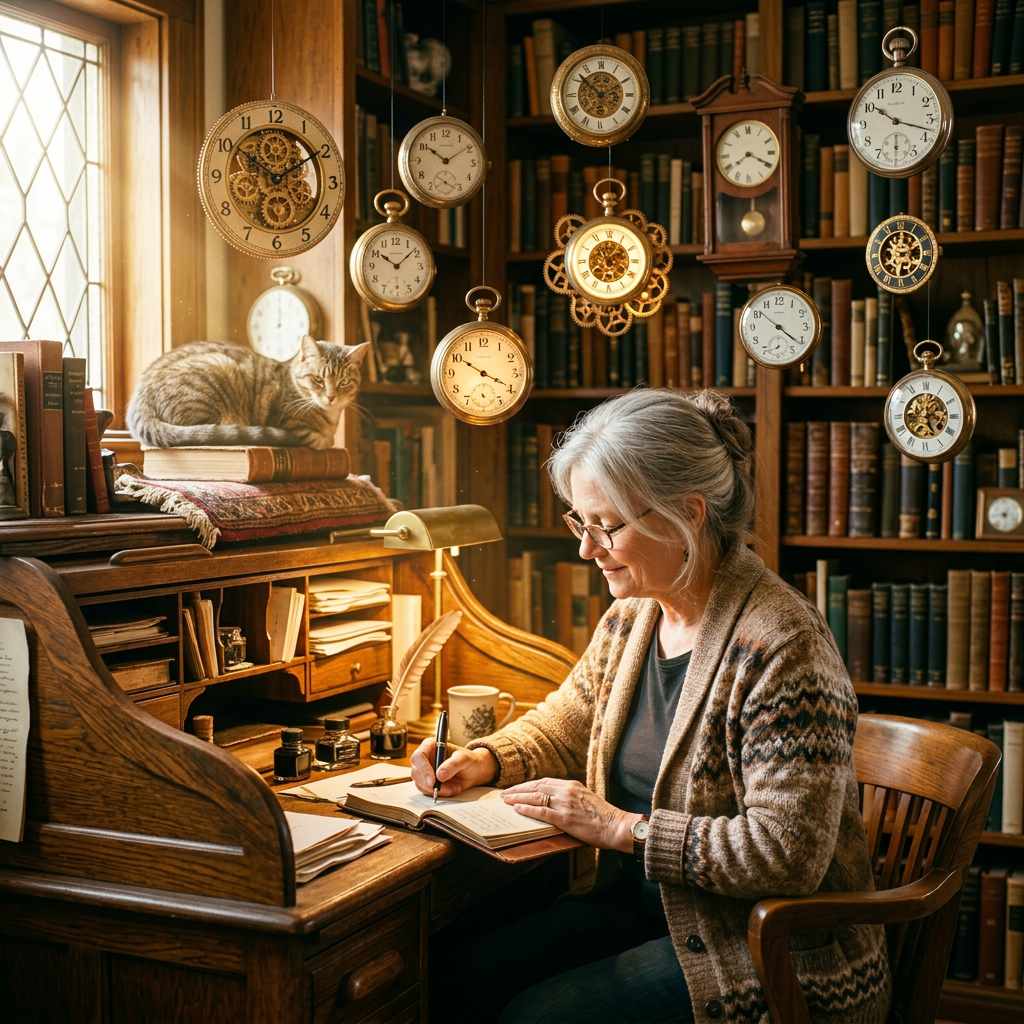
Elderly woman writing at a wooden desk with hanging clocks and a cat resting on books
Time Blindness

I have had this chronic condition my entire life, but didn’t know it had a name. It is being lost in time. My sense of time is limitless. Time as shown on clocks and calendars doesn’t mean much to me. This condition leads to chronic lateness and procrastination. It also leads to constant nagging on the part of people who live with or around me. I’m a champ at ignoring nagging. My mother handed the job over to Ken when we married, and he’s taken the challenge seriously.

I managed as an adult and a parent to overcome some of the effects of time blindness because of other lives involved. But it creeps up on me, like a first cocktail after a year of sobriety. If left on my own, I’d be lost down the rabbit hole of time. Fortunately, I have a life partner, my husband, who is acutely aware of time. He can pull me back onto the boat in the river of time if I get too lost on a far shore.

On one hand, I like being lost in time. I write for hours without sensing the passage of time. It’s heaven on earth. On the other hand, it can be damned inconvenient when I have to make a sudden return to reality and rush to meet a deadline or an appointment or even make dinner before 10:00 pm. I have a cat who wants her dinner at 2:00 and attempts to get my attention starting around 1:30. She doesn’t persist for more than a few minutes, so when I don’t respond, she finds my husband to ask for dinner. He always accedes promptly to her request.

Time blindness has a sibling affliction. I am also directionally challenged or topographically disoriented. If I walk out my front door, there is a distinct possibility I will get lost. I can assert vehemently that something is to the right when everyone but me knows it is to the left. It happened once in Paris, when my friends and I left a restaurant after lunch to go to the Eiffel Tower and I turned left. I knew it was only a few blocks away – on the left. They stopped me. “We turn right,” they insisted. I was adamant that it was the opposite until they told me to look up and sure enough the Eiffel Tower loomed above the buildings on the right. My immediate response was, “When did they move it?”
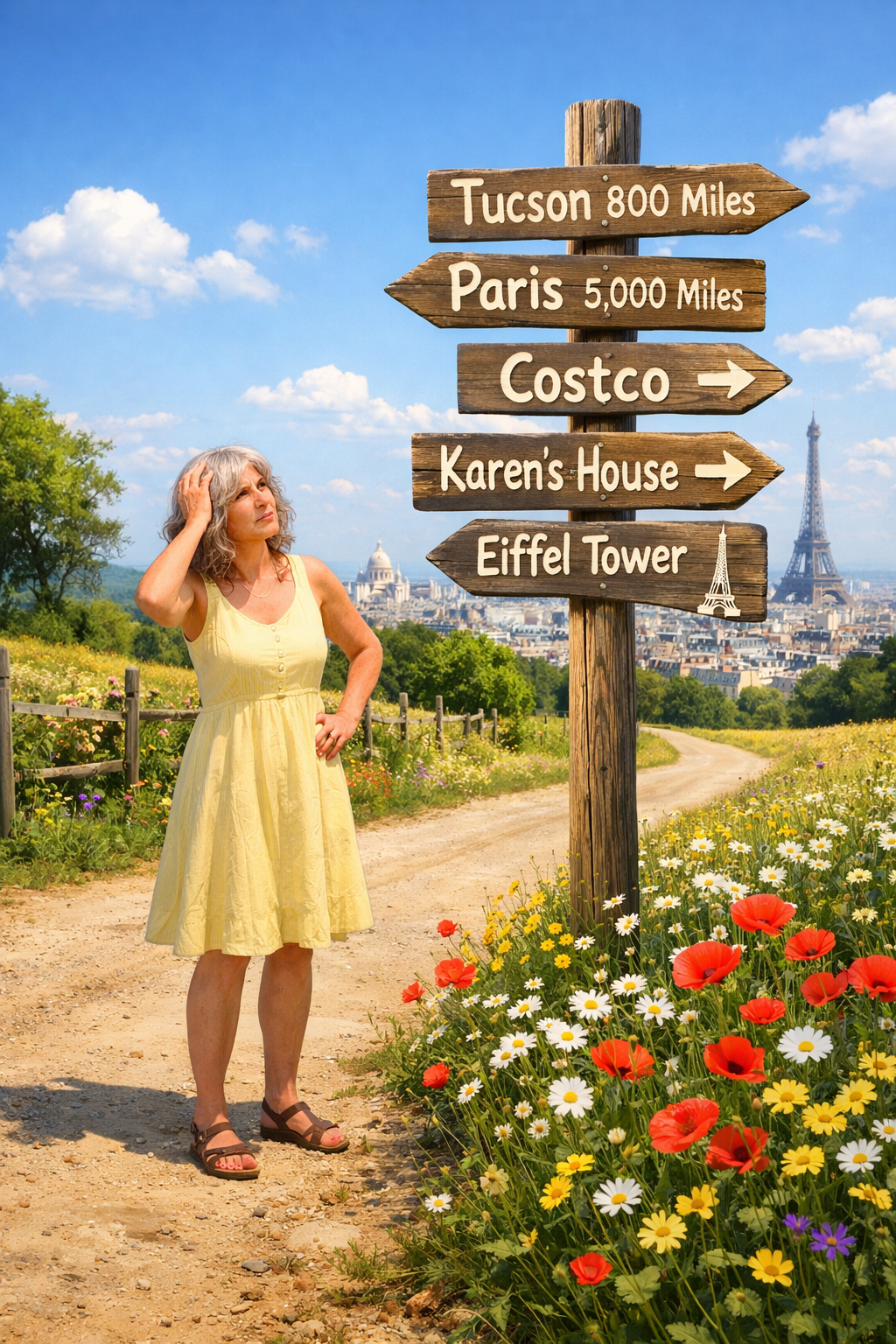
On a different trip I was to meet up with friends at the Musée D’Orsay for lunch at the cafe. They were going to spend the morning at the Rodin museum, but I wanted to go to a workshop at the Fragonard Perfumery to learn how perfumes were made. I took the Metro from our apartment to the Perfumery in the Opera District and spent a couple of hours there. Then I decided to take a train back across town to the Left Bank, a really short ride, I thought. Well, you can guess what happened. I read the train route completely wrong. It didn’t go anywhere near the Left Bank, and when I realized my error, I was halfway to Versailles, about twenty minutes in the wrong direction. I got back to Musée D’Orsay just as they finished lunch. It is a good thing that being lost in a foreign city is one of my favorite things to do.

Even in my hometown, I frequently go off in a direction I am certain is correct, only to find I’ve traveled a few miles out of my way and must reverse course. This is a topic of amusement for my friends. Whenever I am the designated driver, there needs to be a designated navigator. I never know where I am. I can usually picture my destination if it is a place I travel to routinely, but how to get there is a mystery no matter how many times I’ve done it. Thank goodness for GPS. If we get to talking and my navigator is not paying close attention, it is a crap shoot where we end up – but it always ends in laughter. With my phone at the ready, I can stay relatively on course or at least arrive in the vicinity of my destination and eventually reach the goal.

My husband, as luck would have it, is the opposite. He can go somewhere once, and a map to that place is etched forever on his brain. He never makes a wrong turn. Even if we are in a faraway state that we once traveled through, he can find the restaurant we stopped at or the hotel we stayed in without a second’s hesitation. He can find my cousin’s farm in the middle of nowhere Kansas, without prompting. I’m always amazed. He is on time wherever he goes. That takes a special commitment when he is going somewhere with ‘always tardy’ me.

As they say, opposites attract. I would be floating in an ethereal void without Ken to tether me to the earth, a gentle but firm tether.

Now, I must stop writing, because I have to be at a meeting in thirty minutes and I need to get ready.

Adventure in Avignon

In 1999 my daughter, Shari, and I went on a European excursion. We visited England and Scotland, then took the EuroStar (a train that dives under the English Channel) to France. We are both Francophiles so the very air of France and especially Paris made us giddy. I had been to France previously, and it was exciting to share it with my daughter on her first trip. Our final destination was Barcelona to visit our niece and her husband, Disa and Pedro. After a few days in Paris, we took the Eurail to Avignon intending to drive the rest of the way exploring Provence.

Avignon is an ancient city in southcentral France, walled in by the Romans in the first century and used as a fortress over centuries. It served as the Vatican City for the Popes in the 14th century. The impressive gothic Palais des Papes was the residence of seven successive popes. Avignon is on the banks of the Rhône River with a bridge across the river that became popular in a folk song describing people dancing across the bridge, “Sur La Pont D’Avignon”, a song every French child knows and anyone who studies the language is taught.

Our adventure in Avignon is the set piece of this story. The third day after looking around the city we decided to take in a movie. It was called Drôle de Père in French or Big Daddy in English. We went to the theater, bought our soft drinks and our choice of sugar popcorn, caramel popcorn, salted popcorn, or cheese popcorn. I got salted, Shari chose caramel. We watched the hilarious antics of Adam Sandler trying to impress his girlfriend with “his son”, who was actually the five-year-old son of his friend. It was dubbed in French and watching it made every line even funnier.

After the movie, we returned to our hotel before we went out to see more of Avignon. I checked for my purse. I had put it in the back of the closet. It was gone, stolen from our room. Shari had her purse with her. I didn’t want the whole bulky purse so only took my waist pack with my wallet and passport. Our airline vouchers for the prepaid return tickets home and our prepaid vouchers for the rental car we were going to drive from Avignon to Barcelona were gone.  Personal items including my grandmother’s mother-of-pearl rosary beads were GONE. I was most upset about the rosary beads because it was the only treasure I had that belonged to my beloved grandmother, irreplaceable. But, of course, we were very concerned about our travel vouchers. How were we going to get to Barcelona? Was I going to have to call Pedro in Barcelona to bail us out? How would we return to the States?

Shari has some college French, and I have high school French. Enough for us to limp along in Paris where English is universally used in tourist locations. In smaller towns, there are not as many people who speak or understand English. We went to the hotel concierge and told him of our dilemma.

“Ah, madame, je suis désolée,” he said, “Vous devez vous rendre à la police et faire un rapport.”  (So sorry. You must take yourself to the police to make a report.)

I wanted to say, Monsieur, it must have been an inside job – someone from your staff who had access to our room – but I didn’t have the words nor the inclination to argue with him because I wanted to get to the police as soon as I could.

A police report! Oh my, what would that look like? Visions of American TV shows about police departments, chaos, and disinterested officers taking down statements with a yawn if they didn’t include murder. How would I get across the urgency of our need to recover our paperwork quickly so we could continue our journey? We were expected in Barcelona in five days. Not a lot of time to hang around police stations and wait for someone to take notice. Besides it would all have to be done in French! Oooo-la-la.

Off we went to the address given for the Commissariat de Police. It appeared to be a storefront operation, not a big imposing building. We walked through the glass door, no security. A young man greeted us from behind a glass-topped desk and we did our best to explain to him why we were there. Two or three other uniformed men were in that front office.

“Eh bon, tellement désolé que vous ayez été volé” he calmly said. “Nous pouvons vous aider.” (Ah, good, sorry you were robbed. We can help you.) I felt this was not the first time he’d heard a story like ours.

He ushered us into a glass-enclosed office. He offered us seats in front of the desk. No one was in the office.

This is what we saw: a simple wood desk with nothing on it except a telephone; totally clean, no papers, no files, no pens, nothing; a padded desk chair behind the desk. We sat in two padded folding chairs. A couple of bookshelf units stood against one wall, only a few (I mean three or four) books or notebooks in each unit, the rest bare shelves; no computer, no printer, no file cabinets, no clutter. I began to look around.

I said to Shari, “Do you think this is a real police department? Are we on candid camera? Is this a spoof for foreigners? Where are the criminals waiting to be jailed? Where is the chaos of an active police station? It looks like a movie set before they holler ‘Roll ‘em’. It’s just too quiet to be real.”

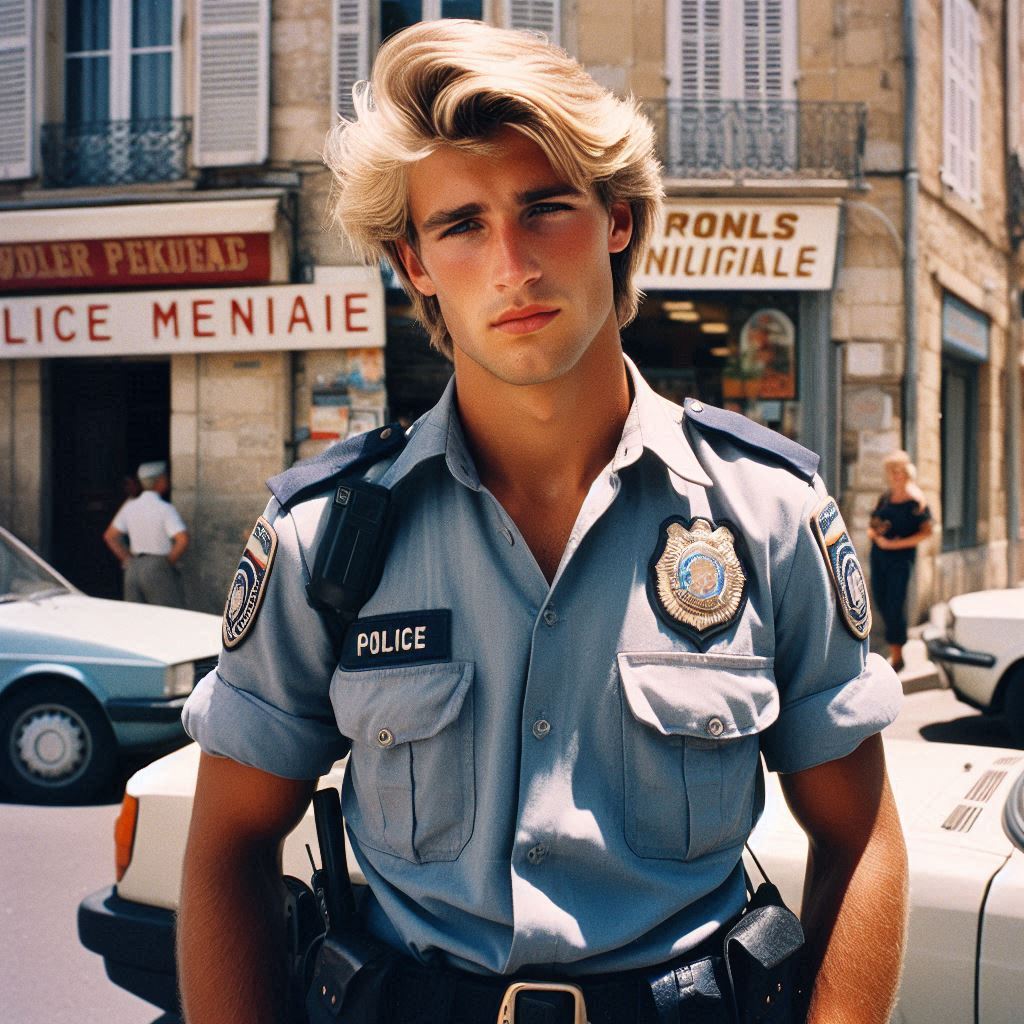
Enter a young man in a uniform – central casting, tall, blond, and beautiful. He smiled and offered a handshake. In halting English he said, “I’m sorry your trip has been interrupted by this mistake.”

“Mistake?” I’m thinking.

“Ce n’est pas un mistake,” I said. “It was a robbery, and we lost all our papers for our trip. We are expected in Barcelona in five days and then we return to the U.S. in a week.”

“Oui, un vol, excusez-moi.” he continued calmly. (Yes, pardon me, a robbery.)

Our discussion went on with him speaking in French with an occasional errant English word and me speaking in English with an occasional fractured French word. Lots of gestures accompanied the conversation. Shari did her best to translate here and there. The policeman seemed to understand everything we told him but was not making any notes or looking for forms. He did ask to see our passports.

Finally, he said he would sign a police report, and we could take it to the rental car agency to get our car. He assured us that it would also be enough evidence to have airline tickets reissued. Not to worry. He was completely unruffled, and matter-of-fact. Wait! Wait! Where was the investigation? Where was the fingerprinting? Where was the drama? Drôle indeed. I wondered if this was some kind of setup, some kind of con to make tourists relax before they laid down a hammer and charged us oodles of dollars to get out of their country.

After all, the French have a universal reputation of being haughty, rude, and nasty to foreigners. That had not been my experience on my previous trip to France, but there is always a first time, and this time was serious. Could we count on their assistance?

A one-page printed report was issued within fifteen minutes. We left the police station, still shaking our heads at what we perceived as the unusual calm we encountered. We went directly to the rental car agency. I explained our situation and showed them the report, preparing for an onslaught of questions and requests for proof beyond the report. They asked to see our passports, then handed me the keys to the car. It took less than ten minutes.

It still felt surreal. To be in a foreign country, being robbed of all our paperwork and still being allowed to rent a car so simply. It takes more effort to rent a car in my hometown.  

Gleefully, we left with our car. It was a Ford KA, a subcompact city car. Too small to be called a KAR – like half of a VW bug. No backseat, it was barely big enough for Shari, me, and two suitcases. We zipped along the freeway and through small towns like a gnat on a summer breeze. It was great to park. We fit anywhere we wanted, almost like a motorcycle. Each time we returned to our parked KA, I was surprised to find it still there. It was so small I could imagine someone coming along and picking it up like a child’s toy.

We stayed another day in Avignon then left for a winding trip through Provence and Occitanie along the southeast coast. We visited the cathedral in Nimes. We stayed a night in a nearly deserted resort town on the Mediterranean, Palavas. It was past the tourist season, being mid September, and all the hotels were closed. One very nice hotelier offered us a room overnight without any services. We were the only ones there. We ate a simple meal in a small restaurant on a canal that led to the Gulf of Lion. Fishing boats were docked along the edge of the canal. We visited the castle in Carcassonne, learning its quaint legend, and stayed in Narbonne; got lost trying to find a public bathroom; looked for carousels in each little French village (they all seemed to have one); and, Shari got to eat at a Mickey D’s in France. We crossed the Spanish border without a border check, arriving in Barcelona safe and sound, welcomed by a round of warm Spanish hugs and kisses from our family. We left Spain on schedule with no issues over airline tickets, just a very small fee. All that is another story or two…

Two Gentlemen of Paris

This is a writing exercise based on a scene. Prompt scene: A busy small neighborhood café in the 5th arrondissement of Paris. Two old men each alone at his own table ate peacefully by themselves. One picked up fries with delicate fingers as the other spooned an ice cream sundae into his mouth, both protected and seemingly immune from the surge and retreat of customers around them. How long had they been coming here, months or years? Did they know each other, even a little bit? What are their stories?

Gerard walked with purpose past several couples already sipping coffee and nibbling croissants at square tables on the terrace in front of Café Couronne. Gerard was rarely this late to brunch. The café was a short brisk walk from his flat on Rue de Rennes at the intersection of Rue de la Couronne. It opened at 10:00 each weekday. It was nearly 10:20. His table was always inside even during the glorious summer months. Today was one of those soft spring days, with filtered sun, and a cool dampness from the night’s rain. While Gerard loved the Paris sunshine when it appeared, he hated the traffic along Rue de la Couronne. It frustrated his need for quiet as he ate brunch each day. The peace inside the tiny café, only 16 tables, was perfect for contemplation. Martin saw Gerard coming in his gray wool topcoat, with a grey scarf and fedora. He had short gray hair and a conservative mustache. Martin waved to him, pulling out his chair.

Every weekday Gerard occupied the table near the back wall of the café so he could observe without hindrance those who came and went. Martin faithfully served the regular patrons each morning.

and knew his order, plain yogurt, strawberries, or blueberries, depending on the chef’s choice, frites, and strong coffee. He immediately went to collect it from the kitchen. In his seventy-three years, Gerard found routine to be the cornerstone of his existence.

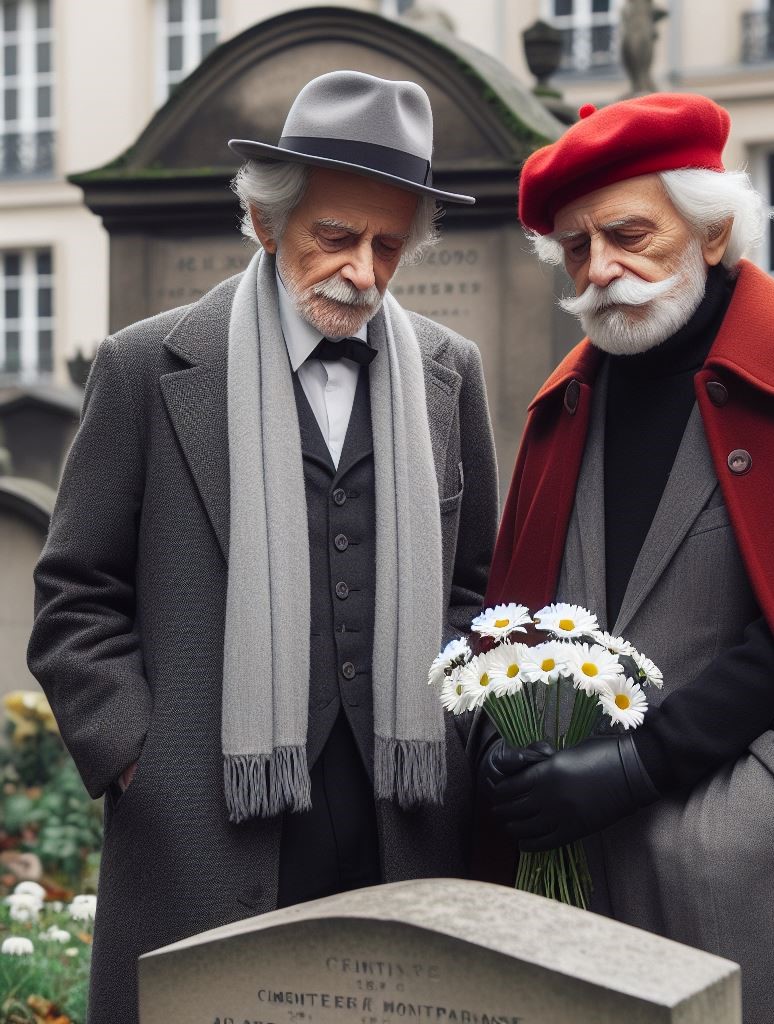
Gerard acknowledged, with a nod, Phillipe as he entered the café. Phillipe always sat at a table smack in the center of the room. In his red cape and beret, he preferred to be the obvious but unapproachable sun around which the other diners and staff revolved throughout the morning. His thick white handlebar mustache accented a face with twinkling eyes. Although they frequented the same café for ten years nearly every day, neither man spoke to the other.

When each man had his order, they settled in to enjoy their respective breakfasts. Gerard finished his yogurt with fruit and picked with delicate fingers at his fries while Phillipe spooned his sundae into his mouth slowly, delicious bite by delicious bite as the world spun inevitably around them.

Martin hurried to Phillipe’s table after delivering Gerard’s breakfast. He placed a steaming pot of green tea along with a large mug on the table and asked after Phillipe’s health. Phillipe was a habitual diner at Café Couronne but not daily. His apartment on the sixth floor of the old Art Nouveau building was a bit further down Le Rue de Rennes from Gerard. Phillipe’s attitude was com ci, com ça. He abhorred routine. At age seventy-six, he was sometimes absent of a morning due to a variety of ailments, heart, back, liver, eye, shoulder, or hips, but he never missed Thursdays. He had come on thirteen consecutive mornings so Martin felt sure he might be due to have a breakdown soon.  Phillipe said he was sound this day and looking forward to meeting a friend for a stroll through the Jardin du Luxembourg after his petit dejeuner. “I’ll have a strawberry parfait sundae this morning,” he told Martin.

The two men left the café within ten minutes of each other, Phillipe being the first, stopped at the flower shop down the street from the café and purchased two dozen white daisies. At precisely 12:00 pm the two gentlemen of Paris met at the Rue Guynemer entrance on the northwest side of the Jardin du Luxembourg (6th arrondissement). From there they silently strolled the path past L’Orangerie with its intoxicating citrus smells, then around the green grassy oval in front of the Palais toward their favorite statue. The statue reminded them of her. They took two side-by-side chairs at the edge of the path and quietly spoke of her. After thirty minutes they strolled together to the Cimetière du Montparnasse to stand at her gravesite, privately mourning the woman they both loved.’The two men left the café within ten minutes of each other, Phillipe being the first, stopped at the flower shop down the street from the café and purchased two dozen white daisies. At precisely 12:00 pm the two gentlemen of Paris met at the Rue Guynemer entrance on the northwest side of the Jardin du Luxembourg (6th arrondissement). From there they silently strolled the path past L’Orangerie with its intoxicating citrus smells, then around the green grassy oval in front of the Palais toward their favorite statue. The statue reminded them of her. They took two side-by-side chairs at the edge of the path and quietly spoke of her. After thirty minutes they strolled together to the Cimetière du Montparnasse to stand at her gravesite, privately mourning the woman they both loved.

Gerard loved her first when she was seventeen. A muscular athletic man, he was ten years older than she. She had been an aerialist in the circus where he trained lions, tigers, and bears. She only performed there for two years, but they remained lovers even after she left to study magical arts at Arcane University in Paris. He would take the train from wherever the circus was temporarily situated in Europe to see her when he had a few days off. His hope was to persuade her to marry him and start a farm retreat for old circus animals in the Loire Valley. She finally tired of their long-distance affair. She asked him to stay away. Heartbroken, Gerard married the circus horse trainer on the rebound, and they had thirty-one quarrelsome, combative, marital years. After his wife died, he retired to spend his days in Paris researching butterfly habits and habitats with his true love still very much on his mind.

Phillipe met her when she was twenty-six.  He was a professor of alchemy and enchantment at Arcane University. She was his most creative student, inventing unique ideas for magical entertainments. They became lovers within two weeks of her matriculation. She told him of Gerard, her first love, and the dozen or so that followed, but vowed he would be her last. They had happy times writing and producing magic shows for children. Sadly, she died of pneumonia after a mere five years together.

Twenty years went by, Phillipe and Gerard met one day at her grave in the Cimetière du Montparnasse. They eyed each other but didn’t speak. After several chance meetings, a coincidence neither of them questioned, they began a conversation about her. They assumed she intentionally brought them together. As time went by their meetings were formalized every Thursday at 12:00. When they met, they shared stories about how she enriched their lives. Each revealed a different side of her. To Gerard, she was a daring acrobat, lithe and supple, a physical wonder. To Phillipe, she was a cerebral partner with ideas flowing from her inventive mind.  It made them feel that she was still with them. They alternated taking flowers to her grave. Occasionally both took flowers when a specific memory was observed by one or the other. After a while, they began eating breakfast at the same café, but never spoke except on Thursday. Their only subject was of her.

Conversation with a Stranger

This story is from a prompt. Write about a conversation with a stranger who turns out to not be a stranger. Include five different “clicks” that happen as your character begins to remember the person.

It was one of those lines that went nearly around the perimeter of Whole Foods when COVID embraced our town. Everyone stood their respectful distance from the stranger ahead and the stranger behind waiting as the line inched toward the three clerks at the front of the store. I was halted next to the deli section. Not a good thing since all I needed to buy was a bag of organic lettuce and one of organic arugula.  My weakness is stinky French cheese. I eyed all the goodies, especially the creamy raclette and camembert that always enticed my taste buds into a dance of ecstasy. I averted my eyes and caught the smile of the man standing behind me. With raised eyebrows, he nodded toward the cheeses acknowledging the temptation. He looked oddly familiar but not. Click.

The five-day stubble beard was interrupted by a ragged trail of a scar scoring the left side of his face from temple to chin, nicking the side of his mouth. The scar pulled his mouth to the left with a little pucker so his smile was lopsided but never-the-less friendly. His left eye drooped.

“A reminder of Paris, eh?” he asked.
“Oh, yes,” I replied inhaling the memories. Click

I turned to move my cart forward.

A low laugh, full and rich, rumbled smoothly from his belly to throat and made me look back again. His eyes, a deep brown, looked me over from tête to toe. Click.

“Imagine seeing you at a grocery store in Tucson after all these years and all those miles.”
I stared hard at him again. “Do I know you?”
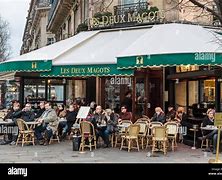
“Does Les Deux Magots one midnight in July 2003 ring a bell?”

A warm melting quiver involuntarily coursed through my body. Click.
Again, I moved my cart forward, my mind racing through a dense forest of memories of those balmy July evenings.

“Sorry, did I disturb you?” he asked quietly.
“I can’t believe, it is you, Anthony. What happened?”  I looked directly at his scar. He had easily been one of the most attractive men I’d ever met, let alone bedded.  The magnetism had been more than skin deep but his handsome face had instant appeal.

“One of those crazy challenges I couldn’t resist.”

I pulled my cart out of the line and circled back to him. Standing well within the prohibited six-foot radius of personal space I could smell his signature Jaguar Black Classic cologne. The musk, cedar, and bitter orange combination was the clincher. Click.

The disruption in the orderly line was noted by the other patrons who dithered their carts attempting to reestablish regulation.

“A race?”
“Of course. And I won. But the ending was,” he paused, “explosive – one might say.”

Again, the low laugh that sent me back in time. He pulled his cart out of line and a collective sigh ruffled through the systemized cart-pushers.

“Do you have someplace to be or could we grab a cup of coffee? I’m in town for just a few days. I was going to look you up and I’m amazed at our serendipitous meeting. Meant to be, I guess.”

We left our carts at the end of the deli section and walked over to the coffee bar.

“Two French press Carte Noir, s’il vous plait.” Anthony told the barista.

I smiled. Ah, the memories that order brought back and it wasn’t just one midnight.