Years after I retired, I came upon notes from a case I tried when I was the prosecuting attorney for our state. The case had haunted me off and on for years. I questioned my motives for requesting a ten-year sentence for a first-time offender. I wanted to find out if the man I sent to jail had ever been released. My friend, who was still in the prosecutor’s office, agreed to help me. She looked up the file and emailed me some information. I sent a letter to the address of the offender’s wife.
After several months, I received a reply from the man’s son. His mother died recently, and her mail had been forwarded to him. He wrote that his father died in prison about four years into his six-year sentence. He had been attacked by another inmate, a racist, who stabbed him. He lived for a while in the infirmary but died of his wounds. His younger brother, Bashir, died from alcohol poisoning when he was nineteen. His mother cursed my name until her dying day, blaming me for the premature deaths of both her husband and her son. She believed I robbed their family of a good husband and a father’s steady guidance. He asked that I not contact him again.
I remember my first day back to work from bereavement leave, feeling disoriented by grief. The chief prosecutor asked me to meet with a woman, the wife of a man being prosecuted by my office. I had been kept up-to-date on the trial and was to deliver the final argument to the judge the next day. Mrs. Darwish came to make a last-minute plea for her husband.
“Thank you for seeing me, Mrs. Judge,” Nour Darwish started. She was accompanied by their two young sons, Yusif and Bashir. Yusif’s lively dark eyes reminded me so much of my son, Teddy, the boy I just buried. They were about the same age. Bashir, the younger boy, was more solemn.
“I am not the judge, Mrs. Darwish. My name is Makena Washington; I am the prosecuting attorney. What can I do for you?” I knew I sounded abrupt. Why was this woman, this wife, this mother, coming to me? Why did she have two living sons when my only one was in a fresh grave? I could barely listen to her; jealousy gripped every fiber of my being.
“My Tarek did a bad thing, but it was for a good reason. We have been in this country two years only. We want our sons to have a better life than we had in Syria. Tarek drove his truck for farmer products. He was asked to take something with the farmer crop without knowing it. They said he would be paid big money, so he allowed his truck to be used to haul things, illegal things. He was paid for savings to help our sons to school.
“Mr. Darwish was arrested driving his truck with nearly a thousand pounds of methamphetamine hidden in farm produce. That much crystal meth is a death sentence for thousands of people. It is a simple law, a felony, leading to incarceration of three to twenty years in jail in this state.”
“He didn’t know what they were putting in his truck. He just wanted the extra pay for our sons.”
“His motivation has no bearing on the fact that he was transporting a deadly substance. To be clear, Mrs. Darwish, I am not the judge. I make recommendations to the judge based on my understanding of the case. He will do the actual sentencing.
“I know Tarek must be punished, Mrs. Judge. I’m asking for kindness. My sons need their baba while they are growing. Give him short time in jail, please.”
Her entreaties fell on deaf ears. Where was the mercy for my Teddy? He deserved to live a life. A full life. Why had he been the target, run down by an unlicensed driver? What is justice? What is mercy? How many people would live another day without being poisoned by the meth in Tarek’s truck? I could suggest leniency for a first offense, but what does that accomplish? There are no guarantees. Tarek Darwish could have been hit by a bus the day he got out of jail. It is better that he be a symbol, a warning to others who think they can bend the law for their own purposes, I reasoned.
How many lives did I impact that day? That day of grieving.
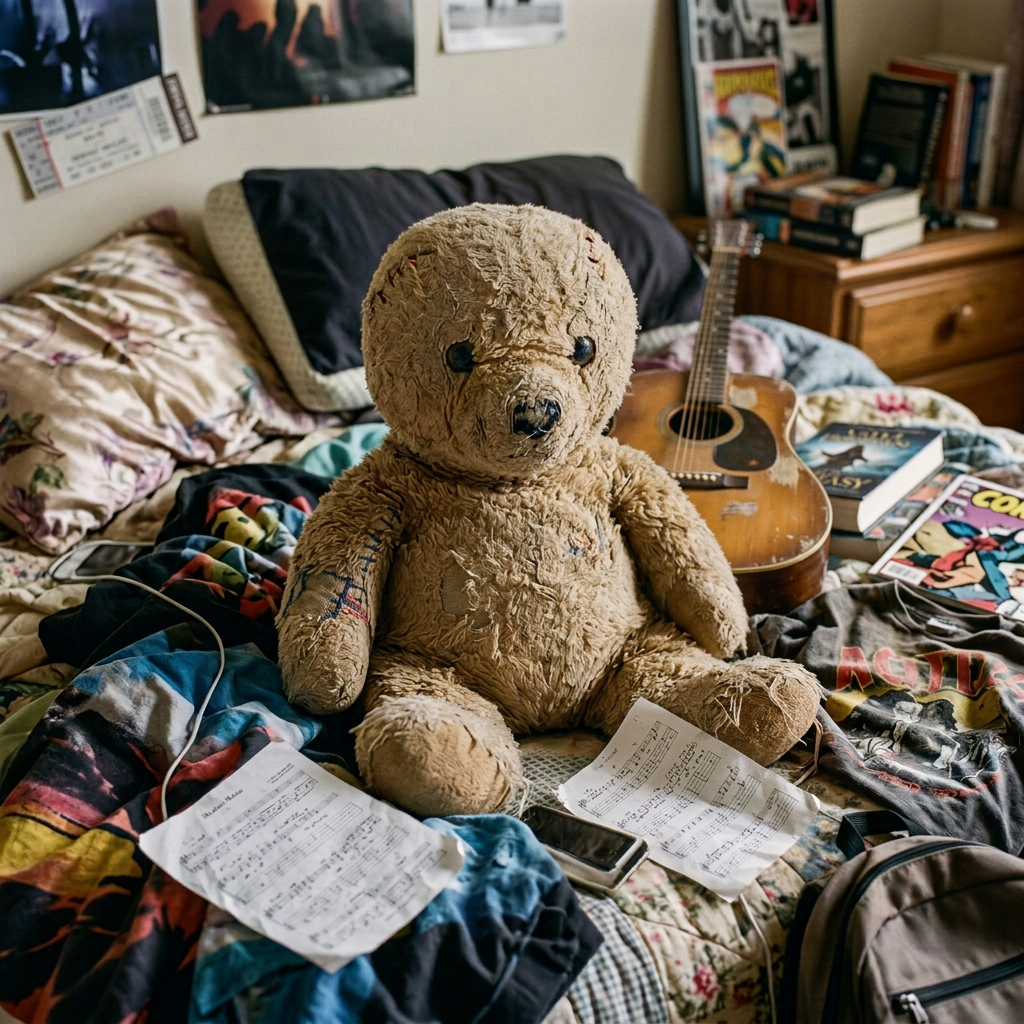
I leaned against the doorway of Dom’s room, my body hollow as a swamp reed yet heavy as stone. The only thing keeping my exhausted body upright was the solid wooden doorframe. Stinging tears etched fresh trails of day-old mascara down my face. My throat ached, a thick pulsing knot I couldn’t swallow. I looked at his empty bed, still rumpled from countless unmade mornings. Despite repeated bribes and threats, it was never completely made. On top of the carelessly thrown sheets lay his guitar and scattered pieces of lined music notepaper, his unfinished songs. Musical notes dotted across staves, while lyrics dribbled along the margins of the notepaper in search of their melody. A life-sized stuffed Disney Tramp dog and an earless brown teddy bear slumped in the corner by the closet, symbols of the childhood he seemed reluctant to surrender. The top of his dresser was so cluttered it was hard to pick out any one thing to focus on. A molehill of dirty clothes lay between the door and the bed. Dom’s room. Just a few days before, I was thinking I would fumigate it when he left for college. Now, the heavy musky odor of teen boyhood comforted me. I could have picked his room out of a lineup. It would have been a snap. It rarely changed even after he “cleaned up.”
The hospital has sent us home to sleep. Sleep eluded me. My thoughts raced from begging to bartering with God in frantic, weary circles. Please God, let him come home. Let him breathe again in this space. I’ll be a better parent. I’ll listen harder to everything he has to say. Please, please, oh God, please let my son live. Take me instead, trade me. He’s just beginning; he has so much to do and see. Let this just be one tiny mistake in his life, not the last big one.
Was it only yesterday that the nightmare began?
“Mrs. Chase?” the disembodied stranger’s voice questioned when I picked up the bedside phone about midnight.
“Yes?” I replied. My groggy voice sounded like a stranger.
“Mrs. Chase, is your husband with you?”
“What’s the matter? What’s wrong?”
My mind began to function, searching possibilities.
“Do you have someone with you?” the woman on the phone insisted.
“Yes. Yes.” I rolled over and poked the somnolent form of my husband.
He came awake. “Who’re you talking to?” he grumbled.
“Mrs. Chase, your son, Dominic, has been in a motorcycle accident. We would like you and your husband to come to emergency at Wesley Hospital as soon as possible.”
“Is he okay? Is he alive?”
With those words, Dave came fully awake. He rose quickly and pulled on his pants.
“It’s Dom,” he said, a note of inevitability in his voice.
I tried to get up with the phone still pressed to my ear. I wobbled; my weak knees struggled to support me.
“He’s in and out of consciousness and asks for you,” said the woman. “Please drive carefully, but come as soon as you can.”
I don’t recall the drive to the hospital through quiet night streets. Thank heaven Dave had his senses together. We went to bed knowing Dom was spending the night at his friend Mike’s house and would be home in the morning. Images of Dom growing up ran in a continuous loop in my mind. His two-year-old voice asserting his independence when I tried to help him get dressed. “No, Mommy. I do it all my by the self.”
The clock above the door of his hospital room was our enemy. The second hand swooped along yet seemed unable to move the minute hand that marched its slow clunk clunk way from spot to spot between the numbers. Hours were interminable. We didn’t take our eyes off Dom. His long-boned eighteen-year-old form lay unnaturally still under the hospital sheet. Dom. Our Dom, so bright, inquisitive, creative, full of cat-quick energy and always moving. His brown eyes openly laughed at the amusing incongruities of daily living. Now his life depended on a web of tubes going in and out of his body.
Dom opened his eyes only once in those hours I sat by his bed. They searched the ceiling blankly, and when they found my face, I saw a glimmer of light. Dom was still in there even though he drifted far, far away most of the time.
Three doctors agreed that he needed surgery as soon as possible to relieve pressure on his brain. Again, we waited in suspended time for him to come to the recovery room. After surgery, the medical staff insisted that Dave and I go home. Dom would be kept in a coma for twenty-four hours, and they would be unable to give any further prognosis until then. He was out of immediate danger.
Dom had wanted a motorcycle since he was ten. We told him that after graduation, when he was eighteen, he could buy his own provided he could pay for his insurance, gas and bike maintenance. He worked to save for his dream. Two months after his eighteenth birthday, he rewarded himself with a used Honda. He took safety classes and told us he was a better driver on a motorcycle than most people in cars because he had to be alert for more hazards in the roadway that cars just drove past.
“Relax, Mom. Remember what you always say. When it’s your turn to go to heaven, nothing will prevent it, and when it’s not your turn, you will rise from ashes of devastation.”
“I know, I know, Dom, but I can’t help thinking that a motorcycle could be tempting fate more than usual.”
“You know I have plans,” he said. “I’m not ready for a quick exit. I love the freedom I feel on my bike. I’ll be an old steady guy just like Dad someday. Dad’s always told me the worst thing would be to wake up when you’re sixty-five saying, if only I had… I don’t want to look back and wish I’d taken a few road trips on a motorcycle when I had the chance. Now is my time for that kind of adventure.”
His arguments succeeded in pushing aside my fears. He was a sensible kid with goals, good friends, and plans for his future. He and his best friend, Mike, took a few one-day road trips to test their skills. His immediate dream was to go down the west coast on a motorcycle with Mike before settling down to college in the fall. The trip was to start in two weeks. I stared at his empty room, praying for a miracle that he would be alive in two weeks.
Nurse Sandy called. Dom was beginning to come around. We left immediately.
At the hospital, we prepared for another day of unknowns while we silently willed Dom back into our world. Assured by his doctor that he was on the mend, but that it would be a long process.
Dom was smiling and more alert than the day before. His speech was a little slurred, his communication halting.
“Mom, do you have a blank paper?” He slowed his words to make them clear.
I searched my purse and came up with a little notebook I kept for reminder notes to myself.
“Will this do?”
“Yeah, do you have a pencil?”
Again, I searched my purse. No pencil but a pen.
“What do you want with these?” I asked. I knew he wasn’t capable of writing anything with both arms pinioned by needles and tubes.
“I want you to write down a poem.”
My breath caught in my throat. He was lying in pain and still wanted to write.
“Sure, Dom. I’m ready when you are. Are these lyrics to one of your songs?” Dave stood beside me with his hand on my shoulder as I wrote.
Dom closed his eyes and began. His words came at a measured but steady pace, words that must have lingered in his mind until he was able to let them go.
“I am here
I have always been
I will endure
When my body leaves this earthly plane
Remember my love, my soul remains.
To guide and comfort, until together again.”
He paused and took several long breaths.
“Life is but a spark in time
An ember ignited to shine
In hearts that are forever mine
Eternity may claim me
My…”
There was another long pause.
“I’m not finished,” he said very quietly, closing his eyes. “I’ll catch you on the other side.”
Suddenly buzzers and bells jangled a cacophony. Two nurses rushed into the room.
“What happened? What’s going on?” Both Dave and I panicked.
A third nurse came in, asked us to leave, and pushed us toward the door.
“We’ll call you back in when we have him stabilized.” I could hear the stress in her tone.
We’re planning Dom’s funeral, a green burial. He would love that. I am still in shock. It’s not real. But it is. I sat in his room for hours after we got back home yesterday. Dave wandered in and out, mostly staying downstairs listening to music that Dom loved. I cannot imagine changing anything in this room. I want to believe he will be back in a few days, pick up his guitar and finish his song. Our lives will never … what? Be the same? Of course not. He was here. He told us he will always be here. I hold his teddy bear, the one he slept with since he was an infant. Teddy knows.
Teddy Knows
I apologize for the formatting of this story. As many times as I tried I couldn’t get the paragraphs and the spaces between paragraphs to format correctly.
The first day of English class on my very first day of college in September,1964, I arrived at Thompson Hall, the ancient brick edifice that housed the English Department. Built in the 1890’s, it was the oldest building on campus. Everything about the building was massive and was intended to remain a steadfast educational guidepost through generations of students.
I took my seat in anticipation of learning brilliant new insights into Chaucer, Shakespeare, Austin, and Hemingway. In high school, Mrs. Lupton instilled in me an almost fanatic love of literature. I teetered on the brink of becoming an English literature maven or a primary school teacher. Neither came true since I retired after my freshman year from academia, fueled by hormones, romance, and a super stud boyfriend, to become a wife and mother –but that is a whole different Oprah for a later time. The boyfriend, now husband, lasted much longer than my academic career would have – we are still together.
The teacher arrived, a youngish handsome man in a sport coat, open-collar white shirt, and gray slacks. Ahh, thought I. He will be a pleasure to spend a semester with. He adjusted his black-rimmed glasses and addressed the class, giving his name and academic status. I have forgotten both in the intervening sixty-five years.
In an authoritative voice, he gave the class one abrupt directive. “Look at that door and spend the next forty minutes writing about it.” He pointed to a door that took up space in a wall at the front of the classroom next to the huge blackboard. “Place your essays on my desk as you leave class. I will see you Wednesday at this same time, and we will discuss your essays.”
Then he left. There was a murmur in the room, but the students, freshmen all, eager to begin their academic career with a win, began writing. Me, not so much. I spent at least fifteen of those precious minutes glaring at the oversized – at least ten feet high, heavy door meant to convey authority. It wasn’t the door out of the room, the exit. It was a door to who knows what: a closet, another room, a stairway, a secret cavern? This is when imagination, figurative language such as simile and metaphor, and sensory details became the most important part of learning. We were thrown into the deep end of the pool without practice or instruction. It was very deep and extremely cold. Staring at the grain of the wood, the dark stain which became variegated as I observed it, and the ancient hardware of knob and lock, I finally mind-merged with the door so it would give up its secrets.
Sad to say, I don’t know what became of that essay. I do remember I managed to write a few unworthy pages. However, it was the beginning of my love of prompts – words, sentences, or pictures untethered to anything in particular that lead your mind and pen into labyrinths of imagination. Prompts can blow out even the most stubborn writer’s block. When you get the right side of the brain humming with the magic of ‘what if’, you can then employ the left side to organize those ideas.
The door remained an object of fascination every time I entered that classroom. I can conjure that door in my mind to this day. Is it the end to an event or idea, a door slammed closed; or is it the beginning, an invitation to a new adventure, a new concept?
What did Dorothy see in OZ? How did Wart learn to see the world in The Sword and The Stone? What did Alice see in Wonderland? What did Milo observe through the Phantom Tollbooth? Employ the kind of vision that a writer uses when creating a poem or a story. Look with the eyes of a stranger. It is possibly the most difficult part of writing, the most challenging and ultimately the most satisfying.
My recent prompt for our writers’ group was to discover something sublime in something ordinary. Look around the meeting room and find an object, then describe the object in an interesting way. Write continuously without taking the pen from the paper for ten minutes.
This is my contribution:
The Library Clock
If popularity were judged by how many times a day someone is watched, I win the library popularity contest hands down – pun intended. I could not count how many times a day I am glanced at and outright stared at. I keep my hands in front of my face, an attempt at modesty (false though it may be since I am rather handsome) – but the stares continue. I am the library meeting room clock, a simple white-faced, wood-framed, battery-operated clock.
My batteries are changed on January 5th every year like clockwork (another pun intended-I’m full of them), so I never slow down. I am not dependent on electricity during storms. I am faithful to my duties regardless of external circumstances. Being an Arizona clock, I am thankfully relieved of the whole Daylight Saving Time fiasco. I cannot understand what geniuses concocted that stupidity. Technically, I am here to measure time, but I covertly measure aspiration and reality – without comment. There are occasions when I wish I had a chime, a buzzer, or something I could employ to register my approval or disapproval. Through it all, I remain calm, reliable, and only slightly smug.
In contradiction, I am always running in a room that I cannot escape. My room is in almost constant use. It has the largest capacity in the library, holding up to seventy-five people for a gathering.
Time management can be an issue for the humans that use my room. I am the professional witness to the gap between what people schedule and what people do. I’ve seen a writers’ group go beyond their two-hour limit on a number of occasions. Once, the librarian needed to come in and shoo them out so the staff could prepare the room for the Mystery Club book discussion group.
What I love about being a clock high on the wall is what I observe in my room. It runs the gamut from serious to ridiculous. For instance, a few weeks ago I watched citizens voting in local elections. For twelve hours, people flowed in and out of my room, making decisions for their city that would resonate for years. A big deal.
On the other hand, I watched as an HOA group spent at least one of my hours haggling over where trash bins should be located at or near curbside. I must say, during that hour I was stared at continuously. My ticking may have sounded a bit more judgmental.
I receive the most attention when a teen group gathers for a math tutoring session. Last week, one young man looked at me every 15 seconds for two hours. If I could blush from all the attention, I certainly would have. I pride myself on not being conceited.
~end of ten minutes.
I will probably complete, edit, and revise this for a longer essay.
One summer evening, our writers’ group meeting took place at Sally’s. She is a gourmet cook, as well as a published author, and her husband, Allen, is a master in the kitchen himself. He often prepares part of the meal served at our meetings in their home. He makes a heavenly guacamole and is willing to share his recipes. He is a real treasure for our little group. On this early evening, Allen prepared a grilled salad with his own recipe for homemade Caesar dressing. Sally made sourdough bread and a luscious three-tiered strawberry and cream dessert. Sally’s presentation of food is an art form. We look forward to her creations. She had stopped by the store for fresh strawberries and lettuce on her way home from work.
Linda and I arrived, plopped our notebooks and purses on the sofa, and went to the table. Jackie was already there.
While Allen and Sally put the finishing touches on the meal, we all chatted about our day. Then Sally told us she had a prompt for us. She and Allen exchanged amused looks, and she told us the story of the bag of lettuce she picked up at the market. Yes, the very lettuce that was part of our salad. Their story went like this:
Before Allen opened the package, he noticed moneyinside the bag.
“Sally”, he said, holding the bagged lettuce in the air. “Did you look at this lettuce before you bought it?”
“Duh, of course,” was her exasperated reply. “I always check for the freshest. Why? Are there brown leaves in it?”
“Not exactly, but there are some strange green things in it.”
“Bugs?” she asked as she stopped measuring the cream for whipping.
“No, more like dollars.”
“What are you talking about?” Sally turned to look closely at the bag. Sure enough, there were dollar bills in the sealed package of lettuce.
A squeal and “What the heck?” escaped her as she noticed in the sealed package of organic lettuce a twenty-dollar bill and six ones.
Thus, a prompt was born – Tell how the dollars got into the bag. After dinner, we grabbed our notebooks and began to write. (Needless to say, Sally washed the lettuce before making the salad.)
The story of Harmon Pettigrew developed as I wrote. During dessert, we shared our theories about the placement of the money. Harmon only had a couple of pages, and I knew he would need more to tell his whole story, so I continued to write after I got home. At the next meeting, I read Harmon’s story to the group.
The Almost True Story of Harmon Pettigrew and His Crop of “Lettuce”
You’ve heard of money being called lettuce. Well, here is a true story validating the claim.
Once upon a time, around 2008, in a small town in California called Salinas, the salad bowl of America, a lettuce grower named Harmon Pettigrew decided to diversify. After the E. coli scare took his business down to practically nothing, he went into his basement and began to develop the seeds of a new enterprise. He retrieved the savings from the family bank account and worked day and night diligently for nearly two years to produce a new kind of lettuce seed, one that would ensure future profit no matter what blight might come upon the lettuce crop.
Harmon grew up on a small farm on the outskirts of Salinas. He worked in the fields harvesting lettuce from the time he was a sprout of five. His daddy taught him the fine points of how to plant Romaine and Butter lettuce from seed in shallow holes 8 inches apart in rows ten inches wide with twenty-four inches between rows. They used organic fungicides and fertilizers. Both his mother, Claudia, and his father, Earl, were flower children of the 60s. They believed world peace would eventually come about if the whole world ate organic. Harmon’s legal name was Harmony Light-of-the-World Pettigrew, but for obvious reasons, he shortened it when he was in high school. He had every intention of getting out of Salinas after high school graduation, but his father died from a heart attack the week after graduation, and his mom, who was losing her sight to a genetic disorder, needed him to keep the farm going.
Claudia prided herself on being self-sufficient but quickly realized some limitations as her eyesight made it harder to carry on the business side of the farm. That had been Earl’s job. Reading contracts and doing the accounting became challenging. She was still very capable of tending the gardens as well as house chores.
“I know you’ve been waiting to get out on your own and explore the world, Harmony, but I do need you to stay, if only for a year or two, and help stabilize the business and find a good manager for me. Dear boy, I want you to employ all your talents in ways that make you successful in life. If you could please delay for a short while, I promise I’ll save enough to give you a stake in your future.”
Harmon acquiesced to his mother’s plea.
Harmon Pettigrew was not a genius in the sense of book learning, although he went to Hartnell Community College in downtown Salinas, where he took introduction to business and introduction to computer classes. He found complex theory taxing, so he quit after the first semester and enrolled in night classes at Wayne’s College of Beauty just a few blocks from Hartnell. He figured he would acquire a backup skill in the event that a lettuce crop failed. Harmon was more of a hands-on type of learner. It was at Wayne’s where he discovered the concept of mixing chemicals and transforming the ordinary into the extraordinary.
Mrs. Haven was one of his biggest achievements. A transformation from a seventy-year-old grieving widow to a seventy-year-old go-go girl took Harmon only a few months. He created unique hair and makeup applications with the help of chemistry and science that wowed not only the salon but the entire town. Mrs. Haven acquired a whole new outlook on life and was beset with proposals. Harmon became the favorite of the over-sixty crowd even though he only worked at Wayne’s part-time while maintaining and improving the farm. He was offered several opportunities to open his own salon, but he knew his true calling was agriculture, where he adapted his peculiar brand of genius.
After ten years of farming just as his father taught him, he decided to change the crop and grow money. He knew printing counterfeit money was illegal and would land him in jail. Using his beginning computer skills, he went online to research state and federal penalties attached to growing money and found there was no restriction, no penalty and, in fact, the concept was not even mentioned in law. He read about sheep being made in petri dishes from seed and even human babies being made in test tubes. He reasoned that if something as complicated as a baby could be made, why not money? Money is made from organic materials, so all he needed to do was take it down to basic elements and formulate a seed from which it could be reproduced.
Harmon had the perfect laboratory to work out his experiment in the basement of the family farmhouse. Earl, the hippy lettuce farmer, had grown pot as a side business. The basement was set up for growing plants. The walls were lined with sixteen seventy-five-gallon aquariums and grow lights for each. When Earl passed away, the pot-growing business fell off. Claudia lost interest in the plants, and Harmon had never been a part of the operation. Now he had a use for the abandoned equipment.
With the aid of a few simple chemical compounds purchased at the local feed store and beauty supply and his community church teaching “…faith is the assurance of things hoped for, a conviction of things not seen” (Heb.11:1), Harmon labored to develop a seed that grew into money. He practiced with one-dollar bills, going through nearly four thousand dollars in ones, trying to reduce the money to its most basic form and then to seed.
One morning in early February, after trial and error, when he was near the end of his family fortune, he went down into the basement to check his plants. There, in the third aquarium from the east wall, he found a tightly curled one-dollar bill poking out of the soil. He almost fainted from surprise. He was a man of faith, but it had been tested for so many months. He didn’t want to pluck it before its full growth, and he wasn’t sure if it was a single or if the seed would develop into a branched plant with many singles. He packed up twelve PB & J sandwiches and told his mom not to disturb him for the next few days while he stayed in the basement working on his new project. Claudia surmised he was starting up pot production again.
For five more days, he waited and watched, giving small amounts of plant food and water to the incubating plant as it grew and unfurled. In the early evening of the sixth day, Harmon noticed the dollar bill was beginning to wither, so he plucked it and laid it out under a clear glass plate. With a magnifying glass, he examined it both front and back, checking for any imperfections. The only thing he found was a tiny soil stain on the bottom left corner of the bill. Other than that, it looked exactly like the one-dollar bill he had in his wallet.
For the next several months, he worked on developing five, ten and twenty-dollar bills, all the while planting and growing the lettuce crop in the field. He was able to recreate his success with one-dollar bills, but the fives and tens withered before they completely formed. The twenty-dollar bill seemed hardier but not as prolific as the ones. He successfully grew two thousand dollars within ten months and decided to take it to the bank for a final test.
Shifting his balance discretely from one leg to the other and twisting his clammy clasped fingers, Harmon asked, “Ms Hempshaw, could you please check one of the twenty-dollar bills? I have a feeling they may be counterfeit.” He breathed deeply to calm his rapid heart rate.
The teller called the bank manager from his office to support her findings. “No, Harmon, it doesn’t appear to be counterfeit. Why did you suspect it?” asked Mr. Withers.
“It was part of a cash transaction for a truckload of cabbages. I’d never done business with the guy, and I wasn’t comfortable with him. I don’t often do cash transactions.”
“It’s fine. We will accept it for deposit,” Mr. Withers nodded.
Harmon exhaled a sigh of relief. His crop was now ready for planting.
His next hurdle was to plant his seeds outside to see how they would grow in his lettuce field. He picked a small field he could manage all by himself and told his mom he was planting a prototype new lettuce, and he didn’t want her or any of their seasonal crew to work in that field. He placed a row of money between two rows of Romaine and watched it carefully. He planted the money seeds after the lettuce was nearly ready for harvest because money grew much faster, and he wanted it to be hidden by rows of fully leafed lettuce.
The day he was to harvest his crop, he fell very ill with a twenty-four-hour flu and had to stay in bed. His mother, to be helpful and without telling him, went to his private little field to harvest the lettuce for him. Claudia, now in her early sixties, was legally blind from the degenerative eye disease but still had enough sight to do basic farm chores and keep house. Because of her diminished sight, she didn’t notice the difference between green lettuce and green dollar bills. She picked all the rows, took the lettuce to the bagging shed, washed it, bagged and sealed it for shipping with the label – Pettigrew’s Organic Lettuce – Grown the Old-Fashioned Way.
Mystery solved.
Sally’s comment: I would never have thought of the extent of detail, background, locations, and science that would go into using the money found in a lettuce bag as Diana. Diana took this unusual ‘find’ to a level that becomes almost, almost, believable.
• This story is in our book, Telling Tales and Sharing Secrets.
It is funny how memories pop into your head at the weirdest times, sometimes beckoned by music, a photo, or sometimes by nothing at all. Those thoughts strung together create a story. This story is constructed of such random memories. They didn’t come in chronological order, so dates are added to create a logical thread.
Fall, 1964. (age 10) The minute I walked into class at Rock Ridge Elementary School and laid eyes on Elizabeth, I knew I wanted to be her friend. She was the prettiest girl I’d ever seen – a sunshine bright blonde with green eyes, a real beanpole with an angel face. I was new in the school, and it was my first day in fifth grade. We spoke a little bit each day, but both of us were shy. After nearly two weeks, I found out she lived only a few blocks from me. I got up the courage to ask her to come to my house after school. My mom fixed us cocoa in big white mugs, and we talked for hours until she had to go home for dinner. That’s when I found out she was new to the school, too. She moved from Oregon, and we moved from Washington. Both of our fathers had been transferred to Tucson by the same company. Our parents became friends, and we were inseparable. She was the tallest one in class, even taller than the boys, and I was the shortest. Mutt and Jeff, my father dubbed us after the cartoon characters. Elizabeth became Lizzie to me.
Spring, 1991 (age 37)
We sat on the shaded patio of Liz’s house, listening to our kids laughing in the family room as we shared a bottle of summer wine. Our children had grown up like brother and sisters, and whenever they got together, it was a party. Liz’s son, Greg, was 17, and so was my daughter, Ellen. They had been born only two weeks apart. Sara, my other child, was nearly 15. Our family lived in a different part of town from Liz’s. Even so, we spent so much time at each other’s homes that the kids met each other’s friends and felt comfortable in the neighborhood. Raleigh (Liz’s husband) and Brent (my husband) were playing golf and coming back for barbecue.
“Mom, can we go get ice cream?” Greg called. Typical teens, finding any excuse to leave the ‘growns’ behind and drive a car.
“What do you think?” Liz turned to me. “Do you trust his driving?”
“He’s your son. You’ve been driving with him. What do you think? Can he be trusted?”
“Yeah. He’s pretty good, and it’s a short way.”
“Okay.”
“Okay, Greg. Be careful and come straight back. We’re barbecuing burgers when your dad gets home.”
“Got it. Thanks.” Off they scrambled, taking Liz’s extended-cab truck.
“Em, have you ever cheated on Brent?” Liz’s question was completely out of the blue.
“In my heart or in the flesh?” I retorted, laughing.
“I mean, really, have you ever been to bed with anyone else since you’ve been married?”
“Liz, you would have been the first to know if I did. Nothing that big would have happened without me calling you immediately and blabbing. You’ve heard every secret I’ve had since fifth grade.”
“Have you wanted to?”
“Yeah, I guess it crossed my mind on a few occasions, but it didn’t seem worth all the problems. I don’t keep secrets very well, and I certainly don’t want to end my marriage. I love my husband. Brent is the only guy I’ve bedded. Sometimes I feel like a semi-virgin. He was the first, and I’ll probably die with him as the only. I’ve definitely been curious about what could be out there.”
“What if you really fell in love?”
“Why would I do that?”
“Well, sometimes it happens.”
“Who would want this middle-aged body, saggy boobs and ass?”
“Emma, you’re in better shape now than when you were twenty-five.”
“You have a point, but that’s because I was pregnant for eighteen months out of three years.”
“We do yoga twice a week, and you’re on that running kick two or three times a week. You’re in great shape.”
“I’d still have to keep up a lie, and I don’t have that kind of memory or willpower. I’m not looking for trouble. Things like that can get out of hand quickly.”
“What if it came to you… unintended, when you least expected it?”
“Liz, are you trying to tell me something?”
“What d’you mean?”
“Are you having an affair?”
“No, don’t be silly. I’m talking midlife crisis stuff. Didn’t you watch Oprah last week? It was all about what happens to people in their 40s when their lives are static. She recommended some books. I remember one about surviving a mismatched marriage, but I don’t remember the name.”
“Do you think you and Raleigh are mismatched?”
“Well, it was a rebound marriage after Ben dumped me. Raleigh doesn’t want to travel and see the world like I do. He’s stuck in Tucson forever.”
“I thought the ‘Ben thing’ was mutual. Your breakup. You knew Raleigh wasn’t an adventurer when you married him. We even talked about it. He’s always been clear about that as long as I’ve known him. You two have been married as long as we have. Nobody’s ever 100% compatible. Look at me and Brent. He’s a golf-clubbing, high-maintenance, extroverted salesman, and I’m a book-reading, earth-hugging hippy, but we manage. He has to buy a whole new, bigger house every time a light bulb needs to be changed, and I simply want to plant a garden and stay to reap the results.”
“Oh, never mind. Let’s not get on this subject. It’s depressing. When are the guys supposed to get here?” Liz got up from the patio chair and walked across the flagstone toward the back door. “Brent said they’d be through golfing about 4:30. Shall we start fixing the salad? Have some more wine. Have you started getting Ellen’s stuff together for college in the fall?”
A nagging feeling fell over me. I couldn’t imagine Liz with a stranger, not Raleigh. The guys were great friends. Liz and I had never been closer. Our friendship as couples and families was a fundamental part of my life, but it felt like she was trying to tell me something.
Late Summer, 1972 (age 18)
“I can’t believe you’re going to be so far away,” I said. We were at her house, taking a break from packing her trunk for college. Lizzie was leaving the next morning for Pennsylvania. We sipped iced tea in her parents’ sunny kitchen while her mom made lunch.
“We will write, and I’ll be home on school breaks.”
“It won’t be the same,” I said.
“I know. I’ll miss you too.”
“Bucknell is another world, another universe from Tucson. You’ll end up all east coasty and I’ll be left southwesty.”
“Emma, don’t be ridiculous. I’m not going to change; I just have different experiences. I’ll make sure we share some of them.”
“Why did you have to be so smart?”
“I’m not smarter than you, silly. I want different things, and leaving Tucson is one of them. I want out of here. The world is big, and I want to see all of it.”
“I know. You’ve been saying that since fifth grade. So now is your chance. Go for it. I’m proud of you, and I’m happy to be staying here close to home at the U. of A. I love Tucson.”
As we finished packing, I took a pocket-sized book of Eighteenth Century English Love Poetry from her trunk and slipped it into my purse without her seeing. I wanted to have something of hers after she left. I told myself I’d make something up about finding it and give it back when she came home for Christmas break.
Lizzie came home for Christmas that year, but I clung to the book. I knew I’d return it someday and we’d laugh about it.
January 1977 (age 23)
“Guess what?” Liz’s voice was clear and excited on the long-distance call.
“What?” I sat in my apartment on campus, drinking warmed-over sludgy black coffee that I had made the night before.
“We’re engaged.” Liz’s voice bubbled.
“Is it Ben?”
“Of course, who else have I dated for two years? He gave me a ring last night before we had dinner with his parents. They came over from New York for the weekend. Ben told them he was going to ask me.”
“Great. Congratulations. Does that mean you’ll live in Philadelphia the rest of your life?” I really longed for her to be closer than two thousand miles away.
“Or New York or Geneva or Rome,” she sang.
“Wow. At least I’ll have cool places to visit on vacation. So, are things going better with his mom?”
“She’s still on my case to convert. They aren’t thrilled to have a Catholic daughter-in-law, old family traditions and all. They want me to study Judaism and think about converting before the wedding.”
“How are your folks with that?”
“They’re pretty much Easter and Christmas Catholics themselves, but I do think they are leery of my converting to Judaism.”
“When is the date?”
“We’re planning next November, before Ben leaves for his assignment in Switzerland. I’ll get to go with him.” Her excitement was palpable.
“You’re still coming back home to be my maid of honor in September, right?”
“Yes. I’ll be there. I wouldn’t miss it. I’ll be there for your graduation too.”
“And I’ll be at Bucknell for yours, Miss Cum Laud. Can you believe it? We’ve done four years of college. It really went fast.”
“I’m sure Brent had a lot to do with making the time go faster for you. How are things between you two? Any signs of strain with your wedding coming up?”
“Not really. My mom took on most of the planning. I need to concentrate on finals first, then the wedding.”
Summer 1992 (age 38)
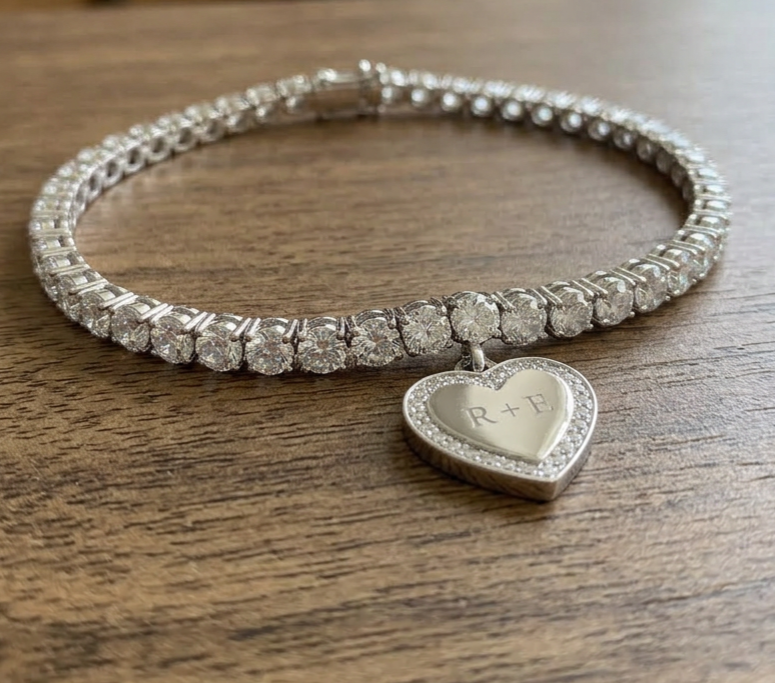
I felt under my bed for the barrette that had dropped and bounced from the nightstand. I felt something else and pulled out a diamond tennis bracelet. I don’t have much jewelry, and certainly not a tennis bracelet. Then I recognized it. It was Liz’s. She must have dropped it when she was here changing after our hike last week. I wondered why she hadn’t mentioned it. The diamond bracelet had a heart-shaped pendant engraved with “R + E “. I remembered when Raleigh gave the bracelet to Liz on their thirteenth anniversary. Liz loved jewelry, and Raleigh, a successful homebuilder, worked hard to give her the things she treasured. I called her.
“Hey, Lizzie. I have something of yours.”
“What?”
“Your tennis bracelet. Haven’t you missed it? You must have dropped it when you changed after our hike last week. I found it under the bed. Why did you wear it hiking?” Liz was quiet at the other end of the line.
“Liz?”
“Maybe,” she said.
“What d’you mean maybe?”
“Maybe it’s mine.”
“It has the inscription from Raleigh, and you’re the only one who’s been in my room except me and Brent.”
“Then it must be mine. I hadn’t missed it. Bring it with you to yoga class. I’ve got to run. See you tomorrow.”
The next morning, as I began my day, I received her call. “Em, could you do me a huge favor?” Liz sounded breathless on the phone.
“Sure, shoot.”
“Could you not let on to Raleigh that I missed yoga tonight?”
“Why aren’t you coming to yoga? What’s going on, Liz? This is the third time you’ve bailed. “
“I’ve met someone, and I’m going to see him.”
“I can’t lie to Raleigh.”
“Don’t lie. Just don’t say anything next time we’re all together. He’ll assume I am with you, and unless you tell him otherwise, it won’t come up.”
“Are you sure you know what you’re doing?” Liz had been talking more and more about how unhappy her marriage was, but nothing concrete. Raleigh seemed unaware of any problems.
“No, but I’m doing it anyway. Raleigh’s probably sleeping around, too.”
“I don’t believe that for a minute. He adores you. Liz, Raleigh is my friend, too. I don’t want to be in the middle of this.”
“Emma, I’m begging you. This is important. I’ll tell you all about the stuff with Raleigh later. It hasn’t been good with us for a long time. Please?”
“Okay, this time, but you’re buying trouble you don’t really want. You have to promise we’ll talk soon.”
“Fine. Thanks, Em.”
“Liz”, I paused, “Is he married?”
“What difference does it make?”
“Is he?”
“Yes.”
“You’re really messing up, girl.”
“We’ll talk.” She hung up.
October 2001 (age 47)
I curled up on my sofa at eight o’clock on a cool autumn night, a steaming mug of chamomile tea in hand. In the background, a mix of my favorite country songs pulsed from the CD player. My brass floor lamp shed a warm glow over the book I was reading for book club. All was well in my little world. The phone rang. It was Liz. Eight years had passed since we last spoke, eight years of tumult, recrimination, resolution, and recovery. Now she wanted to come over to see me. ‘Why?’ I wondered.
Once upon a time, Elizabeth and I were best friends with all that could mean in a thirty-plus-year relationship that began as children. We knew each secret of our formative souls and the giddy girlish highs of women-to-be. For years, every moment of the day was discussed and examined in detail. She was my diary and I hers. We shared our experiences of the first blood of puberty, the angst, the disgust, the wonder. We shared the excitement of our first boyfriend’s kiss, the first love of each heart. Plundering the mysteries of religion, we sought to understand who we were in the world and what we really believed. As mad Anglophiles, we planned a trip to London, a city we both yearned to see. Our post-college ambition was to live in Europe, either as diplomatic interpreters or high-class escorts.
Those teen daydreams were never realized, as our lives trended toward traditional roles. We settled into suburban married lives as friends. We were counselors to each other through marriage, husbands, and children. We encouraged each other through pregnancies, experienced the miracle of giving birth, and faced the challenges of raising children. I kept her secret and went with her when she had an abortion and didn’t want Raleigh to know about it.
There were no taboo subjects. We were closer than sisters with no sibling rivalry. We never had a fight. We understood and tolerated the bitchy days, allowed space for moods that demanded solitude or, at least, unconditional love. I knew everything about her. I knew when she started cheating on her husband. Our paths began like parallel trails through the woods; side by side, then diverged as the undergrowth of other relationships grew denser in between us, so we did not see each other with the same clarity. But the knowing was there. Until it wasn’t.
Why did she want to see me now? A wise therapist, years ago, reminded me that even though you don’t forget, you can forgive. Forgiveness takes the burden from your soul, not necessarily the memory from your heart. Heart wounds heal, leaving scars. Maybe I’ll return her book of old English love poetry.
September 1977 (age 23)
We both came home from college with a young man in tow, feet firmly set on paths to happily ever after. We spent the last night before my marriage together. Our last slumber party as maids at my parents’ home. We giggled, drank cocoa my mom made like old times, and talked about the import of being a wife and not losing ourselves in the transition.
“I have something to tell you before tomorrow, but I don’t want it to screw up your day, so please tell me it won’t,” Liz said, putting down the white mug.
“What’s the matter?”
“Ben left this morning to go back to Pennsylvania. We called off our wedding.”
“For good or for a while?”
“It’s over. I think watching you and Brent, we both realized that our relationship is not right. He really wants a Jewish princess in his life, and I can never be that. There was pressure from his folks and I…”
“I’m so sorry. I know you were looking forward to all the world travel, being part of Ben’s lifestyle. You must be devastated.” I put my arms around her.
“Actually, I’m not,” she said, patting me on the back and pulling away. “Maybe it’s not set in yet, but I think it’s the right decision. I’m going to get a job here in Tucson for the time being and rethink my options.”
September 1977, 10 days later (age 23)
“Welcome back. How was the honeymoon?” Liz walked into the living room of our tiny apartment.
“Lovely. I’ll show you pictures from Butchart Gardens. Some of them still need to be developed. Canada was beautiful.”
“I have something to tell you.” Her voice vibrated with suppressed exhilaration.
“Sit down, have a cup of tea, and give me the news. Brent will be home in a little while from work.” I had my new tea set from one of the wedding showers sitting on the coffee table. “I’m married,” she blurted out.
“You’re what?” I sat down hard on the sofa.
“Raleigh and I got married while you were gone. We went to Vegas.”
“Are you crazy? You met him at our wedding, just ten days ago. Don’t get me wrong, I think he’s a great guy, but that was pretty sudden. You just broke up with Ben.”
“I know. I know. I know. It was a whirlwind, but I’m happy, really happy.” She sounded like she was trying to convince herself as well as me.
“Raleigh’s not the kind of guy who’s going to take you to live in foreign capitals. He’s a local boy, he works construction, and he likes it. What happened to all those big dreams?”
“They melted along with my heart. He’s terrific. I’m in the kind of love I didn’t know could happen. He’s so good to me.” Liz gushed.
“What did your parents say?”
“We haven’t broken the news. We went to Vegas for a quickie wedding and came right back. I’m still living at home. I’ve got a line on a job. I’ll move out, and then we’ll tell them and Raleigh’s folks when I move into his apartment.”
“They’re going to be mad, especially your mom. You cheated her out of her only daughter’s wedding. She’s like my mom, really looking forward to the experience.”
“Dad will probably be glad, less expense. He went on and on about how much your dad shelled out for your wedding.”
“Well, I’m mad. I was supposed to be your maid of honor. Remember that was a promise we made a long, long time ago. I kept my part.”
“Don’t be bitchy. Be happy for me.”
“I’m stunned, that’s all. It’s hard to believe you went from breaking up with Ben to being married to Raleigh in only a few days, and you didn’t even let me know.”
“Hey, you were on your honeymoon. I’m not putting my life on hold until I can clear things with you.”
“I didn’t mean it that way. I’m happy if you’re happy. Call him up. We’ll have dinner together. He and Brent were buddies in college. Brent will like the idea. I don’t think he was all that crazy about Ben. This is super. We won’t have a long-distance friendship, after all, like the last four years. You’ll be right here at home.”
September 1993 (age 39)
“Let’s move the party outside. It’s cooled down now, and the night is beautiful. We can play cards on the patio,” Brent suggested.
“I’ll go out and light the patio lanterns,” said Raleigh, going to the kitchen to get the long-handled Bic lighter. He felt as much at home in our house as in his own.
I placed the handmade ceramic wine goblets that I purchased at Pier One earlier that day on a wooden tray. As I started out of the French doors to our patio, I looked up. The lights in the room turned the French door windows into mirrors, reflecting the dining room. In slow motion behind my back, I saw Brent put his fingertips to his lips, pass by Liz, touching her face and mouthing the words, “I love you”.
The goblets crashed to the floor, and with quaking knees, I walked through the kitchen, down the hall, and into my bathroom, slamming and locking the door. I crumpled to the floor, my world collapsing around me, the debris of infidelity.
“Em, Em, what happened?” Liz’s voice called from the hall.
“Emma, are you okay?” The voice of my husband from outside the bathroom door. He tried to open it.
In that slow-motion second, I realized Liz’s married lover was Brent. The lies were double-edged. Liz hadn’t lied to Raleigh. She didn’t have to. I had been the perfect foil. She lied to me. Brent lied to me without words. I didn’t cry, I couldn’t. I struggled to take a breath. How do I navigate through the waves of pain that accost me, moment by protracted moment? How do I survive the tsunami of torment that overwhelms me, sweeping away the foundation of who I am? l was paralyzed on the shifting sands of my identity. Unsteady, bereft. What I always believed to be true is not. Who am I?
Brent pounded on the door. “Emma, what’s the matter? Are you hurt? Are you sick?”
Through clenched teeth, suffering the knot in my throat, I whispered, “Tell them to go home. Tell them to leave. Now.”
“What in God’s name has come over you? Come out here or let me in.” Brent sounded panicked.
“Just do what I said. I saw you. I saw you and Liz. I know what’s going on. Your late-night business meetings. Her tennis bracelet under our bed. I returned it to her, never thinking she’d been in my bed with you. Her – missing yoga class, not wanting me to mention it. It’s you, it’s you, and her. Now get them out of here.” My throat tightened with each word.
“I don’t know what you’re talking about…”
“Don’t lie anymore. I know what I saw. I can’t believe you would do this to us – to all of us.”
“Emma. Open the door now. Let me talk to you.”
“Tell them to go.”
“I’ll be right back. Please calm down. We need to talk.”
I listened to the sounds of Raleigh and Liz leaving, the thudding end of friendship.
The origin of this story was a prompt to write a short story that reveals the plot by alternating present and past scenes. I read a book recently, Broken Country by Clare Leslie Hall. She used that device to write a mystery, going back and forth in time. It was a good story that kept you guessing who was guilty until the end.
Sheila didn’t remember why she took the drink offered by the bartender at Pirate’s Cove. She didn’t normally drink alcohol. She was out with co-workers who indulged in cocktails with names like Fuzzy Navel, Cannon Ball Express, Fluffy Duck, and Margara-Mai Tai. Sheila typically steered clear of the social scene. However, she was becoming friends with a new hire at the library, Twyla, the children’s librarian. On two other occasions, Twyla had urged her to join the lively group at the bar. Somewhat reluctantly, she was getting to know Jon from IT, Sandy the media specialist, James the archivist, and Twyla. They were a friendly group of coworkers. Sheila always ordered a Coke. She decided to take a sip of the drink offered to see what it tasted like. Roman was his name, the bartender.
Next thing she knew, she was at her desk in the library. The book in front of her was a copy of the Odyssey by Homer, in GREEK. She looked around. Everyone and everything seemed to be as usual. She turned several pages in the book, and sure enough, she could read it. She called her colleague, Sandy, over to her desk and read aloud a few paragraphs from the book – in Greek. Sandy looked stunned and went back to her office, shaking her head. Sheila searched WebMD for the answer to “sudden ability to read ancient Greek”. It was not helpful. She slammed the book closed and took it to James.
The Odyssey
“Did I ask for this book?” she questioned.
“Yes, early this morning. You were the first here today, and when I came in, you asked me to find a copy of the Odyssey in Greek in our archives. You looked a little out of it. Maybe a bit of a hangover from last night?”
“Okay. Well…”
“Are you doing research for something in Greece?”
“Not exactly.” Sheila paused, bewildered. “You can reshelve it now. Thanks.”
A tourist stopped her outside the library as she left for the day. He asked for directions – in Mandarin. Sheila answered in Mandarin. The words escaped her mouth like a ribbon of sound. It was like she could see it float through the air.
I’ve got to see somebody about this, she thought. I wonder if HR can help?
On the subway across town after work, she heard conversations in multiple languages as usual. What wasn’t usual, she could understand them. She heard a couple wrangling away in Portuguese, another woman oversharing with her seatmate about her boyfriend in vivid and unnecessary detail – in Japanese, and a man mumbled to himself in Russian as he analyzed other passengers on the subway – he was not very complimentary, she thought, although she agreed with most of his assessments. His reaction to the thirty-something lady with tattoos covering all her exposed skin except her face was spot on. He grumbled that she looked like a walking billboard for Dharma’s Eightfold Path. Sheila giggled but turned quickly away.
She thought, I really don’t want to know all this stuff. I can’t ignore them anymore. I can’t look people in the face when they think I don’t understand them. It’s almost like reading minds. Maybe this is a gift.I don’t want to seem ungrateful. Maybe it will lead to other job opportunities.But, she argued with herself, I don’t want other jobs, I like working in the quiet atmosphere of the library. It is what I was made for.
The next day, Twyla asked Sheila if she wanted to go to the racetrack. She said she knew one of the grooms, and they could get entrance into the paddock before one of the races. Twyla had been trying to interest Sheila in the races for months. Never one to challenge the odds, Sheila preferred to stay home and read books. Her occasional attempts at social interaction had fallen flat. She didn’t fit in. It risked her peaceful equanimity and anonymity to try.
With her new powers of language, she was now curious about the outside world. She was uncomfortable being home alone. Her mind kept spinning, trying to reason how she could understand other languages. She needed company to take her mind off her problem. The racetrack seemed to be as good a place as any. She promised to go on Saturday.
That night, Sheila flipped through TV channels, searching for foreign language movies. She challenged herself to find out what languages she could understand. She found a French-language film that she enjoyed. She came across a German-language gameshow and she couldn’t understand it. Wow, good. I’m poly-lingual, but not a pantoglot. THAT would be scary, she thought, somewhat relieved.
In the morning, she watched the news as she got ready for work. There was a major shakeup in the stock market. That was the big news of the day. She glanced at the TV and, lo and behold, all the stocks listed were in technicolor! The stocks the analysts said were “buys” blossomed on the screen as various shades of green, from bright to pale. The stocks he claimed were on the downslide showed in browns from tan to deep chocolate. Other stocks mentioned were in a variety of colors. She didn’t see any dollar amounts, just colors. She was mesmerized by the rainbow of stocks.
Sheila heard the analyst name one corporation as a “dump this” stock, but she saw it in brilliant green. When she went to work, she asked Clarence in HR about stock options through the library savings plan. He said it was one of the benefits. She was beginning to appreciate the craziness in her head. What if?
“I want to put all my 401K into Salton Claremont Industries.”
“We can’t do that, Sheila. You are limited to moving only 20% of your savings at any one time. I can put 20% of your savings into that stock if you like, but not the whole thing.”
“Okay, do that.”
“Did you get a hot tip?”
“No, it sounded good this morning on the stock review part of the news.”
“In the ten years you’ve worked for the library, you’ve never seemed interested in the savings plans, but I’m happy to make the buy for you through our investment plan supervisor.”
On Friday morning, Sheila attentively watched the stock market review on TV. Sure enough, Salton Claremont Industries made an unheard of gain – up 50% overnight. The analyst was gobsmacked. There was no sound reason for the uptick. But there it was. Sheila appreciated the intense green aura around the stock name.
She went to Clarence and told him to sell the stock right away. Again, he was puzzled by her seeming expertise. He looked up the price of the stock on the internet and was in total surprise at the change in it.
“What did you know?”
“It just looked good to me. No insider info. Can you sell immediately? I want to take the win.” Sheila surprised herself with her certainty.
“Sure, I’ll do it now. The gain will be locked up at today’s price. Funds clear Monday. That’s a tidy sum you just banked – $15,000.”
“Great!”
She went to see Twyla at her break. “I’d love to go to the races tomorrow.”
“I’ll meet you there about 11:00. We’ll watch the races and have lunch. Bring $100 if you can, so you can bet ten bucks on each race,” Twyla said.
“Do you ever bet more?”
“No. I bet for fun and rarely win. I choose the winners by the color of the jockey silks or by their name, not by what shows in the racing form. It’s just a fun way to spend the afternoon.”
“I recently came into a little money. I might bring a bit more and see how it goes.”
“Your money, your chances. Gotta go. I have kiddies coming for story time in fifteen minutes. See you tomorrow.”
Saturday morning dawned bright, but there was a chance of rain in the afternoon. Sheila went down to the newsstand to get a copy of the racing form. She studied it while she ate breakfast, without understanding much of it. She decided she would bet on names. Papa’s Hunch was in the sixth race and sounded good.
Sheila met Twyla at the track, and they went to their seats.
“Herm said we could go down to the paddock just before the fifth race. That’s the one his horse is in.”
“Does he own it?”
“No, he works for the trainer. He thinks it’s a good horse, though. Its name is Butter Buster.”
“Is that the one you’re betting on? I saw one called Papa’s Hunch in the sixth. I like that name.”
“As good a way to bet as any,” Twyla said. “Let’s order lunch.”
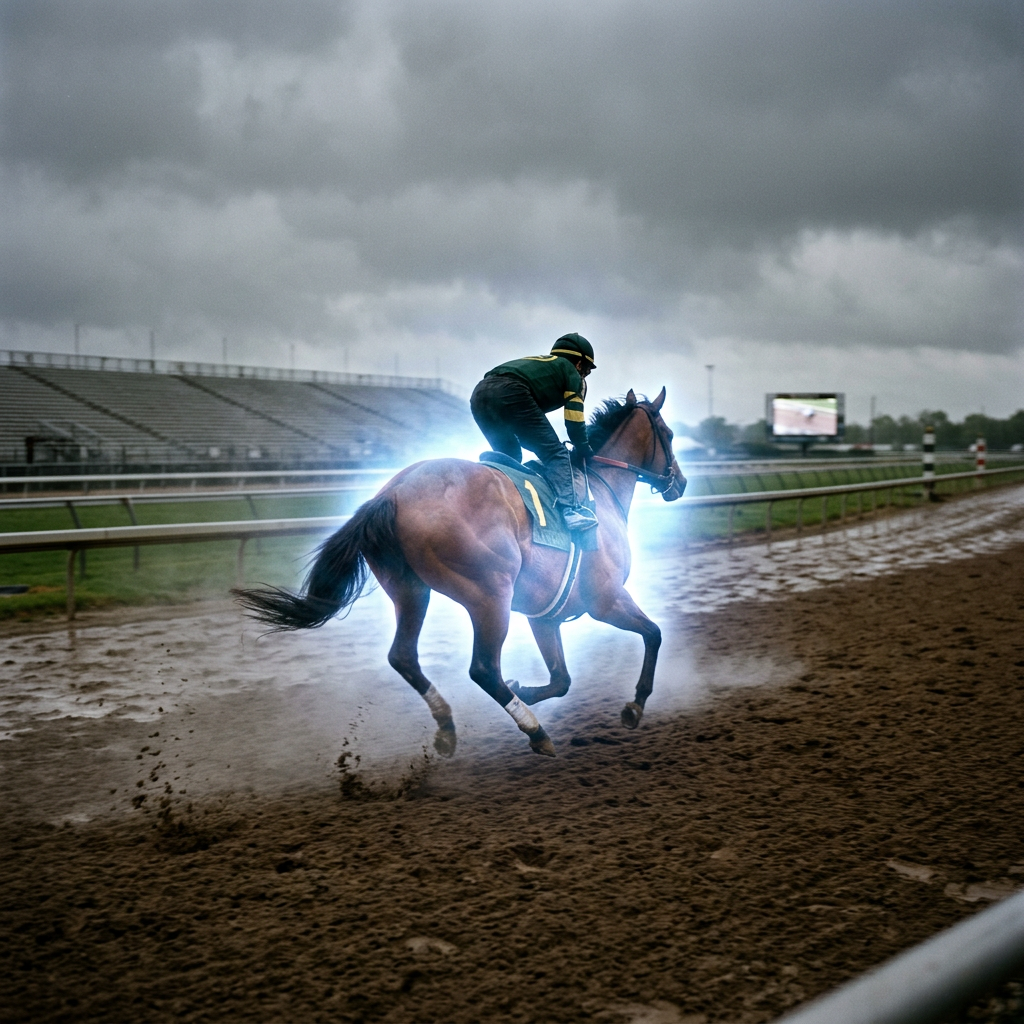
The horses came onto the track for the first race. Sheila noticed right away that one of them had a bright aura around it.
“I’m betting ten dollars on number three,” she told Twyla.
“Ah, you like the name?”
“What is its name? I like how it looks.”
“It’s Camel Ott. I’m going for number two, Simpleman”.
They went to bet.
Camel Ott came in first, Simpleman came in fourth.
For the next three races, Sheila bet on the horse with the aura and won. After her first win, Sheila bet more than the ten dollars per race – considerably more.
“First time luck, I guess,” Twyla said. “You have a knack. What are you betting next? I think I’ll do what you do.”
Before the fifth race, they went down to the paddock and met Herm. He let them in but told them to stay way back from the horses because the high-strung beasts were sensitive to strangers. They stayed in the center of the circular paddock parade path, away from the stable area. Again, Sheila noticed one of the horses had a special light around it.
“I’m choosing that one,” she said, pointing to the dappled grey horse.
“They say, bet a grey horse on a grey day,” Twyla said, looking at clouds gathering overhead. “Herm’s horse is the one next to it. I’m betting his horse, number six.”
After riders up and the paddock parade, the women placed their bets at the betting windows.
Sure enough, number seven won the race – the grey horse with the aura. Twyla’s horse came in second.
“You’re making a killing. How are you doing it?” Twyla asked.
“Don’t know. Lucky, I guess.”
Then came the sixth, and Papa’s Hunch was warming up on the track.
“There’s your horse,” Twyla said, pointing to the big bay sporting purple and yellow jockey colors.
Sheila didn’t see any aura around Papa, but she did see a glow around Sissy’s Crime.
Sissy’s Crime – a long shot wins easily
“I changed my mind. I’m betting on Sissy instead.”
“He’s a long shot, but whatever you do, I’ll follow.”
Sissy’s Crime won. Papa’s Hunch came in last.
“Let’s go,” Sheila said. By that time, she was ahead by $4,000.
“You’re doing so good, why don’t you stay for the last four races?”
“It’s just getting a bit much for me.” Sheila was beginning to be uncomfortable. At first the winning was a heady experience, but she feared being swallowed by expectation, following the signs, no longer in control.
“I never considered winning to be exhausting,” Twyla said.
“I know it sounds strange, but I’m getting a headache. I’m leaving.”
“Okay, see you Monday. Thanks for the wins.”
On Monday, Jon showed up at Sheila’s desk with a legal pad and hungry eyes asking for advice on stock picks. Clarence had told him about her lucky strike. Her supervisor called her into the office to ask about a biotech stock. James asked her to help him organize some unpublished Polish documents pertaining to WWII in the archives. Word had gotten out. A fellow named Ted, who said he worked in IT with Jon, wanted a tip on the next big race coming up. She was no longer the quiet research librarian whose name nobody could remember; she was now the most interesting person in the library. She was pushed beyond her comfort zone. It had stopped being a gift and felt more like a curse. Was this what it was like to win the lottery? All the expectations from other people?
That evening, Sheila went to Pirate’s Cove. Roman was behind the bar and managing the boisterous crowd. In the bustling swarm, he noticed Sheila and immediately went to her.
“What was in that drink you gave me last week?” Sheila asked
“Hmmm. Don’t know what you mean. When were you in here?” He asked, but she could see a knowing twinkle in his dark eyes.
“I came with my friends from the library. I know they are regulars. You called them by name. I’ve come a time or two, but never had a cocktail before. You offered me a special drink. I want to know what you gave me. Why me?”
Roman smiled, a deep dimple creasing the left cheek in his deeply tanned face. “Did you like it? Want another? A good bartender knows what his customers require.”
“No, I want the antidote. I want to go back to my old quiet life. I’m afraid of the next thing that might happen to me. I don’t want that much responsibility. Just give me my old life back, please. I’ve climbed to the top of the roller coaster, and the ride ahead looks terrifying – probably more than I can handle.”
Roman tipped his head in mild acquiescence and put two glasses on the bar in front of her. In one, he poured a blue-tinted concoction; in the other, he poured a clear beverage.
“Are you sure? It’s up to you now,” he said. “Choose carefully. It is your destiny.”
Two choices in Roman’s bar
The pictures in this story are generated by AI through WordPress.
That day had been the perfect spring Sunday for Ethan and Rhonda Hedgerton. Jonathan, their son, and Evie, his wife, had come for the afternoon with the twins. They made it a point to get together one Sunday every month to catch up on family events and activities. Jon and Evie lived about an hour away. On warmer days, they were at Ethan and Rhonda’s so the kids could swim in the pool. During cooler months, they met at Jonathan and Evie’s. Holidays were always at Evie’s and included her parents…she insisted.
The boys played in the pool as the adults watched from the patio with drinks. Ethan had Guinness, room temp, Evie had iced tea, Jonathan and Rhonda had G&Ts. Later, Ethan barbequed steaks for the grownups and hamburgers for the eight-year-old boys. Rhonda served a medley of oven-roasted veggies and, for dessert, special cream cheese-filled chocolate cupcakes that always made the boys squeal with delight. After the kids left, Ethan and Rhonda cleaned up the kitchen and patio. They settled in for the evening.
Ethan sat in his leather recliner with the footrest up and his stocking feet dangling over the end. He was reading the Times sports section. Other sections were scattered on the floor by his chair. Rhonda sat on the couch across from him, her bare feet tucked under her dress, and the cat curled up in the crook of her knees. She was reading the sixth novel in a series of Gilded Age Mysteries by her favorite mystery author, Rosemary Simpson. She found herself reading the same page over and over. Finally, she plunked down the book without putting her bookmark in it. Rhonda scratched Simone’s silky caramel head, eliciting a rumbling purr.
“Ethan…,” she paused to see if he was listening.
“Huh?” He answered from behind the paper.
“Why did you marry me?”
“I donknow.”
“Really, Ethan. Why did you ask me to marry you?”
“What’s going on?” Ethan lowered the paper a bit to look over the top at Rhonda.
“I want to know why you asked me to marry you.”
“It just slipped out.”
“You mean you had no thought? No intention? I could have said no, and things would have just gone on?”
“Ronnie, what do you want from me. It was forty years ago. I don’t remember what I was thinking.”
“You hadn’t agonized over popping the question?”
“I don’t remember. It seemed to be the right thing, the right time, I guess. What brought this on?” His paper was crumpled in his lap.
“Today, when the kids were here, Jon mentioned he and Evie were going to Hawaii for their tenth anniversary, taking the kids with. You said, ‘Hey boy, you just might get stuck for forty years like me’.”
“So?”
“Well, I saw a look pass between Evie and Jon. I felt like you had thrown cold water in my face. Stuck, you said, stuck.”
“Oh, get over it, Ronnie.” A peevish tone entered his voice.
“I can’t get OVER it. I want to know why you married me?”
“Look, I’m here, aren’t I. No visible chains. You’re making something out of nothing.”
“It’s not nothing if Jon and Evie noticed it. You must have had some thought about us being us.”
“I told you, I don’t remember.”
“That’s not good enough.”
With a sigh, Ethan responded, “I married you because of your soft brown eyes. I liked the idea of having sex with you, morning, noon, and night, without worrying about your roommate coming home.”
“That’s it…sex?”
“Pretty much.” Ethan paused. “Okay then, Miss Third Degree, why did you say yes? Why did you marry me?”
“Because I thought you loved me. I thought we had the same idea about family and our future.”
“I don’t recall ever talking about a future OR a family. I wasn’t really keen on the idea of kids back then.”
“So, we didn’t have the same goals?”
“Goals are something I do to advance my career, not live with my wife.”
“You go your way, I go mine. You work all week. You play golf every weekend and poker once a week. You go out with your college friends for dinner. We don’t do anything as a couple.” Ronda was getting visibly upset.
“I relax with my buddies, put work stuff out of my mind. I enjoy golf. It’s my excuse for exercise. I knew Skip and Tim before I met you. Skip is a bachelor, so there’s no couple to go with. The last time I invited Tim and Kim over for dinner, you told me you didn’t like her. After all these years, you said she was boring, opinionated, and talked too much. I don’t connect with your friends’ husbands. We don’t have anything in common. When I go out with Tim, Kim joins us sometimes, even Skip, and it is easy. Kim’s a kick and blends right in with the guys. For a couple of hours, we all have a good time.”
“You mean you go with them, and I’m not invited?”
“You’re invited, but I tell them you have mahjong that night or are babysitting the twins or something because you made it clear how much you disliked being around Kim. I think they get the picture. If you want to join us and listen to old college reminiscences, you can anytime.”
“We’re living here together for no reason. We’re like roommates.”
“Roommates with privileges,” Ethan quipped.
“Not so much anymore. You barely touch me. Our lovemaking is perfunctory. Like you just want sex but no commitment.”
“I barely touch you because after you started menopause, you said your skin hurt. You flinched every time I tried to hold you. You said you felt sweaty all the time. Over the years, I got used to keeping my distance. I felt like I was invading hostile territory. I don’t want to impose on you. I feel left out when I see you hug your girlfriends, even the guys in your book club, and our grandkids.”
Rhonda opened her mouth to respond, but shrugged her shoulders sadly.
“Hey, I haven’t noticed you being lonesome. You have your mahjong group, your tennis friends, your book club, and you go to dinner with your girlfriends for birthdays and such,” Ethan said.
“We used to go to concerts, plays, and movies, sometimes just us, but lots of times with friends. We used to go dancing and listen to live music around town. Now we just sit here and watch TV. You’re going to retire next year, and we’ll be stuck here looking at each other, wondering why. Why are we together? We have nothing in common except Jonathan and his family. Marj and Colin are planning a cruise the first year he retires, but you don’t like to travel. Bev and Spike are getting a divorce after thirty-six years together. What are we going to be doing?”
“There’s that word stuck again. I get seasick. I don’t like to travel because I like the food I eat here, the bed I sleep in here, and having everything I like, just where I like it…including you. I don’t want to worry about foreign money, foreign language, foreign food, and people I don’t know and don’t want to know.”
“Travel doesn’t have to be foreign. We could travel in the US. There’s a Denny’s or Applebee’s everywhere.”
“But you know how hard it is for me to sleep in a strange bed. My back aches if the mattress isn’t firm enough. I get cramps. My stomach gets upset easily with weird food.”
Rhonda shook her head and looked down at Simone, tears threatened to breach the edges of her eyes.
Ethan got up and walked over to Rhonda. Taking her hands in his, he pulled her to her feet, dumping Simone onto the floor. He put his arms around her carefully, then feeling no resistance, tightened his hug; his chin nestled on the top of her head.
“I’m winding up my last project at work. Next year, when I retire, we will plan things together again, maybe even a car trip. I’ve been so busy I didn’t realize we weren’t.”
He bent a little to whisper in her ear. “As far as stuck, I’ll borrow from Elvis, ‘I’m stuck on you’ and that’s a good thing. I married you because I thought you were sexy, and you laugh at my lame jokes. Your laugh, that starts deep inside you, fills the room and warms my heart.”
The prompt is to reimagine an old legend or fairy tale in modern times.
Goldilocks was a lively curious girl of twelve. She contributed to several blogs with a large following of her peers. One afternoon, taking her smartphone and her adventurous spirit, she went hiking in the nearby woods to boost her step count. Far into the woods, she discovered a charming eco-friendly cottage with solar panels, a rainwater-harvesting system, and a compost bin. The door was slightly ajar.
She called out, “Yoo-hoo? Anybody home?”
Having heard no reply, her curiosity overcame her good manners, and she walked in. It was a cozy place, and she quickly surmised that three beings lived there in harmony with the woodlands.
Inside, she found three bowls of oatmeal on the kitchen counter—one was big, with some foil over the top to hold the steamy temperature, and it was too hot. One was sitting in a bowl of ice and subsequently too cold – who eats cold oatmeal, she wondered? The third was just right with brown sugar and raisins on top. Being a bit peckish, she snapped a photo for her food blog before devouring the third.
Then she went into the living room and tried out three ergonomic chairs—one was too stiff and so high her feet didn’t touch the floor; one was too squishy with a fuzzy throw and a big dip in the seat, obviously made by an overweight being; but the third fit her perfectly. She noted the manufacturer of each chair so she could post a review on her lifestyle blog and moved on.
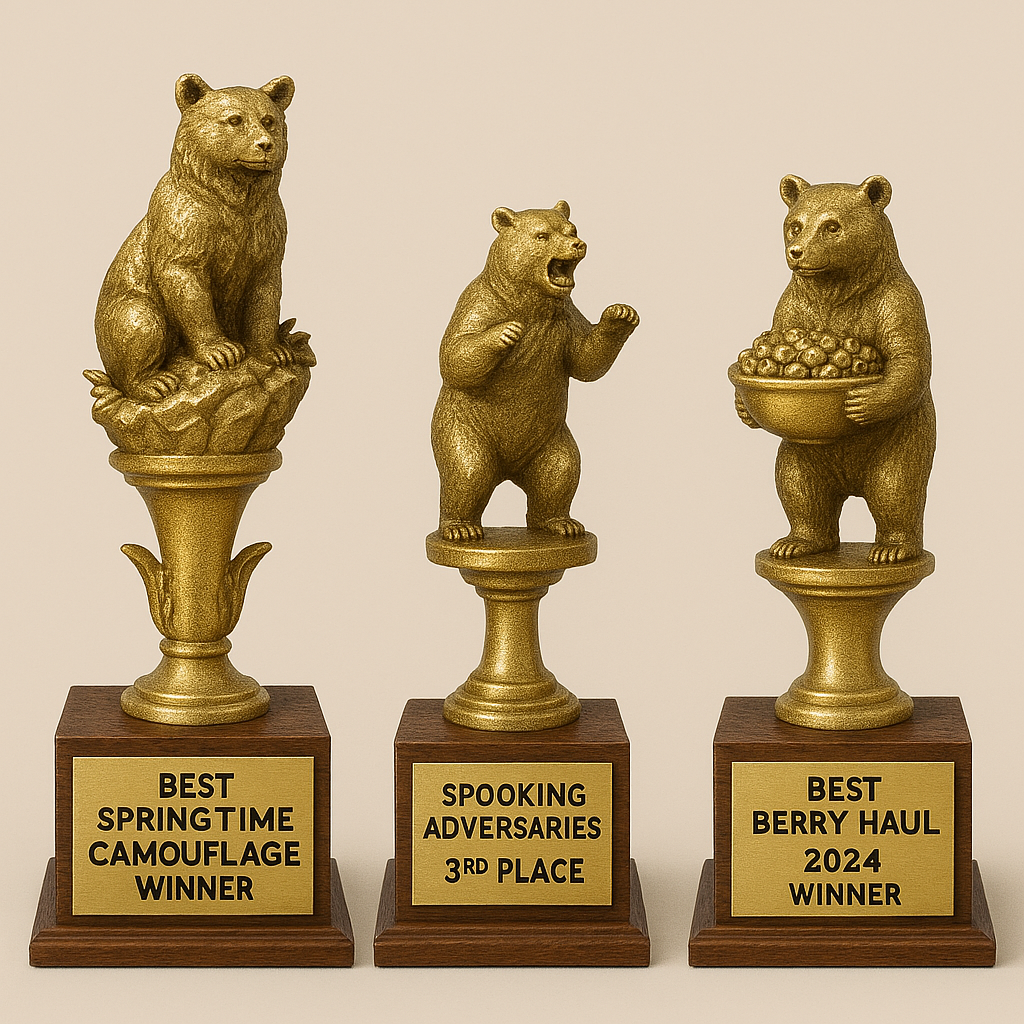
She noticed some trophies on the mantel in the living room. She took a photo of those too. None were familiar to her. One was for winner of Best Springtime Camouflage, one was third place for Spooking Adversaries, and another was winner for Best Berry Haul of the Year 2024. She wasn’t sure which blog site to post this photo to, positing she might start a new one.
Upstairs, she tested three smart beds—one was too firm, and the control was stuck on high, one too soft with the control stuck on low, and the third, with temperature control and lumbar support, was just right. She fell asleep in the third, dreaming of five-star ratings.
Soon, the Bear family, who owned the charming cottage, returned from their morning yoga in the park. Mr. Bear, Bruno, grumbled at the missing oatmeal, Mrs. Bear, Ursula, frowned when she saw the chair cushions that had been disturbed, and Baby Bear, Osito, found Goldilocks snoring in his bed.
“Look, Mama and Papa, I found a stranger in my bed,” he called out.
Startled awake, Goldilocks apologized profusely. The Bears, being progressive and mindful, forgave her—but asked her to respect boundaries, knock next time, and wait to be invited in. Before she left, she asked to take a selfie with the family to post on her relationship blog. They agreed and said she was welcome to come again.
Moral: Curiosity is wonderful, but respect and consent matter—even in fairy tales.
Prompt: Write a short poem, story, or essay in ten minutes using these five words: snooze, black, pocket, dollar-store, Egypt. This may be the beginning of a story when I get the nudge to continue it. I know next to nothing about pyramids, antiquities, or Egypt, so I’ll need to do a little research in order to continue the story.
As always, a prompt challenge tickles my brain in so many ways. This was quick fun. I admit I looked up the Egyptian script after writing the story in which I just wrote “his name was written in Egyptian script”.
SNOOZE AND SUP BED AND BREAKFAST
Simon stepped off the plane in Cairo with a huge grin on his face. This was going to be a great summer. He had snagged a summer internship studying Egyptian pyramids. He was as excited as a six-year-old in the dollar store with ten bucks. He went toward baggage claim to collect his luggage and scientific toolbox. Standing there with a sign that read حرينومتساويين, and under that “Cairo Institute of Antiquities” was a swarthy man who stood about 4’6”. Simon walked up and bent his 6’3” body and said, I believe you are looking for me, I’m Simon. The diminutive man responded with a big white toothy smile and shining black eyes, “Salaam Ustaaz, My name is Asim. I’m so glad you found me. I hope I spelled your name correctly.”
“That’s supposed to be my name?”
“Ustaaz, I didn’t know how to spell it, but I did my best. I will take you to your accommodations.”
Asim led Simon to an old jeep that was covered in a 10-year layer of Arabian desert dust thick enough to be armor.
“Where will I be staying for the summer?”
“Ah, Ustaaz, you have great accommodations at the Snooze and Sup Bed and Breakfast in the Dhjoser pyramid.”
“At the pyramid?”
“Yes Ustaaz, they have a lovely bed and breakfast at the third level.”
“You use the pyramids for hotels?”
“That and other things.”
“But the pyramids are sacred antiquities to be studied and protected.”
“You see, we have so many, and most are not very interesting, so our government decided to put them to use. It has helped our economy since the US bullied its way into the fossil fuel market. Only two kilometers away from your bed and breakfast is the Pick a Pocket Casino, also in a pyramid. It is rated very highly by Conde Nast.”
Sure enough. Asim pulled up in front of a small pyramid with a marquee reading Snooze and Sup, Bed and Breakfast. He helped Simon take his bags and equipment into the lobby. There in front of him was a dimly lit tunnel with ramps crisscrossing up to the third level and beyond.
Setting: The time, Spring 1931; Place – Fargo, North Dakota.
Vylette closed the door to Billy’s and Steven’s room quietly and turned to go downstairs. She had tucked the boys in bed after prayers and a short story. They were her older sister, Wilma’s, two sons aged nine and seven. There were two little girls in the family too. Olive, age three and baby, Eve, age one. Wilma had put them to bed earlier.
Vylette lived with Wilma, her sister’s husband, Harry, and their four children in Fargo, North Dakota about seventy-five miles from the family farm near Wolf Lake, Minnesota. At the farm she was the third youngest of ten children, many of whom were grown and left to start lives of their own. Her parents wanted her to go to high school in the city instead of the small country school. She was super smart, a straight A student, and showed promise as a distance runner. They believed she would have more advantages at the larger school.
Vylette was fourteen, a freshman in high school. She helped Wilma around the house and babysat the kids when she wasn’t at school or attending school events.
At dinner that night, Vylette asked Harry if she could have 50₵ to enter a cross-country race sponsored by the county. There was a prize of $5.00 for the winner, $3.00 for second place, and $1.00 for third. She loved running and would challenge the wind. She knew she could win.
Harry’s face went hard and sour at her request. He said they would talk later. She thought maybe she could talk him into it by offering to do extra work around the house and by splitting the winnings with him. He had not been very welcoming when she moved in with them last August, but she did her best to please him and make him see how helpful she was.
Vylette heard voices from the kitchen as she soundlessly descended the stairs. Harsh words from Harry were indistinct but definitely angry. She tiptoed to the doorway of the kitchen and stood out of view to listen.
“I want your bastard daughter out of the house by the end of school term. Three weeks. I’m not raising another man’s kid. She can go back to the farm or go live with one of your sisters.”
“But Harry,” Wilma pleaded. “She is a help to me. I haven’t been able to be a mother to her since she was a baby. We were married when she only four and I left the farm. Can’t she please stay with us through high school?”
“Fifty cents now for a race, school clothes, schoolbooks, and on and on. You need to take care of our kids. I’m not spending my hard-earned money on a bastard.”
Blood drained from Vylette’s face. Her knees were jelly. Tears streamed unbidden from her eyes. Bastard? She knew what that ugly word meant. Was she her sister’s illegitimate daughter? Her sister – her mother? Who was she? Why was this damning secret kept from her? She ran back upstairs to her small room, her breath coming in uneven gulps. She shut the door loudly; loudly enough, she hoped it would make her sister come upstairs. She couldn’t face Harry.
A few minutes later, Wilma opened the door. Vylette’s red, tear-stained face told the story.
“You heard,” Wilma said flatly. “I’m sorry this was the way you found out. I was going to tell you when you were older.”
Vylette wanted an embrace, to be held as she stood trembling in the middle of the room. Wilma offered no such comfort.
“You have to go back to the farm after this year at school. Harry is adamant.”
“I won’t go back to the farm.”
“You’re too young to be on your own. Would you go out west to live with Tyne in Montana?”
“Anything to get far away from here.”
Tyne was one of Wilma’s sisters. Vylette thought of her as a sister, too, but realized she was her aunt. Tyne owned a boardinghouse in Butte that housed men who worked at the copper mines.
“I’ll write her and ask if that would be okay. In the meantime, don’t cross Harry or he’ll send you back to the farm right away.”
“Don’t worry. I’ll eat by myself in my room and leave any room that he comes into. I hate him,” Vylette hissed. “I hate you too and what you did to me.”
“Vylette, you don’t know the whole story. I’ll tell you more when you have calmed down.”
“I don’t want to hear. Just leave me alone. Only three weeks and I’ll be out of here no matter what I have to do. Does Tyne know what you did? Do Mom and Dad know? Oh no, I guess they are my grandparents. Does the whole world know?”
“Of course, the family knows because I was your age, fourteen, when it happened. They accepted you and love you. You are part of the family, no different than any of us. Very few others knew and most of them moved out of town. It is a closely held secret.”
“But I am different. I’m a bastard. A nobody. I shouldn’t be born.” The words felt like rocks being vomited from her gut.
In June, Vylette went by train to Butte to live with her aunt, Tyne, until she graduated from high school. She worked in the boarding house and met the man she married while still in her teens, a copper miner who loved her and provided a good life for their family. The secret of her birth was never discussed again in or outside the family. It only became known to her children after they were adults, and Tyne divulged the part of the story that she knew to one of them. Unfortunately, the issue of mistrust was a big part of Vylette’s personality. She had a hard time being close to anyone, even her own children.
Ripples of pain across generations
Afterword:
In today’s world, children born out of wedlock are common and children do not carry the burden of public scorn. Two out of five United States’ births in 2022 were to unwed mothers. That was not the case in the early decades of the 20th century. At that time, pregnancies out of wedlock were scandalous and covered up. Now there are government programs designed to help the women who choose to birth children outside the sanctions of marriage. Although not ideal in the realm of childrearing, single parenting has been normalized. The mark of illegitimacy is not carved into a child’s personality in the way it was one hundred years ago.
This story is fiction but is based on rumors in our family. Vylette was born in 1917 in a small town in western Minnesota. She was part of a large farm family. What was not known to Vylette was that sister was actually her mother. Wilma had been “interfered with” when she was fourteen and become pregnant. Ashamed, she kept the secret of the man’s identity to her grave. The family surmised it was a neighboring farmer, a middle-aged man with a wife and children. That man was confronted by Wilma’s brothers, and he quickly left the area with his family. Vylette’s family became the owners of that neighbor’s property.
Vylette grew up believing her aunts and uncles were her sisters and brothers. It wasn’t until later she discovered in a vulgar way that she was illegitimate. Traumatized by the disclosure, Vylette’s life was forever colored by feelings of shame and degradation. Trust was destroyed. How could she trust anything if she couldn’t trust those closest to her? Those feelings permeated her personality and affected all her relationships for the remainder of her life. She kept a cold shield between herself and others, never having friends, and keeping her children at a distance. Childhood trauma leaves hidden but indelible marks on a person’s psyche and personality.
The problem with secrets is that facts buried in the story, like a body hidden in a shallow grave, can putrefy and work their way to the surface. There is space for corruption. All the people involved in this story have died. No one knew the whole truth except the two people involved. Was it rape or incest? Was the neighbor really involved; or was it a coincidence that they left town, and the family acquired the property at that time? Was that farm sold or was it payment for not reporting a crime to the authorities? Was it a boardinghouse or a brothel in Butte? Both were prevalent in the 1930s as a means for single women to earn a living. When no one speaks the truth, truth becomes conjecture and conjecture has no boundaries. The pain of a secret, like a rock thrown into a pond, sends ripples throughout many generations.