Swallowtail: “In the East, adults fly primarily in late spring and summer, but this butterfly is more common in late summer and fall in the South and Southwest. Where lack of freezing temperatures permit, the female adult may fly continuously. In lowland tropical Mexico, they may be found in any month.” – Encarta
Emerging abruptly from a deep sleep to respond to the insistent tone of his phone, Michael heard, “I miss you, Michael. I’m lonely for you. I’m lonely for Moses.” Her voice, a low purr, curled into his ear and sent blue electric currents crackling through his body.
“No, Janie, not again,” Michael struggled to keep the groan out of his voice. He got up in the dark from the rumpled king-sized bed and walked into the living room, his phone to his ear. He couldn’t bear to have her in his bedroom again, even on the phone. He turned on the lamp and slumped onto the couch. The cat followed him, stretching and yawning.
“What? Not again, what?” she asked.
“Do you have any idea what time it is?”
“I don’t know what your clock says, but I know it’s time for me to hear your voice, smell your sweet sweat, touch your warm skin, and roll up next to you in bed.”
“It’s 5 AM.”
“I want you here with me. I need to be close to you. Everything is good, but with you it would be great.”
“Funny, Moses and I had a long talk just last Sunday, and we decided to move on. We took every trace of you to the dump.” He reached across the coffee table and turned her smiling photograph onto its face.
“We can start over. I’m ready now. I found the right place.”
“Where are you?”
“I’m in San Diego this week, but the place is Santa Lucia. It’s a few kilometers south of Puerto Vallarta.
“You must be some kind of witch. You call just when I’ve reclaimed my life; when I finally decided I can live without you.”
“Oh baby, that’s….”
“No, Janie, I mean it. I’m not following you anywhere again. You left Memphis for Canyon, Texas, and I followed. When you suddenly up and left Texas, I followed you to McCall. When the tall pines of the Idaho woods smothered you, you took off again. I followed you here to Tucson, and this is where I’m staying. Trying to keep hold of you is like trying to catch mercury between your fingers. It’s impossible not to mention dangerous. I’m done.”
“Do you still have my paintings?”
Michael looked to both sides of the new tin mirror at the intensely colored acrylics. One was of a woman looking through an archway toward distant purple and rose-colored hills, stroking a green cat. The other showed a naked woman with long black hair astride a vivid scarlet horse galloping across a field of bright orange and blue poppies.
“No,” Michael said. “I replaced them with seascapes, the calm of crashing blue and gray waves.”
“My pictures might be worth something someday. I wouldn’t throw them out just yet. I’m in California for a one-woman show at the Smithson gallery in La Jolla. I have an agent. I’m selling prints to tourists in Mexico. I mean, really selling. I finally found the place I imagined and have been painting since I was twelve.”
“You found the place with purple mountains, red horses, and green cats?”
“Don’t be obtuse. Mexico is bursting with colors. And smells and laughter and…I’m home now. This is what I’ve searched for. Now all I need is you. You and Moses.”
Michael looked down at the big gray-striped tomcat that had been weaving in and out of his legs. Moses sensed he was the topic and flopped down on the top of Michael’s bare feet, his white mittened paws around his ankle, looking up at Michael.
“Moses isn’t interested in more travel. He told me he likes Tucson. I like Tucson. I’ve got a good job here.”
“You’re a poet, Michael. You are a poet who writes stupid technical manuals for a company that produces war machines for an oversized, out-of-control fascist government.”
“How do you know I still work at Raytheon?”
“Did you quit?”
“No.”
“There. Come to Santa Lucia with me. Poetry will fair drip from your pen. It’s magical. It’s cheap to live. And I’m making money now. Bring the trailer down. We’ll park it on the beach. We’ll eat mangos and shrimp. We’ll make love on the beach in the afternoon. We’ll play in the surf. We will…”
A momentary image of Jane, naked on a beach, nearly scuttled his resolve. He pulled back with a snap. “I don’t live in the trailer anymore. I sold it. I live in a real house.”
“You bought a house?”
“Well…lease-purchase.” He squinted out the window to the backyard, where dawn was beginning to streak the sky with pink and gray. “I have a yard, a saguaro, a lemon tree, and a brick wall.”
“Brick walls enclose tiny brick minds.”
Michael cringed a little. “If just once you had told me you wanted to move, we could have discussed it.”
“I didn’t need a discussion. I needed to leave. You would have planned and plotted. You are so anal. No sense of adventure. That’s what’s wrong with your poetry, too. You need Santa Lucia. It will break down all that shit in you and set you free. I was suffocating. By the time you made an analysis of our situation, I would have been dead. I didn’t know where I wanted to go…just away. It took me a while to find Santa Lucia.”
“Two years. Why did you call now?”
“It’s not two years.”
“Yes, Janie, it is. You left three Augusts ago, and it’s now September.”
“Clocks and calendars, calendars and clocks, tick tock, tick tock,” she chanted.
“Real world stuff,” he replied.
“Please, please come see me in San Diego, just for a day or two. I’ll be here this whole week and next weekend. It’s only a few hours’ drive, or I could pick you up at the airport.”
“Are you still living in the goddess-mobile?”
“Umm-hmm, mostly. But I have a studio on the second floor of a building in Santa Lucia. Its balcony overlooks the street, and I can see the ocean. Some days I paint outside, sometimes inside, depending on the light. I walk everywhere, so my rig stays parked by the beach. I’m sorry you sold the trailer. It worked so well in my daydream. We won’t both fit in the goddess-mobile long-term. We need more room than that. There’s a house not far up the beach from where I park that’s for sale. I’ll look into it.”
“Don’t bother. I’m not coming to Mexico.”
“I think you’re being too hasty. You should at least come for a visit. A teeny short visit. Then if you loathe it, you…”
“Hear me out. I’m not going to Mexico for a week, a day, or a minute. You can sell any dream to me if I give you enough time. Your time is up. I’m staying here. I’m happy, even proud, that you are selling your paintings. But you broke that last little piece of my heart when you left this time. I don’t have one to give you anymore.”
“There’s a marina too. We could buy another sailboat like we had on Payette Lake. Only we’d be warm all the time and could sail every day.”
“You’re not listening. I don’t care how beautiful it is. I don’t care how much you want to be with me. I don’t want to be with you anymore. I’ve broken the habit.”
“What happened to soulmates and undying love?” Jane asked. “You promised me you would forever be my family. Remember all those nights when I had the nightmares without end about when my parents died. You held me and told me you would never turn away.”
“You left me, remember? More than once.” Michael started to pace the kitchen, dining room, and living room with the phone to his ear.
“I didn’t leave you. I went looking for me, and unfortunately, I was always out of town,” Jane said. “But now I’m found. I promise I can stay put now.”
“Your promises aren’t worth much anymore. You promised that the desert would be your eternal home when you came to Tucson. Now you’re by the ocean for Christ’s sake,” Michael paused. “And I don’t speak Spanish.”
“You’ll pick it up. I did. It’s so musical, it’s easy.”
“The answer is still no,” Michael said. “I’m going to hang up now. Please don’t call me again. Have a nice life and congratulations on your success.”
Michael ended the call. He didn’t want it to ring again and, in his heart, prayed it would.
He couldn’t go back to sleep. It was Saturday, and he planned to play golf with Keith at 10:00. He fed Moses and let him out for his morning prowl. He shaved, got into the shower, and washed his hair. As hot water ran full force over his scalp down his back and legs, he let himself imagine lying beside Jane in the warm white sand with salty waves lapping over them, making love to her in the sunshine. He thought he heard the phone ring but when he turned off the water, he heard silence.
“Get yourself together, man,” he said aloud. She’s a figment of your imagination, a phantom. Just when you think she’s there, she’s gone again. It’s never going to work out.
Swallowtail Butterfly: “In the East, adults fly primarily in late spring and summer, but this butterfly is more common in late summer and fall in the South and Southwest. Where lack of freezing temperatures permit, the female adult may fly continuously. In lowland tropical Mexico, they may be found in any month.” – Encarta
Michael remembered when he met Janie at a diner on a Memphis spring morning ten years ago. She was 18 and he had just celebrated his 21st birthday the night before. His head felt a little thick, and his eyesight and hearing were not too dependable. She offered him coffee, but he didn’t hear her the first time.
“Hi, I’m Janie. I say, you look like you could use a whole pot instead of a cup,” she said, bending down a little into his line of sight, her scoop-necked tee-shirt allowed a peek of her breasts.
“What?” Oh, yeah. Give me some coffee, please.” There was a caring look in her gray-green eyes.
“I hope it was a good time you had, not a bad one,” she said over her shoulder as she went back to the kitchen.
He watched her sashay away, swinging her tightly jeaned bottom in a deliberate invitation. His head hurt, but not too much to read the proposition. It was 4 AM, and he hadn’t been to sleep all night. His friend, Tim, brought him to Jim Bob’s All-Night Diner for a birthday breakfast, then left him in a booth while he sought out the facilities to relieve a churning stomach. Tim, the sober one, the designated driver, had eaten something during their all-nighter that sent him into the bathroom every twenty minutes. The other partygoers had been dropped at their homes to sleep off the celebration. All five planned to meet again at the racetrack later that day.
“Here you go,” she said when she came back with a pot of coffee, two cups, and a bottle of aspirin.
“How do you want your eggs? With eyes or without?”
“No eggs, just toast.”
“You need protein to sop up some of that barley pop. How about scrambled and a side of country ham?”
“No, I really don’t want eggs. Thanks for the aspirin, though.” He took two pills and swallowed them with some coffee.
“Is your friend coming back?”
“He’s feeling a little rough, but he’ll be back.”
“Shall I bring him eggs, too?”
“Just the toast, toast only.” Michael looked around the restaurant. He was the only customer. He could see the cook through the pass-thru window at the kitchen. A few minutes later, she was back with a plate of scrambled eggs, hash browns, ham, and two plates of toast. She put them down in front of Michael and stood with her hands on her hips.
“Now, you eat as much as you can. The sooner you get something in your tummy, the faster you’ll feel human again.”
“What is your problem? I said I just wanted toast. Take the rest of this back. I’m not paying for what I didn’t order.” His head throbbed at the exertion of making this statement.
The girl slid into the booth across from him. “It’s okay. I paid for it. Just eat what you can, I’ll eat the rest. What’s your name? I’m Janie. I don’t think you heard me when I told you the first time.”
She sat and watched him eat, taking bites off the hash browns herself. The cook yelled at her once to get back to work, and she ignored him. He said he’d call the manager, and she said that was fine.
“You don’t want to lose your job, do you?” Michael asked.
“Not much of a job. I was just doing this until something better came along, and it has.” She looked directly into his eyes and smiled.
Tim came out of the restroom, looking pale green, glistening with sick sweat.
“I can’t drive, old buddy. I’m too fucked up. Can you get us both home?”
“Don’t worry. I’ll take you home,” Janie said, taking the car keys Tim held out to Michael. “Hey, Howie. I quit. See ya in the movies.” She undid the apron and laid it on the counter.
The cook came out sputtering oaths. “Damn it! You can’t just quit like that. The breakfast crowd will be starting in a few minutes.”
“Call Shirley. She likes the overtime. Bye.”
She dropped Tim off at his apartment, then took Michael home to sleep off the beer. She sent him out with his friends for the afternoon while she stayed at his apartment. He figured she’d be gone when he got home and was surprised to find a birthday cake, ice cream, and a tiny gray and white kitten when he returned at 9:00 that night.
“What’s with the cat?” asked Michael.
“He was hanging out in the parking lot at the grocery store when I walked over to get the cake mix and ice cream. He said his name was Moses and he was wandering in the wilderness. I decided to bring him home for your birthday. He might not want to stay, but he’ll let us know later.”
They made first time love for hours that night, discovering the pleasures of each other’s bodies.
“Are you homeless?” he asked the next morning.
“Not entirely. I could go back to my Uncle Bill’s, but I’d rather not. His job is done now that I’ve graduated from high school. He is the school drama teacher and a sweet old queen, who loves everything Elvis. But I’m tired of hanging out in fairy land. You will find I’m very useful around the house, I can cook, and I don’t eat much. I do think Moses is homeless, though, so why don’t we offer him a permanent gig?”
She and Moses stayed with him for the next year. She exaggerated the ‘I can cook’ part of her resume. She was good at boxed cakes and boiled hot dogs, but Michael decided to do most of the real cooking. Nevertheless, she didn’t eat much, and she was handy around the house. She could fix any appliance that got sideways, and she was fun between the sheets.
Janie had no end of interesting stories to tell of her adventures as an orphan in the custody of various relatives and near-relatives. She was born in Texas but lived all over the U.S. Her parents were murdered in a home invasion when she was six. She witnessed it from a hiding place in a closet through the louvers on the door. The effects of that trauma were still showing up in her life, even though she had been cared for by a loving family.
“They all tell family stories from a different point of view, and the heroes and villains change depending on the narrator. I’ve been shuffled around several states. I have a very complex view of my family.”
Janie got a job at a craft store while he continued working at the local newspaper and finished his degree in creative writing. She bought materials for painting and showed him on canvas the colorful world that was in her head. She said she had painted since she was a little girl, and it was as important to her as breathing. He read her his poetry and introduced her to his parents.
Then one day, he came home from work to find a note.
Gone Greyhound back to Texas, maybe, it read. I’ll call when I find out where I am. Moses will keep you company until then. Love, Janie
That was the first of her escapes.
“I wasn’t abused or a sex slave or anything exotic,” she once told him. “My relatives were good to me, but because of one circumstance or another, no one could give me a permanent home, so I was passed around. I lived with five families until I stayed with Uncle Bill, who got me through high school. I’ve been on my own for a while now. Aunt Betty in Louisiana was my favorite. She bought my first art supplies when I was ten and encouraged me to draw and paint. She gave me my passion.”
Michael thought Janie would eventually settle, and they might even get married, but like a nomadic butterfly, she would only light for a short time, then fly off again. They rarely fought, and she never left mad. She seemed to have little capacity for anger. He never knew why she left. She just left.
It was to Texas that he first followed her, a little town called Canyon. And it was in Texas that they acquired the goddess-mobile. It started life as a used 1982 Toyota truck with a camper shell. Inside the camper, Jane hung beaded curtains, made devotional alters for her Buddha, golden plastic Ganesh, serene Vishnu, and an eclectic collection of saints. She was ready for any possibility, if the hereafter came calling.
Michael installed a foldout bed, camper-sized refrigerator, and a sink with a 50-gallon water tank. He put in outlets for a microwave and hotplate. In the cab, Janie glued statues of saints, Joseph and Francis, a St. Christopher medal, a plush Garfield with rosary beads around his neck, assorted rocks, leaves, and seeds she collected in her travels, on a piece of green faux fur that covered the dash. She painted designs and quotes around the outside of the truck and camper:
“In Goddess We Trust”
“In the morning, I bathe my intellect in the stupendous and cosmogonal philosophy of the Bhagvat Geeta…Henry David Thoreau
“I’ve always wanted to be somebody, but now I see I should have been more specific.” — Lily Tomlin
“Mediocrity thrives on standardization.” “The only difference between a rut and a grave is the depth.” “A great many people think they are thinking when they are merely rearranging their prejudices.” — William James “Reality is just one of my many options.”
They used the goddess-mobile for camping trips and inspirational journeys to cleanse their minds from everyday humdrum. Michael drove the Camry his father bought him after college, and Janie had custody of the truck. It amused him when curious strangers approached Janie when she parked her unique vehicle near a grocery store or in a shopping mall. He knew she loved the attention.
Michael got a job again with a small local newspaper, and Janie taught crafts at an elderly care center. Moses kept his people supplied with affection and dead rodents.
“Mrs. Whipple, our ninety-year-old Scrabble champion, has a sharp tongue on her,” said Janie one day after she came home from the center. “She scolded me today in front of the entire ‘Natural Materials for Greeting Cards’ class for living in sin. She said a woman’s only security is a good marriage, and why wouldn’t my young man commit to me?”
“And what did you tell her?” asked Michael.
“I said commitment is for institutions, and I wouldn’t put anyone I love in an institution.”
It felt like a normal life to Michael, and after nearly three years, he had begun thinking in terms of marriage.
“Janie, why don’t we get married?”
“Is that a proposal or a real question?”
“Well.”
“Well.”
“Okay. Janie, will you marry me?”
“Nope. But I’ll love you to the end of my days on this planet and beyond.”
“I think we should get married.”
“I don’t.”
“What’s your reason?”
“No reason in particular, but ‘no’ wins the discussion – no marriage. I don’t see the point. People get married to please other people. We’re happy just the way we are. Aren’t we?” She gave him a meaningful stare.
“I think people get married because they want to tell the world they promise to share the rest of their lives and love together.”
“Let’s hire a sky-writer.”
“Don’t be flip. I’m serious. I think we should consider the idea. What about having children? We’ve never talked about it before. Do you want to have kids?”
“Maybe. I don’t hear your parents clambering for an official ceremony and grandchildren from your loins. I think they secretly hope that you will eventually find some nice girl and have a real family.”
“What makes you think they don’t like you?”
“Oh, I think they like me, okay. But I don’t think I’m a prime prospect for official daughter-in-law. I’m not like Judy or Helen, your brothers’ wives. I’m a little too out there for them.”
“They treat you with the same respect as they treat Brad and Mark’s wives. They love you. They always talk about how clever you are, and talented. They hung that huge picture you painted them for Christmas last year in the living room for all to see. I think showing off a picture of persimmon, teal, and gold coyotes prowling a shopping mall is telling the world they approve of the painter.”
“It matched the throw pillows on their white leather couch.”
The next day, he came home to find the note.
Need to see evergreen trees and mountains. I’ll call you when I find them. Love, Janie.
She took the goddess-mobile and left Moses.
This is part of a short story about Michael and his wandering love, Janie. The story continues in the next post.
In a recent Oro Valley Writers’ Forum meeting, we were given a prompt to write for five minutes from the point of view of an object. Prompts are always fun challenges for me, so I put pencil to paper and began. This is my short short story from the POV of an object.
I’m always the last to know what was for dinner. I get the detritus of the meal. I can only surmise how good it tasted or sometimes I am really happy I missed it all altogether. Those goopey gravy-laden things are not my favorites. Hard to choke down. On the other hand, I really don’t appreciate the crusty stuff that I have to scrub, or else I hear Madame complain that she will have to replace me. I do my best. I welcome the well-rinsed pot and plate.
Then there are the glasses – don’t get me started. Young master drinks milk, then lets the glass sit without rinsing, and a hard ring forms at the bottom. How am I supposed to get that out?? I don’t have fingers, you know – nothing that can reach in and rub the ring away. Again, I get grief for my performance because the glass doesn’t sparkle in the sunshine. Oh my, it is a hard life.
I overheard one of Madame’s friends talk about how she has neverused her appliance for washing dishes. Her husband has somewhat of a drinking problem, but she enjoys a tipple now and again. Her appliance holds all the liquor in her house, so her husband won’t find it. He would NEVER think of opening the dishwasher.
As it happened, the last thing I did before leaving the house that morning was to turn on our dishwasher. It was the first thing I thought of when given this prompt. Try it yourself. Write a short essay or poem from the point of view of an inanimate object and see what happens.
We live amidst a variety of birds that visit our yard daily. Some are seasonal visitors, and some stick it out through hot or cold, sweltering sun, monsoon rain, or winter snow. The doves are the latter. They are always here.
Our yard backs to a nature preserve that used to be a golf course. Substantial old mesquite trees line the edge of the preserve. Rising above the other trees and brush, they are lookout posts for birds. Doves wait patiently in the top branches for me to put birdseed on top of five block fence pillars each morning. Then they swoop down, and the seeds disappear within minutes. If the doves are slow, smaller birds will start their feast.
The gentle cooing of the Mourning Dove is soothing. We hear the more aggressive sounds of the White Wing Dove – still a coo but stronger with an emphasis on the beginning sound. The White Winged dove is slightly larger and more decorous than the mourning dove. White Winged Doves have light gray bodies with white stripes on their wings and, when they fly, rounded tails sport white feathered fans. The smaller mourning doves are drab gray-brown with black spots and have narrow black tails, but their wistful call is so much sweeter.
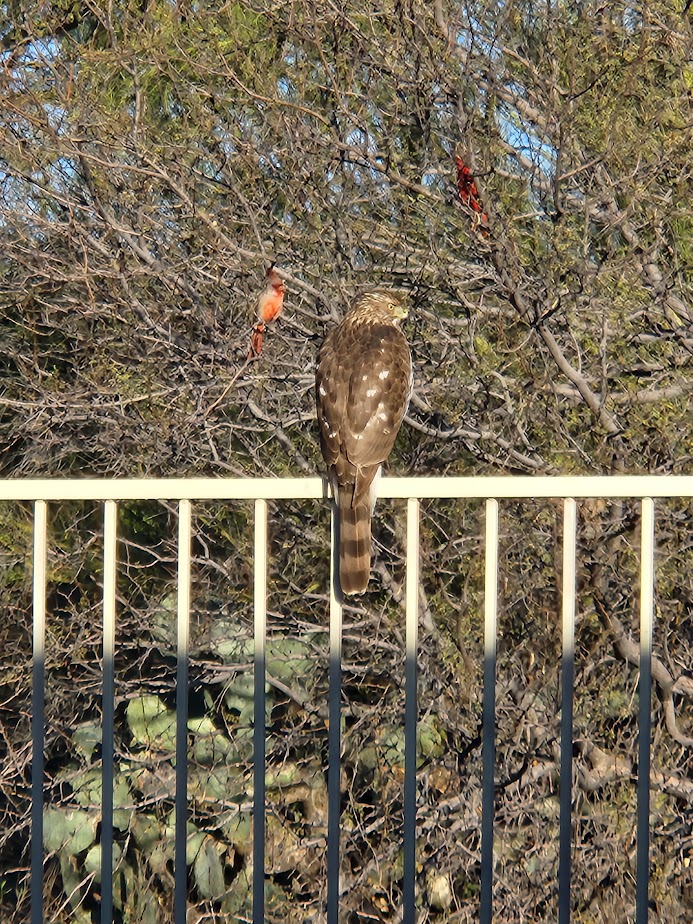
We enjoy the gleeful cheeps and tweets of other birds, most of which I have not identified. Harris Hawk sounds like the beginning of a baby cry that stops abruptly. She is the dark presence of a predator in our benign assemblage. She is beautiful, however, and oh so clever.
My favorite of all time is the Mockingbird. Their chatter is a symphony of sounds, sometimes a birdy twitter, sometimes a hammer, then a barking dog. When our mockingbird visits, we are entertained for as long as he wants to stay. I never leave the backyard as long as he is around. He used to visit often, but it has been over a year since we’ve seen or heard him in the backyard. I heard him this morning, as I walked through the Preserve, so I know he and his cohorts are still around.
We are blessed with little hummers too. I believe they are the variety called Anna’s Hummingbird. They are mostly green and gray, but some have a reddish head. The females are gray-brown with a bit of white on them. They are attracted to anything red. When Ken wears his red ball cap outside, they come to investigate his head. They hang around the lemon tree when it is in bloom. They rise and dive through the air in a birdy ballet.
Doves signify peace, hope, and spiritual purity in many cultures worldwide. To the Greeks, they were holy animals of Aphrodite. To the Jews, they represent God’s holy spirit after the flood. The Cheyenne people of North America had a saying, “If a man is as wise as a serpent, he can afford to be as harmless as a dove,” the equivalent of “speak softly but carry a big stick.” In Hinduism, the Inca Dove represents love and spiritual peace. Doves are used as a universal symbol of peace at international gatherings.
Those folks have not met Lefty.
Lefty is a white wing dove. He is at our back fence nearly every day. We sit on the patio with our morning coffee to watch the coming and going of our bird neighbors. We identified Lefty because he is arguably the major antithesis of a peaceful bird. When he flies in to join other birds, he shoos them off by lifting his left wing and pushing at them until they move or fly away. Mourning doves and small birds skitter when he lands. Even our cardinals who are more his size, leave after he knocks them with his wing a couple of times. The only bird I’ve seen stand up to Lefty is a Gambel Quail. They are roughly half again his size. He doesn’t back down readily but if push comes to shove, their shove is mightier.
The Cactus Wrens are chatty birds, and they are here year-round. They don’t fight, but they are active, flitting from pillar to pillar, staying out of Lefty’s way. They raise their bold voices to scold the other birds, but they don’t get physical. I love to watch them scale the side of the block fence. When other birds are landing on the top, the cactus wren will hop up the wall sideways.
When a local Harris Hawk comes to visit, Lefty along with ALL the birds disappears in a furious burst of winged agitation.
Every now and then, Harris sits on our fence waiting for her breakfast. She knows a dove will eventually come out of hiding. Doves, not known for their smarts, are very low on the food chain. They are the perfect size for a hawk’s meal. Harris has to work harder to get a quail, but I’ve witnessed one being devoured by her.
As I watched one day, Harris patiently observed the Preserve from our back fence. She was waiting for the right morsel to break her nighttime fast. She watched the trees, then cocked her head, looking to the ground. I think she was ready for anything feathered or furred to move. After fifteen minutes, several of the smallest birds came out of hiding, flashing their feathered finery and darting through the branches of trees right in front of her. Instinctively, they knew they were safe because they weren’t even a mouthful for the predator. They acted like a motley crew of comedians, skipping, fluttering and dipping through the tree limbs as if putting on a show. They sat directly in her line of sight as if to say, “ha-ha, catch me if you can.” Of course, it would have been easy for Harris to pick off one of those jeering birds, but the nourishment acquired would not compensate for the energy expended. Harris is no fool. Harris turned her head to look at me as I videoed the scene from my patio, off and on for over an hour, as if to say, “I’m the star of this flick, right?” Finally, a furry creature, I think was a mouse, possibly a pack rat, darted through the underbrush and swoop went Harris. When she flew away, I could see the small meaty creature in her talons, destined to be her morning repast.
We don’t have to leave home to find amusement. We have an endless display of nature to enchant us, especially the charming members of the bird kingdom.
I love to write to prompts. Quick stories, handwritten in a limited amount of time, jump-start the right side of my brain. The windows to my imagination are flung open and words fly freely onto the page. They are untethered to logic, only conforming to the guidelines of the prompt. Often, I am taken by surprise at the words that leave my pencil and show up on the page. Most of the time, they are zany musings, sometimes the beginning of a story to develop later, and sometimes a dark force compels a tragedy. Occasionally, nonsense dribbles out, and I find it hard to follow the labyrinth of thoughts. I am always in awe of the process and its revelations. The following story popped up when given ten minutes to write a scene from three different points of view.
The Scene: A female hitchhiker is dropped off at an emergency room with a problem. Tell the scene from the POV of the nurse, the patient, and a hospital administrator.
Nurse POV:
A young miss came into the ER early this morning with a problem. One I haven’t seen in my twenty-four years of nursing. She had been hitchhiking along Highway I-10 from Mobile on her way to Jacksonville, Florida. Her thumb was the size and color of a pickle, not dill, more like a large sweet. She didn’t appear to be in pain, and the rest of her hand looked quite normal and pink, but she complained that since the weather had turned cold, it had been impossible to put on her gloves. I took her vitals, then sent for Dr. Shambala, who was on call. He came in and examined the majestic, inflated digit with no discernible dismay.
His only question to her was, “Is it easy to get rides with that thing?”
To which she replied, “Actually, it comes in handy.”
“Well then, no surgery,” he said. “I think the answer is to buy larger stretchy gloves. I wouldn’t want to inhibit your travels or your gardening.”
I discreetly took a photo of her thumb. I wanted to show it to Hiram, our hospital admin. We had a meeting just last week about the anomalies of the human body and how to address those issues.
Patient POV:
My thumb had been bothering me for several days. Snow and sleet had become an everyday occurrence, even though I had consciously chosen a southern route for my winter journeys. My gloves just didn’t fit anymore. My thumb was getting larger and was really, really cold. I hitched a ride on a pig wagon to the nearest ER. It was a twenty-mile ride, but the farmer was swell. He asked me about my thumb, and I told him it was the reason I needed to see a doctor.
“Going to have it cut off?” he asked.
“Heavens no,” I replied, “just wonder if it could be made a little smaller for my gloves.”
In the emergency room, the doctor asked the obvious question. “How did it happen?”
It’s not the first time that question has come up. I get tired of the same old answer, “I was born this way”, so I told him I was picking crops in Mexico and got a cut, and the juice from the pickles I was picking dripped in, and lo and behold, I woke up with a pickle-sized green thumb.
The nurse at the ER looked a little disconcerted, but kept her cool, and the doctor suggested I get larger gloves for my travels.
“We wouldn’t want to impede your traveling abilities. It clearly is a significant benefit to your lifestyle.
As I was leaving, a sour-looking gentleman, round as a wine keg, came up and asked that I go with him to his office. I did, thinking he might have a suggestion for my thumb. I found out he was a pervert with a title and a fancy office. He wanted to suck my pickle. I left without “goodbye.”
Hospital Administrator POV:
Nurse Nancy came to my office this morning with a photo she took of one of our ER patients. That’s strictly forbidden, but when I saw the photo, I understood her motivation. The girl had a thumb the size of a juicy green pickle. I had given a mini-seminar to the staff about physical anomalies and injuries they could encounter in a rural hospital; everything from nails in the head or hand, to animal parts embedded in human parts – enough said. The thumb picture triggered something in me, and I had to go down to see it in person. The young lady was just leaving the ER. I asked her to come up to my office for a chat. She obliged, but when the door closed, a powerful urge overcame me. I just had to taste that thumb. I had been a thumb sucker up to the age of fifteen when the shame heaped upon me by my peers finally inhibited the craving, and I quit cold turkey. The girl was offended by my request to suck her thumb and left in a huff. I wished her well on her journey and hope she has a dilly of a life.
Just as I wrote in my blog post about Captain Hershey on January 29, 2024, words have consequences. I had three interactions with then Officer Hershey in a two-year period. The first contact was the most impactful. He was the epitome of what a policeman is. He understood in the deepest way what it means to serve and protect, and the power he had to serve with his words, not with physical interactions.
If Officer Hershey had given me a speeding ticket and sent me on my way that morning, I would have paid the ticket, cursed under my breath, forgotten him, and probably sped down the hill again. Instead, he told me with his words that I mattered, that my speeding had consequences beyond the law. In short, he said, “Do you love your husband? Call him and take him to lunch. It will cost what this ticket should cost. Tell him you are sorry for endangering yourself.” I was immediately taken from the momentary annoyance of getting a traffic ticket to the bigger picture. My speeding on a hazardous road had consequences for someone other than me. I was endangering myself and impacting my husband. His words made a huge difference. I never went down that hill again (safely, I might add) without thinking of Officer Hershey and his words.
As a young mother, I occasionally told my kids exaggerated stories to make a point. One day, when they were about five, seven, and nine, I was talking about being self-sufficient. I think I was trying to show them how to make their own lunches. I said in an offhand way that when they turned twelve, they would be out of the house and had to prepare for it. I said they would be on their own. Our oldest understood the hyperbole, our youngest didn’t really care and blew it off, but our sensitive middle child took it to heart. Days and years passed, and on our eldest daughter’s eleventh birthday, I found Shari in her room crying.
“What’s the matter? Aren’t you going to help me get ready for Karen’s birthday party?”
“I feel so bad,” she said.
“Why?”
“She only has one more year to live with us.”
“What?”
“She has to leave when she is twelve. That’s what you told us.”
Click click click went my brain. I very vaguely remembered saying something like that. I never thought any of them would take it seriously, and think we would really kick them out of the house. At first, I thought it was funny that she believed me, then I realized she had lived with the burden of my words for two years. What kind of monster would hurt their own child with that kind of threat? Shari was devastated, and so was I. It took a lot of hugs and reassurances from both my husband and me to let her know she would determine when she wanted to move out at some point in the future. She said she would NEVER leave us. A smile returned to her pretty face, and her heart was lighter. The birthday party was on, and everyone was happy.
It is critical for all of us to choose our words, whether written or spoken, with care. We can impact someone for good or ill. That’s not to say you can never be critical, but there are words that can help even when you have a negative message.
Writing IS rewriting and rewriting and rewriting…ad nauseum. When I have put a story on paper, I put it away for a day or two, even a year or two, then go back to reread it to see if it makes sense. I inevitably find a different word or phrase I think works better in a sentence, a description that can be sharpened. It is a never-ending process. I have spoken to real authors, writers of dozens of books, and they say the same thing. At some point you have to STOP writing. It is hard to say it is finished because you know there is something that could be illustrated better or you change your mind on the purpose of the story, even the plot. A new character pops up and works their way into the story. On and on it goes.
I recently read a book, Writing with the Master, by Anthony Vanderwarker, in which he described how he wrote his novel under the gentle and not-so-gentle guidance of his friend John Grisham. He worked for years writing his novel, Sleeping Dogs. During that time, John Grisham pointed out the weaknesses and gave him tips to make the story better. It took a full year for him just to get his outline right. Then he outlined each chapter and finally started the novel. The process was arduous, and he never gave up. After writing five or six novels over a period of time and shoving them into the back drawers of file folders, he finally had a novel that was worthy of publication.
Not since I was thirty have I thought of writing a novel. I just don’t have the patience for a long storyline. I love writing short stories and poems. They may be shorter, but it does take the same kind of effort to make a story coherent and interesting – just not the same amount of time. I have too many stories to tell to spend that much time on just one.
Characters develop from people I know or hear about. Sometimes a character in my head wants to have their story told. Often, from observation, I see or hear something that catches my attention and wants to become a story. Inspiration is all around. I live in an inspiration stew.
Finding time to write is always the challenge. I can go to my writing room, sit in a chair with pencil and paper, or at my computer, and be lost in a different world, consumed by a character, for hours on end. At least until my husband comes in to see if I’m still breathing. The cats, Sadie and Oliver, find me to remind me when it is dinnertime. Thank heaven I have them. Without my family, I can imagine I’d be a shrunken mummy sitting in a chair, poised with pencil in hand after leaving this earth without notice. Time totally disappears. Ahhh – I just thought of a story. A woman starts to write and disappears into her story, never to be found again. Well, I’ll work on it.
A continuation of the story of my trip to Europe in 1999 with my daughter, Shari. The first part was Adventure in Avignon, published in September 2024. We decided that carousels would be the focus of our adventure through the rest of Provence and the Côte d’Azur.
Carousels were conceived from tragedy. Jousting, initially a tournament sport in medieval times that tested skill and horsemanship among the nobility, began in the 11th century. It became a fixture at festivals throughout France and England. A jousting accident killed French King Henri II, Catherine de Medici’s husband, in 1559. She prohibited further jousts, compelling knights to create a safer alternative to these tournaments. They began riding a circular course, spearing suspended rings with their lances.
By the end of England’s Queen Elizabeth I’s reign in 1558, jousting was a thing of the past. Carousels powered by humans or animals took the place of that military exercise, becoming a family-friendly entertainment that spread throughout Europe and eventually the world. Many carousels are very elaborate and considered to be an art form. They were later mechanized and powered by steam, then by electricity.
Avignon Carousel
Avignon
Avignon was once the seat of the Catholic papacy. The Palais des Papes was the residence of seven Catholic popes in the 1300s. It is a very short walk from the Palais des Papes to St. Pierre’s square outside the Basilica St. Pierre. And there is the lovely Avignon carousel.
After leaving Avignon in our tiny rental KA, we drove zigzag across the south of France, stopping to explore Nimes, Aix, Arles, Palavas-les-Flots, Carcassonne, and Perpignon headed to my niece’s house outside Barcelona, Spain. We took delight in searching for the carousels in each town. Not every town had a carousel.
Aix
Aix-en-Provence Carousel
One of the things I love about traveling in Europe is I feel I can step back in time. Roads, buildings, and bridges have withstood the ages, and even in the 21st Century, I sense the ancient history around me. Aix is no exception. It was founded by the Romans in the century before Christ and has been inhabited for all this time. Paul Cézanne was born in Aix, and many of his dreamy landscape paintings depict his hometown and the surrounding area.
Nimes
Carousel – Nimes
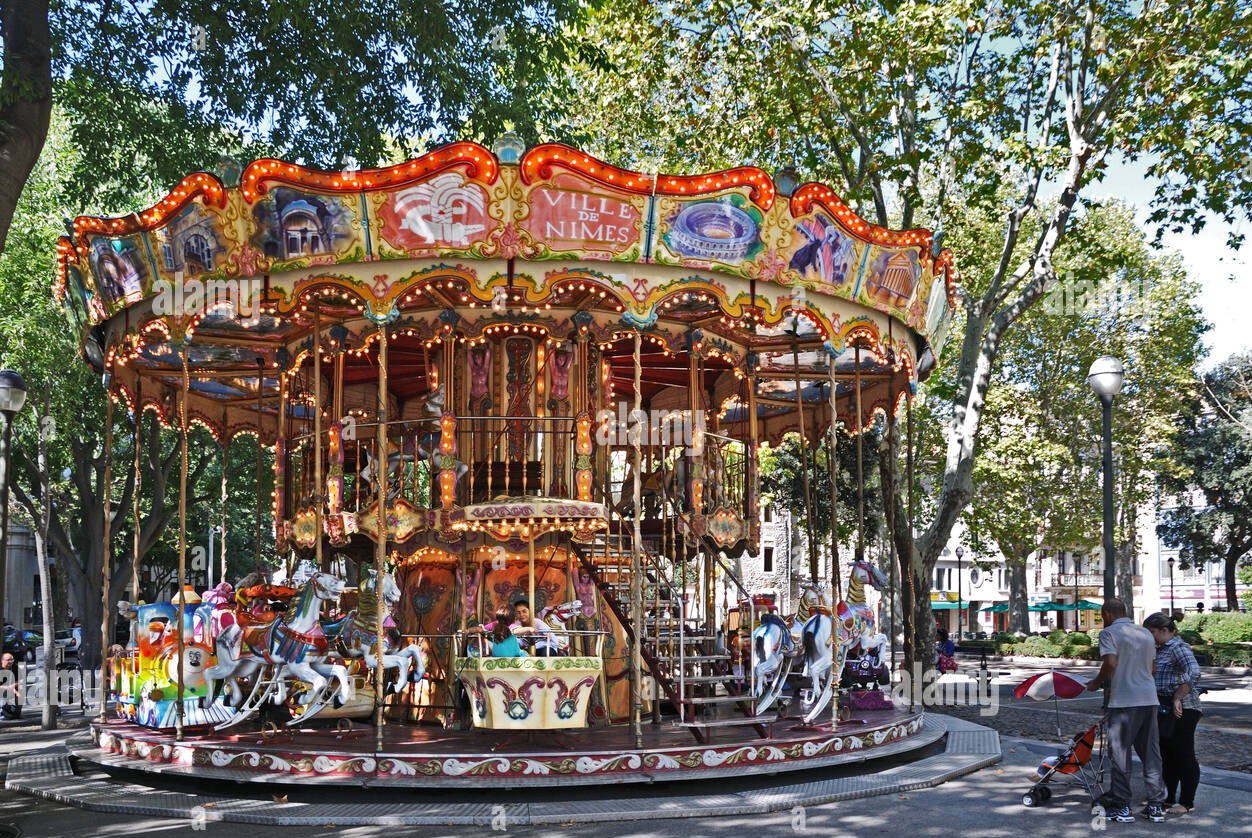
The Romans left significant evidence of their culture throughout France. Nimes is considered the Rome of France. There are the remains of a Roman aqueduct, an amphitheater still used today, and a Roman temple that date back before the birth of Christ. There is the cathedral of Notre Dame and Saint Castor that we briefly visited before our search for the carousel located near the center of town in the Esplanade de Charles de Gaul. The cathedral didn’t compare to so many of the magnificent churches in France, but the carousel did not disappoint.
Arles
Carousel Arles France
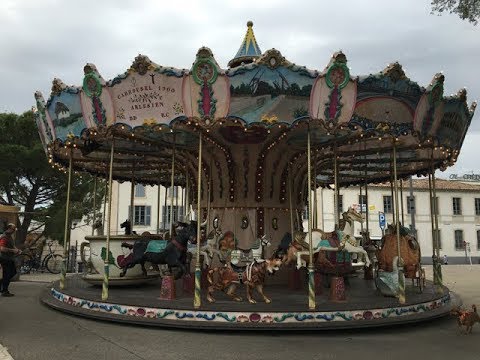
As Aix is associated with Paul Cézanne, so Arles is linked with Vincent van Gogh. Among the Van Gogh paintings representative of Arles are “Starry Starry Night” and “The Old Mill”. The city was an important Phoenician trading port hundreds of years before the Romans took over. There are many reminders of Roman culture, including a Roman amphitheater. They still conduct bullfights in the amphitheater, but the bull is not killed. Instead, a team of men tries to remove tassels from the bull’s horn without being injured. Arles once boasted a floating bridge, a pontoon type supported by boats that were secured in place by anchors and tethered to towers on the two riverbanks. It has been replaced in modern times. A short walk from the Amphitheater is the carousel called Le Manege d’Autrefois, which means Old Fashioned Merry-Go-Round.
Palavas-les-Flots
Grand Large Hotel – Palavas
We drove into Palavas, a very small fishing village with a few hotels along the beach. Sand dunes separate two lakes along a canal with the Gulf of Lion and the Mediterranean right there. (The movie The Triplets of Belleville, a feature-length animated movie with lovely music, has a song about Palavas in it.) It was dusk approaching dark, and I didn’t want to drive in the dark. Things looked very quiet. We stopped at Le Grand Large Hotel to get a room for one night. We went into the big lobby, again remarking at how quiet it was. A man came to the front desk. In my very best Frenglish, I asked for one room with two beds for one night.
“Non, madame,” he replied with a sad face. His name was Gabriel. “Nous sommes fermé pour la saison, nous sommes désolés.” (No, madame, we are closed for the season, we’re very sorry.)
I continued in my butchered mongrelled language to inquire if other hotels were open. He, so politely and sadly, responded that they were all closed until Spring.
Palavas beach
This little fishing village only had a few hotels to accommodate French vacationers during the summer. They received very few non-European tourists. August is the biggest month for European vacations, and we missed it by two weeks. The hotel had a skeleton staff, no rooms available, and no services. I told him that Shari and I were traveling through the south of France to see the beautiful countryside and that our destination was Barcelona to visit family. I explained how we had been in Avignon and had my purse stolen, but still rented a car, and wanted to see the carousels in southern France, and wanted to stay one night on the Cote d’Azur. He laughed at the way I told my story with one French word, then one English word, then a lot of gestures. I asked how far it would be to find a hotel open.
“Vous devrez retourner à Montpellier, une plus grande ville, pour trouver des hotels à cette période de l’année.” (You will have to drive back to Montpellier, a larger city, to find a hotel at this time of the year.)
It was now dark outside. I sighed. OK. I told Shari to get back in the car, and we’d drive to Montpellier, about a thirty-minute drive.
“Un moment,” he said and left the desk to go into a small office at the side of the lobby.
He came back. “Je peux vous proposer une chambre pour ce soir. Un lit. Mais il n’y a pas de services ici.” (I will offer you one room, one bed for tonight. But there are no services.) They offered no food services. We had no access to the spa or swimming pools, and we only had one towel each.
Super duper great, said I. No translation needed.
Shari and I got our small bags from the car. I parked where Gabriel indicated. We wondered if all the restaurants were closed too. Shari asked if there was a restaurant open nearby.
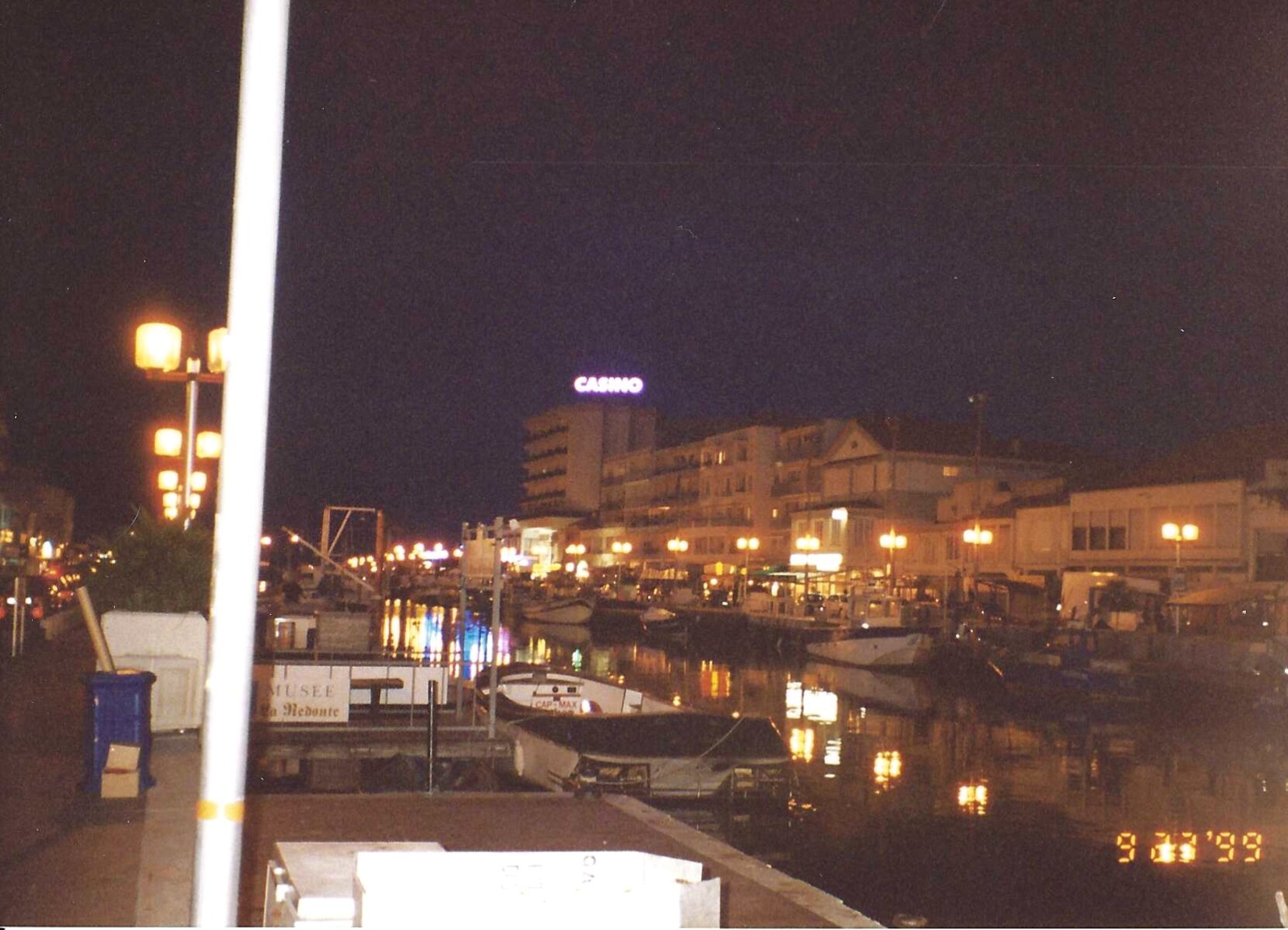
Palavas Quay at night
“Oui. Un excellent restaurant de fruits de mer au quai.” Gabriel pointed out the front door toward the beach. (Yes, an excellent seafood restaurant on the pier.) He said restaurants didn’t close for the season, just scaled back hours.
We trotted off across the beach to a long jetty along a canal. There were several restaurants open. La Marine Du Pêcheure was the one Gabriel suggested so we had a nice dinner there outside by the water. Shari is not a fan of seafood, but she found something she would eat on the menu. We were both ravenous and very relieved to have a place to stay. The next morning, we left to continue our journey after many declarations of gratitude to Gabriel. Un Grand Merci!!! There was no carousel in Palavas.
Carcassonne
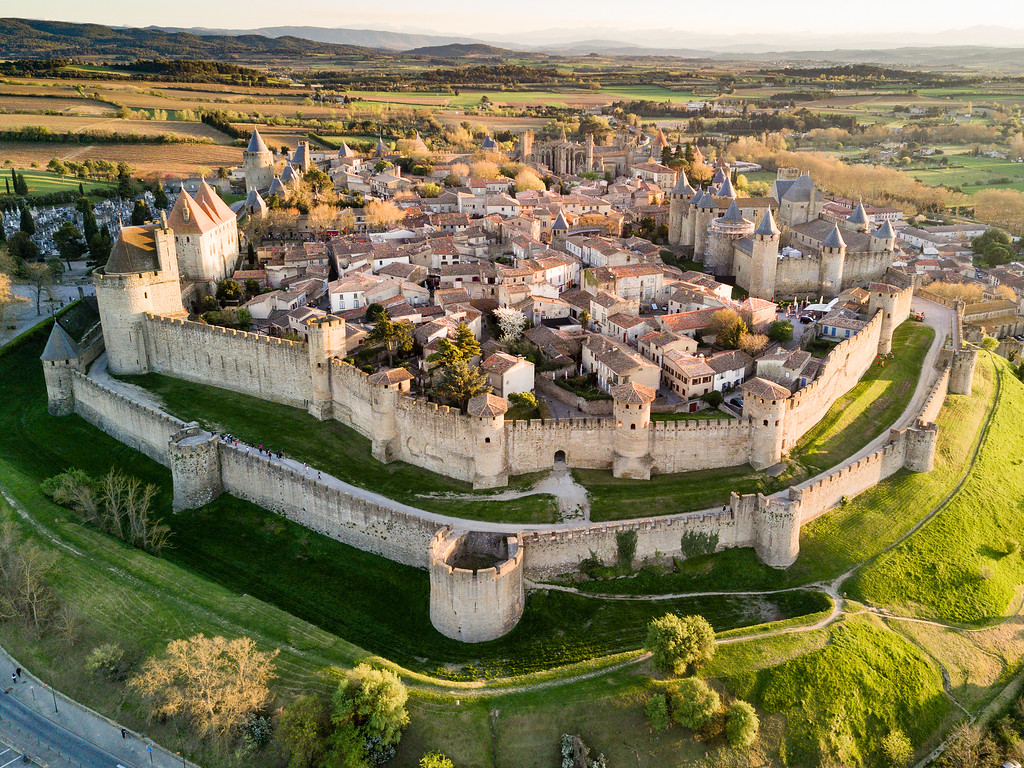
Walled City of Carcassonne, France
The ancient town of Carcassonne has a fascinating legend. Carcassonne was founded in the 3rd century by the Gauls and turned into a fortified town by the Romans. The legend takes place in the 8th century, during the wars between Christians and Muslims in the southwest of Europe. At the time, Carcassonne was under Saracen rule, and Charlemagne’s army was at the gates to reconquer the city for the French. A Saracen princess named Carcas ruled the city after the death of her husband. The siege lasted for five years with French forces surrounding the town. Charlemagne’s tactic was to starve the population into submission. Early in the sixth year, food and water were running out. Lady Carcas made an inventory of all remaining reserves. Then she demanded that the villagers bring her the last pig and the last sack of wheat. She force fed the wheat to the pig and then threw it from the highest tower of the city walls. Upon landing, it split open, and the invading soldiers could see it was stuffed with food. Charlemagne lifted the siege, believing that the city had enough food to the point of wasting pigs fed with wheat. Overjoyed by the success of her plan, Lady Carcas decided to sound all the bells in the city. One of Charlemagne’s men then exclaimed: “Carcas sonne!” (which means “Carcas rings”). Hence the name of the city.
Carcassonne Carousel
I wish we had had more time to meander through the south of France, but we were on a timeline to get to Barcelona. It was like drinking through a firehose, gorging on everything we saw with thirsty eyes. We gulped as much of the countryside and towns as we could, hoping to return someday and spend more time.
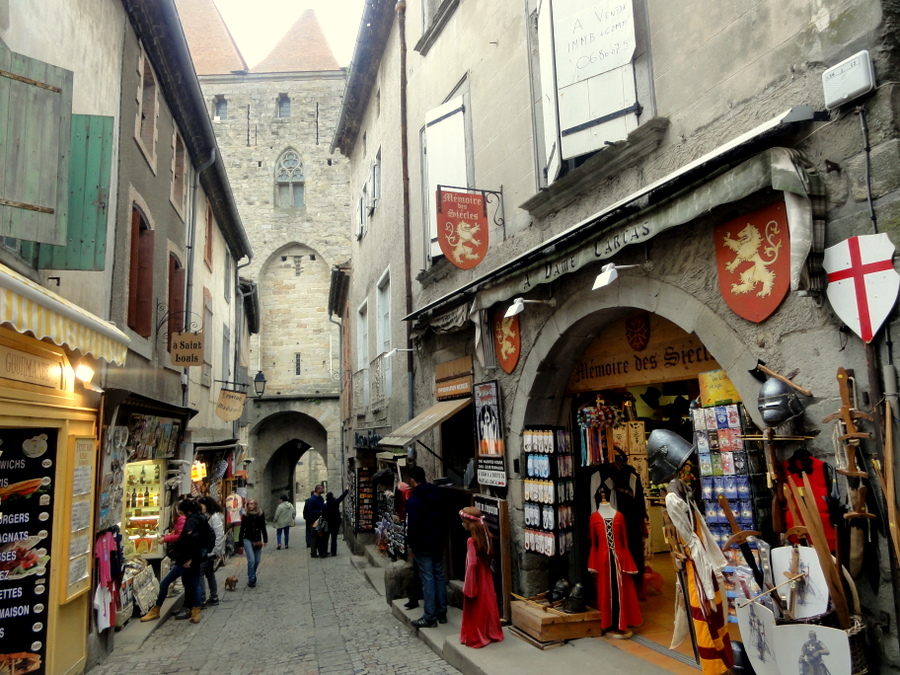
Carcassonne markets
We walked through the tiny winding streets, looking into shops. We had a quick bite at a bistro as we browsed the markets. We bought a beautiful blue and yellow bowl, the colors of Provence, to take back as a gift to Karen, my oldest daughter. We found the carousel. Then got back into the car and headed for Spain, a three-hour drive.
Pérignon
We stopped briefly in Pérignon for ice cream, but we missed all the historical attractions and didn’t find a carousel. We were in a hurry to meet my niece in Barcelona. We cruised on to the border of Spain.
Our book club read The Gift of Rain by Tan Twan Eng earlier this year. In our discussion, the subject of the three Eastern religions arose, specifically Buddhism, Taoism, and Confucianism. All three philosophies are represented in the story. In Buddhism, a primary tenet is reincarnation. In the story, the sensei, Endo-San, tells his pupil that they were connected in past lives and will be in future lives.
There were differing views on the idea of reincarnation in our book group. I volunteered my experience with our daughter, Shari, as an example of how spirits may be connected over and over across time.
In 1971, when Shari was three, she was watching out of our living room window as her friend, our six-year-old neighbor, Glenny, learned to ride his new Christmas bike on the street in front of our house.
She turned to me and said, “I used to have a bike just like that.”
“No, sweetie. You’ve never had a bike. We’ll get you one when you are a little bit older.”
“I did have a bike when I was a boy,” she said emphatically.
That took me back. What?
“But you’re a girl,” I countered. “You aren’t a boy.”
“Mommy”, she said with an exasperated tone. “No, when I WAS a boy. Then I fell out of a tree and died.”
Now, the concepts of being dead or a different gender were not subjects that ever came up in any of our discussions or games. I was a stay-at-home mom with three children, so I spent hours and hours with my kids. Nothing remotely close had ever been touched on in our play or conversations.
I asked her to tell me more, but she just shrugged and turned to watch Glenny again. It was the end of the conversation.
Later in the spring, she and I were in her room cleaning out her toy box to give away some old, used toys.
She stopped with a reflective look on her face. “Mommy, do you remember when we were Indians?”
I searched my memory for a time when we played Indian and couldn’t come up with anything.
“No, honey, I don’t. When did we play that?”
“We didn’t play it. I was the grandmother, and you were the baby, and I rocked you in my arms outside by the fire.”
Prickles ran up my arms. Again, she was telling me about an experience that she believed happened. She had changed our roles. She was the ancient one, and I, a baby. We were connected, but in different roles.
“When did that happen?” I asked. “Were we playing a game? Did you have a dream?”
“No.”
And that was the end of the memory. She had nothing more to add. She changed the subject to talk about the toys we were sorting. She lost the thought and didn’t want to explain more. It didn’t sound like a dream.
Shari was a very chatty child. She had a lot to say about everything and had an advanced vocabulary for her age. The concepts of death, gender, and role reversal in the extreme were not topics we ever talked about, except for those two instances. She seemed to wander into a reverie, then snap back to the present quickly and didn’t reconnect to the memory at all. When she was eleven or twelve, I asked her about those memories or if they were dreams, and she had no recollection of anything connected to it.
Those two experiences made me question the idea of reincarnation, and I did some research. Psychologists and researchers have documented children who spontaneously reveal memories from past lives. It happens from the age of two when speech is beginning, until about six, when children go to school and are infused with the day-to-day reality of this life. Many recorded cases have been detailed in books, magazine articles, and research papers. They can be ascribed to a rich fantasy imagination. My experience didn’t feel like imagination – it felt like Shari was telling me of real, very specific memories.
A few years ago, we were the caretakers of our grandson, Henry, from the age of one until he started school, while his mom worked weekdays. When he was three, he and a friend were playing in his room, building Lego forts, then bombing them with little rubber balls. He told his playmate that he had been in WWII and died.
From the time he was two, he had an uncommon attraction to guns. When he learned to draw, he drew gun-like figures. When I was teaching him the geography of the U.S., he picked out Florida as his favorite state because it looked like a gun. He bit his cheese sandwich into the shape of a gun. We never had guns or been around them, and certainly never talked about them. I asked my daughter if she had talked about war or guns with him, and she said no, but that he did talk about it when he was home too.
We took Henry to story hour at the library every week, and afterward, we would look for books to check out. He only wanted to pick out books in the history section about WWII or any war. We checked out big volumes. At home, he sat and looked at the pictures and asked me to read parts of the books related to those pictures.
Henry earned TV time by doing small tasks around the house. Usually, he watched old TV shows like Mayberry RFD or a science kid show. One day he watched a documentary about Churchill and war strategy on the History channel. He never took his eyes off of it for the entire hour. He asked me to find war documentaries when he had TV time, not cartoons or kid shows. He wanted to talk about wars, WWI, WWII, and the Civil War. They fascinated him. All that disappeared when he got to school, and it hasn’t been part of his life since.
I certainly learned a lot about wars while I was attempting to satisfy his curiosity. It is a mystery to me how a very young child can connect to experiences they didn’t have in their three or four years on the planet but are able to make them seem real. Could they have been here before? Is it totally imagination? It is a mystery.
PS: I recommend The Gift of Rain. It is about Malaysia during WWII, an area of the world I knew little about. It is the coming-of-age story of a young man, half-English, half-Chinese, with a Japanese teacher. All three cultures collide in his story during the turbulence of war. The concepts in the story are interesting, even if the main character is a bit flat. Questions of loyalty and betrayal are examined.
If you are interested in a recent report regarding children with past life memories, this is a link to a study reported by the University of Virginia, School of Medicine.
My title may have oversold the train trip Ken and I had to San Antonio. Although all those elements were part of the trip, they were not the focus. I just liked the sound of the title.
If I had a bucket list, it would include more train travel. I received a surprise from my husband for Mother’s Day – a train trip! We took our excursion the first week of June. Of course, when he mentioned a train trip my imagination immediately flew to the movie, North by Northwest, with Cary Grant and Eva Marie Saint. I could see us having a white tablecloth dinner in the dining car and retiring to our intimate compartment for a romantic evening. Well, not so much. The dining room did indeed have white tables (uncovered) with blue cloth napkins and courteous service. The food was above average. But the intimate compartments cost three times as much as the reclinable coach seats, and we are not in that class. The seats are very cushy and comfortable, and Ken was able to stretch out his 6’1” frame easily, but we did not have the privacy of a separate room. Oh well, we’re not driven by our hormones so much anymore after sixty-one years together.
Our destination was San Antonio, a nineteen-hour trip starting at 8:00 am MST and ending in San Antonio at 5:00am CDT. Not my idea of convenient departure and arrival times. We lost two hours en route due to time zone changes. Our train originated in L.A., and we joined the train in Tucson with eight more stops before it reached San Antonio.
I made sure we were in an IM-level train car. IM stands for Impaired Mobility, assuring we were close to a restroom. Ken’s Parkinson’s makes it hard for him to walk distances and navigate stairs.
We were indeed located in the IM car, which is the restroom car. There are only twelve seats, along with seven restroom cubicles in that car. Most of the seating is up a three-tiered flight of stairs above us. Everyone in the upper-level seating had to descend the stairs to our car for bathroom necessities. Our seating area was separated by a door, so we were not bothered by the coming and going of others using the restrooms. All seemed to be as planned.
Seats, arranged two by two, were staggered so that we were not directly across the aisle from another pair of seats, providing a bit more privacy to each pair. The woman who sat across the aisle and slightly in front of us was coughing. She and her companion had been on the train before our stop in Tucson and looked settled in with their carry-ons around their feet. The coughing continued after the train resumed its eastward journey. In fact, the coughing did not let up through nineteen hours of the trip. She would have a break of five or ten minutes every hour or so, but it was incessant for the whole trip. At first, I was annoyed, then mad, then I realized she had no control. She coughed into her shawl, and when it was soaked, she changed to tissues that piled high in a bag at her feet. Her companion coughed now and then also. After a couple of hours, I realized the woman must have asthma, or COPD, or something of that sort. She had no control over her heaving body. She couldn’t sleep because it didn’t let up and, if she dozed, she woke whimpering. Her companion got up a few times to bring water, snacks, and coffee to the afflicted woman.
Others in the car were obviously very ill in one way or another and immobilized. One woman was in a fetal position under blankets and barely moved the entire trip. Her husband got up and walked around a few times for only five minutes, but she didn’t wake to go to the bathroom or drink water or anything. If she hadn’t moved occasionally, I would have thought she was a cadaver. Ken was not at all like any of them. We escaped our ‘car of agony’ to go upstairs to the lounge area to get away from the coughing. We could see out the big windows as we crossed the Texas plains. Later, we went up the stairs to the dining car and had a great dinner. That was when we realized that we didn’t need the IM car because even though Ken had to go up some stairs, it was not an impossible task. The train was packed, and changing seats at that point was not an option. We endured our torment, knowing it was nothing compared to what the coughing woman was experiencing. We could move about and leave the car at will.
We were seated at dinner with a sweet lady, Leesie, 75 years old, she told us. She had just come from LA, staying for six months with her son, who has MS. She lamented the care he was getting and wished she could have stayed longer. A very sad mama. She was on her way back to her home in North Carolina. A retired registered nurse, she spent twenty years as the night nurse in New York’s Sing Sing prison. She was the lone nurse every night. Lots of stories there. Dinner was too short to get her entire history, but she was a very interesting dinner companion.
Our dinner included three courses, an appetizer, a main course, and dessert. I had a salad, NY steak with potato and green beans, and chocolate cake. Ken had shrimp scampi, a pasta dish, and chocolate cake. We each had a complimentary glass of red wine. The steak was the best I’d had in a long time, very tender and flavorful. Our waitress and waiter were very attentive.
Night fell, lights were extinguished except for guide lights along the floor of the car, so passengers could sleep. I am generally lulled to sleep by rolling wheels. I fall asleep within 30 minutes at the start of a journey, when Ken and I go on road trips. There is something about the motion that puts my brain on snooze. This night, however, sleep was impossible for us with our coughing neighbor. The coughing was so steady, it became background noise after a while, and we were able to get a few winks here and there.
Then, in the pitch dark, around 1:00am, the train slowed and came to a full stop. The intercom communications between the conductor and passengers had been silenced at 10:00pm, so passengers could sleep. We received no information as to why we stopped. We sat on the rails in total darkness and silence for over an hour. Of course, my overactive imagination worked at creating scenarios of Comanches galloping over the hills to attack the train, robbers in masks boarding the train to rob and kill us, and all sorts of dramatic reasons why we were dead stopped in the middle of the night. I wasn’t really scared. I was intrigued. Ken and I whispered our concerns. The coughing didn’t let up. Then the train slowly began to gather momentum again, and the steady clackity clack was reinstated.
An hour or so later, the train came to an abrupt, shuddering stop. Again, all the lights went out, the air conditioning stopped, and the engine was quashed. No sound, no explanation, just darkness and silence, except for the unrelenting cough. Hmmm. I peered out the window but could only make out a rock wall close to our side of the train. After thirty minutes, the train resumed its trek.
Dawn began to lighten the sky. Shapes appeared on the prairie, mostly cows and a few scrub trees. The lights came on, and the conductor resumed communication. He told us the train had encountered a flash flood that sidelined us the first time. Then, it hit a cow on the tracks that had to be cleared before we could continue. No Comanches or train robbers after all, just flood water and one hapless cow. The poor cow must have been caught on the tracks in a narrow place where rock walls closely bordered the rails and had no way out.
We were two hours late getting to San Antonio. When I made our hotel reservations, I was told they had a shuttle service to the train station, which was only about four or five blocks away, across a freeway. It was 7:00am. I called the hotel. No, they answered, they did not have shuttle service, nor had they ever had shuttle service. I was misinformed. What? I was tired, sleepy, and discombobulated. Now what? They gave me the number of a cab company. I called. $25, they said, for the five-minute ride to the hotel. Not happening, I told them.
I remembered our daughter told me to download the Uber App for the trip. I had done as directed, but still had no idea what to do with it. I was not in the frame of mind to develop a new skill. Ken was dead on his feet, standing in the parking lot of the train station, exhausted from lack of sleep. I noticed a car pulling in to pick up a passenger from the train. I went to him and asked if he was Uber. Yes. I asked how I could get him to take us to the hotel. He said he could be back in 30 minutes if I used the Uber App. Not what I wanted to hear. Deep frustration was beginning to well up. The woman who was his passenger asked, “Haven’t you used Uber before?” I answered in the negative. She said, “Let me see your phone a minute.” I gave it to her, and she quickly connected me to Uber and showed me how to order a ride. I did, and a lovely man named Jacob was there in five minutes, charging $7 for our ride to the hotel. Now I’m an Uberite with 5 stars!
You’ve heard of sea legs after a long boat ride; well, we had train legs for hours after we departed Amtrak. It is a strange sensation that you are in motion when you are standing still. It affected our walking, creating a rolling motion for a little while.
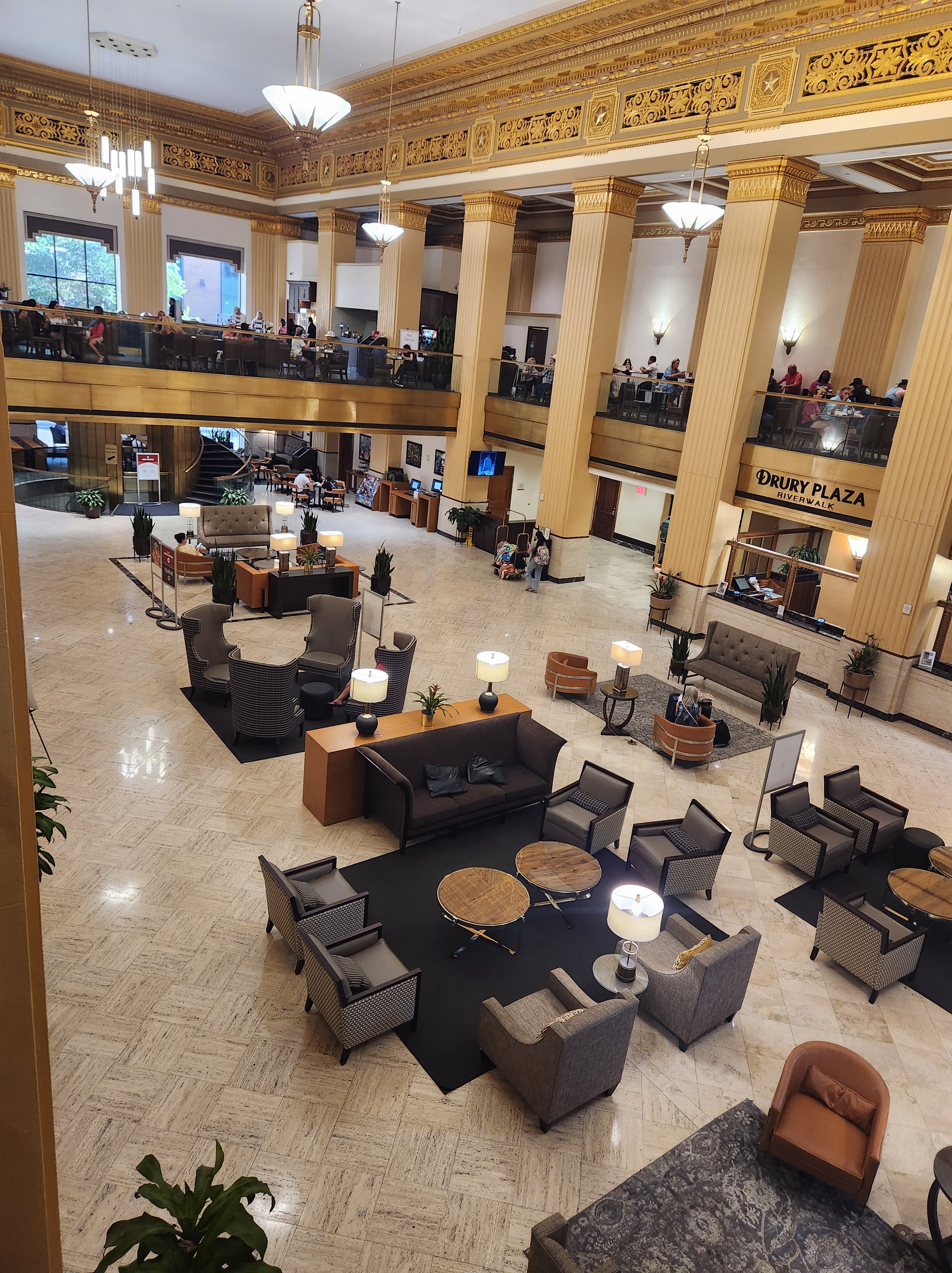
Drury lobby with dining mezzanine above
Despite the lie told by someone representing the hotel, we had a wonderful stay. The Drury Plaza on the Riverwalk is an excellent place in the heart of San Antonio to spend a few days. I explained to the manager my disappointment and frustration about the shuttle confusion, saying it put a blot on the hotel’s name to have people lying about their services. The names I was given over the phone were not people who worked at the hotel, so it must have been a third-party reservation, even though they answered the phone,“Drury Plaza at the Riverwalk”. Grrrr. Traveler Beware! There are so many things to watch out for when traveling.
The hotel served free breakfast from 7 to 9, so we dropped our bags in the room and went to breakfast. Both of us were as hungry as sleepy. The buffet-style breakfast was served on the huge mezzanine above the hotel lobby. Everything ‘Breakfast’ you could think of. We had our fill, then hit the bed as soon as we got to our room. Sleep. That was all we could think of. We both disappeared soundly into slumber for three hours.
Ken stayed in the room to rest, and I went out to explore the Riverwalk and see what I could see. We had been to San Antonio once before at Christmastime in 1984. We watched Santa being escorted by boat down the river, waving at everyone and throwing candy to the kids. The area has grown and changed since then. The Riverwalk, with its trees and flowering gardens, was extended. I walked a 1-1/2 mile loop, glancing into shops and restaurants along the way. I talked with some of the sidewalk marketeers and a couple of the boatmen who shuttle people around the Riverwalk to get insights on the area. The total Walk is fifteen miles, and 4-1/2 miles are in the downtown area of San Antonio. The Alamo was within walking distance, but I’d been there before, and it was hot, so I skipped it. Hot is different in San Antonio – it’s humid hot and wraps around you like a blanket, making it hard to move. You feel lethargic. I’ll take Tucson’s 100° dry heat any day.
The hotel itself is a fun place to explore on an air-conditioned ramble. It was originally the Alamo National Bank that opened in 1929. The décor throughout reflects that era. In 2007, it was reimagined as a 24-story hotel with two towers, balconies overlooking the city and Riverwalk, a large workout room, outdoor and indoor swimming pools, and all the amenities of modern hotels. The lobby is magnificent and harkens back to the building’s original purpose as a bank. The building is on the National Register of Historic Places, and many of its original fixtures are still in place. The original chandeliers hang from the fifty-foot lobby ceiling. The stained-glass window, bronze framework, marble walls, and travertine floors are also original.
Ken in the lobby of Drury Plaza, a 1930 Ford on the right and the original entrance on the left
Our stay included free breakfast and free happy hour with three free adult beverages each day. Happy hour offered a full meal of options served buffet style like the breakfast, Mexican, and Italian entrees, plus pulled pork sandwiches, hot dogs, soups, and salads.
Our day was spent recovering from the sleepless night before. At 5:00, we went to the Mezzanine for Happy Hour and met a nice couple, Paul and Kim, from New Hampshire. We sat with them, chatting about a variety of subjects as we had our cocktails. We found common ground on every subject. They left to have dinner at a restaurant, and we contented ourselves with the wide assortment of dinner items at the buffet.
The next day, we arranged to meet the Jensens, our relatives, at lunchtime. They moved to San Antonio in January and live within thirty minutes of downtown. Charlene, our niece, and Al, her husband, met in college at Texas Lutheran University near San Antonio in 1986. Al is a Lutheran pastor. His calling led them to live all over the western states, raising their kids mainly in Oregon and Arizona. They had been at a church in Montana for a few years and were happy to get back to the warmth of Texas, where their love story began. Mary, Al’s mother, was with them. They treated us to a nice lunch at Rita’s on the Riverwalk. Afterward, we showed them around the hotel, stopping for a while at a large balcony on the eighth floor overlooking the Riverwalk and downtown. When they left, we went back to our room.
Remains of Texas Heroes of the Alamo
Ken needed to rest. I wanted to see the historic San Fernando Cathedral near our hotel. It is the oldest functioning Catholic Cathedral in the U.S., founded in 1736. I walked a couple of blocks to the Cathedral, where the ashes of the Texas Alamo heroes, Bowie, Crockett, and Travis, are interred in a chapel at the front of the church. I walked inside to get a look at the sanctuary and found that I was at a wedding, Karolina and Bryce’s wedding, to be exact. A chamber orchestra began playing a beautiful piece of sacred music as the wedding procession came into the cathedral. I sat in a seat at the side of the sanctuary and listened to the music and the introduction of the bride, groom, and family members. Before the mass began, I quietly slipped out the side door.
I decided to walk across the street to the historic Spanish Governor’s Palace to take a peek through it. It is now the Bexar County courthouse and houses a history museum. I walked in the front doors. I looked back and there was a wedding party assembling on the steps of the courthouse. I watched as a few pictures were taken, then the wedding party came into the building. I was informed that the courthouse was officially closed on Saturday, and only the wedding party was allowed in. I left without seeing any of the museum. I don’t understand why a history museum would be closed on Saturdays, but it was.
I think that is a record, crashing TWO weddings in less than an hour.
I returned to the hotel. We went down to Happy Hour. We had our cocktails and just before we went to get our meal, Kim and Paul showed up. They had been on the opposite side of the mezzanine and saw us across the lobby and wanted to say hello again. They were leaving the next day for a hike and knew we were leaving for home. It was nice to reconnect. Traveling is a great way of making new friends.
Our train back to Tucson left San Antonio at 2:45 am. Again, not a great schedule, forcing us to try to sleep by 7 that evening. We got up at 12:30, gathered our stuff, and went to meet our Uber. I made arrangements, in advance this time, so Lorenzo was there to meet us for the five-minute drive back to Amtrak.
Another five-star ride! I’m a veteran now.
I asked to have our seats moved to the upper level. We didn’t need or want the IM anymore. The train was not as full this time, so they accommodated our change. We hiked up the stairs to nice seats above the rail line. The difference came when the train started. We noticed there is a lot more movement on the upper level. The train sways around turns in the rail, feeling a little top-heavy. It was like riding atop an elephant in one of those big chairs that rock back and forth with each step. The train was dark and quiet. Because of the early hour and my proclivity of falling asleep with motion, I conked out. But I woke up when breakfast was announced.
We had another nice meal in the dining car. This time we were seated with Craig, who was traveling back home to L.A. after working in New Orleans. That is a 45-hour trip, and I thought 19 hours was a long trip. Oh my. He was not as chatty as Leesie, so we didn’t learn much of his story.
George, on the other hand, the snack bar attendant was a wealth of information. I went down to the snack bar to get a Coke, and he and I had a chin wag for nearly twenty minutes. He has been with the railroad for thirty-two years and plans to retire next May. He had lots of stories to share of his thirty-two years. He loves his job but said his wife has the beginnings of Alzheimer’s and he needs to be home more to take care of her. His current schedule is sixteen days on the train and sixteen days home. Other than the route from LA to New Orleans and back, he hasn’t ridden a train. When he retires, he’ll have a lifetime pass and said he would like to ride the East Coast route.
Reclining man boxcar sculpture
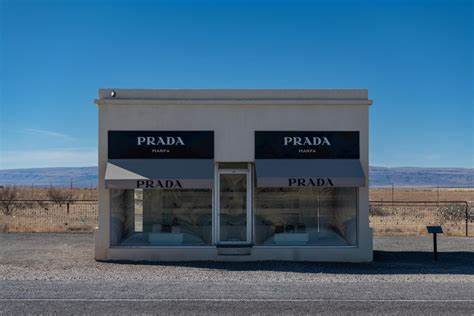
It was so pleasant to be in the upper-level car. We could see across the landscape rather than at the ground level. Our trip back to Tucson was uneventful – cough-free, flood-free, and cow-free, a real blessing. We saw a box-car sculpture set on the open plains and a Prada store in the middle of nowhere next to the tracks with no town in sight. A blimp was tied down in an empty area of the sweeping prairie. We assume it was a weather blimp, but there was nothing around it.
Prada store near Marfa, Texas
Train travel in the US is so much different than in Europe. More expensive for one thing. The sheer expanse of the US makes most trips longer than any in Europe. East coast travel would be more like European travel because up and down the East coast population centers are closer together.
Our daughter, Karen, was there to meet us when we pulled into Tucson station only fifteen minutes behind schedule at 7:15. She escorted us home, safe and sound and we fell into our comfy bed by 9:00. I felt the motion of the train when I woke up in the night, but went quickly back to sleep when I realized I was in my own bed. Now that I’m a seasoned train traveler, I look forward to another ride to a different destination.










 wonkagranny