Unknown's avatar

About Diana

I'm a writer

Living and Learning

Every day brings new opportunities to learn. Sometimes they come as bangs on the head, not literally but emotionally. Sometimes they are more gentle, as an answer to a question you didn’t know you had. These past few weeks have brought so many of both kinds that it has been difficult to keep up.

My husband went into the hospital for brain surgery in May. He has Parkinson’s disorder, a complicated and hard-to-diagnose movement and cognitive disorder that, once contracted, is a life-long companion. There are many approaches to living with Parkinson’s. Each person must research and decide what works for them in the daily battle to make life as normal as possible. It is an individual decision, and it is important that family members and others close can buy into the tactics.

Parkinson’s affects more than just its target human. It affects those around them. The natural reaction of a Parkinson’s sufferer is to withdraw. Withdraw from family and friends and the world at large. Not because it is embarrassing to tremble and shake and move like a sloth but because those outward physical symptoms make others uncomfortable. The uncontrollable shaking of limbs can, at first, look funny. Just stop it. The unnatural movement of the head can cause derision because in the world of normal movement, the head and mouth are controlled, and shaking only happens when someone is acting silly. Speech becomes faster, softer, and nearly unintelligible at times. It is as though the tongue swells, the vocal cords become slack, and the brain cannot moderate the pace of words. Communication is difficult. I, as a “second-degree” Parkinson’s sufferer, had a hard time accepting that my husband’s involuntary muscle contractions were going to be a part of everyday life. Ken is a lifelong athlete. From childhood into his 70’s, he participated in sports. Moving and controlling his body has been a hallmark of his existence. He was an elite athlete in school and signed a pro baseball contract with a bonus right after high school. After he was injured and could no longer play pro ball, he continued in amateur athletics, playing baseball, softball, basketball, tennis, golf, etc. He was always on the move, a big strong guy.

My husband lost the use of his right hand a few years ago. He is predominantly right-handed in everything. He couldn’t feed himself using his right hand. He couldn’t do the simplest of tasks, even blow his nose with a tissue, using his right hand. He learned to be more adept with his left hand and eventually that was affected. How is it that a simple task you never think about becomes impossible? Not just difficult, but impossible. His right hand might as well have been cut off. It was useless. More than that it was annoying, moving uncontrolled. The disorder enlarged its landscape to encompass his head, his jaw, his left arm, both legs and feet. By midafternoon every day he was exhausted by the constant uncontrollable movement of his body.

I was amazed at the grace with which he accepted his disorder. He did not display anger or ask “why me?” He worked hard every day to find ways to use his body with its limitations. He continued to do as much as it allowed him to do even though it took much much longer. He assembled two occasional tables I ordered from Amazon that came in pieces. It was a simple thing he would have done in fifteen or twenty minutes but took hours. He had to stop every few minutes to allow his hands to calm down. The concentration on movement exerted to place a screw and turn the screwdriver caused stress that would send him into a tsunami of unintended movement. He was resolute not to let Parkinson’s win. He did it and we have two very nice tables in our family room. An Olympic accomplishment with Parkinson’s. Brave, determined, and persistent are his pronouns.

We have always walked. Well, in younger days we jogged. Just a few years ago we’d go seven miles in a circuit of our neighborhoods. Usually, we walked three miles at least three or four times a week. Ken’s walk became slower and more tortuous. It was hard for him to move his feet. He said they stuck to the ground. His walk became a shuffle and his back became stooped. He still walked our street, about a mile, each day but it became slower and slower. He had to stop several times and his balance was iffy. Of course, falling is a horrible secondary problem that can happen. If he fell, he couldn’t get himself up and I certainly couldn’t lift or move him.

After exhaustive research over a couple of years, Ken decided to have DBS surgery, Deep Brain Stimulation. Two electrodes were placed in either side of his brain connected to a lead that goes into a device implanted subcutaneously in his upper chest. It is sort of like a pacemaker for the heart, but it controls the brain. He had the two-part operation last month. After some weeks of healing, his stimulator was activated a few days ago. It is a success! His tremors have been substantially reduced. His movement is freer. His walking is improved. He is fully able to do daily tasks to take care of himself. He is even back to cleaning out the cat boxes. He is not all that he expects to be and there will be more appointments over the next few months with the neurologist to tweak the settings as his body adapts to the implants. It is another step along the Parkinson’s journey. It is not a cure. There is NO cure for the disorder, but it will allow him to have an extended period of time, several years, with minimal or no outward symptoms.

Along the way, through nearly three weeks of inpatient care, we both learned patience. Not just the word but the actual fact of patience. In the hospital, the very busy staff tried to keep up with requests. Push the button and someone will be in to help you…go to the bathroom, sit up, get back to the chair, get back into bed, get a drink of water, take a pill, etc. The time between the button push and the actual help could extend to what seemed forever. It is called “hospital time”. We learned to honor hospital time. We knew the nurses and techs had more than one patient to attend. My instincts are to “just do it”, whatever was needed, but when I was there, I could get him food and drink and that was about it. I was not allowed to transfer him or help him get up, or take a short walk, because of liability issues. An alarm was put on his bed so if he moved to get up it screeched – jailbreak, jailbreak. The staff took it that he had fallen out of bed and dropped everything to get to him. Not a good look when all he wanted was to get tissue from the table that was too far to reach. Patience.

We are deeply grateful to the talented surgeon, Dr. Julie Pilitsis, and her stalwart team of neurologists (too many to name here) who came up with solutions to the challenges of Ken’s Parkinson brain. We feel blessed that the DBS option was available and worked for him. Thanks to some very dedicated therapists, we also learned the difference between the Parkinson brain and the normal brain. When Ken thought he was talking normally, Parkinson was deceiving him. When he thought he was taking normal steps, Parkinson was deceiving him. He had to realize that his perception was being modified by Parkinson. It was an ah-ha moment for me too. He wasn’t being purposely obstinate when I said to speak up. He thought he was speaking clearly. He is signed up for outpatient therapies, but we are on “insurance time” waiting for a slot to open for him in a month or so.  Until then we have improvised a regimen at home. He wants to recover the strength he lost over the time he was inactive. He is doing physical, speech, and cognitive therapy every day to regain vigor and relearn things we used to take for granted.

Our eight-year journey with Parkinson’s continues.

Wish

A writer can find inspiration in anything. As I was taking my walk this morning, I noticed a small piece of paper lying at the edge of the street. I picked it up. Litter, you know. I’ll throw it away when I get home. Then I looked at it. WISH. It looked like it was from a student’s vocabulary worksheet. Inspiration! Why did I happen to find the paper? What did that word say to me? There are messages even in trash. What is a WISH?

Will
Intent
Spontaneity
Health

I continued to walk and these words came to mind. Will, Intent, Spontaneity, Health. To make a wish come true you need Will. Intent is a reason, a goal, to keep the dream alive. To be able to fulfill the wish you need to be Spontaneous as options appear before you. And of course, you need Health to enjoy the WISH when it is achieved. I’m sure I’ll discover a story in there at some point. Stay tuned.

You may think of other words that speak to you about WISH. I’d love to know some of them.

Do What You Gotta Do

Nellie Mae stepped back into the cook shack after ringing the big brass bell that hung between two poles at the edge of the back porch. It was a call to breakfast for the men in the peach orchard. Her bare feet scuffed across the wood threshold into the cook shack. She figured she had about fifteen minutes before they appeared in the yard to wash at the pump. They had been hard at work since just before dawn with only the bread and cheese they grabbed to start their day. She made breakfast by about eight each morning. The merciless Kansas wind that awakened with the sun had subsided to a heavy breeze as the day ripened. It was mid-July, the second picking of the trees. They liked to be finished by two when sweat from the heat and humidity blinded their eyes. Nellie Mae’s dad and five brothers made up most of the crew. Four hired men helped through harvest season.

The long trestle table at the end of the room was set for ten with big tin plates, cups, forks, and spoons. Each man carried his own knife. Coffee was made. Cream was in the pitcher. A platter was heaped with chunks of ham, fried fatback, and twelve pieces of fried chicken left from yesterday’s dinner. A big plate of butter sat between two jars of blackberry preserves. Four dozen biscuits were piled in a red woven cloth basket at the end of the table. Sausage gravy bubbled in a small pan at the back of the wood-burning stove. The oatmeal was ready and all she had to do was scramble the eggs. The chickens gave thirty that morning.

Nellie Mae gripped the big handles on the hot cast iron pot with two towels to move it to the side of the wood-burning stove so she could begin the eggs. One hand slipped and the pot fell to the floor. Oatmeal spread in a slow ooze. Nellie Mae jumped back and looked around for a solution. No oatmeal was not an option. She didn’t have time to cook up a new batch.  She grabbed the wide trowel she used when making bread dough and quickly scooped the oatmeal back into the pot, setting it on the stove. She took a jar of left-over cinnamon she had grated for cookies two days before and dumped it into the pot. Dust and cinnamon look roughly the same. Then she added a generous pour of maple syrup and stirred the whole thing quickly. She moved it to the counter beside the stove and got her pan out for the eggs, scrambling them with green onions fresh from the garden. The floor was sticky where the oatmeal landed so she dragged the oval braided rug from by the door to the front of the stove. She knew she’d be washing the floor as soon as the men returned to work and before she could start fixing dinner. She served dinner at three.

The first one through the door was Uri, a hired man from Germany. Prussia, he insisted. He was slender built and shorter than her husky red-headed, blue-eyed Hutchison clansmen whose ancestors arrived from Scotland generations before. When she first met him, Nellie Mae thought he was Cherokee with his swarthy complexion, nearly black hair, and hawk-like nose. Her brothers respected him because, even with his slight build, he was as strong or stronger than any of them.

Uri carried a bucket half full of blackberries. He handed the bucket to her. He looked directly at the rug then his snappy brown eyes smiled at her.

“Just came up to pick berries for breakfast,” he said in his slight accent. With a head nod, he indicated the window across the room from the stove. Blackberry bushes grew on that side of the cook shack among the windbreak trees.

“Thanks,” she replied. A niggling feeling of being watched came over her. Passing by the window, had he seen what happened with the oatmeal?

“I think I’ll skip the oatmeal today,” he said with a wink.

She heard the men in the yard washing dust and sticky peach juice from their hands. One by one they filed in scuffing their feet at the door where the rug usually lay. It was there to catch the dirt and debris from the orchard before it could get all over the house.

“Whadya do with the rug?” William, her eldest brother asked.
“My feet got cold while I was cookin’,” she answered, not daring to look toward Uri.
“Get some shoes on, girl.”
“Too busy.”

They took places on long benches at two sides of the table. Nellie Mae scooped a helping of oatmeal in bowls for each man, except Uri. A quiet giggle bubbled up in her every time she looked at him. She could tell he was stifling a laugh too.

“Not sure I like what you did with the oatmeal today,” her taciturn father commented. “Too sweet.”
“It suits me right down to my toes,” her youngest brother, Ben, chimed in.

The Encounter

Recently I was on my way into one of the mega hospitals in Tucson to visit a sick friend. At the entrance are two sets of sliding glass doors. I was entering the outside set and could see a woman holding an infant carrier coming out through the inside set of doors. I readied my smile and words of congratulations on her little treasure. As she came closer the words died in my mouth and my smile faded when I looked into her face. It was a mask of infinite sorrow. I’m sure she didn’t even see me through the tears that threatened to overflow onto her cheeks. I glanced into the infant carrier and saw only a wadded pink blanket. My mind began clicking away at the incongruity of the baby carrier and the sad face when I saw the sign inside the lobby. This hospital is a Safe Haven newborn drop-off site. A place where an infant less than 30 days old can be left, anonymously, no questions asked. The baby is cared for, then placed into the arms of a loving family who wants it.  Arizona passed the law in 2001 authorizing such safe places to avoid unwanted infants being abandoned to die.

This was a hard post to write. Understanding the difficult reality for other people takes me out of my secure, happy existence and makes me once again realize how very fortunate I am. That encounter lasted less than 30 seconds and a dark blue cloud hung over me the rest of the day and, in fact, I still feel it when the memory passes my mind. I harbor a deep sadness for the infant who was put in a Safe Baby box, instinctively aware that the mother she had been a part of for at least nine months was no longer with her. I felt empathy for the woman who made the heartbreaking decision only she could know and understand that she had to give up the child she carried inside, under her heart for nine months. I am grateful for compassionate lawmakers who sanctioned these safe places to save innocent infants, giving them an opportunity to thrive in families that want to raise a child. A mixed blessing.

The Storyteller – A Beginning

Once upon a time…

There was a little girl
Who had a little curl
Right in the middle of her forehead
And when she was good, she was very very Good
And when she was bad, she was Horrid.

That was a rhyme my mother told me many, many times when I was a child. I believe she meant it to describe me. Of course, I think of myself as a totally sweet, big blue-eyed, curly-headed little girl with a streak of adventure. I’d do almost anything on a dare. But I was also kind to animals and did mostly what I was supposed to do. I think the operative word there is “mostly”. I strayed occasionally although not really on purpose. I didn’t INTEND to be naughty. It just sneaked up on me.

I remember very clearly a time when I caused some chaos – unintentionally of course.  I was in first grade, six years old. I walked to school each day with my friend Billy Baird who lived next door. He would come to my door, or I would go to his in the morning and we’d set off together for the three blocks to Woodland Elementary School. One day, I stopped by his house and his mom told me Billy was ill. He had a cold. She asked me to tell our teacher that he would not be at school for a day or two. I was a bit miffed because I had something really important to talk to Billy about. I went to school and when I arrived, a funny thing happened.

My teacher asked why Billy wasn’t with me.

“Well,” says I. “Billy had a terrible accident. He is very sick, has a bad high fever and broke his bones and wouldn’t be coming back to school maybe for the WHOLE year.”

Our teacher was very worried, a reaction I expected. At recess, I repeated the story to other classmates expressing great emotion and concern. They too were curious about what happened. I declined to give any other details, telling them I’d let them know more later. I think I believed I could get some mileage out of that attention if I continued to add to it daily.

After school, I walked home. My nanny gave me my snack and I played outside and all was well until my mother arrived home from work.

“What exactly happened at school today?” her voice was stern and accusatory.
“Ummmm.” I couldn’t think for the life of me why she was mad. “We played skip rope at recess. I got to do double dutch,” I offered.
“What about Billy?”
“He didn’t go to school today. He was sick.” I still wasn’t catching on.
“How sick was he?”

Now a light was dawning.

“Aaaaaa.”
“Did you tell your teacher he was in an accident? Did you tell her he’d be out of school for the rest of the year?”
“Aaaaaa.”

Now remember – this was in olden days before instant communication and cell phones. How in the world did SHE know what I said at school?

“You told a lie, Diana. A whopper. You have to apologize to Billy’s mom, the teacher, and the whole class.”

My knees turned to jelly. My insides churned. “It was just a story.” I stammered.

“It was a lie and many people were concerned”, she repeated. “Your teacher was very upset and after school called Billy’s mom to find out what happened to Billy. Mrs. Baird, called me at work and let me know what you did. Now you have to face up to it and let everyone know you are a liar.”

She marched me next door to tell Billy’s mom I was sorry. Billy stood behind her with a big smirk on his silly face. I stuck my tongue out at him as my mom turned to leave after a brief conversation with Mrs. Baird. I went to bed that night hoping the angels would take me to heaven.

Now I lay me down to sleep
I pray the Lord my soul to keep
If I should die (please, please) before I wake
I pray to God my soul to take.

I survived the night and, with extreme reluctance and a very dry throat, walked to school with my mother to tell the class that I told a story. No, Mom insisted, I lied.

It seemed an injustice to me that my story was more interesting than Billy’s, but I was being punished. After all, I didn’t hurt Billy. He was fine. No harm, no foul. He went back to school the following Monday (I didn’t walk to school with him) and everyone crowded around HIM telling HIM I had lied about his cold. HE was the big deal, not me. It took a few days for the storm to pass. I was shunned by all except my best friend Lois who forgave me instantly. Finally, everyone seemed to forget about it and life continued in its pleasant middle-class suburban way. But the storyteller in me grew and grew. And now I can write stories, and no one can stop me.  Did I learn a lesson? Guess not.

What Is Happiness?

I had a discussion recently with friends at the Oro Valley Writers’ Forum (OVWF) about happiness. Then I read a blog post by Anthony Robert (tonysbalogna).  Do You Suffer From The Curse of Comfort – tonysbologna : Honest. Satirical. Observations

The discussion and blog post seemed to be synchronized. What is happiness? What brings comfort? Does it come with achieving your goals? Is it when you have acquired everything you ever wanted? Is it a daily ritual or habit?  How do we keep that carrot dangling before us, so we continue to reach for our future, our happiness, and contentment?

I believe Anthony has a good hold on it.

I believe that happiness is all in the pursuit of…

Happiness cannot be the end game. No matter what you think, you will find that happiness is just beyond what you thought it was. Comfort is also an elusive concept. What is comfort? There are levels that can only be defined by the individual. Can too much comfort lead to laziness, slack thought, unhappiness? It is the striving that brings satisfaction.

This of course is, as they say, a first- world-problem. People in depressed, exploited, or poverty-ridden areas of the planet have a totally different view of happiness and comfort. Their comfort is taken in small bits, as is happiness. Having a full belly brings comfort and leads to happiness if a full belly is a rare thing not taken for granted.  Food has always been in the immediate reach for me, so comfort is easily achieved. Sometimes food is happiness when an exceptional meal is planned and served.

I was blessed with a happy disposition, not something I work at, just a gift. My husband says it is because I have a very poor memory. I admit I do live without regret or longing for the past. I’m incapable of worrying about the future. That leads to an inability to plan ahead which can be very annoying to a spouse. I’m pretty much a today kind of girl.

Once when our marriage hit a bad patch, we were swirling down the drain headed for divorce after thirteen years. We went to my mother to tell her the news and prepare her for a different relationship with our family. We weren’t mad at each other – it was the times, the circumstances, and the expectations that caused a wedge. It was a matter of having achieved goals – a nice house in a beautiful neighborhood, two cars, three kids, two dogs, a great career – then looking around and saying, “Why am I not satisfied?”  My mother in her misguided effort at support declared, “Ken, I know she is hard to live with, but you’ll never meet a happier person.” A backhanded endorsement of me if I’ve ever heard one. The divorce failed, we reconciled, and the rest is history. My happy disposition must have helped win the day. I’m certainly not any easier to live with.

The things that bring joy in my life are my relationships with my family and friends and even strangers. I love to meet people and hear their stories. Lives lived in many different ways, yet with so much in common as human beings. I never tire of learning about other people, other cultures, other places. My life is enriched by those discoveries. That is the carrot that keeps me moving forward.

Writing is another joy in my life. There are infinite ideas to explore, infinite memories to share, infinite stories to conjure.  Words paint pictures. Words spark conversations. Words are a never-ending source of revelation.

What about you? What does happiness mean to you? What brings comfort?

This Old House

My family moved into our home on Burns Avenue in the Riverside District of Wichita Kansas when I was three years old. It was an area between two rivers, the Little Arkansas and the Big Arkansas. The rivers were just a few blocks from us, one to the East and one to the West of our house. To the south, in the fork of the two rivers, is Riverside Park, less than two miles from our house. Our neighborhood was built prior to WWII.  Our house, built in 1940, had grey asbestos shakes and white trim. It was about 900 sq. ft. with two bedrooms, one bathroom, and an unfinished basement.  The detached garage was a few feet behind and to the side of the house. The entire neighborhood of homes had a tree-lined street with sidewalks.  Behind our house was an alley and across the alley was a church.  Sunday morning delivered raucous music, loud singing, and righteous preaching that we could hear from our backyard. Around the corner and down the block on another corner was an IGA grocery store. Across 18th Street from the IGA was a drugstore with a lunch counter where we could get ice cream sodas, a rare but delightful treat. In the other direction around the corner in the middle of the block was a tiny mom-and-pop grocery. The old man would soak toothpicks in cinnamon oil and keep them near the cash register. He gave them to neighborhood kids who stopped by on the way to or from school. We chewed on them as we walked. He also stocked the best penny candy.

One of my best friends moved into the house next door within a few months of our arrival. His name was Billy. He was my age and we hit it off, playing cowboys, hide and seek, and climbing my big backyard tree.  My very best friend, Lois, lived two blocks away on Woodland Avenue. When we were five we all attended Woodland Elementary which was two blocks in the other direction from my house on Salina Avenue. John Marshall Jr. High was three blocks further south. I left after sixth grade and didn’t get to attend John Marshall.

My room was at the back of the house and had two windows. The wallpaper on my wall was white with bouquets of lavender posies and yellow ribbons. My bed resided between the windows and I could see the backyard and my tree. It was an enormous maple tree. I sometimes made a tent over my bed with the open side toward the window and would pretend I was camping.

As soon as I was big enough, I climbed into Old Maple’s comforting branches to spend hours daydreaming or reading. It was well over thirty feet tall and, for a couple of years, I needed help to get up to the fork in the trunk that enabled me to climb higher. I could go far out on the limber bottom branch where I straddled it and bounced, pretending I was riding a horse. Dad built a swing attached to the side of the garage – another place to think and dream.

Our house had arched doorways between rooms except the two bedrooms and the bathroom. In the hall that led to the bedrooms and bathroom was a niche in the wall for the telephone. The living room had a fireplace with a floor-to-ceiling bookcase notched in beside it. The dining room had French doors out to the back porch. The kitchen was long and narrow, and my mother painted it Chinese Red. A window over the sink looked out to the backyard. At the end of the kitchen was an alcove where stairs led to the basement. It also had a side door leading out to the driveway where a honeysuckle vine grew on a tall white trellis.

A story I remember about the phone in the hallway was when I was four, I went swimming with the fishes. My mother ran my bath with nice warm water and bubbles and, before I got in, the phone rang. She went into the hall to answer it and began a conversation with someone. I was buck naked, running around the house. I decided to have company in the tub so I climbed on my little red chair, I got my goldfish bowl from the top of my dresser and dumped the fish with their castle, green ceramic mermaid and algae figures, and shiny rocks into the tub and climbed in. I began chasing the fish around in the tub and Mom heard the commotion. She was not amused. The fish were removed along with their paraphernalia to their bowl with clean water. The tub was emptied and washed out. Then I was tubbed, and scrubbed, and put to bed. I don’t believe the fish lasted through the night.

Another story that involved the phone was when I was six. I refused to clean my room. I put up a tantrum about something that was important to me at the time. My mother was at her wit’s end to get me to comply or at least calm down. She tried threatening and yelling at the same level I did with no positive result. Finally, she became very very quiet. She went to the phone in the hall. She dialed a number. I watched from around the corner to see who she was calling – the police? my Dad?  No, she called the Indians. She put her hand over the receiver and told me she was going to send me back to them since I was acting like them and wouldn’t mind her. I begged her to let me stay and promised to try to be a better girl. She relented and told them over the phone I wouldn’t be going to live with them, at least not that day.

The basement was where Mom’s washing machine resided. We had clotheslines in the backyard to hang clothes to dry.  The brown and white hide of my Dad’s horse Knobby was slung over the top of a folding roll-away bed. I sometimes climbed atop it and with a broom stuck in the crevice for a horse head, I pretended to ride the range on my paint pony. To this day I don’t know why my dad had his old horse pelt at our house. I do remember Mom did not appreciate its sentimental value and when we moved from that house it was left behind – who knows where?

I remember a year when the waters of the rivers rose above flood stage. All the neighbors went to the riverbanks to put sandbags along the edges. Even with that precaution, our basement held a few feet of water. The heartbreaking loss for my mom was the letters she received from my dad when he was overseas in the war. He wrote daily and she saved them in bundles with ribbons around them stored in the basement – until the flood when all were lost.

I loved my house, my neighborhood, and my school. The kids played kick the can, hide and seek, cowboys and Indians, a form of baseball across the front yards and into the street all through the year. In summer we’d roller skate from one end of our block to the other. Of course, in the winter we had snowball fights. The neighbor across the street raised chickens and when he decided to make one or two into their dinner he would let us know. The kids would line up to watch him catch a chicken from the coop, lay its head on an old stump in his backyard, and chop its head off with one mighty blow of a sharp axe. Then he let it go and the body would run around the yard and eventually flop over. A bloodthirsty gang we were.

I was eleven when Dad announced he received a promotion, and we were packing up and moving to Seattle Washington. It meant that when fall rolled around I wouldn’t be able to go to John Marshall Jr. High with all my cronies. The promotion I ached for – to be in Junior High. I was devastated. Mom was elated. She did not like living in Wichita. She was from Denver, a big fashionable city. To her eyes, Wichita was a cow town in the midst of the prairie. She yearned for the more cosmopolitan environs of Seattle. I remember trying to strike a deal with them to stay with my great-grandparents on High Street instead of going to Seattle. They reminded me that even if I did stay behind, I wouldn’t be able to go to school with my friends because my great-grandparents lived across the river about two and a half miles away in a different district. I went with them and met my destiny in Seattle.

Taking Time for Gratitude

When I wake each day, I spend a few moments thanking God for another day and counting my blessings. Well, not every day. There are those days when I sling shot into the morning with six things to do before breakfast. But then I try to slow down, take a breath, and remember to be thankful. Thankful that I have six things to do and can do them. Also, I’m thankful that as a retiree I have the luxury of slower mornings.

On Saturday I walk five to seven miles on the trails through Vistoso Nature Preserve, a two-hundred-acre open space that borders our backyard. In every direction, I see the glorious mountain ranges that surround us. Their solid majesty guardian of our valley. I’m grateful for the beautiful Preserve where wildlife is abundant and free to roam. I am grateful they share their space with us, invaders in their world. Today a young coyote crossed the trail about twenty feet in front of me. She stopped on the other side, paused to look at me, and then ambled into the underbrush and trees. Within seconds she disappeared, as animals do, melding into her environment. A couple of miles later, two cavorting coyotes came to the edge of the trail from an open area, noted my presence, then played on chasing each other, leaping and disappearing into the tall grass. They looked like a couple of dolphins breaching from beneath the sea.

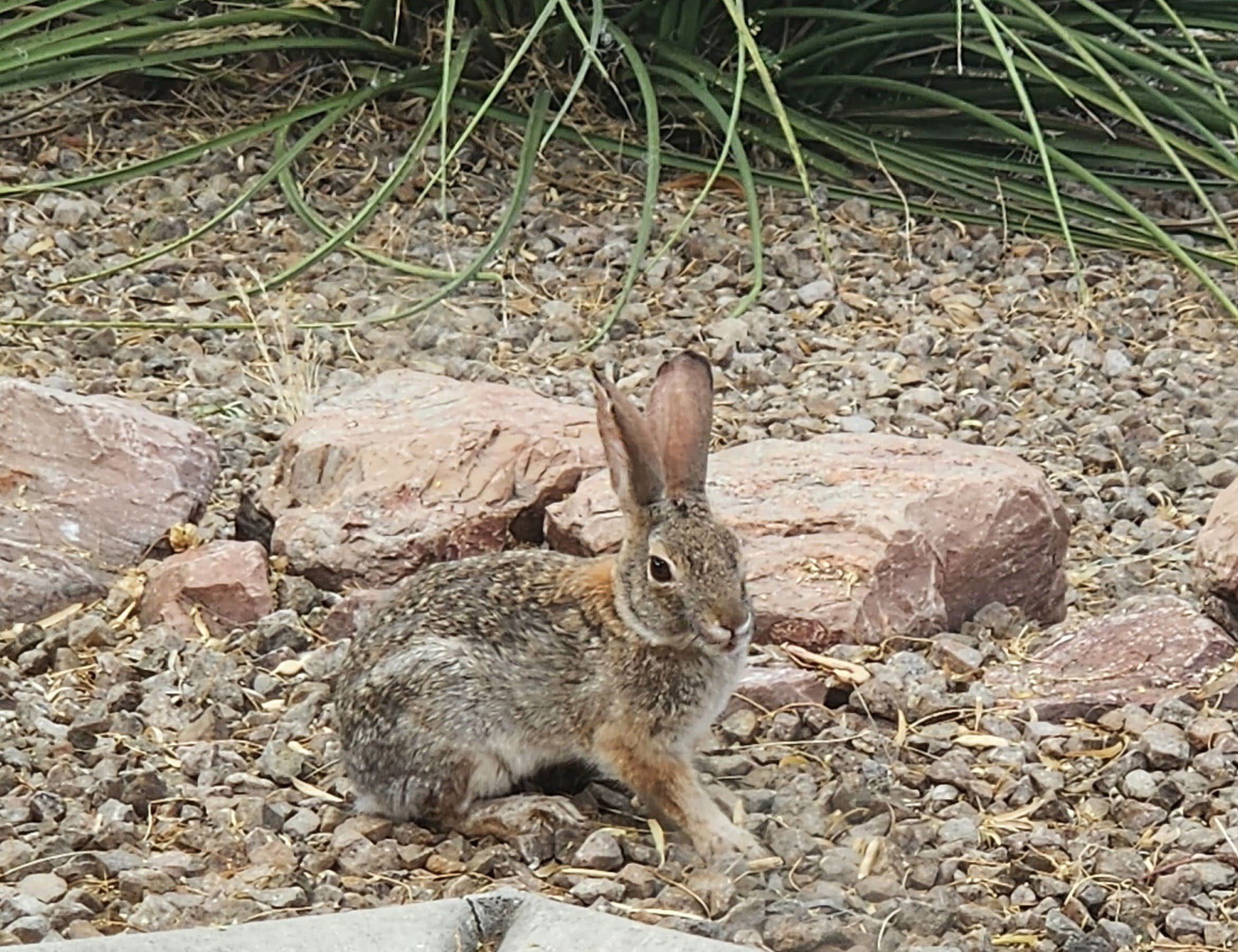
Bird song accompanied my walk. I felt I was being passed along from song to song, bird by bird. I’m not a birder so I couldn’t identify the avian varieties, but their songs were a lovely accompaniment to the walk. Rabbits, large and small, scampered alongside trails busy in their bunny ways. They would halt to give me a look, then go about their business.

I am grateful to be able to walk. A few years ago, I broke my ankle and had to have the shattered bones screwed and plated back together. I spent weeks on the sofa unable to take even a single step on my own. Thank God for Dr. Ty who did a wonderful job of putting Humpty Dumpty back together. I so looked forward to walking across the family room into the kitchen. But… Immediately upon healing, I broke the other ankle. Don’t ask. It’s a dumb story and one for another day. I believe God saw I had not learned the lesson He intended and decided I needed more time immobilized. So again, I had to have surgery and spend more time on the sofa unable to walk.

During that long recovery period, Ken would pack me into the car for little excursions to get me out of the house and lift my spirits. What it mostly did was make me jealous of people I saw walking. Such a simple thing. We learn as babies to stand on two legs and claim our freedom to get from one place to another on our own. I did not appreciate that freedom until suddenly I was anchored down for three months. I swore that once mobile I would walk every day and appreciate each step. I have and I do. My daily walks are one to four miles and each step is blessed.

Ken still accompanies me on daily walks for up to a mile. He cannot walk further right now but hopes to increase his mobility in the near future. I’m cheering him on as he works to improve. I’m grateful that he is making every effort.

Most Saturdays I walk with my friend Roxanne, but she has been away visiting her son in Oregon, so I go alone. When we walk together, we talk, talk, talk for two hours. We solve the problems of the world and a few of our own. When I walk alone, of course, I’m really not alone with all the critters in the Preserve or friends from the neighborhood I meet along the way. My time walking alone during the week is for quiet contemplation, writing poems in my head, thinking about situations a character in one of my stories faces, or sometimes listening to music or a book on my phone. I am grateful for all those opportunities – alone or with friends.

Haiku from today

Silly woodpecker
Rapping on the metal pipe
What is he thinking?

Time and Perspective

Today is opening day of the 2024 MLB season and you cannot scrub the smile from my face. Baseball!!! As I watched the MLB Central show (my favorite morning show) I thought about the changes since my dad was alive. An Army Air Force veteran from WWII, he helped vanquish the reviled forces of evil in 1941 to 1944, Germany and Japan. Today one of the most celebrated baseball players of all time – right up there with The Babe and Lou Gehrig is Shohei Ohtani – a young Japanese man. I cannot even imagine what my father would have thought if that had been told to him in 1944. In fact, the top three players today on the celebrated Dodgers are Mookie Betts, Shohei, and Freddie Freeman, a total fusion of ethnicity on one team. In 1945 when I was born, Jackie Robinson was still two years away from breaking the “color barrier” in major league baseball. Back then there were only a handful of Latino players and no Asians. The Dodgers were the dreaded team still in Brooklyn, across town from my dad’s favorite Yankees. As a farm boy from Kansas who loved baseball, he would have been very surprised, I dare say unbelieving if told about the future of baseball.

Baseball is a merit-based business. No one gets on the field without talent and an overwhelming desire to play the sport. Size, shape, color, and birthplace don’t matter. Some, like my husband, are recruited from high school and join minor league teams sponsored by professional teams to train recruits for their major league team.  A kid as young as 19 can end up on a major league team if he has the right stuff. Some young men go to college and are prepared for professional play on college teams.

Scouts are out all year round searching for talent in every nook and cranny of the country and now across the world. No one gets to the professional level without a lot of talent regardless of their background – talent and drive win out. That is why a Mookie Betts at 5’9” 180 lbs. is as effective on the field as Aaron Judge at 6’7” 282 lbs. Size doesn’t matter. Talent, heart, and intelligence matter. I’ll put Jose Altuve’s passion (5’6”, 166) against any physical barrier. He literally sparks when he is on the field. His happiness, his delight to be playing, glows through his smile.

If a man has talent, it will reveal itself and the fans will show up to watch two teams compete using their players’ skills and strategies. There is no baseball business without fans whether they watch on TV or go to the games.

Baseball as a sport will endure because it is fun to watch, easy to understand, and fun to play at whatever level. A sphere is thrown at top human speed at the round-edged bat – what could go wrong? The players are not only part of a team, but their individual skills are on display. I have likened baseball to a cross between bullfighting and ballet.

When a pitcher faces a batter, mano a mano, it is a bull fight. The pitcher hurls a missile directly at the batter at 90 to 100 miles an hour – the bull. The batter, matador, protected by a helmet, holds a stick less than 3 inches in diameter and not more than 42 inches long to fend off the approaching sphere. If the bat contacts the round missile and sends it out to the field the ballet begins.

Players tall and small will dive, spin, and leap performing ballet-like movements such as –
Fouletté – whipping the body around from one direction to another;
Pirouette – a player steps up on toes of one foot while extending the other leg in a turn as they catch the ball;
Temps lié – connected movement that prepares the body to maintain balance and control while shifting weight from one position to another as they reach for the batted sphere;
Grand jeté – high jump with extended legs to snag a soaring ball;
Penché – a player leans far forward with the forward arm and head low and leg raised in the air;
Renversé – bend the body during a turn, from the waist, sideways and backward, maintaining equilibrium – a real talent;
Sissonne – jump from two feet to one.

After completing these athletic moves, the fielder must then throw the ball with deadly accuracy hundreds of feet across the field aimed at a mitt 10” by 10”, to try to stop the runner on his circuitous route from home back to home. Sometimes this throw is accomplished while the player with balletic grace is still airborne. When that happens ahhhs and oooos erupt from the crowd. Replay is guaranteed on TV.

I stopped rooting for teams, as such, since they became so fluid. Money talks and talent walks. A man, even if he signs a multiyear contract, may be traded or elect to go to another team if the price is right. I can’t blame a guy for getting the most pay that he can. Athletic careers are notoriously short due to injury and burnout. Players spend hours away from the field on conditioning to keep their bodies as fit and flexible as possible. Baseball is an EVERYday sport. There are very few days off and position players show up to play every day. Only pitchers whose bodies are put to exhausting tests in a game are given 4 to 5 days between games. Now I root for the players themselves and whichever team has the most of my favorite players is the team I choose for that matchup. For instance, it is very hard for me when Gerrit Cole, pitcher for the Yankees faces at bat Bo Bichette, shortstop for the Blue Jays. I love them both and find it painful to split my loyalty.

Ahhh, but the season has begun and I’m in heaven no matter who is playing. I’m sure I’ll discover new favorites this season. Right now, the Dodgers just beat the Cardinals, 7-1. Yeah Dodgers, but I feel sad for two of my favorites, Nolan Arenado and Paul Goldschmidt who played their hearts out for the Cards.

The Strangest Job I Ever Had

What was the strangest job you ever had?

In 1965 I became a gas station hostess. My husband signed with the Detroit Tigers Baseball Company in 1963. This was his second season with the Tigers. The previous year he played on minor league teams, the Lakeland Tigers (Lakeland FL) in the Florida State League and then the Cocoa Tigers (Cocoa FL) in the Rookie League. He was assigned to the Syracuse Tigers (Syracuse NY) AAA team in the International League in 1965 so we were in Florida for spring training. He was gone all day at the ball field, and I needed a diversion. I looked for temporary employment since we would be leaving right after spring training.

I answered an ad for a gas station hostess not having a clue what that might entail. I was hired on the spot because…WHO would aspire to be a gas station hostess? Every weekday I dressed in my best, with nylons and high-heeled shoes. I was in full party make-up.  It was late February in Florida, so not as hot as later in the year; but, it was still very humid.

In the 1960s oil companies competed for business by offering perks beyond the full service expected at a gas station. Full service meant that a man or boy would fill the tank with gas, check the oil (add if needed), and wash the windows. Women were rarely hired for that job. In fact, I don’t remember ever seeing a woman working at a gas station in the 50s or 60s. To acquire loyalty, oil companies offered perks such as green stamps, small appliances or other home goods to customers. Green stamps were collectible everywhere. A number of stamps were given depending on the amount of a purchase, then they were glued into a twenty-page book. When the book or books were filled they could be traded in for items from the green stamp catalog according to value. Stamps were valued at 10, 20, or 50 points. Each business determined what dollar amount equated to what green stamp value. Some stations gave more stamps per dollar, thereby gaining customer loyalty. The gas station I worked for decided that entertainment was an avenue to customer loyalty beyond premiums and rewards.

This is an AI representation of what I did. There are no photos of me at that job.

My job was to greet each car as it drove up and offer the customer a menu of goodies. We had green stamps, of course, but we also had toys for the kiddies and small gifts for the homemaker, an apron, a flower vase, a set of cloth napkins, a coffee pot, etc. It was an invitation for men (they were primarily the drivers) to score instant points with the family – no need to collect stamps for months and months. I also offered a paper cup of coffee or a soft drink for the driver.

Some days, they hired a clown – yes, a clown in full regalia from crazy wig, bright baggy costume, to big floppy shoes. His job was to stand at the side of the road to wave customers into our station. If kids were in the car, he would follow it into the service area to entertain with juggling or some crazy stunt while the car was being serviced. The clown’s job was much tougher because he had to be out in the sunshine dancing and waving with breaks a few times an hour. We were both dripping sweat most of the day. We dashed into the station office when we could to stand before the cool of the air conditioner. He didn’t work every weekday but did work on the weekends. When the clown and I worked on the same day we laughed at the implausibility of our jobs and traded stories of the people we met. He was a part-time grocery store worker and an aspiring actor and writer.

I quit or my temp job ended, I can’t remember which, after four weeks. I earned a little money but had a great story to tell. It looked good on my resume – a conversation starter. To this day I have never met anyone else who was a gas station hostess. If you know one, please let me know.