I became enamored with the book, Jonathan Livingston Seagull, by Richard Bach sometime in 1971. I was a young suburban mother of three living in Bellevue, Washington. In the book was wisdom about living your best life that inspired me. A couple of years later my friend Karla told me she read in the newspaper that Richard Bach was going to barnstorm in Issaquah later that week at the small skyport there. We decided to take our kids to see him. Karla’s son was three and so was mine, my two daughters were five and six. We went to a big open field with one runway and a barn to watch Richard Bach guide his biplane to a landing and get out to greet people. There were about twenty or so people there. He looked very spiffy in his jeans, white turtleneck shirt, white scarf, and leather jacket with windblown wavey hair and a mustache.
I wanted an autograph in the worst way but in my excitement, I forgot to bring the book with me. Richard offered to give short rides in his biplane for five dollars. Karla and I looked at each other and exclaimed “Let’s do it!” There were two or three people who flew before us, so we watched as he piloted his plane through various maneuvers. I kept an eye on her son while she took a ride, and she watched my three kiddos while I went up.
When it was my turn Richard asked if I had ever been in a biplane before. “No,” was my answer. “Have you ever been seasick or airsick?” Again “No”. Would you be afraid to be upside down?” My excitement climbed. “No”. “Ok then, we’ll have fun,” he said.
The ride was short and exhilarating. We did loop de loops, barrel rolls, and zig zags. I think my entire flight lasted fifteen minutes and my heart soared. When we were back on the ground, he hopped out of the plane and helped me down. He shook my hand, and I thanked him, utterly starstruck. Then I told him I read his book but forgot to bring it for an autograph. He reached into an inside pocket of his leather jacket and pulled out a piece of blue paper. He tore it in half, took out a pen, drew a picture, and signed his name. “Here,” he said. “Paste this inside the cover of your book.”
I have read and reread most of his books. I think Illusions is my favorite although when I read another it becomes my favorite. These are a few of his quotes I love best.
“When you have come to the edge of all the light you have And step into the darkness of the unknown Believe that one of the two will happen to you Either you’ll find something solid to stand on Or you’ll be taught how to fly!” ― Richard Bach
“No matter how qualified or deserving we are, we will never reach a better life until we can imagine it for ourselves and allow ourselves to have it.” ― Richard Bach
“Remember where you came from, where you’re going, and why you created this mess you got yourself into in the first place.” ― Richard Bach, Illusions: The Adventures of a Reluctant Messiah
“You’re never given a dream without also being given the power to make it true.” ― Richard Bach, Illusions: The Adventures of a Reluctant Messiah
“There is no such thing as a problem without a gift for you in its hands. You seek problems because you need their gifts.” ― Richard Bach, Illusions: The Adventures of a Reluctant Messiah
“You don’t love hatred and evil, of course. You have to practice and see the real gull, the good in every one of them, and to help them see it in themselves. That’s what I mean by love. It’s fun, when you get the knack of it.” ― Richard Bach, Jonathan Livingston Seagull
One Christmastime, my parents drove from Wichita to Longmont Colorado so we could spend Christmas with my mom’s family. We stayed at Grandma and Grandpa’s house. We were there a few days before Christmas. My grandparents’ home on Carolina Avenue was small. The routine during our stay was that I went to bed in grandma’s bed. Then when the adults went to bed, I was transferred to the living room sofa. My parents slept in the guest bedroom. I always went sound asleep, never sensing the move from bed to sofa.
On Christmas Eve my aunt, uncle, and cousins came to visit with us. My cousins were much younger than me, so we didn’t play together. We had dinner then everyone helped decorate the tree. The bright lights cast a colorful glow around the room. There was a fire in the fireplace making the night cozy. The big picture window in the front room framed the snowy scene outside. Grandma had paper and crayons for me to draw pictures. I drew a picture of Santa and his reindeer to leave for Santa along with cookies and milk.
When my aunt and uncle left with my cousins it was time for me to go to bed. I worried that Santa would get burned by the fire when he came down the chimney. Grandpa assured me he would stay up to make sure the fire was out and the fireplace cool so Santa would be fine. I told them I would stay awake until he got there just in case. And then, lights out.
In the morning I awoke when Grandma came into the living room to take the cover off of Mr. Thorndike’s cage. He was their blue and green parakeet. He started to jabber, jabber, jabber as soon as he saw daylight. Slowly I recognized where I was and looked first at the fireplace to check on the fire. It was out. Then I looked at the tree and saw presents all around it. Santa had come. The milk and cookies and my drawing were gone. I missed him – I slept through it all. Oh, how disappointing. But I couldn’t let anyone know I had not fulfilled my mission.
Grandma and Mom went into the kitchen to start breakfast. Grandpa came into the living room followed by my dad. They looked amazed at the tree and all the presents. Dad picked me up and Grandpa took the blankets and pillow off of the sofa so they could sit down. I walked around the presents; everything was wrapped, and I didn’t know what was mine but I tried to guess. Grandpa said we’d open gifts after breakfast. Oooo, I didn’t know if I could wait so long. Grandma took me to the bathroom and helped me dress. I was so anxious. Grandpa picked one present from under the tree and told me I could open just one before breakfast. It was a china tea set with roses on the four small cups and saucers, and a teapot, sugar bowl, and creamer.
Then the question. Did you see Santa? Did you talk to him?
My four-year-old brain lit up. “Yes,” I said emphatically. “Santa came down the chimney and got his pants a little dirty. He saw me lying on the sofa and put a finger to his lips and told me not to talk. He ate the cookies and rubbed his tummy, mmm good. Then he laid out all the presents from his big red bag and blew me a kiss, took my drawing, and disappeared back up the chimney and I fell asleep really quick and didn’t look at the presents.”
“Oh, you’ll have to tell Grandma what you saw,” Grandpa said and called Grandma and my mom in from the kitchen.
I repeated my revelation and added that I heard the reindeer on the roof and their bells.
“You are one lucky girl,” said Grandma. “Not many get to see Santa.”
I did not notice the exchange of looks and winks that I’m sure darted around the room from adult to adult as I told my story. They accepted every word and repeated what a lucky girl I was.
Four years later, when my third-grade teacher told the class just before we left for the day and Christmas break, that although Santa wasn’t real, it was the spirit of giving that made Christmas special. A knot formed in my stomach. Santa, not real? How could that be? My throat went dry, a lump obstructed my swallowing. I couldn’t talk. I was devastated. I went home after school and asked my mom. She grumbled about the teacher telling the class about the myth of Santa but admitted that the teacher was right. Santa was the spirit of giving not a real man. The magic trickled out of the holiday like syrup slowly dripping off my Christmas waffles. It took me the whole Christmas vacation to accept that Santa was not a person, just the essence of giving. I couldn’t even talk about it to my best friend. The day before school began in the new year, I asked her if she knew about Santa before Mrs. Singer told us. She said yes, she was not surprised. Her parents never believed in Santa and told her and her brother not to talk about it to other kids who might believe. That really put the exclamation point on the lesson. I had no choice but to believe them.
Then I remembered my Santa sighting. Another whole dimension developed in my troubled brain. Now I knew, they knew I was telling a whopper of a tale when I described my visit from Santa. By then, I’d convinced myself that it was true. Not once did any of those grownups bring it up. Toward the end of my mother’s life, I asked her about it and she said my imaginative, impromptu story was the highlight of that Colorado trip. I’ve told stories real and imagined since I was four.
Writers obtain inspiration from a variety of sources. Mine usually come in dreams, or as I’m waking in the morning. Sometimes a character talks to me while I’m walking or driving asking to have his/her story told. It can be said to be divine, or mystical, or even crazy but it is magical. This is the true story of a spirit who guided me to write a poem.
At the tender age of sixty-two I suddenly realized that I would never be a grandmother. It had been my highest ambition, having grown up with wonderful grandparents and great-grandparents. As Polonius said, “and it must follow as the night, the day….” (totally out of context) I believed it was the natural culmination of a life well lived. I made the bold statement to my three progeny at various times that my aim in having children was so I could eventually be a grandma. I think that may have been a step too far. In hindsight, probably not a great tactic in the parent/child relationship.
By April, 2008 none of them exhibited any interest in procreation. NONE. They were happily living the lives they designed without one thought to my hopes and desires. Oh me, oh my. For several years, I had pinned baby pictures of my friends’ grandchildren and even the children of my childrens’ friends on a wall in my office cubicle. Someday, I believed, the wall would contain a load of pictures of MY grandchildren. But now all my children had exceeded their fortieth birthday and no grandchildren on the horizon. Not even a hint, a whiff, a whisper, a sign.
That evening I sat with my journal and began to jot down a poem mourning the conscious loss of something I would never have. I wrote about the little granddaughter I wished for – all the things I envisioned doing with her.
The next day I went to my computer to transcribe that story to submit to my writers’ group. As I sat at my desk, I felt the strong presence of a little boy hovering over my left shoulder. I could hear his voice. He wanted me to bake a cake for his third birthday. His spirit was so vivid, that the story of my granddaughter morphed into a poem about my grandson. I read it to my writer’s group the next week with an air of sad resignation, a kind of mourning.
My Grandson at Three A memoir of loss
A chubby bundle of verve Dirty knees, killer smile A charming packet of cuddles, Blue eyes spark with wonder That is my grandson
Innocence and childish wisdom Life – a fish bowl of dashing delights A bright idea swishes past A clever observation The world full of marvels
At three his every thought Becomes action Or question to be explored Energy and curiosity Cascade thru our day
From awakening Til he is tucked away Too tired to dream My grandson to me is Joy, delight, a miracle
Sweet arms surround my neck “Read it again, gramma” Good Night Moon redux Snuggles in my lap Affection, a two-way road, no tolls
I know it can’t last This rapture of childhood If love holds when he is grown He’ll read to me In the afterglow of remembrance
I wished a granddaughter Tea parties and dress up I wanted a granddaughter To primp and pamper I dreamed a grandson, the light of my life
I am the mother of three None plan children of their own Their choice, their path Expectation denied A loss I mourn
He will never be born to the world In consolation of loss My grandson is born to my heart A luminous vibration of life Forever tenderly just mine.
On Mother’s Day, May 11, 2008, I received a call from our eldest daughter who was living in Hawaii. “Hi Mom,” she said, “Happy Mother’s Day. You are going to be a grandma.” I was stunned. Excited, stunned, excited, over-the-moon, amazed. It was several days before I remembered the little boy who asked me to bake his birthday cake. My daughter declared that she was not going to find out the sex of her child until it was born. I had a hard time keeping the secret – I knew a little boy was on his way. He told me so about a month earlier.
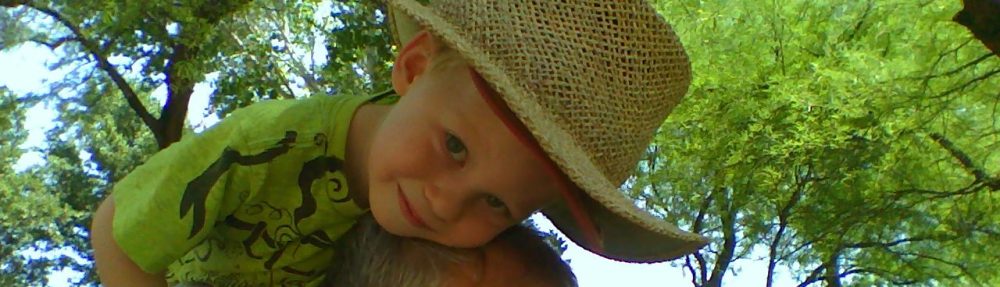
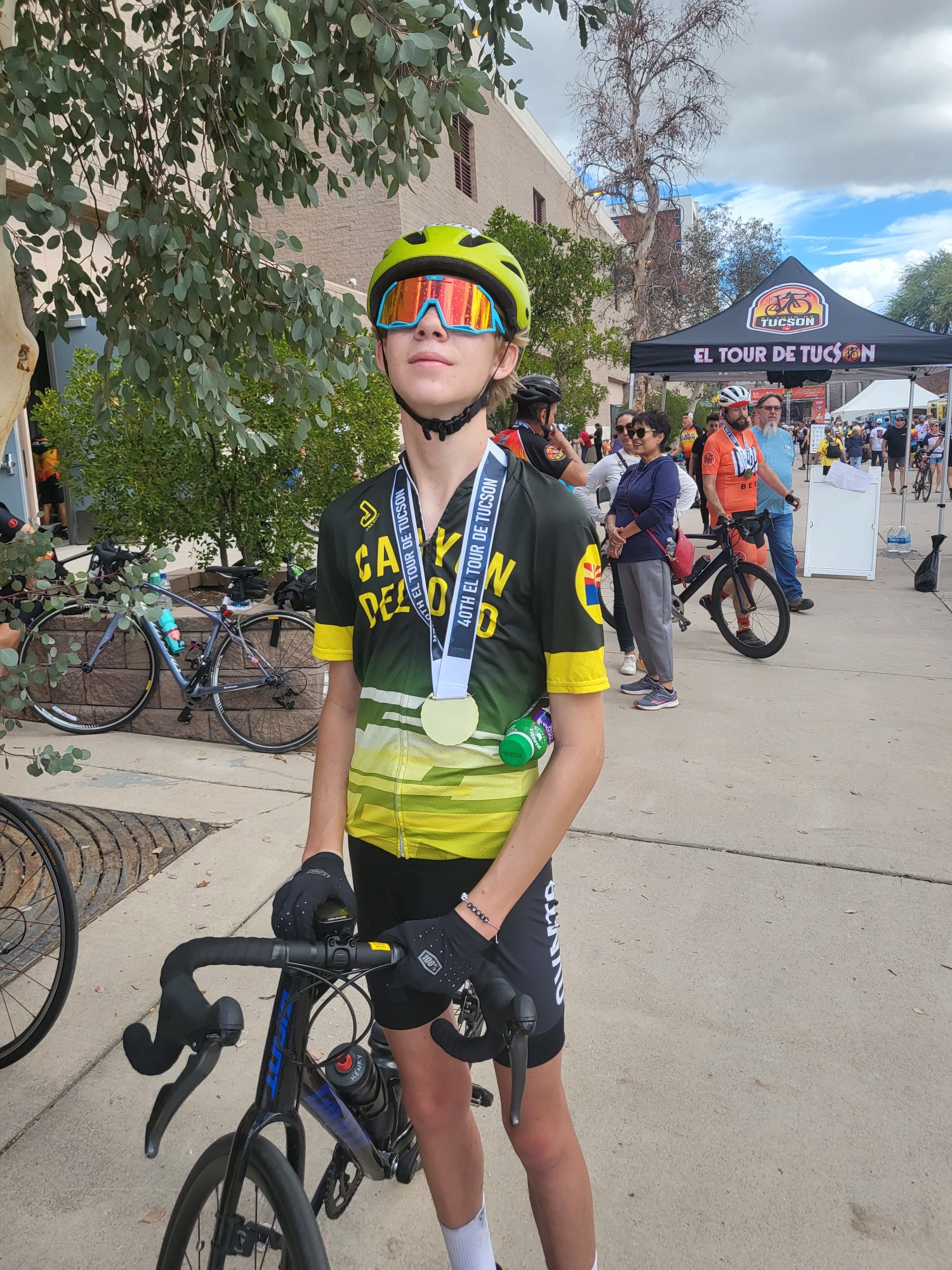
Our daughter was divorced and moved to Tucson just before her baby was born. Ken and I were privileged to be part of his childhood. I did bake his birthday cake for his third birthday, white cake with chocolate frosting and M&M’s. He is all that I dreamed. He does have blue eyes and a killer smile. He is a bundle of energy and light. He is a blessing beyond my imagining. He taught himself to play the piano by ear at age three. He learned to play the guitar from his mama. He played little league with his grandpa as a coach. He’s a scholar at school taking honors and AP courses. He is now over six feet tall, nearly as tall as grandpa, and very much his own person. He belongs to his high school mountain biking team. He has participated in El Tour de Tucson Bike Race every year since he was four starting with the fun run, then the five mile and so on. This year he challenged himself to ride the longest run – 105 miles that he completed in five hours. Oh, the bragging can go on and on for pages.
This past weekend we celebrated his 15th birthday. I baked a German Chocolate birthday cake for him.
And at nap time when he was little, we did read Goodnight Moon – many times.
Happy Thanksgiving to All! This has always been my favorite holiday – all about food, friends, and family. A time to be with those we love with no obligation for gift-giving. Once upon a time our family had a very memorable Thanksgiving – not in the usual way.
The Thanksgiving tradition in our family developed over a number of years. As young marrieds, my husband’s two sisters, their husbands and the two of us went to his parents’ home for Thanksgiving. His single brother came along with the girlfriend of the month. None of us had the room or wherewithal to deal with a crowd for the holiday. We all lived in and around the greater Seattle area.
When children were born to each household, we found it easier to have the feast at one of two houses, ours and Ken’s sister Arlene’s. At one point our two families lived only a block from each other. We had large homes and each had three children of similar ages. The kids attended the same schools. Ken’s dad suffered with medical problems and his mom was getting older, so it was harder for her to prepare a big meal, even with help. We divided up the holidays. One year Ken and I would host Thanksgiving and Arlene and Charles hosted Christmas. The next year we switched. That went on for most of the years our children were small through their teens.
The last year for our big family gathering was the most memorable. Arlene and Charles had moved to a home on a few acres at Offut Lake, south of Seattle. Ken and I moved even further south to Arizona. All our children were adults living in the Seattle area. Ken’s parents had passed away. Charles’ mother, Maude, lived in her own little trailer home on their property so they could care for her as her health declined. A few days before this particular Thanksgiving, we were told she had been moved into the house because she needed twenty-four-hour attention. We expected to spend time with Maude during the day.
We flew to Seattle from Tucson and drove out to the lake. Upon arrival, our arms loaded with gifts and treats for the family, we were greeted on the front porch by Charles with, “Happy Thanksgiving. We’re glad you could make it. Come on in. Mom just died. She’s lying in her room. You can visit with her if you like. We’ve called the coroner.”
Shocking, to say the least. We had no cell phones at that time, so could not receive a heads-up that she was near the end. Momentary confusion rattled us. Should we postpone Thanksgiving dinner? The family no longer all lived in close proximity and everyone traveled a distance to be together. Was it proper to have a celebration with a deceased loved one in the bedroom? Not a common question at Thanksgiving. The whole family was gathered, and we took in the reality each in our own way. There were no tears, just a collection of faces in varying degrees of disbelief. Now wasn’t that just like Maude. She certainly grabbed the center of interest for this family event. We finished preparing the meal reminiscing about past Thanksgivings. Laughter and memories of Maude were shared. We took time, individually, to go to her room and wish her Godspeed toward Heaven.
Dinner was served. We sat down to the feast, Charles said a prayer of Thanksgiving, and we enjoyed the traditional assortment of foods as in past years. Death was an unexpected specter at our table. Just as we finished, a knock came on the door. The coroner with two assistants arrived between dinner and dessert, as if scripted. Maude’s body was removed and we continued our meal with pies and cakes. It was odd but felt completely appropriate and comforting for everyone to be together.
In later years as our family spread out to various states, we gathered friends together who also had far-flung relatives and created a friend/family to celebrate Thanksgiving. It is still my favorite holiday. Has your family or friend/family had an unusual Thanksgiving? I’d love to hear about them.
Here I am after more than three-quarters of a century looking back at some of the changes that occurred during that lifetime. The biggest technical change is the explosion of personal data devices. I did not get a cell phone until about twenty years ago. I was one of those people who said, “I’ll NEVER have a cell phone!!” I considered them an intrusion. I resisted and resisted. Then it became obvious that a cell phone was a necessary accompaniment to my daily lifestyle.
At the time my mother had moved to Tucson and was in need of close attention. She lived on her own but was in her 80s and had moved from the town where she lived for most of her life, away from lifelong friends and familiar places. She needed contact not only for personal needs and information about how to get around a new town, but also for company. My work took me out of the office, so I was not always available by landline. I believed she would find friends fairly quickly but, in the meantime, I was her social link, her sounding board, her complaint department, her connection to the world.
I discovered I needed a cell phone for business. Ken and I had just started a property management and real estate company and the need for quick exchanges of information became evident. So there I was, a new and reluctant cell phone user.
Looking way back…In the mid-1980s my family of three teenagers, two dogs, my husband and I, left our home in Bellevue Washington to travel the country. We journeyed through the forty-eight contiguous states plus a couple of Canadian Provinces and Mexican states for fourteen months. We took two of our kids out of high school (the third had just graduated). They wanted to keep up their studies while traveling so they could stay up in grade with their friends when we returned. That was accomplished with a study program coordinated by the University of Missouri and Bellevue High School. Correspondence courses were mailed (years before email) to us by the University and then back to the University as they completed each section and results were reported to their high school. All communication was by public phone in phone booths across the country and by mail, snail mail. Lots of postage. We had no cell phone and no computer. We were off the grid so to speak. Amazingly they were able to complete their studies in English, History, Math, and Social Studies – the basics, while learning firsthand about our beautiful country, its regions, its national parks, its varied cultures and languages (English has many nuances), history and geography. We took advantage of public libraries and museums along the way. Being teenagers imprisoned with their parents 24/7 for fourteen months, traveling in a van, living in a travel trailer, was indeed a sentence few would volunteer for. The only “device” they had for entertainment were Walkman cassette players with earphones. Those were revolutionary in that time. It was their means of escape into personal head space. I must give them all credit for their stalwart determination to survive. I’m sure it felt to them akin to traveling by covered wagon across the country. We crisscrossed the country from sea to shining sea four times in our quest to visit every state. How did we manage without a cell phone, GPS, the internet?
My how times have changed. Now the idea of leaving my house without a fully charged cell phone makes me quake with anxiety. What if something breaks down, what if my (fill in the blank) _________, husband, friend, daughter, grandson, needs to talk to me, an emergency, what if I get lost and need direction? What if, what if, what if? I can hardly believe the intense change from being a NEVER-CELLPHONER to being a NEVER-BE- WITHOUT-A-CELLPHONER.
Technology has certainly changed my life. For better?
I have volumes of stories about my children and some of their friends as they encountered life in their first years. One of my favorites is about our middle child, our second daughter, the quiet one.
Shari attended morning kindergarten at the elementary school around the corner from our house. Our backyard abutted the playfield. After school she would come home for lunch and tell about her day. Several times a week my husband came home for lunch also. His office was not far from our house and he liked to spend lunchtime with Shari, our three-year-old son Casey, and me. On this particular day in October, Shari’s class went to a pumpkin patch. Each child was to bring a quarter to buy a pumpkin to bring home. Shari arrived home without a pumpkin. Ken arrived at the same time, and this was their exchange.
“Hey Shar, did you have fun at the pumpkin patch?”
“Yes Daddy, I saw lots and lots of biiiiiig punkins.”
“Did you bring one home?”
“Nope. I didn’t have my quarter.”
Ken made sure she had a quarter before he left for work that morning.
“You lost your quarter?”
“No. I didn’t have it.”
“I gave you a quarter this morning.”
“I know Daddy, but I didn’t have it to buy the punkin.”
“You lost your quarter,” he said.
“No.”
“If I gave you a quarter and you didn’t have it, you lost it.”
“No, I DIDN’T lose it.” she said with emphasis.
“Do you still have it?”
“No.”
“Then it is lost.”
“It isn’t lost. I know ‘xactly where it is. It fell between the bus seat and the bus wall. I know where it is, but I can’t get it. It ISN’T lost.”
Case closed. No quarter, no pumpkin but the quarter is NOT lost. I was sure she would grow up to be Clarence Darrow. Her logic was flawless; her argument, decisive. Even her daddy could not shake her. She knew what lost meant and she didn’t waiver.
I am entranced by little people. Any child between birth and eight years old, I find enchanting. I can spend hours watching and talking with them. At one time I wanted to be a second-grade teacher like Miss Jones, with whom I felt a special rapport. Instead, I became a mother. Although those years between birth and eight didn’t last as long with my own children as they would have with year after year of new students in school, I thoroughly enjoyed those times. After the age of eight, children are lured into our larger social structure through school and activities, and they lose that innocent view of the world. Much of the awe is exchanged for a comfort with the reality around them.
I am so privileged to have been a stay-at-home mom. I was able to experience the day-to-day wonder as each child began their journey. Now I think it is a rare privilege. It seems that mothers these days are required to work outside the home for financial reasons or choose to do so because of career choices.
My own mother was a working mom, through choice as much as necessity. I resented that for many years even though I know what she sacrificed to keep both sides of her life humming along. I wanted her to be home with me as all the other kids had their moms at home. My parents did their very best to provide in-home daycare for me. I never went to an outside babysitter or daycare center. Even though I had terrific nannies who I remember with fondness, it still wasn’t Mom. My husband and I agreed that when we had children, I would be home with them. He often worked two jobs to make sure we could provide that lifestyle. Thus, I was able to be a part of those special moments in each child’s life. Many I recorded in journals and many more I have probably forgotten but the echo of that special time remains.
I find a three-year-old to be the most interesting companion. They are full of curiosity and have learned the art of conversation. One morning my son and I were running errands around town, we passed through a construction zone with a crew of men digging a trench on the side of the road.
Casey asked, “What are those men doing?”
We had been through several areas with large machines and workers, and I had gone through explanations about making a ditch to put in sewage pipes, and preparing a new place to build houses for people. Each answer elicited another barrage of questions. What is sewage? Why do we need sewers? Why do people poop? Why do roads need to be fixed? How many houses are going to be built? Who will live in them? Can we meet them sometime? Do those men put their machines in their garage at night? Can we live in one of the new houses? Can Glenny and Johnny come live next door? Each question led to another. Most I could answer easily. We passed a new high-rise being constructed and a bridge being reinforced. Now we were detoured through lanes as a road was under repair.
“Mommy, when will the world be finished?” That question put a pause on the talk, talk, talk.
What a concept – a finished world, a static world, a world without change. This was not a throwaway answer. I always welcomed his curiosity as he learned about the world around him. This question required more thought. Never – is the easy answer. But to a three-year-old that doesn’t cut it. Why? Why? Why? Are the follow-ups. As we paused in our journey delayed by the construction, we discussed how things like roads have a purpose and, when they are used, they wear out just like his beloved blanket that was now in shreds, even after many rebindings, but still a constant companion at bedtime. Sometimes buildings are made and then need to be changed for bigger or better buildings. We discussed the nature of change as the seasons change. How flowers bloom sometimes but not always, and leaves change colors. He was only old enough at that time to really have memory of one complete year of seasons. We talked about how he changed, learning to walk, learning to use the toilet, learning new songs and words. As a person he will change as he gets older. Someday he will be big like Daddy and have his own family. Because of all those things, the world will never be finished. It is always evolving/revolving.
I can liken that to my writing. When is a story finished? I spend hours writing only to find, after review, it needs to be changed. Even a short essay requires review and editing. I usually write something then put it away for a day or two and revisit. I wake from sleep with a brand new line for a story that was born in my unconscious. Many of my stories remain in my computer or, if handwritten, in my file cabinet. If they are to be published, they will be revised and revised before other eyes see them. I always think of different ways of saying something or other words to use to reveal a character or action. I don’t believe I have ever reread a piece of my writing that I haven’t wanted to change something. Even in the book we published last year, I go back and find so many lines that need to be rewritten. I’ve talked to other writers who feel the same. There is a point when “it is good enough” is the only way to actually produce a “finished” story or poem.
Just like the world, my stories are never really finished. What you read is just the latest iteration.
Erica began to tremble. I was seated next to her at our table on the restaurant patio. It was a beautiful spring Tucson day in 2018. We were having lunch at a popular restaurant with three other women volunteers from the hospital surgery center. I noticed a flash of unease cross her face.
“Erica, are you all right?”
“It’s nothing,” she replied.
“You were trembling just now. Are you cold?”
“No, it is an old body memory that I can’t stop.”
“Body memory of what?”
“The war,” she said. “I start shaking when I hear a plane overhead.”
I hadn’t even noticed the sound but did hear it faintly as the plane flew away.
A native of Germany, Erica emigrated to the US with her husband in the 1950s. They established a business and home in the Midwest and raised their son as an American citizen. Erica was a widow, now in her mid-eighties. I knew that much of her story. She volunteered one morning a week at the surgery center of our local hospital, as did I. We occasionally had lunch together. I liked hearing about the customs and recipes she brought from Germany. She made luscious baked goods to share with hospital staff. I enjoyed her wit and positive attitude – always available to help someone.
At lunch that day we talked more about her experiences growing up in a small village in central Germany. During WWII, Allied bombing raids passed over their farm on their way to targets unknown by those on the ground. Bombs were dropped on nearby towns. If she was outside she would run to shelter fearing death from the sky at any moment. The imprint of terror stayed with Erica from the time she was nine or ten throughout her long life in the United States. A teenage brother was killed in one of the bombings, wrong time, wrong place. Even with the lasting repercussions of war for her and her family, Erica had no animus against the men who “did their duty”, or the country that directed those bombers. She was taken in as an immigrant and her family thrived here. She had nothing but gratitude to the U.S.
Many times, I read my father’s journal of his twenty-eight bombing missions during WWII from December 1943 through July 1944. He was the waist gunner on the plane that led the entire Eighth Air Force in the invasion of Normandy on zero day – D-Day June 6, 1944. Unlike bombs dropped on Warsaw, Helsinki, Hamberg, Nagasaki, Hiroshima, London, and Stalingrad that killed thousands of citizens of those cities, none of the bombing raids by his crew were directed at civilian populations. Their targets were strategic military installations and industrial war factories. Of course, civilians were in those places as well, but residential areas were not the focus according to his journal entries.
Dad’s plane, The Red Ass
My dad never talked about his wartime experiences, and I didn’t find out about them until many years after he died at the age of fifty-two. I was proud of his part in securing victory over the Axis Powers in Europe. Never once did I consider the fear that must have sprouted and flourished in the psyche of those helpless folks on the ground who heard the giant purveyors of doom swooping in overhead. They experienced daily the trauma of the unknown – would it be their town or farm this time?
Talking with Erica gave me an entirely different perspective on what war was like for the nameless faceless people who had to endure the decisions made by the powerful. Even after more than seventy years, Erica still visibly trembled at the sound of an airplane overheard. Truly innocent human beings, who wanted to live with their families in peace, became victims of war. A war that had to be endured in the best way possible to survive. It became very personal and was made vivid to me because of her stories. My pride in my dad is tempered by the realization of the physical and psychological damage inflicted even without dropping a bomb. The weapon is terror.
I’m left with the unanswerable question. Why do human beings war with each other? There has not been a time in recorded history that we have not had wars somewhere. Even oral traditions celebrate war and victories over enemies. Our instinctive tribal nature divides us. The reach for power continues to exploit that instinct. When will we learn? As the song says, “There is no profit in peace.” 1 Until unelected oligarchs in our country and around the world, who wield the cudgel of dominance behind the scenes with endless supplies of money, cede power (not likely), or are ousted from power, war is inevitable. George Orwell described in his novel, 1984, how a small minority benefits from war and must keep the general populace dumbed down and compliant by force and fear. Is that the purpose of continuing to divide and segment us by our differences rather than uniting us in our common humanity? Hmmmm. That is the moral question.
Bessie in front row is second from left, Bea is second from right with their mother between them
The early 20th Century, after reconstruction and before the First World War, was something of a golden era in the United States. The country was expanding economically as was optimism for the future. The first transcontinental railroad opened the West to more settlement. My grandmother born in 1888, was the youngest in the John Lambie family of seven girls and eight boys. Her mother was Danish and her father, Scottish. They lived in Wisconsin, on a farm near Kaukauna.
In the buoyant spirit of optimism, my grandmother, Bessie Caroline, and her sister Bea set out for adventure in the wild wild West. They signed on to be Harvey House Girls.
In 1913 a prominent New York food critic, Henry Finck, named Mr. Fred Harvey, “the food missionary” to an underserved population in the West. Mr. Harvey placed restaurants and hotels along the routes of the Atcheson, Topeka, and Santa Fe Railroad and the Gulf, Colorado, and Santa Fe Railroad among others. He is credited with “civilizing the West, one meal at a time.” He is acknowledged to have started the first restaurant chain of eighty-four (at its peak) Harvey House Restaurants extending through twelve states from Chicago to San Diego.
Harvey House Girls had strict rules governing their conduct and living arrangements. The Harvey Company policy was to employ single, well-mannered, and educated American ladies. In newspapers throughout the East Coast and Midwest, their ads specified “white, young women, 18–30 years of age, of good character, attractive and intelligent”. The women were paid $18.50 a month, plus room and board. That was considered a very handsome salary in those days. The opportunity to leave their homes, enjoy travel, have new experiences, and work outside the home was very liberating for thousands of young women.
Bessie in the center – 4th from left – 4th from right
The women lived in a common dormitory much like a sorority house with a strict 10 p.m. curfew. A Harvey Girl with seniority assumed the role and responsibilities of house mother. The official starched black and white uniform was designed to diminish the female physique. It consisted of a shirt waist dress with a skirt that hung no more than eight inches off the floor, and a high pointed collar with a black bow tie. They wore opaque black stockings and black shoes. Their hair was contained in a net and tied with a regulation white ribbon. Makeup of any sort was absolutely prohibited. Marriage was the most common reason for a girl to terminate her employment.
Harvey Company restrictions maintained the clean-cut reputation of the Harvey House Girls and made them even more marriageable. Cowboy philosopher Will Rogers once said, “In the early days the traveler fed on the buffalo. For doing so, the buffalo got his picture on the nickel. Well, Fred Harvey should have his picture on one side of the dime, and one of his waitresses with her arms full of delicious ham and eggs on the other side, ‘cause they have kept the West supplied with food and wives.”
Judging from a few photos in family albums, my grandmother made the most of her twenties. There are pictures dated between 1908-1915 of her hiking in the mountains, picnicking at a lake, cruising in a 1906 convertible Pope Toledo, Type XII gas-powered, chain-driven automobile with five other young men and women, and in the arms of various “boy-friends” and generally having a grand time. Besides photos of her in Wisconsin, she was in Mojave, San Diego, San Fransico, and Bakersfield, California, at the Grand Canyon, in Trinidad, Colorado, at Starvation Peak in New Mexico, and at the home of a Mexican family in New Mexico, among many other places over those years. Bessie and Bea are shown in one photo standing atop a train wreck. It was taken at the 1913 California State Fair in Sacramento. Two trains were intentionally run toward each other at 90 mph as entertainment at the Fair.
Bea, on the left and Bessie standing atop a train wreck. I wish I heard THAT story
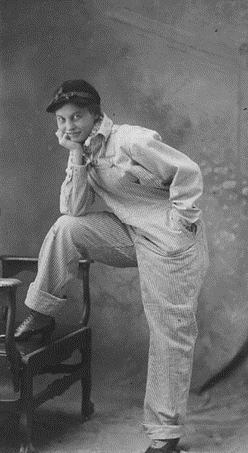
Grandma in her trainman outfit
In 1916, Bessie met Ed Henry, a trainman naturally. They married in 1917 and she settled into a life of domesticity. They had three children of which my mother was the eldest. My grandfather was one of the lucky ones who kept his job during the hard times of the Depression so the family did not suffer as much as some families during that time. My mother did tell stories of hobos knocking on their kitchen door asking for food and Grandmother making a meal for them.
I just wish I had known of Grandmother’s early days when I was a child spending whole summers with my grandparents in Colorado. I can think of so many questions I would have asked her. My grandfather was still a brakeman for the Union Pacific Railroad. I remember him coming home after a two-day round-trip from Denver to Green River, Wyoming. His big embrace when he picked me up upon arriving home smelling of wool, tobacco, and shaving cream is with me to this day. I can conjure it when I close my eyes and think of him. He was a tall man and a loving man. He must have been something to have wooed my grandmother’s adventuring spirit into marriage.
Once when I was six years old, my grandmother and I rode on Grandpa’s train to Green River and back so I could know what Grandpa did when he was gone. I remember being so proud when he came into our car in his uniform and hugged me. Everyone could see my handsome grandpa loved me. I remember how much I loved being on the train. A ten-hour ride each way went swiftly. Grandma and I stayed overnight at the home of their friends in Green River.
Back home at their house in Longmont, Colorado, Grandma was the domestic goddess. She kept a beautiful flower garden with sweet peas, honeysuckle, nasturtiums, roses, and chrysanthemums out back as well as a vegetable garden. I can still recall the sweet earthy smells. She canned peas, beans, tomatoes, peaches, and made jam. They had raspberry vines along the fence. She washed clothes with a wringer washing machine. I got my fingers caught once in the wringer when I tried to “help” her. She made delicious meals. Grandma had a sweet tooth and most everything had sugar in or on it. I had bread and butter with sugar as a snack and fresh garden tomatoes with sugar sprinkled on them. She claimed it was her Danish heritage that made everything sweet.
When Grandpa was home we often went fishing at Estes Park in the mountains. Grandma filled a huge picnic basket with scrumptious food – cold fried chicken, potato salad, chicken sandwiches, tomatoes, carrots, berries, and of course dessert – cookies or cake. Grandpa baited my hook with squirmy worms. I’d watch the bobber closely until it disappeared and I knew I had a rainbow trout on the line. Grandpa would take it off and put it in the woven basket that dangled in the water to keep them fresh. Grandpa would sometimes cook them right there on the little camp stove we brought. We always had more to take home for a dinner or two. Grandpa especially liked trout for breakfast with Grandma’s big fluffy biscuits dripping with butter and homemade jam.
I have great memories of my grandparents and wish I could have learned more of their stories in the years I had with them. In times past, each generation was tasked with passing on family stories from generation to generation. I think we lost that tradition in our hustle-bustle world and it saddens me. Every life is a series of stories and we should keep them alive in the family. I’m sure a semi-fictionalized (creative non-fiction) version of my grandparents’ story will start pestering my crowded brain at some point.
I noticed online that there is a Harvey House in Madison, Wisconsin. It is not the old one but a new version. Wish I lived near there. Maybe a road trip is in the future.
I experienced an unbounded free feeling when jumping out of a perfectly good plane to freefall at 120 mph toward Earth that appeared to be but a distant patchwork of fields below. Falling like a rock.
I went to a skydiving center near Seattle, Washington. After a thirty-minute lesson on safety and what to expect, my fellow adventurers and I geared up and boarded a plane for a fifteen-minute flight to our designated altitude. We circled Mt. Rainier at 14,000 feet. From the plane, we could see the Cascade Mountain Range, Mt. Baker in the distance, Puget Sound, all of Seattle, the San Juan Islands, Vancouver Island, and the Olympic Mountain range. The signal was given to jump. I was fifth in line. I must say there was a moment of trepidation but not of hesitation. It was a tandem dive, so I was tethered to an experienced skydiver, and I knew I’d be going – fluttering butterflies in my stomach, be damned. Oh my, what a rush – an H-bomb of adrenalin. It felt like smacking face first into a swimming pool from the high dive. Instead of water rushing up, thrusting against me, it was a solid wall of air. I gasped at the impact. It took my breath away. Who knew air would feel like a hard slap in the face? I quickly gathered my wits so I could enjoy the ride.
When you are up so high, 12,000 feet was the jump altitude as I remember, you are not falling by anything. Unlike Alice in Wonderland tumbling down the rabbit hole sliding past cupboards, maps, and bookshelves, there is nothing around you by which to judge your rate of downward progress, so your senses don’t register a fall. It feels like air surfing. After a couple of minutes of that delicious sense of floating freedom, my skypartner gave the signal for me to pull the cord and release our parachute. Thunk. The freefall ended abruptly. We snapped to a much slower pace, 20 mph, as we glided slowly toward the target with our big sail unfurled. The entire jump lasted less than ten minutes. I experienced heart-pounding, joyful exhilaration.
This was several years ago. It was one of those things I promised myself I would do. A bucket list item of sorts even though I didn’t really have a bucket list at that time. My husband was out of town for a few days on a golf trip and I wanted an adventure. I knew he would not appreciate the idea of my jumping from a plane, so I didn’t tell him. I made a reservation for the dive and then on another whim, I made a reservation for the next day to go white water rafting on the Skagit River north of Seattle. A different kind of adventure he wouldn’t endorse. Both escapades were something I always wanted to do and that was my chance to do them. A few days before I left, I thought maybe I should tell someone where I was going just in case something happened. I knew I couldn’t tell my husband or mother because both would worry, and I didn’t want that. It would cloud my enjoyment of the adventure. I called our eldest daughter to let her know. She thought it was a grand idea and asked if she could join me. Of course! That would make it even better – a co-conspirator and fellow adventurer. We left early Saturday morning for the skydive, then returned home and left early Sunday morning for the river rafting trip.
Although I liked the white-water rafting episode, I’m not a big fan of water. It is a total body workout to guide a bouncing boat through rocks and waves of a swiftly moving river. Imagine riding a bucking bronco through high tide. It’s nothing like the calm peace of skydiving. It was rigorous and lasted for hours, not minutes. There were four boats in our group and six people, including a guide for each boat. One fellow on another boat didn’t follow the carefully explained instructions and flew out of his craft and had to be rescued. The professional guides smoothly navigated his retrieval. Their calm expertise soothed the panic that threatened me as he was tossed about in the pounding waves. All returned in good shape, and it was a fun experience. My entire body ached for days.
I was so happy to have our daughter join me to share the memory. I hired a photographer to video our skydive, but I never watched the recording. When my husband returned from his golf trip, I told him about our adventure. He wasn’t terribly surprised that I would do something like that. I think he was glad I didn’t tell him before, so he didn’t worry. We also told my mom. She was dismayed and also glad I hadn’t told her.
There are three things in my life that have given me that free feeling. First is riding a horse at a gallop, racing as if being chased by wolves. A horse’s hooves are all off the ground at the same time when they are full out running and the feeling of flying on the back of a powerful animal is awe-inspiring. The second is voyaging in a sailboat with the wind full in the sail, silently slicing through water at six or seven knots. It is a most peaceful feeling of not being earthbound. The third is skydiving. Humans throughout history have envied birds and attempted to defy gravity. In the 1480s Michelangelo observed and tried to replicate the freedom of avian flight as evidenced by his drawings and notes. I never repeated my skydiving experience. Had I started in my 20s, I may have become addicted. The life I lead has kept my feet on the ground, but my head still often floats in the clouds.







 wonkagranny