Once upon a time I had an uncle named Bobby. Well, his name was Robert, and everyone called him Bob, except me. My mother was his big sister. She called him by his childhood name. I learned as a tiny girl his name was Uncle Bobby. When I was in my fifties and he in his seventies he told me I was the only person allowed to call him Bobby.
I got Bobby. He was the middle child and the renegade of the family. He went his own way. He wasn’t a bad guy at all. In fact, he was a very sweet guy, but he did have some complicated relationships except with his best friend, Dennis, and me. Bobby was a drinker, especially after his beloved wife, Jeannie died. He became a regular at his favorite bar swapping lies with the other old dudes there. We knew where to find him if he wasn’t home. I remember when he was in the hospital after a bad fall, his doctor told his daughter to bring him beer every day. He said, “Bob’s an alcoholic and we can’t detox him while we’re trying to heal him. That will have to come later.” Well, it never really did. But he did stop drinking straight vodka with beer chasers and stuck to just beer.
Bobby was in the Navy during WWII, but I never heard any of those stories. A many-talented restless sort of man, he had a successful car dealership and then a printing business. He told me stories about selling cars, people he met in the printing business, and about bow and arrow hunting with his pals. They hunted on horseback and camped for days at a time. I saw photos of them around the campfire. He also told me about his rodeo days, with his buddy Dennis, as a calf roping team. He was a cowboy in his forties and fifties.
The story of the hat came toward the end of his life. In 2006, he became too unsteady to continue living by himself and his daughter wanted him to move to California where she could look after him better. He was packing up to leave his home in Phoenix. I went up there from Tucson to help and say goodbye since I didn’t know if I’d get to see him again. (We did make a trip to see him a year later). As he was getting in the truck to leave, I noticed his favorite hat sitting on the porch. “Uncle Bobby don’t forget your hat,” I called picking it up to take to him. “You can keep it. Remember me,” he said. Tears sprang to my eyes. I had managed to get through the day without them. I knew exactly what I would do with that hat.
In 1996 we bought a wonderful, detailed pencil drawing from the artist Glen S. Powell at the Payson rodeo. It reminded me of Bobby. It depicted a calf roping team – not Bobby and Dennis, but two guys like them. Bobby was the fella ON the horse, Dennis did the leap to take down the calf. I took the hat home and placed it at the corner of the picture and there it remains. Every time I look at the picture, I remember Uncle Bobby with a smile.
Can we ever say thanks enough for those brave souls who gave their lives for our country? Even in wars we may not believe were necessary, they showed patriotism in their defense of our ideals.
Dad is 3rd from rt, back row
My father was a veteran of WWII. He joined the Army Air Corps as it was then known in 1942 after Pearl Harbor and served as a tail gunner and waist gunner on B-24 bombers until after D-Day. Dad, a farm boy from Kansas, was part of the 446th Bombardment Group that was activated in Tucson in April 1943. The group transferred to Lowry AAF Base in Colorado for training and in October 1943 was equipped with B-24H Liberator planes and sent to Flixton Air Base in Bungay, England. He flew a total of thirty missions on several planes, among them was Plastered Bastard, Bomberang, Lady Luck, and the Red Ass.
Twenty-eight of his missions were with the same crew piloted by Lt. C.W. Ryan of Nacogdoches, Tx from December 1943 to July 1944 mostly over Germany but some over German installations in Holland and France. His last recorded mission was July 18, 1944.
He made notes in a small 3 x 5 notepad. An example of his journal notes is “Cognac Air Field Dec. 31 ‘43. Plenty flak and accurate as hell, but no one shot down by it. Fighters galore attacking all stragglers – several planes observed going down. We saw one blow up and one shot down by five fighters using the new merry-go-round tactics fashioned from our own 47 type. ROUGH. An hour hanging around target – escort forced home – no gas. Two planes lost. S/Sgt Louis Phillips W.G. and Lt. Allen, K.I.A.
Another entry was “Berlin – April 29 ’44. Straight in and out – and flak all the way and brother what flak over target it was walkable and we got thru and past before I got hit by burst in tail (he was a tail gunner on this flight) and another one was ruined. Those guys are mad at me. Fighters beat the hell out of 448th and got a couple of our planes.”
As a tail gunner (the most important defensive position), Dad crouched in a cramped bubble under the tail of the plane with his machine gun to defend the rear. As a waist gunner (the most vulnerable position), he stood at an unshielded opening on the side of the plane to shoot enemy fighters that strafed their B-24 bomber. He was injured on several flights by bullets or shrapnel. He witnessed the deaths and injuries of crew mates.
His crew and plane, the Red Ass, led the entire Eighth Air Force on invasion day over the Normandy coast of France, June 6, 1944. He was the tail gunner. His journal states “Ah boy, this was the one. Twenty miles east of Le Havre. Lt. J.T. Goss C.F. volunteered for an extra mission to be in on it. Zero hour for the troops to land was 6:30 and we bombed at 6:00 – 400 yds ahead of ‘em. It was overcast but through the clouds we could see jillions of ships in the water just offshore waiting to attack. Could see ships firing into coastal defenses and returning fire. We led the Group, the Group led the Wing, the Wing led the Division, and the Division led the Eighth. Quite an Honor!” They carried twelve five-hundred-pound bombs and their target was coastal installations on the beach southeast of LeHavre. Colonel Brogger “the big boy” was on board as was Lt. McKenna along with their usual crew.
S/Sgt J.D. Davis
Dad never talked about his experiences in the war. Never, ever. My mother told me he had shock treatments after he came home due to depression and trauma suffered during the war but she never talked about his experiences either. I didn’t find out about his part in the D-Day invasion until many years after his death. He died at the age of 52. Mom claimed he never really recovered from the war. Damage done in war cannot be assessed only by battlefield injury. It is the violence to the soul that lingers. My brother talked with two of his crew mates decades after his and their service and they were surprised he had been hospitalized for depression. They said he was the guy who kept everyone’s spirits up during grim times with his humor and positive talk. Dad’s eyes would glisten tearily when he heard the Air Force Anthem or the song Oh Danny Boy. Those two songs refreshed memories of his war experiences. The only times I believe he was thinking of the friends he lost.
The dark side of Dad was evidenced by alcoholism. He was a functioning alcoholic. I never saw him drunk, but I rarely remember him without a drink in his hand. He drank Old Stagg from the time he got home from work until he fell asleep and, on weekends, it was morning til night. He never missed work and took pride in his job at Boeing as they ushered in new flight and space technology. He loved having people over for barbeque and always entertained them. I don’t think any of our friends suspected how much he drank. My mom, to her dying day, refused to acknowledge he was an alcoholic because she said he was never drunk. He was also a two-pack-a-day smoker, a Camel cigarette in hand at all times. All that contributed to his early death.
My memory of Dad is of a gentle man. He was extremely witty and could capture a room with his stories and jokes. A man who loved literature and history, he always had one, two, or three books and a dictionary on the table next to his favorite chair. I remember him talking to me about Shakespeare when I was six or seven, in reverential tones. He read everything from the classics to Rex Stout and Dashiell Hammett.
Mom was the hammer and Dad the velvet anvil. When she pronounced a penalty for my transgressions, he found ways to soften the blow. He’d cajole her to a lesser or no penalty. The story goes that once when I was two years old, too young to remember, I ran across the street to play with the little girl who lived there. I had been warned to never cross without Mom or Dad, but I didn’t heed the warning. Dad came marching across the street to retrieve me and at home took me over his knee to deliver a paddling. Mom said he cried much harder than I did and that was the last time he tried to enforce a penance.
Mom said he wrote the most incredible letters to her when he was overseas. He had an Irishman’s way with words. She kept the letters in a box in our basement. They were destroyed when our basement flooded during a storm in the 50s. I never saw those letters, but my aunts, uncle, and grandmother also talked about his eloquence. I don’t think he ever wrote a letter after he returned.
Thank you to all the veterans who served. Most of all, thank you Dad for being my Dad
From the time I can remember I wanted a horse. It was my request for birthdays, Christmas, and every occasion when a gift was offered. In my earliest years, we lived in a city, Wichita, Kansas. No place to put a horse. The pelt of my Dad’s old paint horse Knobby was slung over a folded rollaway bed we had in the basement and I’d climb up on Knobby’s pelt with the head of a broom stuck in the fold of the bed, a rope for reins and pretend I was riding the range. Later we moved to the suburbs of Bellevue Washington – still no place for a horse and Knobby’s pelt didn’t even make the trip.
When I was little my father promised he would get me a horse – someday. I was given riding lessons and horses were rented for me to ride at stables and arenas but for the entire time I lived with my parents, nary a living horse of my own. I had plastic and ceramic statues of horses, read books about horses and horse magazines, played with farm sets with horses; pretended I had a horse in our garage that I groomed daily. I lived in hope that a horse would materialize if I kept the faith. But alas, no horse happened. Then my teen years erupted, and my obsession changed to Elvis, music, and boys. I still took riding lessons, but the glow was off the dream of owning a horse.
In the spring of 1967, my dad called and said he had a horse for me. A real horse. I was married with an eight-month-old daughter. We lived on the edge of town on an acre or so and we did have a little room for a little horse. Lucky me, it was a little horse. Periodically the State of Washington would round up wild Palouse ponies and put them up for auction to manage the wild herds. The Buick car dealer purchased some as giveaways with their new cars. My dad was buddies with our local Buick dealer. His friend told him about the giveaway and my dad immediately went down to buy a new car and voilà I got a horse. He had Dandy delivered to our house and we quickly put up a fence to keep him on the back acre of property.
Dandy was feral but I knew with time and love he could be a good riding horse for our daughter. I set about breaking him to saddle. It was slow and bumpy, but we got along pretty well. Then I found out I was pregnant again. Done was the riding. Fortunately, Dandy was a gentle sweet-natured fellow, so training continued. He followed me around like a big dog and I was able to continue working with him. I was confident enough in him to put our daughter on his back and lead him around the yard. A thrill for her. But I knew we couldn’t keep him. We were moving to a new house for our growing family and had to find a home for him. I put notices in the paper and called around, but no takers. Then I called a riding stable that gave lessons to kids. They came out to meet him and agreed he would be perfect for their beginning riders. Dandy found a new home.
Dad fulfilled his promise to me. Little did we know he would be dead in less than a year from a sudden explosive heart attack. Thank you, Dad, for my horse.
Being a mother is a tricky business and there are no operating manuals to tell us how to do it. It’s seat-of-the-pants, learn-as-you-go with each child presenting a different set of idiosyncrasies and personal preferences. It is the single most important title I’ve ever had in my life and the job I love the best. I was privileged to be a stay-at-home mom to my three kiddos (now all in their 50s). I will follow that statement up with how eternally tired I felt having all the little ones within four years. I’m amazed that mothers of twins, triplets, etc. can survive. There were days when I wondered if I’d EVER not be washing diapers. Yes, that is how long ago I had little ones. Disposables were just beginning to become the fashion, but they were ill-fitting. I had a diaper service for the first few months of each baby but after that, I was on my own. I ADORE babies and toddlers so I was in heaven – a kind of sleep deprived euphoria. There were days when my husband would come home from work and I’d still be in my nightgown never having a minute to take a shower and get dressed. It was a three ring circus for many many years. I loved watching them learn, watching their personalities develop, watching their joy as they came to know the world around them. I would have been happy having twelve babies, but my husband said three was enough. He worked hard to support our little brood. Those were my glory days. Then they grew up. I still love them all to pieces as wonderful independent, self-sufficient, adults, but their childhoods are the diamonds and gold in my treasure chest of memories – even if somewhat blured by my lack of sleep.
I didn’t appreciate my mother until I became an older adult and could understand her. She was not the mother I thought I needed or wanted. She and I had very different world views and clashed often as I grew up. She was a dedicated career woman, and I don’t think she particularly wanted to be a mother. My father came home from WWII with a fierce need to have a family. I was raised by a series of nannies most of my youth. To her credit, Mom hired sweet, nurturing women, but I yearned for a mother who stayed home as all my friends had. She needed the challenge and feedback from the adult business world. She was a classy lady, very smart, and actually excelled at two jobs – her career plus that of being a wife and mother. She did both at a very high level and much better than I would have been able to do. She was widowed at the age of forty-nine. My brother was fourteen and she had to be mother, father, and head of the family through his teen years. I’m sure those years were very difficult. I was married with a young family of my own by then. Mom continued working a full-time job that she loved until she was seventy-five. She never complained and always expressed a positive outlook.
She and I were able to heal our relationship when she was in her 60s and I in my 30s. We took a trip to Europe together and got to know one another on an adult level as we traveled from country to country. One of our stops in Italy, was the Vatican. As we walked through St. Peter’s Square, a pigeon flew overhead and pooped on Mom’s head. Locals told us It was a good luck sign. Decades later and a few weeks after she died, I saw the movie Under the Tuscan Sun with Diane Lane. In the movie, a bird flew over and pooped on the heroine’s head. I laughed so hard and thought, ‘Oh, Mom must see this. She’ll get a big kick out of it.’ When the movie was over, I had a strong desire to call her and tell her I’d take her to the show. Suddenly I realized she wasn’t here anymore. I felt my heart crack, tears welled up. A memory we shared was now only mine. I miss her and I am so grateful we had her last twenty plus years to strengthen our relationship. Some children and parents don’t have that blessing of connection. Thank you, Mom, for being you and a strong role model. I love you.
Children are our legacy and the reason we are put on this earth. Happy Mother’s Day.
We are having new carpet put in our bedroom and walk-in closet in two days. This necessitates a spring cleaning of sorts as we have to relocate all the furniture and clothing before carpet can be taken out and replaced. I discovered in the dark back corner of my closet, the ironing board. Not an ironing board but THE ironing board.
I’m of the opinion that if clothing is not wash-and-wear or permanent press it should not belong to us. It is immediately put into a bag and rehomed to a place more suitable – a place where someone likes to iron. In this day when ripped and wrinkled are fashion statements, I am old school – no rips and a modicum of wrinkles. I am not old school enough, however, to iron clothes. I’m a great fan of plissé, crinkle fabrics.
I was eleven when I was pressed (pun intended) into service as the family ironer. Mother ironed Everything from our clothing to sheets and towels – even my Dad’s boxers and undershirts were pressed and folded. She taught me the fine art and it became my Saturday morning task.
THE ironing board came to my house after Mom died. I knew I would probably never use it, but it is older than I, had been in the family eighty-odd years and it felt disrespectful to toss it out. It is wooden with a faded blue gingham padded cover. Those covers were changed often because Mom didn’t like to have scorch marks on them. It is retired now as all good servants should be and has not seen the light of day since 2003.
As an adult, I would tease Mom that she lived in a Doris Day movie in her head. I swear that if you looked into the closets of Ms. Day’s movie set it would look exactly like Mom’s. Her shelves were neat with towels arranged in color-coordinated harmony and stacked from large to small. Dishes too had their own particular symmetry on their shelves. Her clothes closet was organized in order of seasons, then by type (dresses, skirts, shirts, blouses, pants, etc.) then by color. Organize and accomplish were her favorite words.
Mind you she was a full-time career woman until she was seventy-five and she ran our household like her office – precise and orderly. She managed to work all day after making breakfast for her husband and two kids and lunches for school. When she came home, she fixed dinner for all. She laid out my outfits for the following day. Her evenings were spent paying bills, or mending, or ironing and prepping to start all over again the next day. After we bought a TV in 1952, she might spend an hour watching it with the family, but she was always doing a little chore at the same time.
Didn’t have roses for pic but you get the idea
Once THE ironing board became a prop for my dad who loved to think creatively. Mom had talked of buying a steam iron – a relatively new appliance for the modern home in the 1950s. Before the steam iron, Mom would dampen Dad’s freshly laundered shirts (they were washed in a machine, then hung on a line outside to dry), roll them like fat sausages, and put them in the fridge to await ironing. She also used a coke bottle fitted with a sprinkle top that was filled with water to dampen clothes as she ironed them. The steam iron circumvented that process. As a surprise, Dad bought one. Very early on her birthday morning, he set up THE ironing board in the dining room with a pair of his boxers over the end, a vase of two dozen red roses, and the new steam iron on it. He rarely got up before her, so he had to be very sneaky. He got me up to watch. We waited in the kitchen, and he snapped a photo when she saw her birthday gift. She burst out laughing, a rare thing for her and a happy memory for me.
An accessory to being a writer is being a reader. The love of words, whether my own or those of others I admire, is part of the suit I inhabit in the world. I have a library of over 1,000 volumes, hardback and paperback, most in my writing room/library/cat boudoir. There are books in every room of the house. My husband claims every horizontal surface has books on it. I have read most, reread many. Some are on my To Be Read list that I acquired at too-good-to-miss sales at the library and elsewhere. I wonder at times if my library is a subliminal guarantee of eternity as in, I cannot die until I’ve read every book I own. I don’t think so, but it has crossed my mind.
My husband, a man of action not a reader, has come to terms with the love-me-love-my-books attitude and helped transport boxes and boxes from one abode to another over the years. He does not understand the obsession. “Why keep a book you already read?” is his repeated refrain. “Because I love them” is my reply. Even if I don’t reread an entire book, I go back to visit characters or scenes I like. I use books as references or inspiration when I write. My books have sticky notes and penciled notes in them.
I made a promise (lightly made but mostly kept) to stop adding to the library when I discovered Kindle and Audible. Now I have over 600 Kindle books and nearly the same number of audiobooks that don’t have to be moved in boxes. Two-for-one offers and Kindle free are my downfall. I discovered the digital checkout system, Libby, at the public library and use it for book club books I don’t have and don’t want to purchase. I read two or three books concurrently. The three most recent are Trinity by Leon Uris, Since Then by Sheila Bender, and Lessons in Chemistry (audio) by Bonnie Garmus. Love them all.
I discovered, because of GoodReads, another place to hoard books. It is my “Want to Read” list that feels nearly as satisfactory as a TBR list. I read a review or see books my friends read and put them on the WTR list. It’s free and doesn’t take up space in my home.
A corner of the library
Once, several years ago, I decided to organize my library and get rid of books I didn’t NEED. I took every volume off my shelves and put them in the middle of the room in stacks by category. My grandson, then about four, wandered into the room where dozens of stacks reached heights nearly to his shoulder. “Wow, Grandma, you must have a million books”. I, with the coldness of a butcher, put piles of books to be discarded in a corner of the room. Then I asked my best buddies to come over to pick through and take the ones they wanted. We packed up the remainders and I had them take them to the library or Bookman’s or Good Will or wherever they chose. I knew if I took them, I’d end up bringing a few (or many) back because I’d rethink my attachment. I don’t miss them, and I don’t think I repurchased any of them. I didn’t keep a list. My library is again disorganized because I fail to put books back in their assigned place (even with the best intention). Maybe it’s time for reorganization and purge?
I read a blog post recently about old family recipes and it reminded me of one of my favorites. My mother’s mother was a plain cook, but a good cook. She made simple things delicious. One of her recipes was published in a cookbook at the senior living community where she and my grandfather lived in the 60s. I laughed when I read it. Fortunately, I watched her make it many times, so I knew the results of the magic she employed. The recipe is “one head of cabbage, butter, milk, soda crackers, salt, pepper, bake 350 for 45 to 60 minutes”. That was the entire recipe called Cabbage Casserole. No quantities, no explanation of process. If I hadn’t observed her, I would be flummoxed by the lack of description and probably would not try it. I served it on many occasions to people who claim to hate cabbage, and all found it delicious.
I am a seat-of-the-pants or whatever’s-in-the-fridge cook. I only use recipes as inspiration to launch my own inventions. That can be really good or sensationally bad. I’ve had my husband say, ‘oh this is so good, I hope you make it again’. The answer is ‘probably not’ because I’m not actually sure how I made it in the first place. Nothing is ever made the same way twice. A little of this, a dash of that, a smidge of whatever. I don’t write it down as I create it. I’ve tried to make notes but have not been successful in the effort. On the other hand, he has looked up from the first bite or two and indicated with facial expressions that my creativity missed its mark, and it would be best to forget that experiment. He needs no words.
I’m crazy enough to serve guests my one-time-only dishes and, so far, have not poisoned anyone or had them refuse a repeat invitation. I truly know no other way to cook. I may start with the best of intentions to follow a recipe but somewhere along the way find I need to add or subtract something, usually add. It’s a compulsion I cannot deny.
Back to grandma’s cabbage. I like it BECAUSE it doesn’t have a lot of information. I know the destination and I know the road by heart. It gives me lots of room to create without feeling I’ve done an injustice to the spirit of the dish. I sometimes add cheese, sometimes ham, sometimes bacon crumbles, sometimes even chopped broccoli or shredded carrot. It all works.
If you are interested, I will give you more information. Use a well-buttered 13 x 9 baking dish. Shred a head of cabbage (or any vegetable you want to add, in whatever quantity you want – I discourage diced tomatoes or squash, however). Crush a sleeve of soda crackers (maybe two sleeves depending on your taste). Layer half of the cabbage, then a few pats of butter spaced across the cabbage, then half of the crushed soda crackers, salt (not much needed and can be eliminated because of the salted crackers), and pepper (again to taste) and repeat for two luscious layers. I have been known to add some of those French fried onions from the can to the top layer of crackers. Pour enough milk (sometimes with cream added) over the entire casserole until the level of milk is a little more than halfway up the side of the dish. Bake in 350° oven for 45 to 60 minutes – yes, that’s a big discrepancy but that’s what I do. It won’t be ruined by baking an hour and sometimes the veggies are a little crunchy at 45 minutes. If you add protein like cheese or ham, that can be a separate layer under the cracker layer. I bake it a little longer with those additions. I’ve thought of cooked chicken as a possibility, but my taste buds say no; but do it YOUR way.
I hope I’ve written all the steps. If it works for you, let me know. If it doesn’t, I must have missed something because it always works.
Our daughter visited recently from Seattle. It has been over two years since we were together. Although we speak and see each other at least once a week via Duo, nothing replaces the warmth of a hug. Memories bubbled up as we talked of day-to-day experiences, lives in motion.
One such memory was of a trip Shari and I made in September 1999 – wow, before the turn of the century. It brought to mind the universal hubbub about the impact of Y2K. It was THE topic everywhere we went. How would it affect computer systems thereby creating chaos in finance, hospitals, governments, and on and on? Here we are twenty-three years later bumbling through totally different worldwide cataclysmic issues that will become memories in another quarter of a century. Living through history. Thousands of people worked vigorously to make the smooth transition as Shari and I blithely enjoyed our travels in Europe, occasionally pondering if the world as we knew it would still exist on January 1, 2000.
Fun memories of that trip by far supersede the worries of a world in turmoil. One such memory is of our Furby. It was the sort of A-I fad of the time, an alien-looking, hamster-sized toy that spoke in its own language and “acquired” our language as you talked with it. We stayed with friends in Wiltshire, England just a few miles up the hill from Stonehenge. Yes, we visited the four-thousand-year-old Neolithic monument to man’s ingenuity and were awed by the power that emanated from there. Who knows what historical events colored those day-to-day lives? That’s another story. It was at their home where we met the then trendy sensation, Furby. Gail and Brian introduced us. We had a lively evening of discussion with a well-trained Furby and I was smitten. Upon our return to London, I immediately went to Harrod’s to purchase our little friend. Shari and I spent an evening talking to Furby. He told us his name, but it escapes my over-stuffed file drawer of recollection. What remains, however, is the startled reaction of the Parisian cab driver when Furby spoke up spontaneously from the depths of my carry-on bag nestled next to me in the backseat of his taxi.
We were being driven from Charles de Galle airport to our small hotel on Rue Augereau near the Eiffel Tower. Shari and I both had rudimentary French from school, so we figured between us we’d get along just fine during our visit in France. We did not expect Furby to be part of any conversation. At a stop light, Furby decided to join our halting discourse with the cab driver. It uttered some words of Furbish mixed with English in its little voice. The cab driver’s head swiveled in a snap to look at us. He said (in French of course) “Who’s that? I picked up two ladies at the airport. When did we get another passenger?” I hurried to pull Furby from my bag to show him it was a toy because I couldn’t find the words in my basic vocabulary to describe it. He continued to drive but kept a close eye on us from his rear-view mirror. Furby made a few more remarks as I fumbled to turn him off. When we arrived at the hotel, I handed the toy to the driver and explained as best I could what it was. Then we laughed but I’m sure it is a memory he retained. We all survived Y2K and Furby resides on a shelf as a reminder of that trip. He hasn’t spoken a word in nearly twenty-two years.
It seems a small thing. The care of those strange-looking, very necessary appendages, feet.
It was not on our minds when, at ages eighteen and nineteen, we rushed off in the heat of lust and starry-eyed optimism to elope. Toe compatibility. Now as senior citizens, after decades of marriage, it is a point of discussion.
My husband and I indulge ourselves in the luxury of monthly pedicures. Years ago we were gifted His and Hers Pedicures by a friend. I think it was a joke gift to see if my husband would do it. We tried it out. Oh my. The soothing feeling of having tired feet and legs massaged is like lying on a warm beach with ocean waves caressing your legs, an hour in heaven. We were hooked. It took a few appointments to find the right nail tech/massage therapist for each of us, but we came upon perfect matches and have stuck with them for years. Amy is my lady and Kathy takes excellent care of my husband’s feet. He has beautiful feet, like very large baby feet, soft and clear. Kathy points out his feet could be models. He wears socks and shoes always. My feet, in contrast, are gnarly. Because I have bunions, I go barefoot unless leaving the house and then I usually wear sandals exposing my feet to the elements. Poor Amy must use the cheese grater tool to peel the callouses off mine.
I have my nails painted but he eschews such frippery. The ladies try nearly every time to talk him into adding color causing laughter all around. His treatment is done before mine, so he walks next door to Starbucks and buys a mocha that he brings back to share as my nails dry. After our appointment, we are relaxed and feel pampered.
It sounds perfect but…the incompatibility comes because my nails grow quickly so I’m ready for a trim every four weeks; his grow slowly and he can go seven or eight weeks. I know I could trim my nails myself as I used to do, but I’m spoiled. We compromise because we like to go together. My nails are usually long enough to climb trees by the time we go in and my heels are akin to horse hooves. My husband needs a light trim. Who would have dreamed that a simple self-care task would become an issue for monthly discussion?
I read a post, Nostalgia, by Cerebralintrovert yesterday (https://wordpress.com/read/feeds/134502934) and it happened to coincide with a short piece I recently wrote and presented at our library writers’ forum about my great-grandparents, Nellie Mae Hutchison and James Uriah Kasenberg. Children who have good memories of their grandparents are very lucky indeed in these days of scattered fractured families. I am very fortunate to have known all four grandparents well, plus three of my great-grandparents. Of course, I wish I had asked more questions of those wonderful people about their lives. All were born before the 20th century dawned, ordinary lives in extraordinary times including the aftermath of the civil war and reconstruction, two world wars, a worldwide depression, the 19th amendment, and consequential inventions such as the telephone, automobile, airplane, electricity in homes, typewriter, and camera. Things we take for granted impacted their lives in new ways. I’m sure they had inciteful words to offer beyond, “don’t get too close to the creek when it’s runnin’ hard” or, “the dust will still be there tomorrow, so go have fun today, dust furniture tomorrow” or, “good manners don’t cost a thing and are a gift you can give everyone.”
I spent many Sundays, holidays, and celebrations at the Kasenberg home in Wichita Kansas. We were blessed with a close family that even included some ex-wives of my great-uncle Jim (a crowd in itself). When I became an adult and tried sorting out the relationship of the grownups in our “family”, I discovered some were not really related. They were neighbors or church friends of my grandparents. They all rated the name Aunt or Uncle because they were always around at family gatherings.
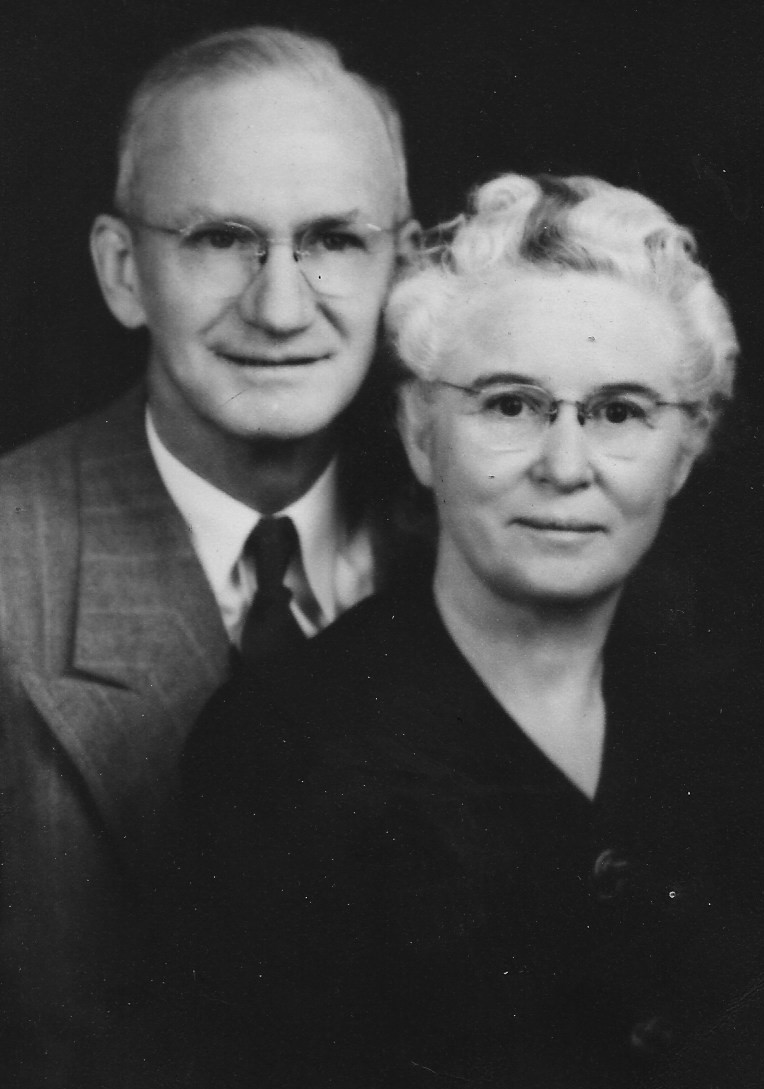
Jess and Mabel Davis, my father’s parents
Two of my “bonus” cousins were the daughters of my dad’s best high school friend. My grandparents, Jess and Mabel Davis, lived next door to my friends’ grandparents in the little town of Anson, Kansas. I called their grandmother, Grandma Meyers, but as a child was never clear how she was MY grandmother too. (She made the BEST egg salad sandwiches.) Later in life, those two “cousins” became step-cousins when my dad’s sister, Nina Maurine, married their father, Mervin. Nina Maurine and Mervin had been an item in their country high school. But Nina Maurine fell madly in love and married a handsome local farmer (a Clark Gable lookalike) and became a rural housewife with three sons. Mervin went on to college, married, had two daughters, and became a successful businessman. Decades passed. Mervin’s wife died. A few years later after Nina Maurine’s husband died, Mervin asked her out. The rest, as they say, is history. The old flame rekindled when they were in their 70s.
Oh, the stories I have about my family are priceless and were generously passed along to me. I’m very sure every family is endowed with stories and wisdom of generations, but we don’t seem obliged to pass them along. In other cultures, in distant times, before writing became universal, a designated person was told the family stories and given the assignment of orally passing them to the next generation. I mourn the loss of that cultural tradition. I applaud all biographers and memoir writers who strive to keep the links between generations alive. I’ve committed to telling my grandson our family stories as part of his birthright.


 wonkagranny