It is Ruth Bader Ginsburg’s 93rd birthday. The Ides of March, 2026. In honor of one of the most iconic women in American history, I want to pass along some of her wisdom. She claims it came from her mother-in-law and pertained to the marital relationship. She broadened the sagacious advice to use during her life as a prestigious and honored member of the highest court in the United States.
I paraphrase here: “In every relationship in life, it helps to be a little deaf. This is not meant to be demeaning, belittling, or dismissive of the other person. It is a self-affirming way to achieve meaningful dialogue. Choose to be a little deaf towards thoughtless or unkind remarks. The type of remarks that are not backed by thought, but are rather reactive, emotional, and lacking reason or fact. Comments that do not serve the higher purpose of advancing an argument but rather attack the person and are derogatory or unkind in nature should fall on deaf ears. Reacting in anger will not advance your ability to persuade. Don’t raise your voice. Improve your argument. If the argument is sound and backed with logic, it should not have to be screamed. Its integrity should stand on its own.”
As it pertains to marriage, it is important to confront disrespectful, thoughtless words and behavior. No one should be a doormat to a partner’s demeaning, thoughtless words or actions. Sometimes the intention is to knock you off-balance, to make you give way. Don’t give anyone control over you. Even in the most loving relationship, emotion can overcome reason. As a long-term strategy, it is important to stay clear of an emotional, reactive response to make a counterpoint in a reasoned way and get to the heart of the matter that can be resolved without invective. Step away to clear your mind, then address the issue. Frame your response with the concept of strengthening your relationship. Speak with honesty, not hostility. Turn tensions to understanding. One way to do this is to write it down. Clarity comes with looking at your own words rather than trying to capture them in a swirling thought process.
As RBG would say, “get it right and keep it tight.”
While I may not agree with all of RBG’s views on the law and the Constitution, I do respect her thoughtful reasoning for her positions.
This headline popped up on my phone and caught my attention.
The UN’s top court has opened a landmark case against Myanmar, accusing the country of committing genocide against its Rohingya (Muslim) minority. The case, filed by Gambia, alleges that Myanmar’s military launched a campaign of violence in 2017 that forced over 700,000 Rohingya to flee to neighboring Bangladesh. The population of Myanmar is predominantly Buddhist, with 90% Buddhist, 6% Christian, 4% Islam, and less than 1% Hindu.
The International Court of Justice (ICJ) in The Hague has begun the hearings, marking the first full genocide case it has taken up in over a decade. The hearings will span three weeks and will include oral arguments, witness testimony, and expert examinations. Gambia alleges the Rohingya community has been subjected to horrific violence and destruction, including atrocities such as gang rape, sexual mutilation and infanticide. The case is significant as it could set precedents for how genocide is defined and proven, and how violations can be remedied. The outcome of the case is expected to have broader implications, including potential repercussions for other genocide cases, such as South Africa’s petition against Israel over its war in Gaza.
Usually, I avoid political news, domestic and international, because it is painfully negative. But this headline stopped me cold because Myanmar is a Buddhist country being charged with genocide. That seems like a huge oxymoron, incompatible, incongruous. Buddhism is considered the most peaceful religion worldwide with its emphasis on non-violence, inner peace, kindness, and respect for nature. This doesn’t even seem real.
What is happening in our world? Riots in Persia, riots in Venezuela, riots in the U.S., riots in Uganda. Can’t we all get along? Give Peace a chance? I have a hard time believing the rioting is the fault of the religions because all the major religions preach peace. The scriptures of Islam, Christianity, and Judaism, all Abrahamic faiths, share messages that encourage unity and peace.
So, it means that bad actors in these countries are ginning up revolts based on criteria that they know will cause division within the population. I can’t say this is new news. It has happened over and over for centuries. Sometimes the issue is real, such as slavery in the U.S. Sometimes it is fabricated by lies like those that were the prelude to the hatred of Jews by a segment of the German population. How do we differentiate the real problems from those that are manufactured intentionally to cause internal strife within a country? What are the power struggles that motivate? Is it money, resources? I believe, more likely, it is an effort to consolidate power among the few to subjugate the many.
When Ken and I moved to southern Arizona to be full-time residents in 1997, we left behind our three kids, all adults, our two mothers, two brothers, and a sister, plus all their families. Throughout our forty years in Bellevue WA, as we established our family, we always spent the holidays with all of them, sharing meals and family traditions. Our first Christmas alone had a daunting, hollow feeling of abandonment, even though it was Ken and me who left the family for our Arizona life.
When we were first married, we spent Christmases just we two, and we didn’t miss anyone because we were so focused on each other and being together. However, after our first child arrived, we were always in the midst of our two families during the holiday season. I decided to find a way to shake the Arizona Christmas blues. I found an ad in the Arizona Star for volunteers to help make Christmas memories for children in Nogales. We signed up.
The patron of the volunteer operation was Jose Canchola, who owned several McDonald’s franchise restaurants. The volunteers all met at one in Nogales. Every year for thirty-one years until his death in 2008, Mr. Canchola hosted a Christmas party for underprivileged children from Nogales, Sonora, Mexico. Jose was born in Chicago to immigrant parents and rose by hard work and persistence to become a business and political leader in Southern Arizona. Besides owning restaurants, he was a part-owner of the Arizona Diamondbacks major league baseball team, and served as mayor in Nogales for a time. His philanthropy was legendary.
On Christmas day, we left for Nogales in the dark morning hours, arriving about 7:00 am. We loaded our backseat with toys and some clothing to add to the contributions of other volunteers and businesses. We were taught a few rudimentary sentences in Spanish to use to help guide them. We learned what our jobs were and waited for the first busload of kids to arrive at about 8:00. We were told the children were from the very poorest part of Nogales and the mountains around it. Buses went into Mexico, collected children in and around Nogales, Sonora, and brought them across the border to Nogales, Arizona, to Mr. Canchola’s McDonald’s restaurant. Bus load after bus load of kids were dropped off to be fed a McDonald’s lunch and receive gifts of clothes and toys.
One large room of the restaurant was heaped with gifts for kids. Toys on one side and clothing on the other side. Each child was greeted at the bus by a volunteer and either taken into the dining room for lunch or brought into the big room to choose clothing, a backpack, and a toy. Then they switched, and the lunch group went into the big room, and the other group went for lunch.
I worked in the toy/clothes room, and Ken worked in the restaurant serving lunch. It was timed perfectly and, as one bus load finished choosing gifts and eating lunch, another bus pulled in with another group of kids. There were about thirty minutes between buses. One group was loaded back onto their bus, returning to Mexico as the next bus was greeted. It was rapid fire with no time between bus loads. I cannot tell you how many children were served that day, but we didn’t stop until after dark, at least nine hours, probably fifteen busloads of kids.
I marveled at the fact that the parents of all the children had faith to put their kids on a bus headed to the U.S., knowing they would be cared for by strangers and returned with gifts and a full tummy. The children were as young as two, on up to ten or twelve. Some kids came in family groups with the eldest looking after one, two or three siblings. A few of the children asked if they could take a gift to a sibling who wasn’t able to come on the bus. Some took a sack lunch of a hamburger and fries back with them to siblings who were left behind. The kindness and generosity of everyone involved was a heart-lifting experience. We were all there for the kids.
Very few of the children spoke English well, but most understood it a bit. My job was to take a child to the clothing area and find for them a shirt, jacket, pants, or coat that fit and that they liked. Shoes were available if they wanted a pair. Most picked out one item of clothing, but a few chose two or three items. Then I took the child to the toy side of the room, and they picked out a toy for themselves or sometimes one to take back to a sibling. Each child expressed their happiness at receiving the bounty they took home, some with words, most with their smiling, happy faces.
Ken told me about little ones with drippy noses that he had to wipe before they had their meals. None were obviously sick, but they were not in the best condition either. All were eager to dive into their yummy Mickey D’s. Hamburgers and fries disappeared in minutes.
One small boy sticks out in my mind. While several of the kids had been part of this gift program for a year or two, many were there for the first time. Their bright eyes grew enormous when they took in the stacks of toys and clothes. One little fellow named Luis was about six. He went into the restaurant first, and when he finished his lunch, he came to the big room. I took his hand and welcomed him, and asked what he wanted for clothes. I’ve since forgotten it all. He picked out a jacket, tried it on, and decided to keep it. Then we went to select a toy. I don’t remember what he chose, but his little arms were full. I walked him out to the bus, he got on, turning to smile at me. I watched other kids load and was about to go back inside when a bundle of love tackled me around the waist. It was Luis. He left his gifts on the bus and jumped off to give me a goodbye hug. He looked up at me with the most gorgeous, sweet smile and said, “Gracias, amable dama.” My heart melted. Tears come into my eyes now as I write this, nearly thirty years later, because I can still feel his hug and the look in his big brown eyes. Another volunteer translated his words, “Thank you, kind lady.”
Ken and I drove back to Oro Valley that night, exhausted but with full hearts. We experienced the essence of Christmas. GIVING and SERVICE to others. Our family now included all the children we met that day, even though we will never see them again. It was and is the very best Christmas I ever had.
We moved to Tucson from the Pacific Northwest, where gray skies and moderate temperatures abounded. We laughingly called rain, liquid sunshine, in an effort to not feel left out when the rest of the country experienced bouts, sometimes whole days of bright skies. The first year and into the second year in Tucson, I marveled that Dillard’s, Sears, and Penney’s stores offered sweaters and even jackets for sale. Why oh why would they have such useless apparel in the stores? I dressed year-round in shorts and sleeveless tops…for the first two years.
Then my blood became as thin as pomegranate juice. I discovered I NEEDED a sweater, especially when going into stores because of the excessive air conditioning. I needed a sweatshirt, sometimes a jacket, for winter, to wear with full-length pants. I began to need long underwear as temps dipped below 80° in November.
Relatives and friends who don’t live here think it strange. 80° is my bottom-line temperature now. Anything below that I consider frigid and requires supplementary attire to combat goose bumps. Long underwear is a staple. Heaven forefend if the atmosphere drops below 50°! I become bundled like an Eskimo. I scan internet ads for excursions to the equator. Fortunately, those chilly temperatures only occur at night when I’m snug in bed with quilts and comforters and a warm hubby beside me.
On the other hand, I can comfortably live in 105°. Of course, I go from my air-conditioned house to my air-conditioned car to an air-conditioned store and back again. I’m not standing outside all day or working in the blazing heat. I worry about those who work in temps up to 115°. I asked Jeff, our landscape guru, how he and his team worked outside all day without expiring. He said they start early, at dawn, when the temperature is milder, and as temperatures rise, their bodies adjust. They are covered head to toe in protective clothing, so the sun doesn’t directly hit their skin, and wear big hats to shade their faces. They drink gallons of water. The dry desert heat evaporates perspiration before you even know you have sweated. They usually quit work around 3:00 pm, which is the hottest time of day.
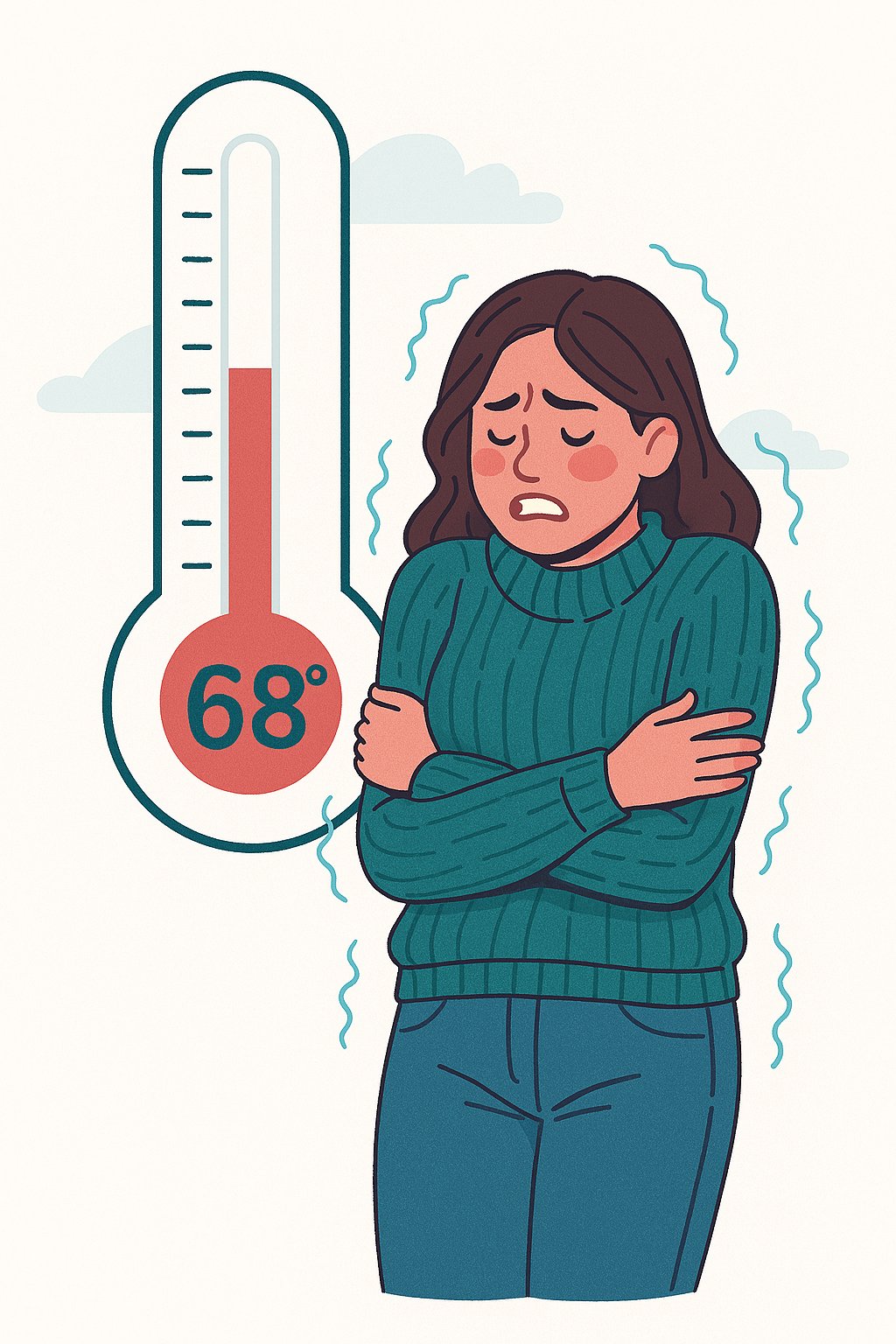
Yesterday, dressed in a long-sleeve top under a long-sleeve sweater and long fleecy pants, I went to the grocery store. Bright sunshine lit my world. I watched people going in and out of the grocery store. I could pick out the snowbirds, winter visitors, immediately. They wore shorts and tank tops. They thought they were experiencing summer, that 68° and sunshine meant it was warm outside. I could only laugh to myself. It was exactly what I thought thirty years ago.
Most of us have décor in our homes: Tchotchkes, pictures, bits and baubles, generational curios, memory laden echoes of our time on earth. My house is full of them. They bring a smile of remembrance. Occasionally I endeavor to thin them out. Endeavor being the operative word in that sentence.
Why, oh why, do I need a 10” yellow ceramic duckling in my curio cabinet? Because it was once a treasured keepsake for my mother. It was given to her by a friend she loved and lost many, many years before Mom died. I remember that friend, and I remember how much my mother loved the duckling. How can I toss it? It is a piece of my mom.
Some of the artwork was given as gifts by friends and family. We have porcelain figurines by Lladro given to us by our niece in Spain that are dear to our hearts. There are carved wooden figurines that Mom brought back after our trip to Germany. We have crystal and glass that dates back to great-great-grandparents.
Most of my walls are filled with photos of friends and family from great-grandparents to our grandchild. I can go to any room and reconnect with those people. We love to take out-of-town visitors to Tombstone and have a photo taken in old west period clothes. Our visitors have endured our obsession. Those pictures reside in various rooms. I chuckle about the memories every time I look at them.
We have collected artwork over our sixty-plus years of marriage that has significance for us. We remember the why and where of each painting and print. A print of praying hands by Albrecht Düerer (1508) graced my great-grandparents living room from the time I remember as a small child. On the back is written 1896. I assume that was when they acquired it.
Among our eclectic collection, we have two prints by Michael Parks, a Salvador Dali, a Diego Rivera, a Renoir, an Edward Hopper, native American drawings, as well as original paintings by close friends who are amazing artists. NONE of which I would part with willingly. I love looking at them every day.
Is it living in the past? Well, maybe, but we have so much more past than future, why not? I’m willing to add new mementos as they arrive.
It is popular among my friends to talk about divesting themselves of those “things” that won’t mean anything to their children or grandchildren. Much of my wall art and shelf dwellers were acquired when our children still lived with us and may evoke a memory or two. I admit the things we collected have no monetary value and will probably not be passed along. They still bring me pleasure and will until I die or become catastrophically forgetful. I want to enjoy them for the remainder of my life, and then, I really don’t care what they choose to do. I will be on to bigger and better things.
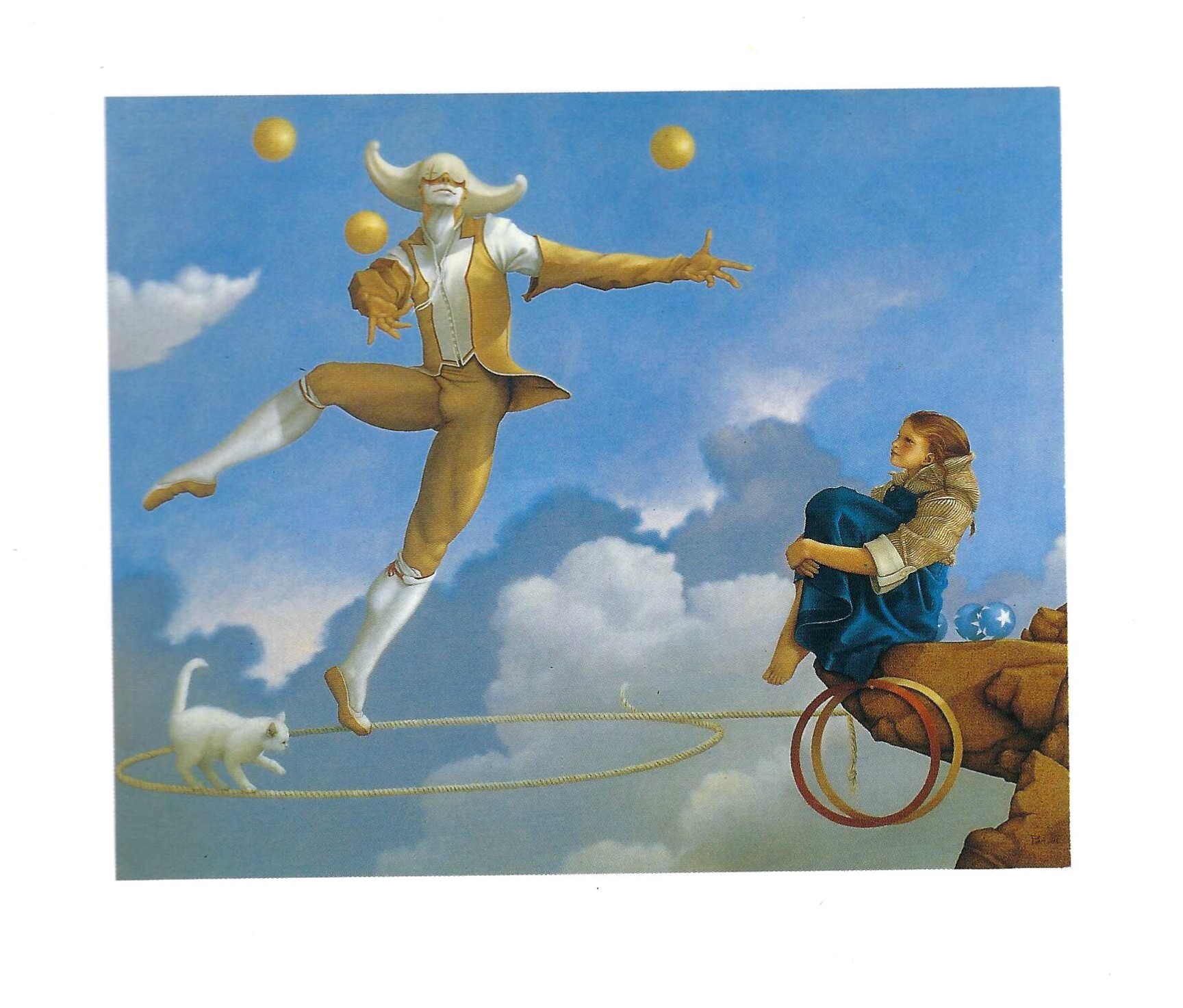
One of my favorites is a print of The Juggler by Michael Parks that is on the wall of my office. Our writing critique group had a prompt to write about a piece of artwork or a photo in our house, and what it means to us. This is a poem about The Juggler.
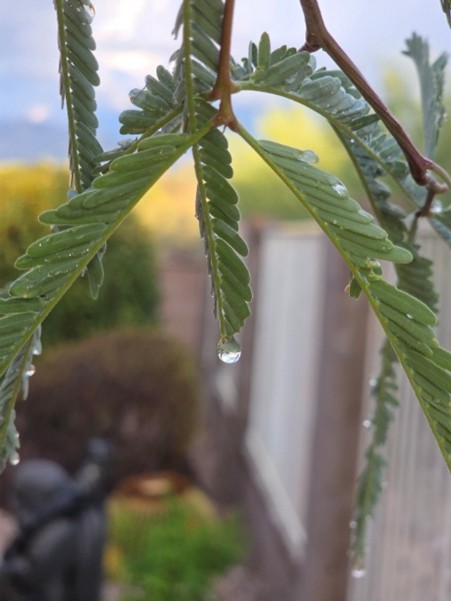
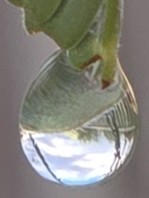
After one of our dynamic monsoon deluges in September, I took a photo of a single drop of rain at the end of a leaf of the mesquite tree that resides in our backyard. Recently, I magnified the drop and, lo and behold, there was the reflection of the world upside down with the sky and clouds at the bottom, the fence reflected at the side, and trees showing above, or rather, below the fence.
I am no scientist, not physics, nor biology, or chemistry, so I cannot tell you why this raindrop reflects so perfectly the world around it – but upside down. I call it a wonder, a miracle of nature, and I’m good with that explanation. It is, in fact, beauty; a beauty that goes unremarked if not examined closely.
Raindrop hanging from end of a mesquite leaf
Raindrop magnified, showing the world around it.
Rain, a miracle in the desert, ushers in a plethora of natural marvels. Grass sprouts up on heretofore barren ground. Flowers, waiting for the moisture, bloom with exuberance. Our mountains, usually in a variegated wardrobe of browns, tans, gold, and grey, turn green. Our air is flooded with the intoxicating smells of the creosote bush and acacia tree. The scents bring with them feelings of serenity. Scientists say the volatile oils of Sonoran Desert plants produce some of the most healthful scents in the world.*
Everyone smiles after a torrential monsoon – it just happens.
Last week I read an essay called Radiances** by Grace Little Rhys. In it, she extolls nature through the innocent observations of children; the radiance of sunlight, of jewels, of rainbows, and of flowers.
“Do you love butter?” say the children; they hold a buttercup under your chin, and by the yellow light that rises up from it and paints your throat, they know that you love butter.” *
We left monsoon season and are entering fall. I can’t say I miss the heat, but I do miss the thunder, the lightning, the cloudbursts, the drama, and the smells of monsoon. I’m so happy to have this photo of the drop of rain that captures the world after a downpour. I will look at it often, in wonder, as I await next year’s monsoon.
One of my favorite philosophers, Jimmy Buffett, titled one of his early albums, Living and Dying in ¾ Time. There is a rhythm to life and there a rhythm to death. This is the chorus of his song Nautical Wheelers sung in ¾ time.
And it’s dance with me, dance with me, Nautical Wheelers
Take me to stars that you know
Come on and dance with me, dance with me, Nautical Wheelers
I want so badly to go.
In the 1970s, the Nautical Wheelers were a square dance group in the Florida Keys who danced the nights away under a tent. The song is about living life to the fullest, embracing the present with spontaneity, celebrating with people who live in joy.
These days, with news of friends and family dying, I’ve been thinking a lot about death. I am in the time of life when expiration dates are imminent. Baby Boomers are at the edge of eternity, and even those much younger reached the finish line ahead of me. The number of goodbyes has increased at a startling rate lately.
The first death I recall was my grandfather, Jesse Pottle Davis, 1888-1952, at the age of sixty-four, when I was six. I knew him, spent time with him, and loved him but was too young to understand death. It wasn’t until my father got down on his knees to hug me as close and hard as he could, crying, that I understood the depth and meaning of grandpa’s loss. My dad was my strength, and to see him so wretched was a life lesson. Dad died eleven years later at the age of fifty-two and my heartbroken reaction was much the same as his had been. The deepest sense of loss and agony. After several years of cardiac illness, his death from a massive heart attack was sudden and, I’m sure, painful
We are all living and dying. It is a fact. I recently started a journal titled 4,000 Days, not about counting forward days but counting backward from 4,000. I gave myself four thousand days to live, with a caveat for bonus days should I live past ninety-one, which is entirely possible. I did it after reading a poem by a friend titled Happy Birthday in which he comments that birthdays are not about accumulating years, but ticking them off toward the inevitable. Some people I shared the poem with found it a depressing thought. I found it to be funny and comforting in an odd way. The point is to make the most of each day as you count them down. A reminder to live each day. No one is given a timeline, a date certain. Even cancer patients are given hope and a range of time to look ahead. Our appointment to meet the hereafter remains a mystery to us. Thank heaven.
Many years ago, a psychic told me I’d live to be one hundred thirteen. At the time, I thought that sounded great. There is a definite difference between being alive and living. As I age, I’m experiencing losses I didn’t anticipate then. The loss of friends and loved ones. The loss of physical stamina. The lessening of my senses. I’m wearing out. If I lived to be one hundred thirteen with all the pieces and parts intact and all the energy of a forty-year-old, that would be great. But I discovered that isn’t in the plan. An old saying I read once said, “I prayed to live a long life, but I forgot to pray for good knees and a sound mind”. My full-time job now is to stay as healthy and active as possible so my long life (it is already pretty long) is not as a suffering, doddering vegetable in a wheelchair, but as a lively, engaged human who still enjoys each day.
My grandmother, Mabel, 1891-1977, lived to be eighty-six. The day she died she had driven one of her “old people” to their doctor appointment and to run errands. Her “old people” were ten or so years younger than she, but needed help. Grandma was there to help church friends and neighbors whenever she could. After Grandma was widowed, she lived with and cared for her parents until their deaths. When her two sisters and brother were widowed or divorced, they returned home, one by one, to all live together once again. It was a circus of the elderly who acted like teenage siblings most of the time. Grandma went home that day after taking her friend out and told her sisters she didn’t want dinner. She was feeling punk. She went to her room, laid on her bed, and died. Death came in its own time with no announcement.
My great aunt Molly, 1902-1999, told me something shocking on her 90th birthday. I was at her birthday party in Cheyenne, Wyoming. The house was full of friends and neighbors who came to celebrate her. She was very active in her church and community and in good health. She was on a bowling team and enjoyed going out for beer and pizza. As I was leaving, I told her I’d try to be there to celebrate her ninety-first.
She took my hand in both of hers, looked into my eyes, and said, “I hope I’m not here.”
I was astonished. “What do you mean?” I asked.
“Everyone I care about is gone. I have been left behind, and I want to go,” she said.
Here she was surrounded by people who cared about her, and she didn’t want to live. Her husband had died. Her only child had died, and all of her lifelong friends had died. Even in the midst of a loving community, she felt alone. She didn’t get her wish; she lived to be ninety-seven.
Now that eighty is upon me, I understand what she meant. Not that I’m anxious to die. I have lots of things I want to do yet, and I have the health to keep going. But I understand her perspective. It seems that every month I hear of another one, two, or three friends or acquaintances who passed over. I have no fear of death but a little of dying. I don’t want pain to be part of the process, and I know that is possible.
I’ve come to equate dying with being born. Both are struggles, voyages into the unknown. Both make major changes in existence. First you are in your mother’s warm dark comfortable womb with all your needs met instantly. Then you are pushed and shoved through a narrow opening into the light, bright, noisy, world with strangers around you, hands moving over you and a sense of loss of your warm safe world. It is a violent change. There is nothing smooth or easy about birth either from the baby’s or the mother’s perspective. It is a struggle to become a physical human. Slowly your soul must learn how to inhabit this new form with its new demands. Your brain must reach for new understanding. Your body needs to learn to be autonomous.
Touch can be painful, sound can be painful, sight can be painful at first. It takes some getting used to. Then you live a life of ups and downs as you learn to navigate our world and stretch to learn what “being” means. It takes a while. For some more time than others. We all learn through experiences, the trauma, the pitfalls, physically as well as emotionally of being a person. That is balanced by the highs, the joys, and the pleasures of our body’s sensual life, along with the spiritual and intellectual journey our worldly life demands – it’s a big undertaking.
The body contracts illness or is broken, there is heartbreak, your spirit suffers on your journey through life. If you are lucky, plucky, and resilient, your life is relatively smooth. Then there are those who go through agony in their earthly existence. Who is to say which path you will be on? Which tune will lead your dance?
And then we die. We all die, no matter if we’ve enjoyed the journey or experienced hell along the way. I’ve heard firsthand stories of those who died and returned to the living. I’ve read stories of people who are pulled toward the hereafter and are given the choice to come back to our world. All the descriptions I’ve heard or read make the passage into death seem a lot like the passage into life. Being drawn into an unknown world.
My mother told me that she experienced something like that shortly after I was born. Her appendix ruptured, and they rushed her into emergency for an appendectomy. She was given an anesthetic and left her body. She said she floated above the doctors, looked down at her body and watched them operate. Then all went quiet again, and she knew she had to come back to her life, so she returned to her body and her brand-new baby girl.
Before she died at the age of eighty-four, Mom expressed to me on more than one occasion that she had a beautiful life, a fulfilling life. I was with her when she received her diagnosis of colon cancer. She chose not to take treatment. The doctors said she would live four to six months without it.
She thanked them and said, “I’ve been given my ticket home and I’m ready to go. All I ask is to be kept as comfortable as possible until the end.”
My mouth was dry. My eyes were dry. My heart overflowed with love and the painful knowledge of her impending death. When we got back to the car, it was hard to speak, but I had to acknowledge Mom’s courage. I told her I was grateful to her for making the decision so willingly and quickly. Then the tears began to flow. I said I believed she saved herself and the entire family the stress, the anxiety of watching her go through painful treatments. She was always gracious, thoughtful, and above all, decisive in her life, and she continued that to the end.
She lived four months. She made a list of “last things to do” (Mom was a list maker). The list included going to her favorite restaurant for a margarita, having a ham sandwich from Honeybaked Ham, seeing the movie “Chicago”, and spending time with her granddaughter, who flew in from Seattle. She wanted to see the new office my husband and I moved our company into (even if it meant going upstairs, which was very hard for her), and about ten more things I’ve forgotten.
Mom resided in an assisted living complex, in a one-bedroom apartment about one mile from our house. I went there every morning before work and in the evening after work to visit and comfort her. I spent more time on weekends. She didn’t want to come to our house, but wanted me to stay with her and talk, mostly about my life. I had a friend interview her and write some of Mom’s memories down. We had talked a lot about her life and memories, but I wanted her to speak without me in the room to see if any new memories were triggered by new questions from a stranger. My friend, Linda, gave me a lovely transcript of their two meetings.
I have a friend, had a friend, Diane, who died with ALS. I cannot think of a crueler way to die, inch by bodily inch, with your mind and will still intact, watching yourself diminish. Diane took tap dance lessons at forty. She learned to play the piano at the age of fifty. She played everything from classical masterpieces to show tunes to Christmas carols. She hiked, traveled the world, and threw wonderful parties. Her annual Christmas party had a guest list that grew each year because people she knew clambered to listen to her play carols and sing along. For two years after her diagnosis, she made every effort to continue all that until her body no longer responded to her will. She put everything she had into those last years. Her greatest pleasure, she said, toward the end, was being with her friends.
She embodied the joyful rhythms of life for seventy years. Eventually, every part of her body was disabled, only her eyes moved. Her mind never dimmed. She communicated by a computer that she directed with her eyes. She was loved by many. A four-foot-ten dynamo, she was engaged in living and loving life until she was stopped by the ugly shadow of ALS threw its shade over her. Finally, she made the decision to pull the plug on her oxygen machine and gave her husband the day and time. Family gathered around her at home to say goodbye and express their love. Her beloved chocolate lab, Diamond, was there.
I miss her, her energy, her laugh, her brightness. I mourn that her light was extinguished too soon. She is with me in memory. Photos of us on trips, golfing, rooting on the UW Huskie football team at stadiums across the country, spa vacations, and things we bought on shopping trips together are part of my everyday life. The big copper coyote she bought as a housewarming gift when we moved to Arizona hangs on the guestroom wall; the crazy Christmas tree that sits on high-heel shoes that I decorate each year; the matching raincoats we bought in San Francisco (hers was hunter green, mine red). We were supposed to go to the football game in the rain, but decided to stay in the hotel to watch it on TV, and didn’t wear the coats at all on the trip. (Our husbands braved the game wearing big green trash bags.) So many reminders of her and our friendship are sprinkled like glowing stardust through my life.
Everyone has a different reason for wanting to be alive or allowing death to come on its own terms. I want to live with as much umphh as my friend, Diane, and with as much purpose as my grandmother, Mabel; then I’ll die with no regrets, and hopefully, with as much grace as my mother.
We live amidst a variety of birds that visit our yard daily. Some are seasonal visitors, and some stick it out through hot or cold, sweltering sun, monsoon rain, or winter snow. The doves are the latter. They are always here.
Our yard backs to a nature preserve that used to be a golf course. Substantial old mesquite trees line the edge of the preserve. Rising above the other trees and brush, they are lookout posts for birds. Doves wait patiently in the top branches for me to put birdseed on top of five block fence pillars each morning. Then they swoop down, and the seeds disappear within minutes. If the doves are slow, smaller birds will start their feast.
The gentle cooing of the Mourning Dove is soothing. We hear the more aggressive sounds of the White Wing Dove – still a coo but stronger with an emphasis on the beginning sound. The White Winged dove is slightly larger and more decorous than the mourning dove. White Winged Doves have light gray bodies with white stripes on their wings and, when they fly, rounded tails sport white feathered fans. The smaller mourning doves are drab gray-brown with black spots and have narrow black tails, but their wistful call is so much sweeter.
We enjoy the gleeful cheeps and tweets of other birds, most of which I have not identified. Harris Hawk sounds like the beginning of a baby cry that stops abruptly. She is the dark presence of a predator in our benign assemblage. She is beautiful, however, and oh so clever.
My favorite of all time is the Mockingbird. Their chatter is a symphony of sounds, sometimes a birdy twitter, sometimes a hammer, then a barking dog. When our mockingbird visits, we are entertained for as long as he wants to stay. I never leave the backyard as long as he is around. He used to visit often, but it has been over a year since we’ve seen or heard him in the backyard. I heard him this morning, as I walked through the Preserve, so I know he and his cohorts are still around.
We are blessed with little hummers too. I believe they are the variety called Anna’s Hummingbird. They are mostly green and gray, but some have a reddish head. The females are gray-brown with a bit of white on them. They are attracted to anything red. When Ken wears his red ball cap outside, they come to investigate his head. They hang around the lemon tree when it is in bloom. They rise and dive through the air in a birdy ballet.
Doves signify peace, hope, and spiritual purity in many cultures worldwide. To the Greeks, they were holy animals of Aphrodite. To the Jews, they represent God’s holy spirit after the flood. The Cheyenne people of North America had a saying, “If a man is as wise as a serpent, he can afford to be as harmless as a dove,” the equivalent of “speak softly but carry a big stick.” In Hinduism, the Inca Dove represents love and spiritual peace. Doves are used as a universal symbol of peace at international gatherings.
Those folks have not met Lefty.
Lefty is a white wing dove. He is at our back fence nearly every day. We sit on the patio with our morning coffee to watch the coming and going of our bird neighbors. We identified Lefty because he is arguably the major antithesis of a peaceful bird. When he flies in to join other birds, he shoos them off by lifting his left wing and pushing at them until they move or fly away. Mourning doves and small birds skitter when he lands. Even our cardinals who are more his size, leave after he knocks them with his wing a couple of times. The only bird I’ve seen stand up to Lefty is a Gambel Quail. They are roughly half again his size. He doesn’t back down readily but if push comes to shove, their shove is mightier.
The Cactus Wrens are chatty birds, and they are here year-round. They don’t fight, but they are active, flitting from pillar to pillar, staying out of Lefty’s way. They raise their bold voices to scold the other birds, but they don’t get physical. I love to watch them scale the side of the block fence. When other birds are landing on the top, the cactus wren will hop up the wall sideways.
When a local Harris Hawk comes to visit, Lefty along with ALL the birds disappears in a furious burst of winged agitation.
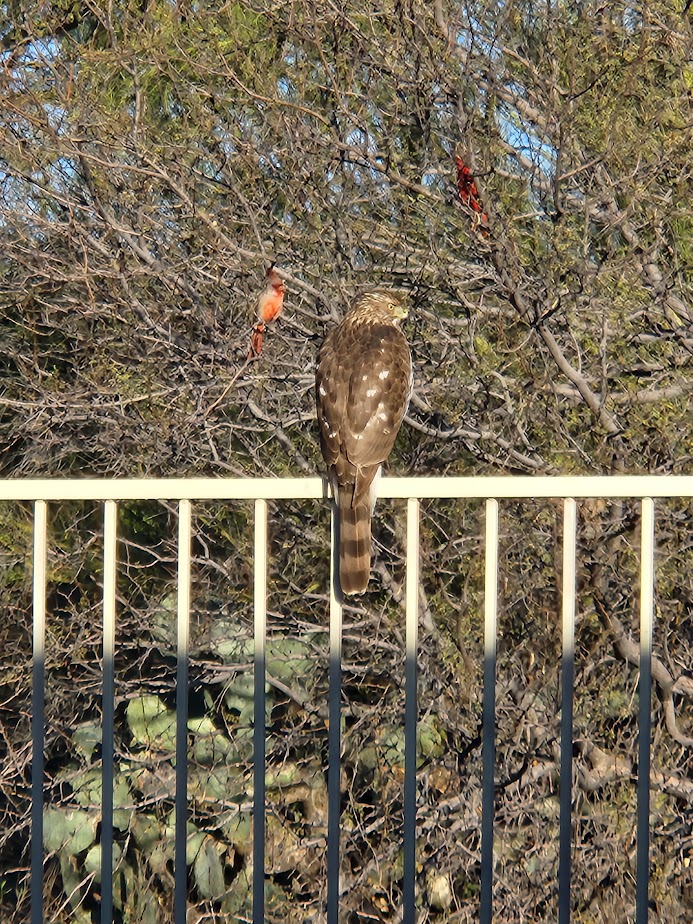
Every now and then, Harris sits on our fence waiting for her breakfast. She knows a dove will eventually come out of hiding. Doves, not known for their smarts, are very low on the food chain. They are the perfect size for a hawk’s meal. Harris has to work harder to get a quail, but I’ve witnessed one being devoured by her.
As I watched one day, Harris patiently observed the Preserve from our back fence. She was waiting for the right morsel to break her nighttime fast. She watched the trees, then cocked her head, looking to the ground. I think she was ready for anything feathered or furred to move. After fifteen minutes, several of the smallest birds came out of hiding, flashing their feathered finery and darting through the branches of trees right in front of her. Instinctively, they knew they were safe because they weren’t even a mouthful for the predator. They acted like a motley crew of comedians, skipping, fluttering and dipping through the tree limbs as if putting on a show. They sat directly in her line of sight as if to say, “ha-ha, catch me if you can.” Of course, it would have been easy for Harris to pick off one of those jeering birds, but the nourishment acquired would not compensate for the energy expended. Harris is no fool. Harris turned her head to look at me as I videoed the scene from my patio, off and on for over an hour, as if to say, “I’m the star of this flick, right?” Finally, a furry creature, I think was a mouse, possibly a pack rat, darted through the underbrush and swoop went Harris. When she flew away, I could see the small meaty creature in her talons, destined to be her morning repast.
We don’t have to leave home to find amusement. We have an endless display of nature to enchant us, especially the charming members of the bird kingdom.
My title may have oversold the train trip Ken and I had to San Antonio. Although all those elements were part of the trip, they were not the focus. I just liked the sound of the title.
If I had a bucket list, it would include more train travel. I received a surprise from my husband for Mother’s Day – a train trip! We took our excursion the first week of June. Of course, when he mentioned a train trip my imagination immediately flew to the movie, North by Northwest, with Cary Grant and Eva Marie Saint. I could see us having a white tablecloth dinner in the dining car and retiring to our intimate compartment for a romantic evening. Well, not so much. The dining room did indeed have white tables (uncovered) with blue cloth napkins and courteous service. The food was above average. But the intimate compartments cost three times as much as the reclinable coach seats, and we are not in that class. The seats are very cushy and comfortable, and Ken was able to stretch out his 6’1” frame easily, but we did not have the privacy of a separate room. Oh well, we’re not driven by our hormones so much anymore after sixty-one years together.
Our destination was San Antonio, a nineteen-hour trip starting at 8:00 am MST and ending in San Antonio at 5:00am CDT. Not my idea of convenient departure and arrival times. We lost two hours en route due to time zone changes. Our train originated in L.A., and we joined the train in Tucson with eight more stops before it reached San Antonio.
I made sure we were in an IM-level train car. IM stands for Impaired Mobility, assuring we were close to a restroom. Ken’s Parkinson’s makes it hard for him to walk distances and navigate stairs.
We were indeed located in the IM car, which is the restroom car. There are only twelve seats, along with seven restroom cubicles in that car. Most of the seating is up a three-tiered flight of stairs above us. Everyone in the upper-level seating had to descend the stairs to our car for bathroom necessities. Our seating area was separated by a door, so we were not bothered by the coming and going of others using the restrooms. All seemed to be as planned.
Seats, arranged two by two, were staggered so that we were not directly across the aisle from another pair of seats, providing a bit more privacy to each pair. The woman who sat across the aisle and slightly in front of us was coughing. She and her companion had been on the train before our stop in Tucson and looked settled in with their carry-ons around their feet. The coughing continued after the train resumed its eastward journey. In fact, the coughing did not let up through nineteen hours of the trip. She would have a break of five or ten minutes every hour or so, but it was incessant for the whole trip. At first, I was annoyed, then mad, then I realized she had no control. She coughed into her shawl, and when it was soaked, she changed to tissues that piled high in a bag at her feet. Her companion coughed now and then also. After a couple of hours, I realized the woman must have asthma, or COPD, or something of that sort. She had no control over her heaving body. She couldn’t sleep because it didn’t let up and, if she dozed, she woke whimpering. Her companion got up a few times to bring water, snacks, and coffee to the afflicted woman.
Others in the car were obviously very ill in one way or another and immobilized. One woman was in a fetal position under blankets and barely moved the entire trip. Her husband got up and walked around a few times for only five minutes, but she didn’t wake to go to the bathroom or drink water or anything. If she hadn’t moved occasionally, I would have thought she was a cadaver. Ken was not at all like any of them. We escaped our ‘car of agony’ to go upstairs to the lounge area to get away from the coughing. We could see out the big windows as we crossed the Texas plains. Later, we went up the stairs to the dining car and had a great dinner. That was when we realized that we didn’t need the IM car because even though Ken had to go up some stairs, it was not an impossible task. The train was packed, and changing seats at that point was not an option. We endured our torment, knowing it was nothing compared to what the coughing woman was experiencing. We could move about and leave the car at will.
We were seated at dinner with a sweet lady, Leesie, 75 years old, she told us. She had just come from LA, staying for six months with her son, who has MS. She lamented the care he was getting and wished she could have stayed longer. A very sad mama. She was on her way back to her home in North Carolina. A retired registered nurse, she spent twenty years as the night nurse in New York’s Sing Sing prison. She was the lone nurse every night. Lots of stories there. Dinner was too short to get her entire history, but she was a very interesting dinner companion.
Our dinner included three courses, an appetizer, a main course, and dessert. I had a salad, NY steak with potato and green beans, and chocolate cake. Ken had shrimp scampi, a pasta dish, and chocolate cake. We each had a complimentary glass of red wine. The steak was the best I’d had in a long time, very tender and flavorful. Our waitress and waiter were very attentive.
Night fell, lights were extinguished except for guide lights along the floor of the car, so passengers could sleep. I am generally lulled to sleep by rolling wheels. I fall asleep within 30 minutes at the start of a journey, when Ken and I go on road trips. There is something about the motion that puts my brain on snooze. This night, however, sleep was impossible for us with our coughing neighbor. The coughing was so steady, it became background noise after a while, and we were able to get a few winks here and there.
Then, in the pitch dark, around 1:00am, the train slowed and came to a full stop. The intercom communications between the conductor and passengers had been silenced at 10:00pm, so passengers could sleep. We received no information as to why we stopped. We sat on the rails in total darkness and silence for over an hour. Of course, my overactive imagination worked at creating scenarios of Comanches galloping over the hills to attack the train, robbers in masks boarding the train to rob and kill us, and all sorts of dramatic reasons why we were dead stopped in the middle of the night. I wasn’t really scared. I was intrigued. Ken and I whispered our concerns. The coughing didn’t let up. Then the train slowly began to gather momentum again, and the steady clackity clack was reinstated.
An hour or so later, the train came to an abrupt, shuddering stop. Again, all the lights went out, the air conditioning stopped, and the engine was quashed. No sound, no explanation, just darkness and silence, except for the unrelenting cough. Hmmm. I peered out the window but could only make out a rock wall close to our side of the train. After thirty minutes, the train resumed its trek.
Dawn began to lighten the sky. Shapes appeared on the prairie, mostly cows and a few scrub trees. The lights came on, and the conductor resumed communication. He told us the train had encountered a flash flood that sidelined us the first time. Then, it hit a cow on the tracks that had to be cleared before we could continue. No Comanches or train robbers after all, just flood water and one hapless cow. The poor cow must have been caught on the tracks in a narrow place where rock walls closely bordered the rails and had no way out.
We were two hours late getting to San Antonio. When I made our hotel reservations, I was told they had a shuttle service to the train station, which was only about four or five blocks away, across a freeway. It was 7:00am. I called the hotel. No, they answered, they did not have shuttle service, nor had they ever had shuttle service. I was misinformed. What? I was tired, sleepy, and discombobulated. Now what? They gave me the number of a cab company. I called. $25, they said, for the five-minute ride to the hotel. Not happening, I told them.
I remembered our daughter told me to download the Uber App for the trip. I had done as directed, but still had no idea what to do with it. I was not in the frame of mind to develop a new skill. Ken was dead on his feet, standing in the parking lot of the train station, exhausted from lack of sleep. I noticed a car pulling in to pick up a passenger from the train. I went to him and asked if he was Uber. Yes. I asked how I could get him to take us to the hotel. He said he could be back in 30 minutes if I used the Uber App. Not what I wanted to hear. Deep frustration was beginning to well up. The woman who was his passenger asked, “Haven’t you used Uber before?” I answered in the negative. She said, “Let me see your phone a minute.” I gave it to her, and she quickly connected me to Uber and showed me how to order a ride. I did, and a lovely man named Jacob was there in five minutes, charging $7 for our ride to the hotel. Now I’m an Uberite with 5 stars!
You’ve heard of sea legs after a long boat ride; well, we had train legs for hours after we departed Amtrak. It is a strange sensation that you are in motion when you are standing still. It affected our walking, creating a rolling motion for a little while.
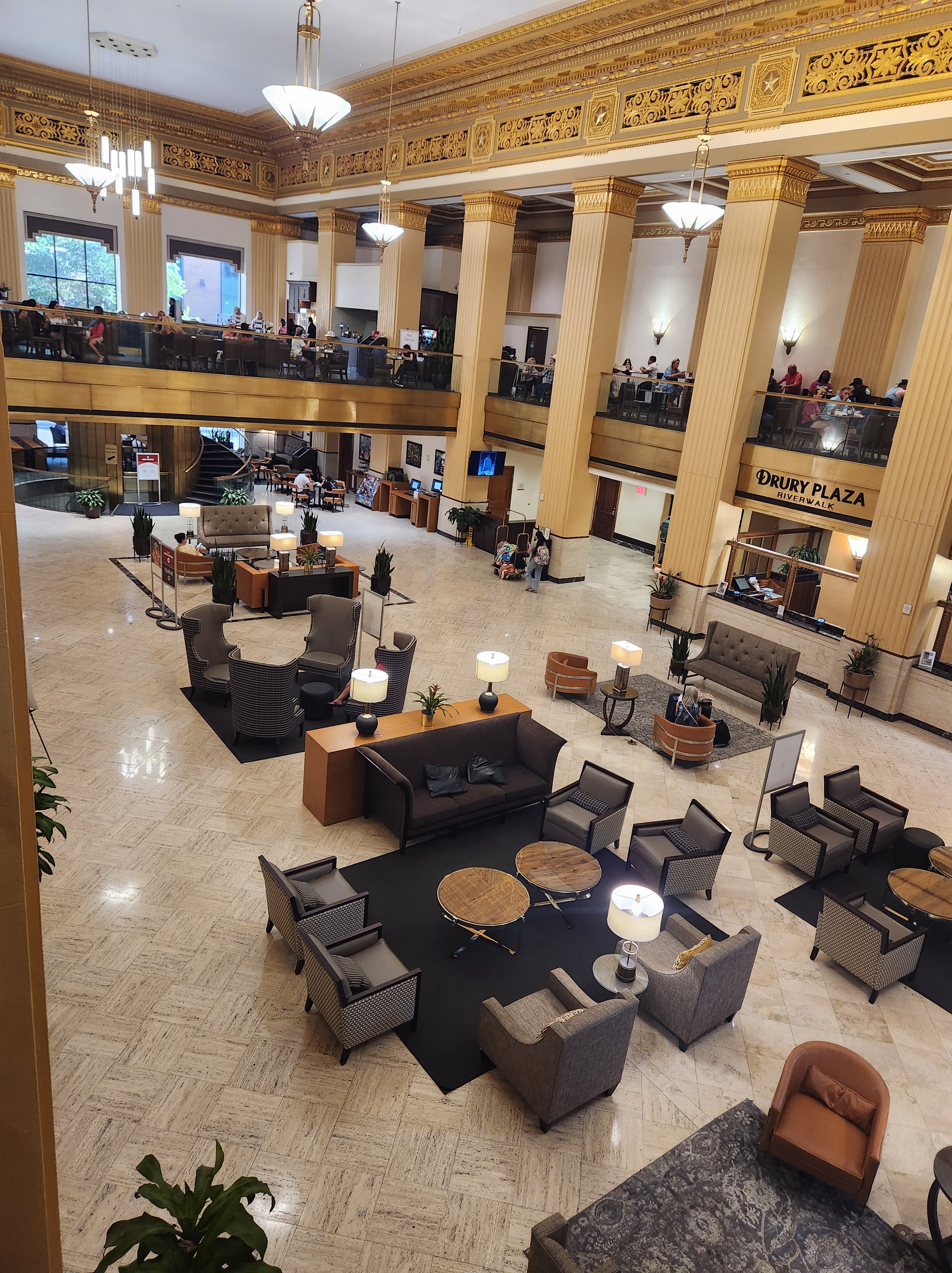
Drury lobby with dining mezzanine above
Despite the lie told by someone representing the hotel, we had a wonderful stay. The Drury Plaza on the Riverwalk is an excellent place in the heart of San Antonio to spend a few days. I explained to the manager my disappointment and frustration about the shuttle confusion, saying it put a blot on the hotel’s name to have people lying about their services. The names I was given over the phone were not people who worked at the hotel, so it must have been a third-party reservation, even though they answered the phone,“Drury Plaza at the Riverwalk”. Grrrr. Traveler Beware! There are so many things to watch out for when traveling.
The hotel served free breakfast from 7 to 9, so we dropped our bags in the room and went to breakfast. Both of us were as hungry as sleepy. The buffet-style breakfast was served on the huge mezzanine above the hotel lobby. Everything ‘Breakfast’ you could think of. We had our fill, then hit the bed as soon as we got to our room. Sleep. That was all we could think of. We both disappeared soundly into slumber for three hours.
Ken stayed in the room to rest, and I went out to explore the Riverwalk and see what I could see. We had been to San Antonio once before at Christmastime in 1984. We watched Santa being escorted by boat down the river, waving at everyone and throwing candy to the kids. The area has grown and changed since then. The Riverwalk, with its trees and flowering gardens, was extended. I walked a 1-1/2 mile loop, glancing into shops and restaurants along the way. I talked with some of the sidewalk marketeers and a couple of the boatmen who shuttle people around the Riverwalk to get insights on the area. The total Walk is fifteen miles, and 4-1/2 miles are in the downtown area of San Antonio. The Alamo was within walking distance, but I’d been there before, and it was hot, so I skipped it. Hot is different in San Antonio – it’s humid hot and wraps around you like a blanket, making it hard to move. You feel lethargic. I’ll take Tucson’s 100° dry heat any day.
The hotel itself is a fun place to explore on an air-conditioned ramble. It was originally the Alamo National Bank that opened in 1929. The décor throughout reflects that era. In 2007, it was reimagined as a 24-story hotel with two towers, balconies overlooking the city and Riverwalk, a large workout room, outdoor and indoor swimming pools, and all the amenities of modern hotels. The lobby is magnificent and harkens back to the building’s original purpose as a bank. The building is on the National Register of Historic Places, and many of its original fixtures are still in place. The original chandeliers hang from the fifty-foot lobby ceiling. The stained-glass window, bronze framework, marble walls, and travertine floors are also original.
Ken in the lobby of Drury Plaza, a 1930 Ford on the right and the original entrance on the left
Our stay included free breakfast and free happy hour with three free adult beverages each day. Happy hour offered a full meal of options served buffet style like the breakfast, Mexican, and Italian entrees, plus pulled pork sandwiches, hot dogs, soups, and salads.
Our day was spent recovering from the sleepless night before. At 5:00, we went to the Mezzanine for Happy Hour and met a nice couple, Paul and Kim, from New Hampshire. We sat with them, chatting about a variety of subjects as we had our cocktails. We found common ground on every subject. They left to have dinner at a restaurant, and we contented ourselves with the wide assortment of dinner items at the buffet.
The next day, we arranged to meet the Jensens, our relatives, at lunchtime. They moved to San Antonio in January and live within thirty minutes of downtown. Charlene, our niece, and Al, her husband, met in college at Texas Lutheran University near San Antonio in 1986. Al is a Lutheran pastor. His calling led them to live all over the western states, raising their kids mainly in Oregon and Arizona. They had been at a church in Montana for a few years and were happy to get back to the warmth of Texas, where their love story began. Mary, Al’s mother, was with them. They treated us to a nice lunch at Rita’s on the Riverwalk. Afterward, we showed them around the hotel, stopping for a while at a large balcony on the eighth floor overlooking the Riverwalk and downtown. When they left, we went back to our room.
Remains of Texas Heroes of the Alamo
Ken needed to rest. I wanted to see the historic San Fernando Cathedral near our hotel. It is the oldest functioning Catholic Cathedral in the U.S., founded in 1736. I walked a couple of blocks to the Cathedral, where the ashes of the Texas Alamo heroes, Bowie, Crockett, and Travis, are interred in a chapel at the front of the church. I walked inside to get a look at the sanctuary and found that I was at a wedding, Karolina and Bryce’s wedding, to be exact. A chamber orchestra began playing a beautiful piece of sacred music as the wedding procession came into the cathedral. I sat in a seat at the side of the sanctuary and listened to the music and the introduction of the bride, groom, and family members. Before the mass began, I quietly slipped out the side door.
I decided to walk across the street to the historic Spanish Governor’s Palace to take a peek through it. It is now the Bexar County courthouse and houses a history museum. I walked in the front doors. I looked back and there was a wedding party assembling on the steps of the courthouse. I watched as a few pictures were taken, then the wedding party came into the building. I was informed that the courthouse was officially closed on Saturday, and only the wedding party was allowed in. I left without seeing any of the museum. I don’t understand why a history museum would be closed on Saturdays, but it was.
I think that is a record, crashing TWO weddings in less than an hour.
I returned to the hotel. We went down to Happy Hour. We had our cocktails and just before we went to get our meal, Kim and Paul showed up. They had been on the opposite side of the mezzanine and saw us across the lobby and wanted to say hello again. They were leaving the next day for a hike and knew we were leaving for home. It was nice to reconnect. Traveling is a great way of making new friends.
Our train back to Tucson left San Antonio at 2:45 am. Again, not a great schedule, forcing us to try to sleep by 7 that evening. We got up at 12:30, gathered our stuff, and went to meet our Uber. I made arrangements, in advance this time, so Lorenzo was there to meet us for the five-minute drive back to Amtrak.
Another five-star ride! I’m a veteran now.
I asked to have our seats moved to the upper level. We didn’t need or want the IM anymore. The train was not as full this time, so they accommodated our change. We hiked up the stairs to nice seats above the rail line. The difference came when the train started. We noticed there is a lot more movement on the upper level. The train sways around turns in the rail, feeling a little top-heavy. It was like riding atop an elephant in one of those big chairs that rock back and forth with each step. The train was dark and quiet. Because of the early hour and my proclivity of falling asleep with motion, I conked out. But I woke up when breakfast was announced.
We had another nice meal in the dining car. This time we were seated with Craig, who was traveling back home to L.A. after working in New Orleans. That is a 45-hour trip, and I thought 19 hours was a long trip. Oh my. He was not as chatty as Leesie, so we didn’t learn much of his story.
George, on the other hand, the snack bar attendant was a wealth of information. I went down to the snack bar to get a Coke, and he and I had a chin wag for nearly twenty minutes. He has been with the railroad for thirty-two years and plans to retire next May. He had lots of stories to share of his thirty-two years. He loves his job but said his wife has the beginnings of Alzheimer’s and he needs to be home more to take care of her. His current schedule is sixteen days on the train and sixteen days home. Other than the route from LA to New Orleans and back, he hasn’t ridden a train. When he retires, he’ll have a lifetime pass and said he would like to ride the East Coast route.
Reclining man boxcar sculpture
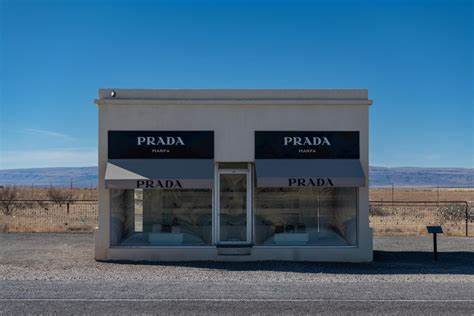
It was so pleasant to be in the upper-level car. We could see across the landscape rather than at the ground level. Our trip back to Tucson was uneventful – cough-free, flood-free, and cow-free, a real blessing. We saw a box-car sculpture set on the open plains and a Prada store in the middle of nowhere next to the tracks with no town in sight. A blimp was tied down in an empty area of the sweeping prairie. We assume it was a weather blimp, but there was nothing around it.
Prada store near Marfa, Texas
Train travel in the US is so much different than in Europe. More expensive for one thing. The sheer expanse of the US makes most trips longer than any in Europe. East coast travel would be more like European travel because up and down the East coast population centers are closer together.
Our daughter, Karen, was there to meet us when we pulled into Tucson station only fifteen minutes behind schedule at 7:15. She escorted us home, safe and sound and we fell into our comfy bed by 9:00. I felt the motion of the train when I woke up in the night, but went quickly back to sleep when I realized I was in my own bed. Now that I’m a seasoned train traveler, I look forward to another ride to a different destination.
Happy Father’s Day to all those great men who shepherd their progeny through the formative years and beyond. Your influence on your children is enormous and felt throughout their lifetimes. Thank you. You are, in many ways, the architects of the future, helping to mold young minds and hearts to take their places in our human society.
Happy Father’s Day to my husband, who has stayed the course with our three children, all adults now. He was there for every school event, every teacher conference, recital, and concert, every soccer and baseball game, even coaching for many years. He takes seriously his role, his responsibility of being a dad beyond providing for the essential physical needs, food, shelter, and clothes. He extended that fidelity to our grandson, who grew up in a one-parent home. Our daughter does an amazing job being the all-around parent, but Henry appreciates having a Grandpa to help guide him, talk about guy things, and give him tips on golf and baseball. Thank you, Ken.
I had a friend who was a jet fighter pilot. As needed in his profession, he had a strong ego, a decisive personality, and many stories to tell about daring deeds. Once, when I asked him what he valued most in all his experiences, he said, “Making memories with my kids. Every day, I try to make at least one memory with each one of them.” He recognized the impact he had on the future and took it seriously. I admire him more for that than any of his brave military exploits. Thank you, Rick.
I’ve written many times of my relationship with my father. It was never expressed during his lifetime, overtly, effusively, or loudly. He was my friend without making a big deal of it. He was my counselor without lectures or making it obvious. He was my dad in every way. A witty, happy-go-lucky guy on the outside, he had lots of demons on the inside. He was powerfully affected by his service as a gunner on a bomber in the European theater of WWII. He received shock treatments for depression when he returned from overseas. He told my mother the only thing he wanted when he was well was to have a baby girl. Mom obliged. I fulfilled his wish.
To my recollection, he never discussed the war in any way. I didn’t learn about his part in the war until after he was dead. Mom said he told her that he wanted to see Germany from the ground someday. He flew many missions over that country, dropping bombs of destruction. He saw how beautiful the country was from the heights of an airplane and, after the war, wanted to visit it in peace. He never did. However, in 1978, ten years after he died, Mom and I went to Germany in his place to witness the peace and beauty of the country. We took a cruise down the Rhine River from Koblenz to Rudesheim, paying homage to my father’s memory.
I remember one day in May, when I was seven, I took home a fancy Mother’s Day card that I made at school. My mom showed it to Dad. When my dad thought I was out of earshot, he said, “I wonder why she never makes me a Father’s Day card?” That hit me hard. We didn’t make Father’s Day cards at school. I’m not sure why. But from that day on, I made sure he had a Father’s Day card, created by me each year. I knew it was important to him.
I was horse-obsessed as a child. I had books and books filled with horse stories, The Black Stallion, Misty of Chincoteague, Marguerite Henry’s Book of Horses, to name a few that I remember. I dreamed horses. My dad bought me countless statues of horses, plastic ones, china ones, carved wooden ones, and cloth ones. When he went on business trips, he always brought back a horse or two for me. I remember a gorgeous pair of china horses, cream colored with gold manes and tails, that he brought to me from a trip to the East Coast. He named them Prince and Grace because it was the year Grace Kelly married the Prince of Monaco. My collection grew and grew with each Christmas and birthday. I played with farm sets like most girls played with dolls. My mother loved dolls and couldn’t understand why the dolls she bought for me were abandoned and unloved. They kept my attention for maybe an hour, then back to my farm animals, fences, barns, and especially horses.
Dad promised to buy me a horse someday. He was raised on a farm and had Old Nobby, but we always lived in suburban environments with no place for a horse. He made sure I got my horse fix. My parents leased horses from stables and individuals for me to ride. I had riding lessons and as much horse time as they could squeeze into their busy lives.
After I was married and had a baby, my father called one evening to say he had bought a horse for me, just as he had promised so many years earlier. My husband and I lived in a small house on an acre of property that we rented from his parents. We had minimal room for a horse, but horses were allowed on acre properties within the town limits. The horse was a Palouse Welsh pony. Every few years, when the wild horse herds became overpopulated, the State of Washington rounded up dozens and sold them at auction. Dandy, a lively brown and white gelding, was delivered to my door. He was housed in the shed area beside the garage and had full use of the acre. He had been tamed but not broken to ride. I started the process and taught him to take me bareback, but not with a saddle. I put our seven-month-old daughter on his back and led him around the property with no problem. He loved to follow me, like a dog, around the yard. The next step was to teach him saddle manners.
Then I found out I was pregnant again. No more riding or breaking horses. With a new baby coming in January, we decided that we needed a bigger house. We had to move and couldn’t afford acreage. I found a good home for Dandy with a local riding stable that needed a small horse for children’s lessons. Dandy was a perfect fit. I was sad to let my horse go after waiting all that time, but my life was taking a different course. My father understood why I had to sell Dandy, but he was happy that he had bought a horse for me as he promised. Dad died suddenly the following February at the age of 52, a little more than a year after he delivered on his promise. Promise made, promise kept. Thank you, Dad.









 wonkagranny