This poem is dedicated to those who were not fortunate enough to find their perfect love on the first try but did find it at last. This is a sample of stories they told me.
His large hand enfolded my own tentative, smaller one on our first date, a move at once assertive but reassuring.
His hands cupped my face, tenderly bestowing our first kiss, third date.
His hand on the small of my back guided me around the dance floor on prom night, and then into our life together.
His hands took mine before God, friends, and family, and placed a ring on my third finger, left hand.
His hands that I crunched with intensity every time cascading labor pains racked my body.
His hand gently held the head of our newborn, her little feet barely reaching the length of his arm to the crook of his elbow.
His hands challenged his copper-miner father’s tough hands to arm wrestling duels – winning more than half the time.
His hand deftly translated an engineer’s arithmetic scribble into precisely drafted drawings of a bridge, or a building, or a subdivision with roads and utilities.
His hand, large enough to hide a baseball and manipulate the shape of a pitch with fingers across seams, two or four, so that it would float surreptitiously by or speed swiftly past a ready batter.
His hands devoted their strength to sensual massages of my body and much appreciated foot rubs.
His hands could fix a toaster or rewire a house.
His hands could stem a bathroom flood or change a kitchen faucet.
His hands cut firewood for our fireplaces.
His hands could adjust a timing belt on an engine or change a tire with dexterity and ease.
His hands mastered every tool needed to maintain our home and cars.
His hands painted every wall in our house with sometimes two or three colors in a room, the joining place of the colors knife-edged perfect.
His hands taught our grandson to build an RC airplane and fly it.
His hands, my safe place.
His hands changed when Parkinson’s appeared with trembling that became shakes, then quakes, until he could barely get a fork to his mouth using both hands.
His hands returned to peace after brain surgery calmed the quakes.
His hands, thin-skinned with ropey blue veins near the surface now weakened, no longer able to open pickle jars or pop champagne corks with aplomb.
His hands still reach across the bed at night to rub my back, soothing unspecified tensions that hide in the crevices of my being.
Most of us have décor in our homes: Tchotchkes, pictures, bits and baubles, generational curios, memory laden echoes of our time on earth. My house is full of them. They bring a smile of remembrance. Occasionally I endeavor to thin them out. Endeavor being the operative word in that sentence.
Why, oh why, do I need a 10” yellow ceramic duckling in my curio cabinet? Because it was once a treasured keepsake for my mother. It was given to her by a friend she loved and lost many, many years before Mom died. I remember that friend, and I remember how much my mother loved the duckling. How can I toss it? It is a piece of my mom.
Some of the artwork was given as gifts by friends and family. We have porcelain figurines by Lladro given to us by our niece in Spain that are dear to our hearts. There are carved wooden figurines that Mom brought back after our trip to Germany. We have crystal and glass that dates back to great-great-grandparents.
Most of my walls are filled with photos of friends and family from great-grandparents to our grandchild. I can go to any room and reconnect with those people. We love to take out-of-town visitors to Tombstone and have a photo taken in old west period clothes. Our visitors have endured our obsession. Those pictures reside in various rooms. I chuckle about the memories every time I look at them.
We have collected artwork over our sixty-plus years of marriage that has significance for us. We remember the why and where of each painting and print. A print of praying hands by Albrecht Düerer (1508) graced my great-grandparents living room from the time I remember as a small child. On the back is written 1896. I assume that was when they acquired it.
Among our eclectic collection, we have two prints by Michael Parks, a Salvador Dali, a Diego Rivera, a Renoir, an Edward Hopper, native American drawings, as well as original paintings by close friends who are amazing artists. NONE of which I would part with willingly. I love looking at them every day.
Is it living in the past? Well, maybe, but we have so much more past than future, why not? I’m willing to add new mementos as they arrive.
It is popular among my friends to talk about divesting themselves of those “things” that won’t mean anything to their children or grandchildren. Much of my wall art and shelf dwellers were acquired when our children still lived with us and may evoke a memory or two. I admit the things we collected have no monetary value and will probably not be passed along. They still bring me pleasure and will until I die or become catastrophically forgetful. I want to enjoy them for the remainder of my life, and then, I really don’t care what they choose to do. I will be on to bigger and better things.
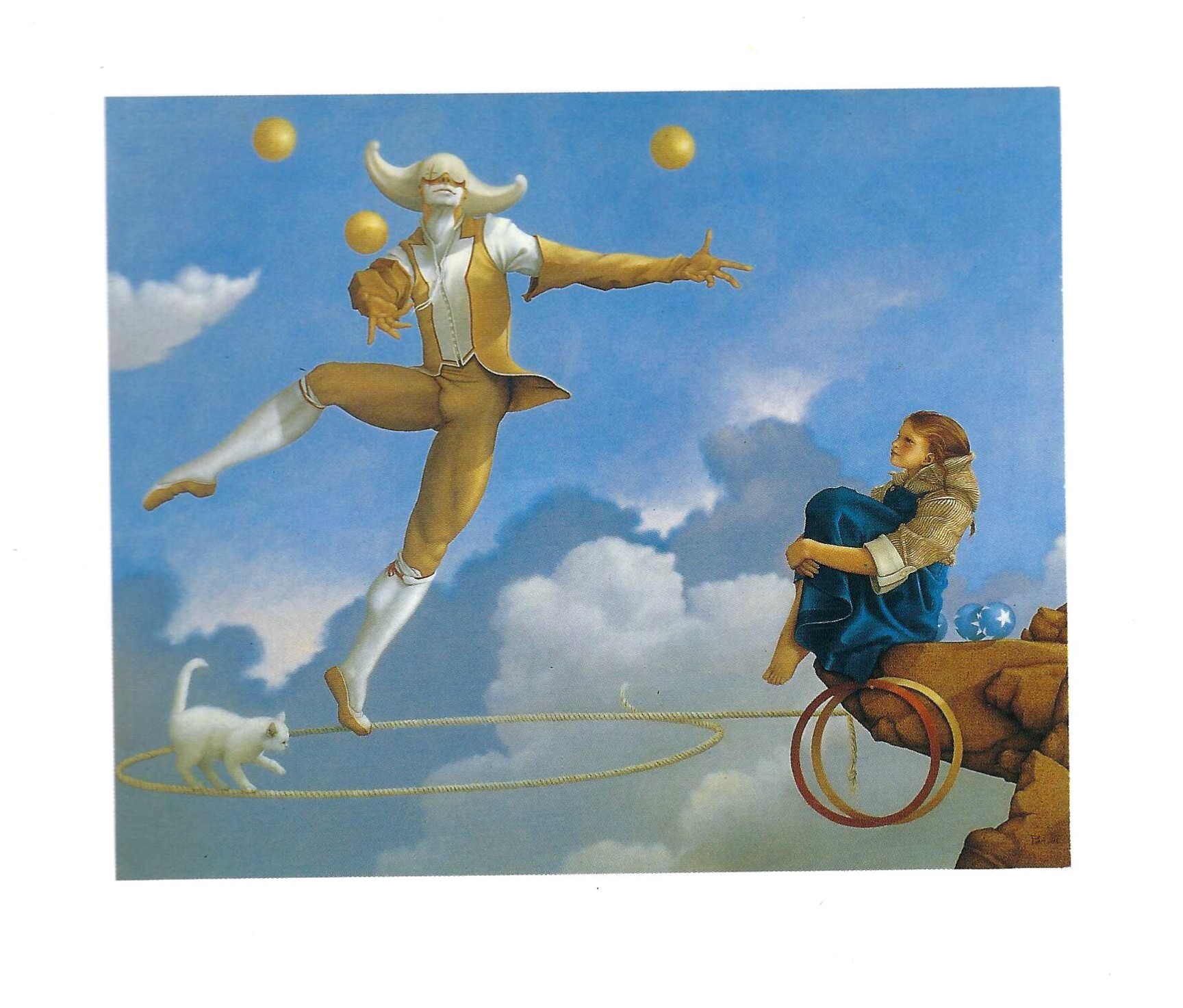
One of my favorites is a print of The Juggler by Michael Parks that is on the wall of my office. Our writing critique group had a prompt to write about a piece of artwork or a photo in our house, and what it means to us. This is a poem about The Juggler.
This poem was written six years ago after the death of a dear childhood friend. Years accumulated without contact between us. In her final months, she reached out to me, a tender reminder of the bond we formed over sixty years before as twelve-year-old girls. Our families both relocated to Bellevue, Washington the summer before our 7th grade year at school; hers from Oregon, mine from Kansas. We were the newbies so naturally clung to each other as we learned how to navigate a new school and integrate into a new community of teens. She will always be a happy memory. Today is her birthday – Happy Birthday, Gerry.
I’m sure all Americans who were adults, even children on September 11, 2001 remember the horror of that September day. Ten days later I was on a plane from Tucson to Seattle and the images of buildings toppling and people throwing themselves into the air were fresh in my mind. Could it happen again? When? Where? How would it feel to be the sacrifice to that terror. This is the poem I wrote while on the plane to Seattle. On the twenty-third anniversary, I am wrapped in the emotions I felt that day.
Billowing palisades, pewter airfalls
Cascade in slow motion
Overflowing the fountain of commerce
Gracefull and grotesque
Soft tarnished silver clouds
Enfold futures lost
Spewing them
Into a bright Manhattan morning
Elegant plumes tumble gently one over another
Carrying tattered remnants of lives
Ripping spirits from bodies
Turning their shells to ash
Is there a torture more sublime
Moment by moment terror
Smelling the hot acrid breath of death
Approaching their prison in the sky?
Does hope flee quickly
Or does it leak slowing
From the corners of their eyes
As the dusk of life turns to night?
Written September 21, 2001 on a plane from Tucson to Seattle.
Our writing group writes to a prompt for each meeting. A recent one was the challenge to write an anaphora poem. First I had to look up what an anaphora poem was. Anaphora is a literary device to emphasize meaning or create rhythm in poetry or prose by using a word or phrase repetitively.
It is exemplified by Charles Dickens’ – It was the best of times, it was the worst of times. It was the age of wisdom, it was the age of foolishness, it was the epoch of belief, it was the epoch of incredulity… giving a rhythm to the opening paragraph of Tale of Two Cities.
Or Martin Luther King’s – I have a dream…. repeated nine times in his speech delivering his dream of hope for our nation.
Or William Blake’s poem London: In every cry of every Man, In every infant’s cry of fear, In every voice, in every ban,…
Last week our writing group had a discussion about place. Where do you consider your home?
I identify as a Kansan even though I haven’t lived there for over sixty-five years. It still feels like home. I have family in several towns across the state from Missouri to Colorado. Whenever I am in Kansas, I am home. I grew up with a large extended family around. Some were city folks, some farm folks. The common meeting place was my great-grandparents’ house where generations gathered for Sunday dinners or family celebrations. My widowed grandmother lived with and took care of her parents in their declining years. After my great-grandparents died, two of her sisters, one a divorcee and one a widow, moved in with her. Then their brother who was also widowed joined them. It remained THE family home for many more years. Oh, the stories that house on High Street could tell. It will always be home even though it passed from family ownership decades ago. There is something that is intrinsically Midwest in my bones.
I spent many summers of my youth with my grandparents in a small town in Colorado. No parents – just doting grandparents. My grandfather was a trainman on the Union Pacific Railroad and was out of town overnight sometimes on runs to Green River, Wyoming. I got to sleep in his bed when he was gone. They had twin beds in their bedroom and I had a big double bed in my room. I loved the cozy twin next to my grandmother. Grandma had a vegetable garden and canned her summer harvest. She had a flower garden that filled my senses with colors and smells. I sat under the weeping willow in the front yard to play with a neighbor girl. Summer at the base of the Rockies was glorious. We fished at Estes Park (Grandpa baited the hook). We always caught enough to cook and eat there with some left to take home for breakfast. The wriggly rainbow trout were put in his woven basket that hung in the water at the edge of the river letting cool water flow through so they were fresh when he cooked them on the portable gas grill. Grandma packed potato salad, buttermilk biscuits, fresh fruit, and cookies for our riverside picnics. Back in their neighborhood, I took long walks with Grandpa, stopping at the ice cream shop for candy cane ice cream. We took trips to the big city of Denver to visit aunts, uncles, and cousins. Grandma and Grandpa listened to baseball every night on the radio. It was a great place to visit, but it wasn’t home.
The bulk of my adult life, over forty years, was spent in the Pacific Northwest where I remained a stranger, an outsider. Even though it was there that I met my beloved, created a family, and had a boatload of friends, it was never home. I love the city of Seattle because of the variety of world cultures that settled and thrive there. You are never far from a festival, an event to celebrate people from far-flung lands. I love my many Seattle area friends. I loved being able to snow ski Mount Rainier and sail Puget Sound, horseback ride and play tennis, most of the year in mild temperatures. Wonderful ethnic food, an enormous variety of world-class arts – museums, theater, music – play a big part in Seattle’s identity. I once wrote a twenty-page paper on the City I Love to Hate – extolling its history and all its virtues and why I suffered in its bounty. I was claustrophobic, confined, imprisoned by the environment. A blue sky is sporadic, appearing a few times a month (occasionally never making an appearance for weeks) and rarely bringing warmth. Clouds hung like Damocles’ sword, low overhead, threatening gloom. My feet never felt dry, my hands never warm. A pervasive smell of mold clung to everything. Trees obscured the horizon and all potential vistas of mountains and lakes. People were closed as tightly as their coats and sweaters, bundled for safety, cliquish.
During our adventure traveling through the contiguous forty-eight states for fourteen months in 1984-1985, we found a place that felt like it could be another home. Tucson. It is ringed by five mountain ranges, not snowy like the Rockies, but rugged and beautiful, rising from the Sonoran Desert. The Santa Catalinas, the Tortolitas, the Rincons, the Santa Rita, and Tucson ranges. These mountains display a mind-blowing range of color at sunrise, sunset, and when clouds filter the desert light. I have photos of them dressed in reds, oranges, blues, purples, and golds. During monsoon season they flaunt a verdant green as vegetation awakens in the nearly tropical heat and humidity. But we still had a life (family and work) in Bellevue, Washington; but when the kids were raised and it was time for retirement we headed south. I am grateful every morning I wake up to the sunshine. I even learned, after many years, to treasure rain again. It was such a curse in Seattle. Anxiety no longer attacks me when dark rain clouds appear on the horizon. They are temporary. I know they will make the cacti and fruit trees blossom, wildflowers erupt into blankets of color and sate thirsty desert critters. I welcome monsoon season like a native. My feet are firmly planted in this place. Breathing clear air, embracing dark skies at night with diamond-bright galaxies shifting overhead, walking trails and communing with desert animals that cross our path or visit our yard, make this place home.
This poem is about the four places that influenced me from childhood until now. Home is more than just an address, a dot on a map. It is a place where your soul can breathe.
Where I Am From
I am from the traveling wind, deep roots, Wide blue skies, far horizons, and waving wheat, Great-grandma’s raw onions by her supper plate, Great-grandpa’s spittoon beside his rocker, Refrigerator on the back porch and dirt fruit cellar, Fireflies on summer nights.
I am from deep dark earth and snowy mountain highs Grandpa’s railroad uniform smelling of wool and tobacco Fishing at Estes Park, summer night baseball, Honeysuckle, snapdragons, and putting up the beans A ringer on the washing machine Cold fried chicken, white bread with butter and sugar
I am from endless gray skies, armies of black-green sentinel fir trees Reaching to the smothering clouds A city where art and music blend past and present A thousand cultures mingle like flavors in a stew The drizzle of cold, the smell of mold Wind in the sails, islands in the fog
I am from the knife-edged peaks with mysterious crevices Rising from the desert floor. Dark starry nights, quiet as serenity Deer, coyote, and javelina share their space. The soul-filling scent of the creosote bush after a summer monsoon. The endless blue of sky and translucent flower of prickly pear.