I lived most of my life in Bellevue, Washington, a suburb of Seattle. I met my husband while still in high school. Ken was a senior at Bellevue HS, a rival high school. I went to Sammamish HS across town.
In the 1962 Senior Class at Bellevue, two men touched our lives in the six degrees of separation way. One was Peter Vall-Spinosa, whose father, Arthur, was one of the priests who officiated at my wedding to Ken in 1964.
Father Vall, as he was known to my family, was the priest at St. Thomas Episcopal Church, where my family attended from the time we moved to Bellevue in 1956. In the 60s, a new Episcopal church was founded in our neighborhood of Lake Hills on Bellevue’s east side. Our priest was Father MacMurtry, known as Father Mac. Father Mac and his family, a wife and two small daughters, lived across the street from us. On occasion, Father Mac would come to our house, where he and my dad would share a bourbon or two while discussing how to change the world.
I wanted to be married at St. Thomas, a beautiful Gothic-modern stone church, instead of the new church that was temporarily housed in an old school building until construction could be financed. Father Mac had to get permission from Father Vall, and both men officiated at our wedding.
The next connection was through Richard Reinking, a good friend of Peter Vall-Spinosa. Dick became a psychotherapist and treated Ken’s older sister during a troubling time in her life. In the 1970s, Dick’s sister, Ann, became famous on Broadway as an actor-dancer-choreographer. She came to the attention of Bob Fosse, a renowned theatrical choreographer and producer. She was his protege/lover. She was in productions of Pippin, A Chorus Line, Cabaret, and Chicago, among others. Ann then starred in the movie All That Jazz, based on Bob Fosse’s life, his marriage to Gwen Verdon, and his six-year affair with Ann. Ann and Gwen became good friends, and they collaborated in the development and production of the Tony Award-winning musical Fosse about his life and work. One of the dance moves used prevalently by and associated with Fosse is his stylized, energetic version of Jazz Hands.
Here are my six degrees of separation to Jazz Hands. I personally knew Arthur Vall-Spinosa, so it starts with him, then to his son Peter Vall-Spinosa, then to Peter’s friend and my sister-in-law’s therapist, Dick Reinking, then to Dick’s sister, Ann Reinking, then to Bob Fosse, who was known for Jazz Hands. TA_DA!
This is a fun exercise for a prompt – pick a person or thing and find a way to relate to them or it through six connections.
Most of us have décor in our homes: Tchotchkes, pictures, bits and baubles, generational curios, memory laden echoes of our time on earth. My house is full of them. They bring a smile of remembrance. Occasionally I endeavor to thin them out. Endeavor being the operative word in that sentence.
Why, oh why, do I need a 10” yellow ceramic duckling in my curio cabinet? Because it was once a treasured keepsake for my mother. It was given to her by a friend she loved and lost many, many years before Mom died. I remember that friend, and I remember how much my mother loved the duckling. How can I toss it? It is a piece of my mom.
Some of the artwork was given as gifts by friends and family. We have porcelain figurines by Lladro given to us by our niece in Spain that are dear to our hearts. There are carved wooden figurines that Mom brought back after our trip to Germany. We have crystal and glass that dates back to great-great-grandparents.
Most of my walls are filled with photos of friends and family from great-grandparents to our grandchild. I can go to any room and reconnect with those people. We love to take out-of-town visitors to Tombstone and have a photo taken in old west period clothes. Our visitors have endured our obsession. Those pictures reside in various rooms. I chuckle about the memories every time I look at them.
We have collected artwork over our sixty-plus years of marriage that has significance for us. We remember the why and where of each painting and print. A print of praying hands by Albrecht Düerer (1508) graced my great-grandparents living room from the time I remember as a small child. On the back is written 1896. I assume that was when they acquired it.
Among our eclectic collection, we have two prints by Michael Parks, a Salvador Dali, a Diego Rivera, a Renoir, an Edward Hopper, native American drawings, as well as original paintings by close friends who are amazing artists. NONE of which I would part with willingly. I love looking at them every day.
Is it living in the past? Well, maybe, but we have so much more past than future, why not? I’m willing to add new mementos as they arrive.
It is popular among my friends to talk about divesting themselves of those “things” that won’t mean anything to their children or grandchildren. Much of my wall art and shelf dwellers were acquired when our children still lived with us and may evoke a memory or two. I admit the things we collected have no monetary value and will probably not be passed along. They still bring me pleasure and will until I die or become catastrophically forgetful. I want to enjoy them for the remainder of my life, and then, I really don’t care what they choose to do. I will be on to bigger and better things.
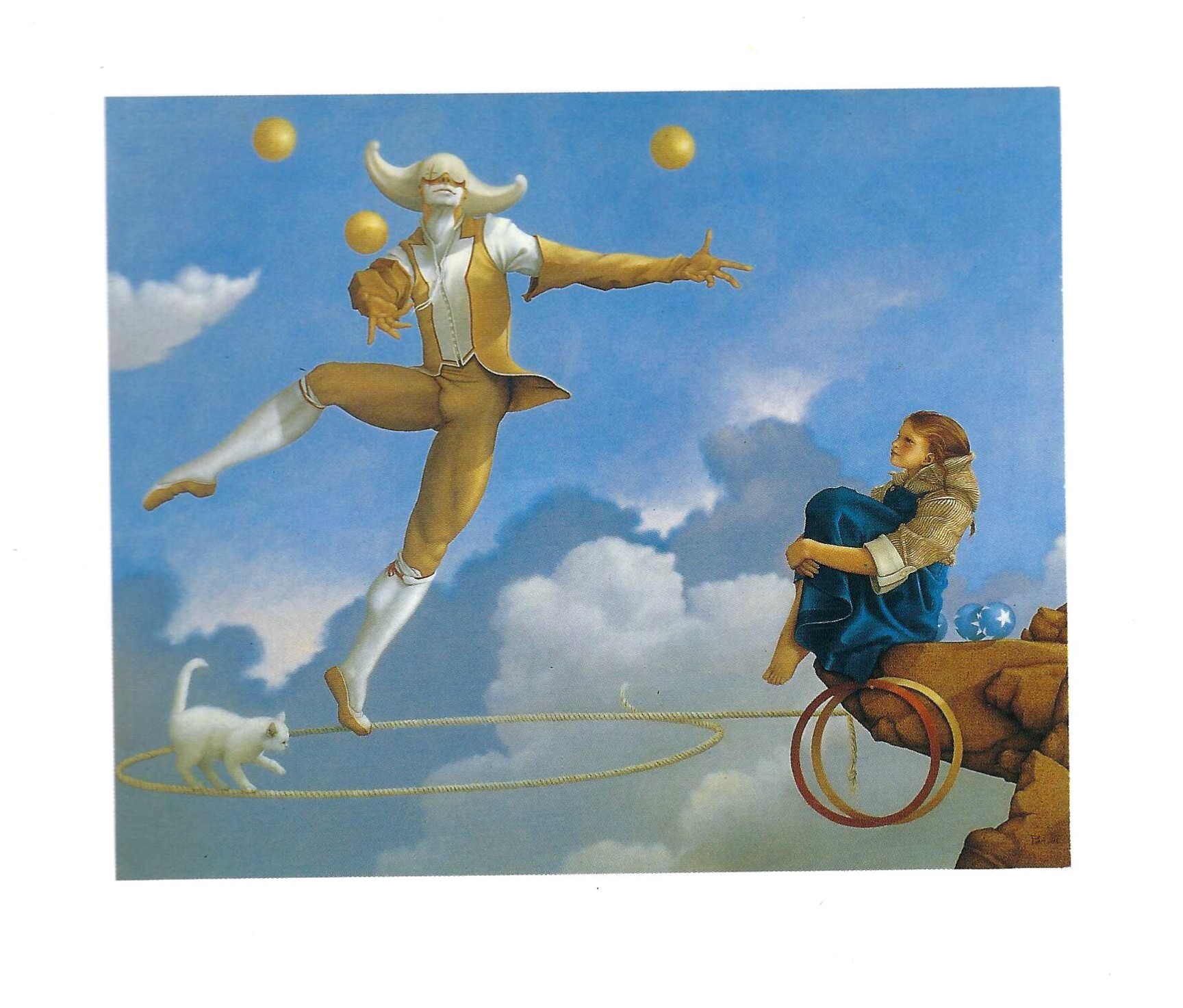
One of my favorites is a print of The Juggler by Michael Parks that is on the wall of my office. Our writing critique group had a prompt to write about a piece of artwork or a photo in our house, and what it means to us. This is a poem about The Juggler.
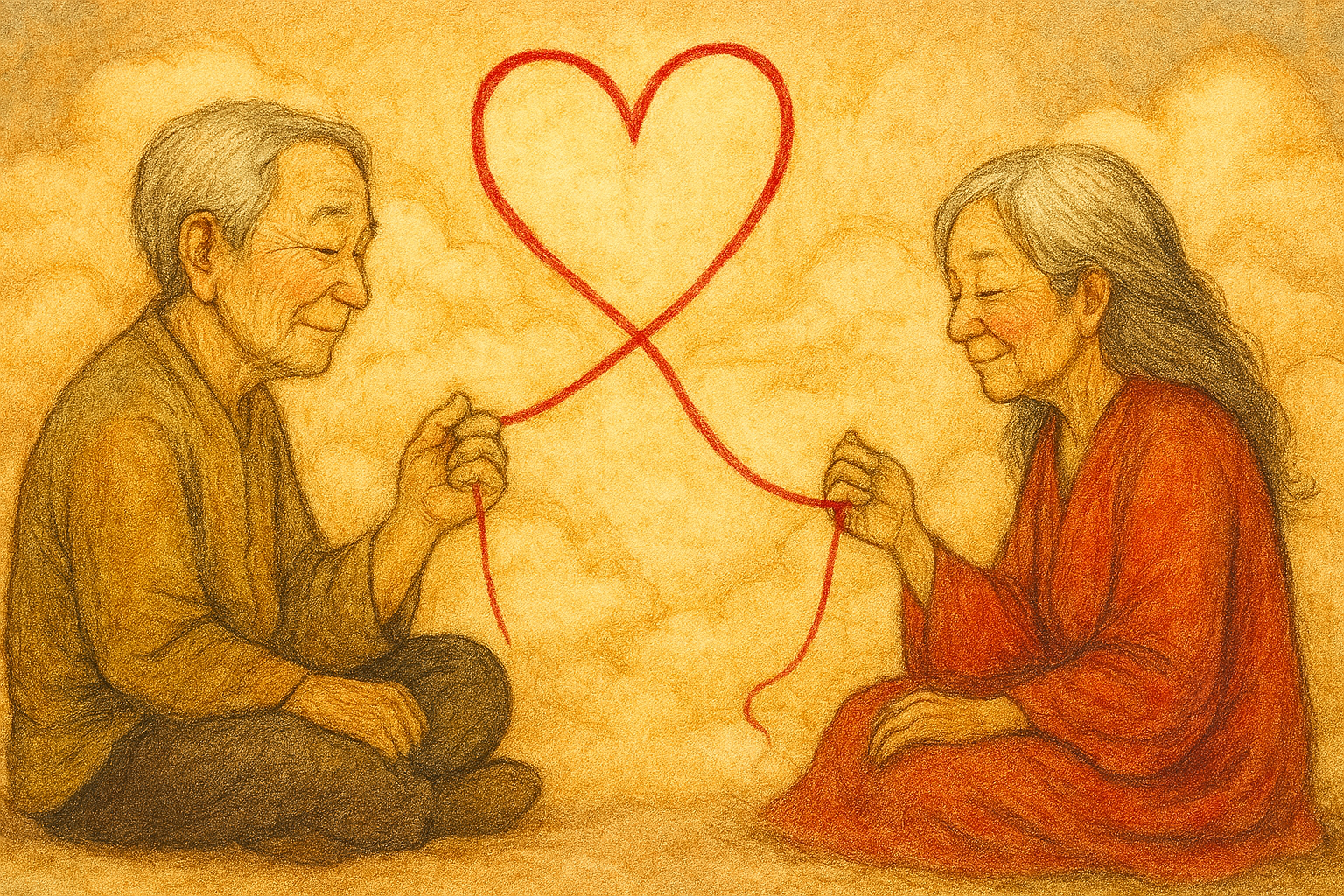
There is an ancient East Asian mythology about love and destiny. It is believed that a lunar god ties an invisible red string around the ankles or little fingers of two people who are predestined to be lovers. The string may stretch or tangle, but will never break because their soul connection has been foretold by the god. Despite challenges and distance, the string will pull these two people together at some point in their lives for a deeply rooted relationship as soulmates. Different versions of this story can be found in Chinese, Vietnamese, Korean, and Japanese cultures.
I know of four stories that can confirm this kind of soul connection that connects lovers even after time and distance separate them.
I recently read a book by Delia Ephron called Left on Tenth. It is a memoir of her life after seventy. Delia was the second of four sisters, all of whom are writers. Her eldest sister Nora is famous for writing Sleepless in Seattle, When Harry Met Sally, Silkwood, and others. Delia worked with Nora on projects as well as writing, directing, and producing on her own.
In this book, Delia describes the heartbreak and trauma of losing her older sister to leukemia and her husband of over thirty years to prostate cancer, all within a year. She writes about her own pre-leukemia diagnosis, a Damocles sword held over her head. Her story tells of reconnecting with an old acquaintance, Peter. He read one of her New York Times op-eds and contacted her. They had been introduced by Nora and dated when they were very young. Delia didn’t remember him or their dates. They corresponded by mail and phone calls. Then Peter flew from California to New York to meet her. They fell instantly in love. Love after seventy. Her story continues through the ups and downs of their courtship and marriage amid her health issues. Her story is sad, scary, funny, upbeat and honest.
Delia’s book made me think of other latter-year romances I’ve known about.
My aunt Nina, her two brothers, and two sisters attended a country school in Sumner County, Kansas in the 1920s. She was the second of five kids. My father was her big brother. A petite, vibrant redhead, she had her sights on a music career. She wanted to move away from the small-town farming community. She had a marvelous soprano voice and performed in a variety of opera and musical comedy theatrical productions throughout her college years. She didn’t want to be a farmer’s wife.
As fate would have it, she fell passionately in love with a handsome farmer, Lee, who looked a lot like Clark Gable. She ended up living in the rural community she sought to escape. They raised their three boys on a farm, in very modest circumstances. At times, they had no electricity in their house. At one time, she had a pump at the kitchen sink and an outhouse, instead of indoor plumbing – not how she dreamed her life would be. She continued her love of music by giving voice and piano lessons and singing in her church choir. She got an LPN degree and worked as a neonatal hospital nurse for years after her family was raised.
Nina was widowed after fifty-two years of marriage. One of her schoolmates, my father’s childhood friend, Mervin, was at Lee’s funeral. Mervin and my dad kept in contact throughout the years after school. Both Dad and Mervin were in World War II, then attended college, got married with children, and went on to separate careers. Our families lived a few blocks from each other. I went to elementary school with his two daughters.
According to family lore passed on by my father, Mervin had a crush on Nina most of their time in school. Mervin was a widower, having lost his wife a few years before. He asked Nina to join him at his sister’s house for dinner, a safe date. His sister, Margaret, and Nina had been friends at school, too. He continued to woo her after their dinner date. She succumbed to his attentions. Within a few months, realizing they had a short future to enjoy, they were married. She was 76 and he was 80. Mervin was a successful businessman and had a large, beautiful home in the big city of Wichita. Nina was finally taken out of her small town, relatively modest life, to a much more comfortable future. They enjoyed their time together until Mervin’s death, two years later. Mervin made sure she was secure with an easy life until her death at ninety-two.
The third love affair I know of is that of my friend, I’ll call Rita. She is seventy. She divorced thirty or so years ago, worked in advertising and real estate, and raised her son as a single parent. She moved to Arizona but kept in contact with friends from her hometown in Indiana. Many of them she has known since grade school.
Over a year ago, she was contacted by Tom. They were in fifth grade together. He never forgot her and found a way to contact her after over fifty years. For months they spoke by phone and texted as they became reacquainted. Their phone calls soon lasted for hours. He flew to Arizona to meet in person and stayed with her for a week. They fell in love. Rita has had several health challenges over the last year, and Tom supported her here and at a distance when he couldn’t be here. Once they traveled by car to California so she could meet his daughter. He pushed her wheelchair on their adventures in Southern California. His devotion is inspirational. They phone and text daily, sometimes hourly, and are now talking marriage.
Another friend of mine recently told me her story about reconnecting with someone from her past and finding love again. Laura was a divorcee living in Colorado. Her children were grown. She attended a family reunion in California. An old family friend, Frank was also there. Frank and Laura had known each other since high school because he was her brother’s best friend. After school, both had married, and Laura’s family moved to Colorado. Although they lived in different states, they saw each other occasionally over the years at family events in California. Laura knew Frank’s wife and kids, and he knew her family. Her kids called him Uncle Frank because he was always invited to big family gatherings. At the reunion, Frank told Laura he had divorced after his kids grew up and left home, and he was single again. He asked her if she would like to go out to dinner. They did, and within a couple of hours, realized they had a connection beyond old friendship. They courted long distance between California and Colorado and were married within a year. They now enjoy their life together in Arizona. Her kids were surprised. “You’re going to marry Uncle Frank?” Her brother was taken aback too. “But Frank has been our friend for decades. What’s going on?”
And so it goes. It is never too late to meet your destiny.
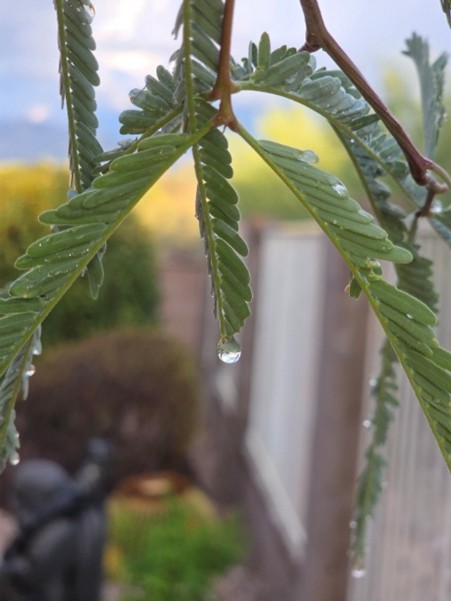
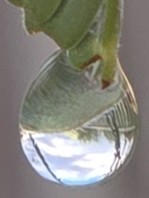
After one of our dynamic monsoon deluges in September, I took a photo of a single drop of rain at the end of a leaf of the mesquite tree that resides in our backyard. Recently, I magnified the drop and, lo and behold, there was the reflection of the world upside down with the sky and clouds at the bottom, the fence reflected at the side, and trees showing above, or rather, below the fence.
I am no scientist, not physics, nor biology, or chemistry, so I cannot tell you why this raindrop reflects so perfectly the world around it – but upside down. I call it a wonder, a miracle of nature, and I’m good with that explanation. It is, in fact, beauty; a beauty that goes unremarked if not examined closely.
Raindrop hanging from end of a mesquite leaf
Raindrop magnified, showing the world around it.
Rain, a miracle in the desert, ushers in a plethora of natural marvels. Grass sprouts up on heretofore barren ground. Flowers, waiting for the moisture, bloom with exuberance. Our mountains, usually in a variegated wardrobe of browns, tans, gold, and grey, turn green. Our air is flooded with the intoxicating smells of the creosote bush and acacia tree. The scents bring with them feelings of serenity. Scientists say the volatile oils of Sonoran Desert plants produce some of the most healthful scents in the world.*
Everyone smiles after a torrential monsoon – it just happens.
Last week I read an essay called Radiances** by Grace Little Rhys. In it, she extolls nature through the innocent observations of children; the radiance of sunlight, of jewels, of rainbows, and of flowers.
“Do you love butter?” say the children; they hold a buttercup under your chin, and by the yellow light that rises up from it and paints your throat, they know that you love butter.” *
We left monsoon season and are entering fall. I can’t say I miss the heat, but I do miss the thunder, the lightning, the cloudbursts, the drama, and the smells of monsoon. I’m so happy to have this photo of the drop of rain that captures the world after a downpour. I will look at it often, in wonder, as I await next year’s monsoon.
The secret sauce of a long marriage is the memories that connect two hearts and minds. Such is the case when Ken and I watched a TV show last evening. We mostly watch British TV because we find the stories and series more interesting. Less about shoot-em-ups and car chases – more about relationship building among characters and good writing. BBC, Acorn, and BritBox are our go-to platforms. Ken mentioned that we don’t have to visit England because it is in our home every day. It feels so familiar.
The title of one episode in the series, Professor T., was A Fish Named Walter. When the name came up on the TV, we looked at each other and started laughing. Not because it is a funny name, which it is, but because it relates to a dog who once upon a time adopted us. Is that a stretch? Not really. This is the story.
In 1982, we went to see the movie On Golden Pond. Norman Thayer, played by Henry Fonda, fished the pond near their summer home in search of the large fish he named Walter, that evaded being caught by him for years. One summer, he took a young boy, Billy, with him fishing, and they finally caught Walter. Norman insisted they throw him back.
The day after we saw the movie, we took a walk to our Medina neighborhood park and were talking about the film as we walked around its shallow pond. Engrossed in conversation, we were surprised when a small golden retriever popped up from the middle of the pond, swam toward us, shook itself off, and followed us around the path. We hadn’t seen the dog enter the pond, just pop up and swim out of it. We looked at each other and, laughing, said, “That must be Walter.”
We tried to discourage the dog, thinking it must belong to someone near the park, but it followed us all the way home. It didn’t have an identity tag or collar, so we couldn’t contact an owner. At that time, we had a six-year-old black lab, Quincey, but decided to allow the dog to stay with us, half expecting it would return to its home. Quincey and the new dog managed a friendly connection.
We continued to call her Walter even after we realized she was a she. Her name probably should have been Zsa Zsa or Marilyn. She was a stereotypical ditsy blonde, sweet and friendly, with soft brown eyes, golden locks, and a constant wag. The vet said she was a mature two or three-year-old mixed breed, mostly retriever, with no evidence of abuse or starvation, and she had been spayed. Someone had taken care of her. She had good manners. She didn’t jump on people, bark, or bite. She was house-trained. Our three kids instantly loved her, and she returned their affection.
She hung around the house, never leaving the yard, for weeks. Our yard wasn’t fenced. Our lab never left the property, and Walter seemed to like being there. We thought that if she had another home, she would eventually go back to it. After a couple of months, I bought a collar for her with a tag that read,’ Hi I’m Walter. If I am lost, please call Diana or Ken at 744-3374′.
Walter began to explore the neighborhood, always returning by dinnertime. I received calls occasionally from nearby people and some as far away as two miles, asking me to pick up our Walter. They usually had a chuckle in their voice when they said her name. We were trying to figure out how to keep her home. Our property was fairly large, and we didn’t like the idea of a fence, but we thought about making a dog run.
One Saturday afternoon, as I was getting ready for a party we were hosting, I received a call from a neighbor who lived around the corner. “Come get Walter,” she said. “She was hit by a car.” Ken went to pick her up to take her to the vet, but she had died. The end of our sweet Walter.
A sad story, but one that nonetheless makes us smile. Walter adopted us, lived with us, and loved us for a little over a year, until her wanderlust took her into danger.
As it happens, we watched On Golden Pond for the second time on TV just a few weeks ago. Seeing the title of the Britbox series’ episode made it all fresh in our minds. It was an emotional movie that had a very different meaning for us as 80-year-olds than it did as 30-somethings. We are both older now than the actors were when they played the old couple. Katharine Hepburn was 75 and Henry Fonda, 77.
Just as I wrote in my blog post about Captain Hershey on January 29, 2024, words have consequences. I had three interactions with then Officer Hershey in a two-year period. The first contact was the most impactful. He was the epitome of what a policeman is. He understood in the deepest way what it means to serve and protect, and the power he had to serve with his words, not with physical interactions.
If Officer Hershey had given me a speeding ticket and sent me on my way that morning, I would have paid the ticket, cursed under my breath, forgotten him, and probably sped down the hill again. Instead, he told me with his words that I mattered, that my speeding had consequences beyond the law. In short, he said, “Do you love your husband? Call him and take him to lunch. It will cost what this ticket should cost. Tell him you are sorry for endangering yourself.” I was immediately taken from the momentary annoyance of getting a traffic ticket to the bigger picture. My speeding on a hazardous road had consequences for someone other than me. I was endangering myself and impacting my husband. His words made a huge difference. I never went down that hill again (safely, I might add) without thinking of Officer Hershey and his words.
As a young mother, I occasionally told my kids exaggerated stories to make a point. One day, when they were about five, seven, and nine, I was talking about being self-sufficient. I think I was trying to show them how to make their own lunches. I said in an offhand way that when they turned twelve, they would be out of the house and had to prepare for it. I said they would be on their own. Our oldest understood the hyperbole, our youngest didn’t really care and blew it off, but our sensitive middle child took it to heart. Days and years passed, and on our eldest daughter’s eleventh birthday, I found Shari in her room crying.
“What’s the matter? Aren’t you going to help me get ready for Karen’s birthday party?”
“I feel so bad,” she said.
“Why?”
“She only has one more year to live with us.”
“What?”
“She has to leave when she is twelve. That’s what you told us.”
Click click click went my brain. I very vaguely remembered saying something like that. I never thought any of them would take it seriously, and think we would really kick them out of the house. At first, I thought it was funny that she believed me, then I realized she had lived with the burden of my words for two years. What kind of monster would hurt their own child with that kind of threat? Shari was devastated, and so was I. It took a lot of hugs and reassurances from both my husband and me to let her know she would determine when she wanted to move out at some point in the future. She said she would NEVER leave us. A smile returned to her pretty face, and her heart was lighter. The birthday party was on, and everyone was happy.
It is critical for all of us to choose our words, whether written or spoken, with care. We can impact someone for good or ill. That’s not to say you can never be critical, but there are words that can help even when you have a negative message.
Our book club read The Gift of Rain by Tan Twan Eng earlier this year. In our discussion, the subject of the three Eastern religions arose, specifically Buddhism, Taoism, and Confucianism. All three philosophies are represented in the story. In Buddhism, a primary tenet is reincarnation. In the story, the sensei, Endo-San, tells his pupil that they were connected in past lives and will be in future lives.
There were differing views on the idea of reincarnation in our book group. I volunteered my experience with our daughter, Shari, as an example of how spirits may be connected over and over across time.
In 1971, when Shari was three, she was watching out of our living room window as her friend, our six-year-old neighbor, Glenny, learned to ride his new Christmas bike on the street in front of our house.
She turned to me and said, “I used to have a bike just like that.”
“No, sweetie. You’ve never had a bike. We’ll get you one when you are a little bit older.”
“I did have a bike when I was a boy,” she said emphatically.
That took me back. What?
“But you’re a girl,” I countered. “You aren’t a boy.”
“Mommy”, she said with an exasperated tone. “No, when I WAS a boy. Then I fell out of a tree and died.”
Now, the concepts of being dead or a different gender were not subjects that ever came up in any of our discussions or games. I was a stay-at-home mom with three children, so I spent hours and hours with my kids. Nothing remotely close had ever been touched on in our play or conversations.
I asked her to tell me more, but she just shrugged and turned to watch Glenny again. It was the end of the conversation.
Later in the spring, she and I were in her room cleaning out her toy box to give away some old, used toys.
She stopped with a reflective look on her face. “Mommy, do you remember when we were Indians?”
I searched my memory for a time when we played Indian and couldn’t come up with anything.
“No, honey, I don’t. When did we play that?”
“We didn’t play it. I was the grandmother, and you were the baby, and I rocked you in my arms outside by the fire.”
Prickles ran up my arms. Again, she was telling me about an experience that she believed happened. She had changed our roles. She was the ancient one, and I, a baby. We were connected, but in different roles.
“When did that happen?” I asked. “Were we playing a game? Did you have a dream?”
“No.”
And that was the end of the memory. She had nothing more to add. She changed the subject to talk about the toys we were sorting. She lost the thought and didn’t want to explain more. It didn’t sound like a dream.
Shari was a very chatty child. She had a lot to say about everything and had an advanced vocabulary for her age. The concepts of death, gender, and role reversal in the extreme were not topics we ever talked about, except for those two instances. She seemed to wander into a reverie, then snap back to the present quickly and didn’t reconnect to the memory at all. When she was eleven or twelve, I asked her about those memories or if they were dreams, and she had no recollection of anything connected to it.
Those two experiences made me question the idea of reincarnation, and I did some research. Psychologists and researchers have documented children who spontaneously reveal memories from past lives. It happens from the age of two when speech is beginning, until about six, when children go to school and are infused with the day-to-day reality of this life. Many recorded cases have been detailed in books, magazine articles, and research papers. They can be ascribed to a rich fantasy imagination. My experience didn’t feel like imagination – it felt like Shari was telling me of real, very specific memories.
A few years ago, we were the caretakers of our grandson, Henry, from the age of one until he started school, while his mom worked weekdays. When he was three, he and a friend were playing in his room, building Lego forts, then bombing them with little rubber balls. He told his playmate that he had been in WWII and died.
From the time he was two, he had an uncommon attraction to guns. When he learned to draw, he drew gun-like figures. When I was teaching him the geography of the U.S., he picked out Florida as his favorite state because it looked like a gun. He bit his cheese sandwich into the shape of a gun. We never had guns or been around them, and certainly never talked about them. I asked my daughter if she had talked about war or guns with him, and she said no, but that he did talk about it when he was home too.
We took Henry to story hour at the library every week, and afterward, we would look for books to check out. He only wanted to pick out books in the history section about WWII or any war. We checked out big volumes. At home, he sat and looked at the pictures and asked me to read parts of the books related to those pictures.
Henry earned TV time by doing small tasks around the house. Usually, he watched old TV shows like Mayberry RFD or a science kid show. One day he watched a documentary about Churchill and war strategy on the History channel. He never took his eyes off of it for the entire hour. He asked me to find war documentaries when he had TV time, not cartoons or kid shows. He wanted to talk about wars, WWI, WWII, and the Civil War. They fascinated him. All that disappeared when he got to school, and it hasn’t been part of his life since.
I certainly learned a lot about wars while I was attempting to satisfy his curiosity. It is a mystery to me how a very young child can connect to experiences they didn’t have in their three or four years on the planet but are able to make them seem real. Could they have been here before? Is it totally imagination? It is a mystery.
PS: I recommend The Gift of Rain. It is about Malaysia during WWII, an area of the world I knew little about. It is the coming-of-age story of a young man, half-English, half-Chinese, with a Japanese teacher. All three cultures collide in his story during the turbulence of war. The concepts in the story are interesting, even if the main character is a bit flat. Questions of loyalty and betrayal are examined.
If you are interested in a recent report regarding children with past life memories, this is a link to a study reported by the University of Virginia, School of Medicine.
A short post to acknowledge all who died in service to our country. God Bless. Not a holiday to say “happy”, but a day to remember those who protected us. They gave their lives so we could live ours in peace.
Red Ass, B24 Liberator
I especially want to thank my father, Jesse Dale Davis who served honorably in WWII as a gunner aboard B-24 Liberator bombers, especially The Red Ass that led the entire 8th Air Force from England to Normandy, France on the D-Day invasion. He was wounded during his twenty-eight bombing raids across Germany, and occupied France, and Holland. He recovered from the physical wounds. The emotional scars remained for his entire life. He provided a comfortable life for his family until his death at age 52. He covered the trauma left in his psyche with wit and humor and never talked about his wartime experiences. Thank you, Dad. I miss you daily and wish we could have talked about your war experiences.
I also want to remember and honor contemporaries who gave their lives in Vietnam – their destiny cut short. They served our country with an innocence of belief in what our leaders said was important. Both were barely 21.
Paul Michael Gregovich DOB: 6/16/46. He died on July 15, 1967, in Vietnam Quang Tin province.
Dennis Quentin Zambano DOB: 10/14/46. He died on October 15, 1967, in South Vietnam Bing Dinh Province.
And to the thousands of others who we don’t call by name, Thank You for your sacrifice.
Standing on the brink of eighty, I have so much past and a diminished amount of future. I must keep reminding myself of that because I don’t feel a day over thirty-five, and my tomorrows still seem endless. I’m listening to friends and colleagues about all they are doing to prepare for their inevitable end. Things like clearing out closets and storage so their heirs are not overwhelmed with the detritus of their lives.
That’s a good idea even if you are not anticipating the Grim Reaper. It cleanses the mind to get rid of stuff instead of stuffing it in nooks and crannies. The same can be said of ideas and memories. They can be aired out, shared with the world, or discarded entirely.
I have so many wonderful remembrances to look back on, I don’t dwell on woes. Among my very happiest memories, besides my relationships, are my stories. I have written countless stories, character sketches, and poems over the years. Only in the last twenty years have I shared any of them. I wrote for myself. As a matter of fact, no one in my family even knew I was a writer. Of course, I didn’t call myself a writer then because to me that was an exalted status far above my humble reach. You know Hemingway, Huxley, du Maurier, Woolf, Rowling, Fitzgerald, Austin, Dickens, and so many more I admire. When I took my first writing class, I was told that if I write, even in secret, I AM a writer. Hallelujah! Now I can say it out loud.
When we moved from the Pacific Northwest to Southern Arizona, I tossed out volumes of diaries, journals, and notebooks of my writing. I figured I’d never have any reason to revisit them. It was my secret life. By chance, some were overlooked, so I have dribs and drabs of my early reflections on life, including my senior year of high school. I would love to look through all those old notebooks again to see how my perspective may have changed.
I started blogging as a marketing tool for a book I co-authored three years ago. It was fun. I was hooked. I started asking my husband to read stories I write for my critique group and blog. He was surprised that I wrote. Fortunately, he likes my writing. At least he says he does. He is not a literary critic, only a reader. He has never liked reading books, so my short essays or reminiscences are just the ticket. Longer projects I have written require an editorial type of review. For now, I’m enjoying the interaction I receive from readers at the Oro Valley Writers’ Forum, my critique group, and my online blog.
I encourage EVERYONE who likes to put pen to paper or tap away on a computer to consider themselves A WRITER. Find a writers’ group that agrees to read and critique your stories. It is a way of strengthening your skills and receiving feedback for your ideas. Writer groups are formed in writing classes given through Pima or the U. of A. The Oro Valley Writers’ Forum at the Oro Valley Library is another place to meet writers and share ideas. It is never too late to share your perspectives with the world. Everyone has a story. Every day is a story. Don’t live in a secret world. Clear out your closet of ideas and reveal your insights through fiction stories, non-fiction, memoir, or poetry. Your voice is an important thread in the fabric of humanity. We have so much more in common than in opposition.
I apologize to anyone who was misled by the title of this piece, thinking there might be some delicious salacious tidbits in the offing. Eighty years have been filled with a myriad of highs and lows, disappointments, and missteps. My deepest, darkest secrets are still locked away in my journals. Some are delicious in retrospect. They may see the light of day at some point.
Today is one of those not-quite-sunny-but-definitely-not-raining days, so we’ll go to another part of Seattle where I once worked, Leschi. It is on the east border of Seattle along Lake Washington, just north of the Lacey V. Morrow floating bridge (the second longest floating bridge in the world, next to the other Lake Washington Evergreen Point Bridge further north on the Lake, which is the longest in the world). Lake Washington is a navigable body of water about 22 miles long. It is deep enough for ocean-going vessels to enter its ports through the canal, then down to the south end. Across Lake Washington, further east of Seattle, are Bellevue and Medina, where my family lived.
Leschi is a mix of beautiful homes, from craftsman bungalows built in the early 1900s to stately Tudors and contemporary homes built later. It was originally a place for summer cottages, but now it is an enclave for multi-million-dollar lakefront properties. I remember the day when, in one of those million-dollar waterfront mansions at Leschi, Kurt Cobain shot himself in the head, leaving Nirvana headless. Sorry, bad joke.
In the late 80s, I worked for two companies at 120 Lakeside Avenue in Leschi. Both were headed by multi-millionaires. First, I worked for a venture capitalist S.S. Besides being a successful entrepreneur, he was a philanthropist. He owned a mall in north Seattle and a prominent grocery chain, which became part of Kroger. He donated to various charities and supported an inner-city elementary school with a $1 million per year endowment. There were only five of us in the office. I was hired as a secretary/receptionist with general office duties. He didn’t have much work that challenged me, and I had time on my hands. It was while working in his office that I taught myself computer skills – back in the day of DOS.
One story about S.S. that I remember was when my husband and I decided to purchase a boat. I told S.S. we were looking around for a modest sailboat. He owned a sailboat, did a lot of cruising, and had some good advice. One piece of advice though, depicts the difference between his place in the world and ours. Speaking very earnestly, he told me to be sure the sailboat had a washer and dryer onboard so that when we were out cruising for weeks, we could have clean clothes. I know my mouth gaped when he said it, but I recovered and thanked him for his advice. His idea of a sailboat was more YACHT than boat. On neither of the boats we eventually owned was there room, let alone hookups, for a washer and dryer. Nor did we cruise for more than ten days at a time. Oh well, a girl can dream.
Later, I went to work for his friend T.L., who, with his partner D.S., managed the upscale commercial building of offices, retail, a marina, and gas dock on the shore of the lake. S.S. bragged to T.L. about my computer skills, and T.L. was just beginning to get savvy about computers for his company. He offered me a job with challenge and a better salary, so I left S.S. We all remained friendly. T.L.’s offices were downstairs from S.S. Cabin cruisers, yachts, fishing boats, kayaks, commercial hauling boats, ski boats, and sailboats paraded past the lakeside windows of my office daily. I managed and leased office space and kept books for the dock facilities. I also set up their computerized accounting system. Those who know me will laugh. I am terrible with numbers, but I do understand computerized systems. Well, I did then when they were less complicated than today.
Let’s have lunch at BluWater; it used to be the Leschi Café when I worked there. They had the very best clam chowder in town. Well, maybe second best next to Duke’s. It’s a nice enough day so we can sit on the patio with a jacket on, watch the boats, and look across the lake to the city of Bellevue, connected to Seattle by the floating bridge. Until the 1940s, the only way to get across Lake Washington was by ferry boat. You can now zip across quickly in your powerboat or go across one of two bridges.
Our son and his friend Mike sometimes skipped a class in high school on a nice day and drove Mike’s speedboat across the lake to my office. I treated them to lunch at the pizza restaurant downstairs in our building before they went back to school. I was not a terribly strict mother. I’ve always felt that experience trumps classroom learning. I occasionally practiced the art of experiential learning as a high school student.
Big Ships at dock during Fleet Week
The last week of July is the celebration of SeaFair, with SeaFair royalty and pirates in the torchlight parade, boat parades on Lake Washington, Navy Blue Angels exhibitions, Boeing airshows, Fleet Week in Elliott Bay with tours of big naval ships, and all manner of hilarity. The size of those naval ships is astonishing. Both of my mother’s brothers were in the Navy during WWII. My Uncle Johnny described his harrowing experience in the Battle of Leyte Gulf and recommended a book, The Last Stand of the Tin Can Sailors. It is about a different naval battle, but he said it brings the feelings to life. In his later years, he talked about it rather matter-of-factly, but I sensed the emotions it brought back.
Hydroplane races on Lake Washington during SeaFair
One of the most exciting things I remember about SeaFair is the hydroplane races. Flat-bottom boats with powerful airplane engines race each other around a course reaching 200+ mph, lifting off the water. It is thrilling to watch their explosive water fantails shoot high in the warm August air. Just as in car races, their roar is so loud you remain deafened for a few hours afterward. SeaFair was a highlight of my youthful summers, I think, because it was usually such a nice weather week with so many diversions.
To continue our Seattle tour, we’ll drive up and over First Hill, one of the original seven hills of Seattle, which we called “pill hill” because of three big hospitals located there. Now we’re in the Central area, the most ethnically diverse neighborhood. It started as a Jewish settlement and is still the home of Temple de Hirsch Sinai, the largest Jewish congregation in Washington. Rabbi Raphael Levine was the leader of that congregation when I lived in Seattle and he was a towering presence throughout the 60s, 70s, and 80s, fighting for civil rights and brotherhood. A Buddhist Church is nearby as well as a Japanese Congregational Church. The Central area had the highest population of blacks in Seattle. The Central area was the childhood home of Jimi Hendrix, Dave Lewis, Quincy Jones, and Bruce Lee, and a staging area for the Black Panther movement in the 60s.
I remember the Central area most because that is where I often went when I skipped school in my senior year. One of the high schools in the area is Garfield. Garfield’s basketball, track, and football teams made the championships every year in the 50s and 60s. In 1963, they had a jukebox in their lunchroom. One of my friends, Kelly, had a car, and her boyfriend, John, was a basketball player on the Garfield team. Kelly and I would leave our school in Bellevue at about 11:30 in the morning and drive across the lake to Garfield to dance to the music and eat our lunch with John and his friends. We got back to our school in time for last period and went home at the proper time. We had friends in the attendance office who made sure we were marked present officially during that time. Can’t get away with that these days.
One time, Kelly and I were walking the halls of Garfield on our way to the lunchroom when a phalanx of large – think football player – young black men with their arms across each other’s shoulders blocked the hall, wall to wall. They wore serious eye-squinting faces as they marched toward us. There was no escape except to go through them. We did. We ducked under their arms. They broke out in laughter. Hearts pounding, we were relieved it was a prank, not a threat.
My French teacher was suspicious and called my house one day when I missed her class one time too many. Usually, that was no big deal because both of my parents worked, so she would not have reached anyone. This was in ancient days before cell phones and message machines. Just my luck, my father was home sick that day, and she told him I missed French class several times in a few weeks. When I got home at the regular time, my father greeted me at the door.
“Where were you all day?” he asked. “School,” I said with total truthfulness, I left out that I had been in two different schools. “Miss D called to say you were not in class today and had been absent several times.” At that point, I was speechless. I thought I had everything pretty well covered. “I’ll ask again. Where were you?” “I was at school,” I insisted, but then admitted, “At lunchtime, Kelly and I went to Garfield to see John. When we got back, it was too late to go to French, but I did get to my last class.” “Don’t do it again,” he admonished, but I could see he was stifling a grin, knowing that was an empty directive. “I told her you came home and weren’t feeling well. She’s watching you.” Then, as an aside, “And don’t let your mother know, you know how she is.” Dad always had my back.
That was the end of the conversation and the end of the episode. Miss D didn’t give up trying to catch me, and I strived to get back in time for her class when we skipped for lunch. I got a B in French (a class I really liked). In retrospect, I think Miss D was one of the teachers who actually cared about my future. She tried her best to give me advice, even keeping me after class to explain how I was cheating myself and that I had so much potential. I blew it off, but I remember her now as a mentor, a failed mentor, but not from lack of trying. It was not the end of my “experiential learning”. My mother never learned about my truancy until I told her years later, after my dad died, that he had been a co-conspirator in my escapades. Her remark was, “That sounds like your dad.”
I graduated with a respectable B average and was accepted to Washington State University for the fall. I liked school and classes, but I enjoyed being a little rebellious, too. I do not think I learned a lesson or reaped the consequences for my misdeeds. Although my college career was short-lived, it was a fun year. That is another story entirely.
On our next tour, we will visit Discovery Park in Magnolia, Elliott Bay, and Queen Anne. I will tell you a little about living on our sailboat.