It is Ruth Bader Ginsburg’s 93rd birthday. The Ides of March, 2026. In honor of one of the most iconic women in American history, I want to pass along some of her wisdom. She claims it came from her mother-in-law and pertained to the marital relationship. She broadened the sagacious advice to use during her life as a prestigious and honored member of the highest court in the United States.
I paraphrase here: “In every relationship in life, it helps to be a little deaf. This is not meant to be demeaning, belittling, or dismissive of the other person. It is a self-affirming way to achieve meaningful dialogue. Choose to be a little deaf towards thoughtless or unkind remarks. The type of remarks that are not backed by thought, but are rather reactive, emotional, and lacking reason or fact. Comments that do not serve the higher purpose of advancing an argument but rather attack the person and are derogatory or unkind in nature should fall on deaf ears. Reacting in anger will not advance your ability to persuade. Don’t raise your voice. Improve your argument. If the argument is sound and backed with logic, it should not have to be screamed. Its integrity should stand on its own.”
As it pertains to marriage, it is important to confront disrespectful, thoughtless words and behavior. No one should be a doormat to a partner’s demeaning, thoughtless words or actions. Sometimes the intention is to knock you off-balance, to make you give way. Don’t give anyone control over you. Even in the most loving relationship, emotion can overcome reason. As a long-term strategy, it is important to stay clear of an emotional, reactive response to make a counterpoint in a reasoned way and get to the heart of the matter that can be resolved without invective. Step away to clear your mind, then address the issue. Frame your response with the concept of strengthening your relationship. Speak with honesty, not hostility. Turn tensions to understanding. One way to do this is to write it down. Clarity comes with looking at your own words rather than trying to capture them in a swirling thought process.
As RBG would say, “get it right and keep it tight.”
While I may not agree with all of RBG’s views on the law and the Constitution, I do respect her thoughtful reasoning for her positions.
How the deep bond between a man and a boy, grandfather and grandson taught me about poetry.
Walter, my father-in-law suffered for five long years from Alzheimer’s disease. His dependency over that time became the elephant in our midst. He lurched from anger, to sadness to confusion and back to anger at his cognitive losses. During ever decreasing lucid moments, he would smile in fleeting recognition even though he forgot our names only to plunge again into no mans land where we couldn’t reach him. Day in and day out, he spent in front of the television even though he couldn’t understand what was going on. He dozed and nibbled snacks. He wouldn’t eat a full meal and forgot how to use a fork, so ate with his fingers. He became a dependant baby animal and lost touch with everything that made him human. Lost in the maze of a home in which he lived for over 20 years, his tortuous days and nights were filled with endless hours of not knowing who shared his world. At times he wept because he was frightened by his image who he called the man in the mirror.
Walt, always an active man, was still well built and muscular into his late-60’s. He initiated arm wrestling contests with his sons and grandsons and nearly always won. In his youth he mined copper in the rough and tumble town of Butte, Montana. He was proud of where he came from and what he achieved not only by his physical hardiness but also his strength of mind and character. He built a two story home for his family from the ground up in Butte. He built the family’s summer cabin at Georgetown Lake. He was carpenter, plumber and electrician all in one. As a true Finn, Walt felt it was necessary to add a sauna to every house they lived in as he moved his family from Butte to Anchorage to Seattle searching for a better life. With less than a high school education he pulled himself up out of the mines and into the business community. He always laughed when he said he went to the best university life had to offer, the school of hard knocks. By the age of 35 he was a city councilman and owned a grocery store uptown in Butte. He and his wife, Pearl, raised and college educated three children and delighted in their seven grandchildren.
The effects of his illness devastated our family. His physical death came three years later than the death of his soul. Walt, the man we loved, disappeared long before he was buried. The disease not only looted his mind, it took his spirit and left behind an infantile creature with dull eyes. Physically he withered to barely 100 pounds. Pearl, his wife of over 50 years, insisted on keeping him home to take care of him herself. The last few months of feeding, bathing, changing diapers and being on constant call wore through even her relentless patience. Her dejected face revealed the pain of watching her husband, lover, and companion grow ever more distant and helpless under her care. Family members took turns spending three or four hours at a time with him to give her a break. During those times he cried or snarled and mumbled incoherently because it took longer and longer to remember words to make phrases. When he finally put a few words together he demanded, “Where did mommy go?”
When he was hospitalized after a slight heart attack, we took turns staying with him at the hospital because the strange surroundings terrified him. He wouldn’t stay in bed unless he was occupied or distracted by someone. I took photograph albums and showed him pictures of his life in Butte, the only past he could recall. Occasionally a glimmer of recollection came, and he would struggle to name a name or describe a place. Since nurses couldn’t spend all their time with him my husband, Ken, stayed in his room all night every night because he awakened so often.
When Walt died, Casey, our son, was 18, a freshman at Washington State University, and a typical teen. Being both gregarious and shy, a charming, contradictory combination, made him popular with his peers. Casey’s best friend in 7th grade was still his best friend twenty years later, even though they chose different colleges and paths in life. He has a whole raft of friends who used our home and refrigerator as their own. In self-defense, I learned to dress immediately upon arising when Casey was home because often I stumbled over sleeping bodies when I went downstairs to let the dog out. I got caught a couple of times in my nighty by strangers who said Casey told them they could crash on our couch or family room floor after a late night or disagreement with parents. Casey spent hours on the phone. I believe he was the social secretary for his group since nothing was planned without his direct contact with each and every friend. When he was away from home, the telephone was his only means of communication with us, most commonly, a request for money. I was never totally positive that he even learned how to write.
Casey’s room resembled Nagasaki after the bomb. Momentos from rock concerts and Japan were strewn among dirty clothes, heaps of clean clothes lay scattered on the floor among school papers, matchbox cars, and stuffed animals. His walls were a collage of rock posters, sports souvenirs, photos of friends, and lists of the current top 100 rock tunes. The built-in desk, which went the length of one wall, had an assortment of unusual beer bottles, more stuffed animals and games lying on it and no room for studying, which was generally done in front of the TV in the kitchen. From his door to his stereo to his waterbed, there was a small, barely visible path amongst the rubble.
Casey had a reverence for ear-splitting heavy metal music along with an appreciation of such classics as the Beach Boys and the Beatles. He taught himself to play the piano, then learned guitar, which he refined daily in his room, hooked to his amplifier with his headphones so we couldn’t hear it.
In his 15th year, Casey grew from five feet to six feet and added an inch each year for the next two years. His weight never caught up. He was unbelievably thin at eighteen, weighing only one hundred twenty-five pounds. His shadow scrambled to stay visible when he turned sideways. He liked his hair long, but his brown locks curled so that, even when grown well below his shoulders, they kinked up tightly at the base of his neck, natural dreads. He wore a diamond stud in his ear, a personal affectation which gave his conservative father apoplexy. They negotiated. Casey didn’t wear his earring in his father’s presence. That changed over time as Ken learned to accept Casey’s personal sense of style.
Casey’s main passion, other than a current girlfriend, was and still is the University of Washington Husky football. Actually, I believe Husky football has, on occasion, come first. He played football and loved it at a younger age, but had the good sense to quit when his teammates got beefy while he stayed reedy. He is probably the only kid to sit in the enemy student section at Washington State University during the Apple Cup rivalry game, cheering for his beloved Huskys to beat WSU …and live to tell about it.
Casey’s second love was Japan, which he visited twice as a teen. It was the focus of his degree program in International Studies. Another of his diversions was magic. His blue eyes gleamed when he mastered yet another illusion to baffle his poor mom. All in all, Casey was a standard model for his generation, delightful and contrary.
Fishing with Walt was a highlight of Casey’s youth. He looked forward to annual trips to Westport with his dad and grandpa. Casey enjoyed Walt’s company and would sometimes get off his school bus at an earlier stop to visit his grandparents. Grandma fed him cookies, and then he’d go outside to help Grandpa in the yard or in his workshop. We lived only 10 blocks away, and his grandpa would give him a ride the rest of the way home after their visit.
During most of Walt’s final year, Casey was away at college. We kept him informed of Grandpa’s condition. The bond between Casey and his grandfather was long ago established in the mystical way that small boys and old men see themselves in each other. When Walt’s health began to wane, their connection was apparent in the way Casey watched out for grandpa when we took him somewhere. Before we were aware of his incipient illness, Walt and Pearl traveled to a Rose Bowl Game in Pasadena with us. After the Rose Parade, we walked toward the stadium for the game. In the mass of people at an intersection, Walt was somehow separated from us. He stood in the middle of the intersection, confused about which way to go. The traffic began to move and honk but he couldn’t find a direction. We were several yards ahead along the sidewalk when we realized he wasn’t beside us and focused on the commotion behind. Casey, then 12 years old, immediately ran to his side and didn’t let go of him for the rest of the day. Walt laughed it off, but it was the first real indication that his problem was more than mere forgetfulness. Casey appointed himself Grandpa’s guardian and protector for the remainder of that trip.
As Walt’s condition worsened, Casey was less and less comfortable being around him for very long. He refused to visit his grandparents. When Casey’s presence was required for family celebrations he glued himself to the TV and wouldn’t get involved when we had to help Walt eat or go the bathroom. The changes disturbed him. It was obvious he didn’t want to see his grandfather in that helpless condition.
What we didn’t know was that while away at school, Casey wrote poetry and sent it to his grandfather. We were shown the letters after Walt’s death. To say we were surprised is an understatement. Casey, who never wrote so much as a postcard to us. Casey’s phone bills were a testament to his inability to put pen to paper. Casey was always so caught up in sports and social activities that we couldn’t imagine his spending enough quiet reflective time or sitting still long enough to put poetic phrases together. But there was the proof. One rhymed and clever composition was sent to wish his grandparents a happy Halloween. It was an “over-the-river-and-through-the-woods” kind of poem about ghosts, goblins, and grandparents.
When we called with the news of Walt’s death, Casey made immediate arrangements to leave school. He took an overnight bus for 15 hours to get home. Pearl asked Casey to write a poem for the minister to read as part of the eulogy. Casey readily agreed. We were surprised because Casey didn’t like being put on the spot to perform, not even his music that he practiced day and night.
The day before the funeral, while everyone dithered about making arrangements and finding accommodations for visiting relatives, Casey slept. He slept on the couch. He slept on the floor. He slept anywhere there was a level surface. I begged him over and over to get busy writing his poem. He told me not to worry, it would be ready for the funeral.
The next morning, again I asked him if he had written his poem. He said no with a “don’t bug me” look and returned to his room, where he strummed his guitar and listened to AC/DC blasting on his stereo. I knew that he was going to disappoint his grandmother and add another sadness to the day, but the more I harassed him the more firmly he resisted. Finally, about an hour before we planned to leave for church, Casey came into the kitchen. As I prepared food for the reception to follow the funeral, Casey slumped his 6′ 2″ frame into a chair at the kitchen table. He tore a scrap from an envelope and started writing in his tiny cramped printing. When he finished he handed me two scraps of paper. On them was the poem. It was beautiful. He hadn’t labored over the words or created draft after draft. He slept and dreamed and played music and let the poem form in his heart. When it was ready, it flowed onto the paper complete and perfect. The poem recalled Walt’s strength, hard work, and devotion to his family. Casey urged us to be inspired by the kind of man his grandpa was. He acknowledged that grandpa was quick to see the good things in him and bloated his head with praise. He urged us to never forget what Walt tried to teach each of his grandkids – to try to be their best. He recalled a float in the 1982 Rose Parade with an old man and boy on it fishing. The float said “Gramps and Me”. When it passed by he and Walt looked at each other and smiled. He asked us all “to take some care and say a prayer and remember what’s been said”.
At the funeral, Casey chose to read the poem to his grandfather himself instead of giving it to the minister. All eyes welled with tears as he recited the love and respect that he felt for Grandpa. It was a simple poem, not rooted in rules of cadence and meter but brimming with a spirit and eloquence from deep within his human soul. In those moments, as Casey stood at the pulpit of the church, our son changed forever in my eyes. He grew from a lively, loving boy to a thoughtful man with the ability and willingness to share his deepest feelings in his own words. It was then, from our son, that I learned what poetry really was, not as I learned in school, but the unknowable stuff of Muses and spirit.
I just read an epistolary novel called The Correspondent by Virginia Evans. It reminded me of other novels of that genre that I read: 84 Charing Cross Road, Frankenstein, and The Guernsey Literary and Potato Peel Pie Society, among them. Letter writing is a long-neglected art of communication. I decided to write a letter to my mother. She died in 2004 and although I was with her almost daily for the last four years of her life, there are still memories to share and things left unsaid.
Dear Mom,
I love you, and I miss you. It’s been over two decades since you left, and I haven’t heard from you, not even a little tweak or shadow.
I remember going to the movie Under the Tuscan Sun about two months after you died. In the movie, Diane Lane walked through an old Italian house when a pigeon flew over and pooped on her head. It made me laugh because I was reminded of the time we were walking across St. Peter’s Square in Vatican City, and a pigeon flew over you and plopped its poop on your forehead. In both instances, everyone around said, “Don’t be upset. That’s a good omen.” I wanted to leave the theater to call you to tell you about it and make sure you saw the movie too. Then I remembered you died. I think that was when I really grasped that you were gone, and I couldn’t share that memory with you again. It hurt. Grief takes so many forms as it comes and goes long after death.
Mother dear, I regret that we had so many years of misunderstandings as I was growing up. I didn’t get you, and you didn’t get me. Fortunately for both of us, Daddy was there to referee. The two of you had different theories on child-rearing. Yours was to set standards and rules and make sure I didn’t deviate from them. Dad’s was to let me make mistakes, take responsibility, learn, and move on. He believed “I’m sorry” was better than “Mother, may I”. I learned from both of you, but of course, gravitated to Daddy’s way of thinking.
It wasn’t until we went to Europe together, I in my thirties and you, at age sixty, that we really talked and got to know each other as adults. I admit I dreaded going alone with you. I thought we’d fight the whole time. You wanted to make reservations in advance for accommodations in every place we stopped, and I wanted to play it by ear and see what turned up. No strings. We compromised; you made reservations in half the cities, and in the remainder, I was responsible for finding our hotel, hostel, or B&B when we arrived. Your choices were lovely hotels; mine were eclectic B&Bs and one very questionable hotel. I apologize once again for the bedbugs. I love being lost in a foreign place, talking with strangers, and finding my way around. You wanted everything planned out to the minute. You started packing a month before we left, with each item of clothing wrapped in its own tissue paper cocoon, and I threw things in a small suitcase the night before. We survived three weeks together and became friends.
As a child and teen, I was always pulling your chain, exploring the outer limits of the rules, as you tried hard to draw me back into line. I’m grateful we had twenty years to make it better, and I know we were great friends when you died. You left an indelible impression on my children. I’m glad they were adults by the time you died. They all have great memories of you. You are a wonderful grandmother.
That day had been the perfect spring Sunday for Ethan and Rhonda Hedgerton. Jonathan, their son, and Evie, his wife, had come for the afternoon with the twins. They made it a point to get together one Sunday every month to catch up on family events and activities. Jon and Evie lived about an hour away. On warmer days, they were at Ethan and Rhonda’s so the kids could swim in the pool. During cooler months, they met at Jonathan and Evie’s. Holidays were always at Evie’s and included her parents…she insisted.
The boys played in the pool as the adults watched from the patio with drinks. Ethan had Guinness, room temp, Evie had iced tea, Jonathan and Rhonda had G&Ts. Later, Ethan barbequed steaks for the grownups and hamburgers for the eight-year-old boys. Rhonda served a medley of oven-roasted veggies and, for dessert, special cream cheese-filled chocolate cupcakes that always made the boys squeal with delight. After the kids left, Ethan and Rhonda cleaned up the kitchen and patio. They settled in for the evening.
Ethan sat in his leather recliner with the footrest up and his stocking feet dangling over the end. He was reading the Times sports section. Other sections were scattered on the floor by his chair. Rhonda sat on the couch across from him, her bare feet tucked under her dress, and the cat curled up in the crook of her knees. She was reading the sixth novel in a series of Gilded Age Mysteries by her favorite mystery author, Rosemary Simpson. She found herself reading the same page over and over. Finally, she plunked down the book without putting her bookmark in it. Rhonda scratched Simone’s silky caramel head, eliciting a rumbling purr.
“Ethan…,” she paused to see if he was listening.
“Huh?” He answered from behind the paper.
“Why did you marry me?”
“I donknow.”
“Really, Ethan. Why did you ask me to marry you?”
“What’s going on?” Ethan lowered the paper a bit to look over the top at Rhonda.
“I want to know why you asked me to marry you.”
“It just slipped out.”
“You mean you had no thought? No intention? I could have said no, and things would have just gone on?”
“Ronnie, what do you want from me. It was forty years ago. I don’t remember what I was thinking.”
“You hadn’t agonized over popping the question?”
“I don’t remember. It seemed to be the right thing, the right time, I guess. What brought this on?” His paper was crumpled in his lap.
“Today, when the kids were here, Jon mentioned he and Evie were going to Hawaii for their tenth anniversary, taking the kids with. You said, ‘Hey boy, you just might get stuck for forty years like me’.”
“So?”
“Well, I saw a look pass between Evie and Jon. I felt like you had thrown cold water in my face. Stuck, you said, stuck.”
“Oh, get over it, Ronnie.” A peevish tone entered his voice.
“I can’t get OVER it. I want to know why you married me?”
“Look, I’m here, aren’t I. No visible chains. You’re making something out of nothing.”
“It’s not nothing if Jon and Evie noticed it. You must have had some thought about us being us.”
“I told you, I don’t remember.”
“That’s not good enough.”
With a sigh, Ethan responded, “I married you because of your soft brown eyes. I liked the idea of having sex with you, morning, noon, and night, without worrying about your roommate coming home.”
“That’s it…sex?”
“Pretty much.” Ethan paused. “Okay then, Miss Third Degree, why did you say yes? Why did you marry me?”
“Because I thought you loved me. I thought we had the same idea about family and our future.”
“I don’t recall ever talking about a future OR a family. I wasn’t really keen on the idea of kids back then.”
“So, we didn’t have the same goals?”
“Goals are something I do to advance my career, not live with my wife.”
“You go your way, I go mine. You work all week. You play golf every weekend and poker once a week. You go out with your college friends for dinner. We don’t do anything as a couple.” Ronda was getting visibly upset.
“I relax with my buddies, put work stuff out of my mind. I enjoy golf. It’s my excuse for exercise. I knew Skip and Tim before I met you. Skip is a bachelor, so there’s no couple to go with. The last time I invited Tim and Kim over for dinner, you told me you didn’t like her. After all these years, you said she was boring, opinionated, and talked too much. I don’t connect with your friends’ husbands. We don’t have anything in common. When I go out with Tim, Kim joins us sometimes, even Skip, and it is easy. Kim’s a kick and blends right in with the guys. For a couple of hours, we all have a good time.”
“You mean you go with them, and I’m not invited?”
“You’re invited, but I tell them you have mahjong that night or are babysitting the twins or something because you made it clear how much you disliked being around Kim. I think they get the picture. If you want to join us and listen to old college reminiscences, you can anytime.”
“We’re living here together for no reason. We’re like roommates.”
“Roommates with privileges,” Ethan quipped.
“Not so much anymore. You barely touch me. Our lovemaking is perfunctory. Like you just want sex but no commitment.”
“I barely touch you because after you started menopause, you said your skin hurt. You flinched every time I tried to hold you. You said you felt sweaty all the time. Over the years, I got used to keeping my distance. I felt like I was invading hostile territory. I don’t want to impose on you. I feel left out when I see you hug your girlfriends, even the guys in your book club, and our grandkids.”
Rhonda opened her mouth to respond, but shrugged her shoulders sadly.
“Hey, I haven’t noticed you being lonesome. You have your mahjong group, your tennis friends, your book club, and you go to dinner with your girlfriends for birthdays and such,” Ethan said.
“We used to go to concerts, plays, and movies, sometimes just us, but lots of times with friends. We used to go dancing and listen to live music around town. Now we just sit here and watch TV. You’re going to retire next year, and we’ll be stuck here looking at each other, wondering why. Why are we together? We have nothing in common except Jonathan and his family. Marj and Colin are planning a cruise the first year he retires, but you don’t like to travel. Bev and Spike are getting a divorce after thirty-six years together. What are we going to be doing?”
“There’s that word stuck again. I get seasick. I don’t like to travel because I like the food I eat here, the bed I sleep in here, and having everything I like, just where I like it…including you. I don’t want to worry about foreign money, foreign language, foreign food, and people I don’t know and don’t want to know.”
“Travel doesn’t have to be foreign. We could travel in the US. There’s a Denny’s or Applebee’s everywhere.”
“But you know how hard it is for me to sleep in a strange bed. My back aches if the mattress isn’t firm enough. I get cramps. My stomach gets upset easily with weird food.”
Rhonda shook her head and looked down at Simone, tears threatened to breach the edges of her eyes.
Ethan got up and walked over to Rhonda. Taking her hands in his, he pulled her to her feet, dumping Simone onto the floor. He put his arms around her carefully, then feeling no resistance, tightened his hug; his chin nestled on the top of her head.
“I’m winding up my last project at work. Next year, when I retire, we will plan things together again, maybe even a car trip. I’ve been so busy I didn’t realize we weren’t.”
He bent a little to whisper in her ear. “As far as stuck, I’ll borrow from Elvis, ‘I’m stuck on you’ and that’s a good thing. I married you because I thought you were sexy, and you laugh at my lame jokes. Your laugh, that starts deep inside you, fills the room and warms my heart.”
The prompt is to reimagine an old legend or fairy tale in modern times.
Goldilocks was a lively curious girl of twelve. She contributed to several blogs with a large following of her peers. One afternoon, taking her smartphone and her adventurous spirit, she went hiking in the nearby woods to boost her step count. Far into the woods, she discovered a charming eco-friendly cottage with solar panels, a rainwater-harvesting system, and a compost bin. The door was slightly ajar.
She called out, “Yoo-hoo? Anybody home?”
Having heard no reply, her curiosity overcame her good manners, and she walked in. It was a cozy place, and she quickly surmised that three beings lived there in harmony with the woodlands.
Inside, she found three bowls of oatmeal on the kitchen counter—one was big, with some foil over the top to hold the steamy temperature, and it was too hot. One was sitting in a bowl of ice and subsequently too cold – who eats cold oatmeal, she wondered? The third was just right with brown sugar and raisins on top. Being a bit peckish, she snapped a photo for her food blog before devouring the third.
Then she went into the living room and tried out three ergonomic chairs—one was too stiff and so high her feet didn’t touch the floor; one was too squishy with a fuzzy throw and a big dip in the seat, obviously made by an overweight being; but the third fit her perfectly. She noted the manufacturer of each chair so she could post a review on her lifestyle blog and moved on.
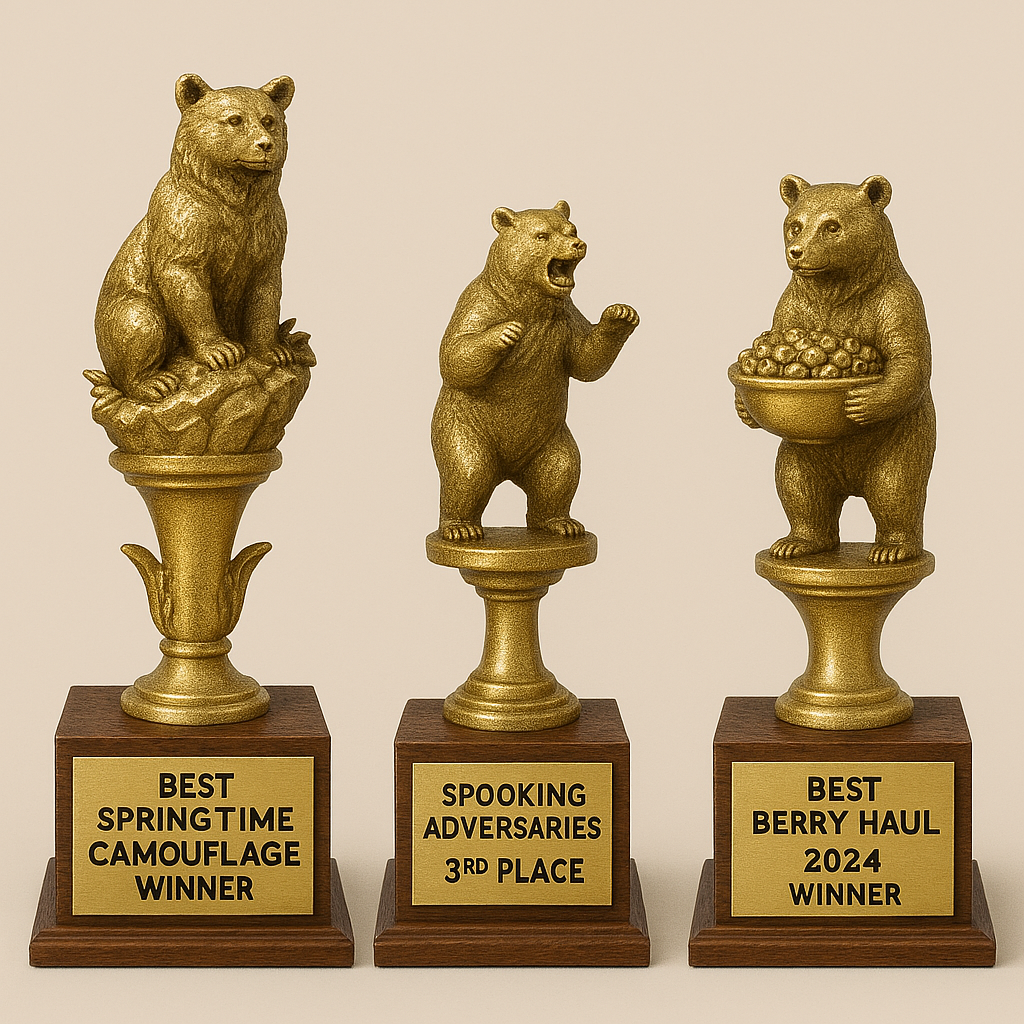
She noticed some trophies on the mantel in the living room. She took a photo of those too. None were familiar to her. One was for winner of Best Springtime Camouflage, one was third place for Spooking Adversaries, and another was winner for Best Berry Haul of the Year 2024. She wasn’t sure which blog site to post this photo to, positing she might start a new one.
Upstairs, she tested three smart beds—one was too firm, and the control was stuck on high, one too soft with the control stuck on low, and the third, with temperature control and lumbar support, was just right. She fell asleep in the third, dreaming of five-star ratings.
Soon, the Bear family, who owned the charming cottage, returned from their morning yoga in the park. Mr. Bear, Bruno, grumbled at the missing oatmeal, Mrs. Bear, Ursula, frowned when she saw the chair cushions that had been disturbed, and Baby Bear, Osito, found Goldilocks snoring in his bed.
“Look, Mama and Papa, I found a stranger in my bed,” he called out.
Startled awake, Goldilocks apologized profusely. The Bears, being progressive and mindful, forgave her—but asked her to respect boundaries, knock next time, and wait to be invited in. Before she left, she asked to take a selfie with the family to post on her relationship blog. They agreed and said she was welcome to come again.
Moral: Curiosity is wonderful, but respect and consent matter—even in fairy tales.
Sweet memories, buried for decades, that popped up when cleaning out my closet.
Last week, as an homage to the new year, I decided to clean out my “craft” closet. You know the kind. It has shelves and a big space to stack boxes on boxes on boxes. It was where I kept all the crafty supplies I used when our grandson spent his weekdays with us while his mama worked, before he started school. After he started school, he joined Odyssey of the Mind and, as the coach for his teams, I kept the closet full of even more stuff, bigger materials for costumes, props, and backdrops. There were at least seven years of mélange that I shifted and restacked over and over – paper, cardboard for building things, paints, plasters, rocks, plastics parts for cars and planes, shells, crayons, markers, stickers, clips, scissors, etc. – you get the idea. Now he’s seventeen, off on another course – competitive cycling, and crafty materials are no longer needed. I looked for filters for the water system in our frig and they were hiding under piles of all that important stuff. After I dug them out, I decided to clear out what was no longer useful. And there were three giant lawn-and-leaf-sized trash bags full. Some went to recycle, some to Goodwill, and lots to the trash. It made me think of the old radio show Fibber McGee and Molly. You have to be of a certain age to recall old radio shows. And that set me remembering, since I’m now a certain age plus one.
My parents both worked when I was a kid. Before I was old enough for school, Mom took me to a woman’s house on workdays. I don’t remember anything about the woman except that she, and consequently we, listened to the radio all day long. In those days, the 1940s, the Golden Age of Radio, families enjoyed a variety of great entertainment.
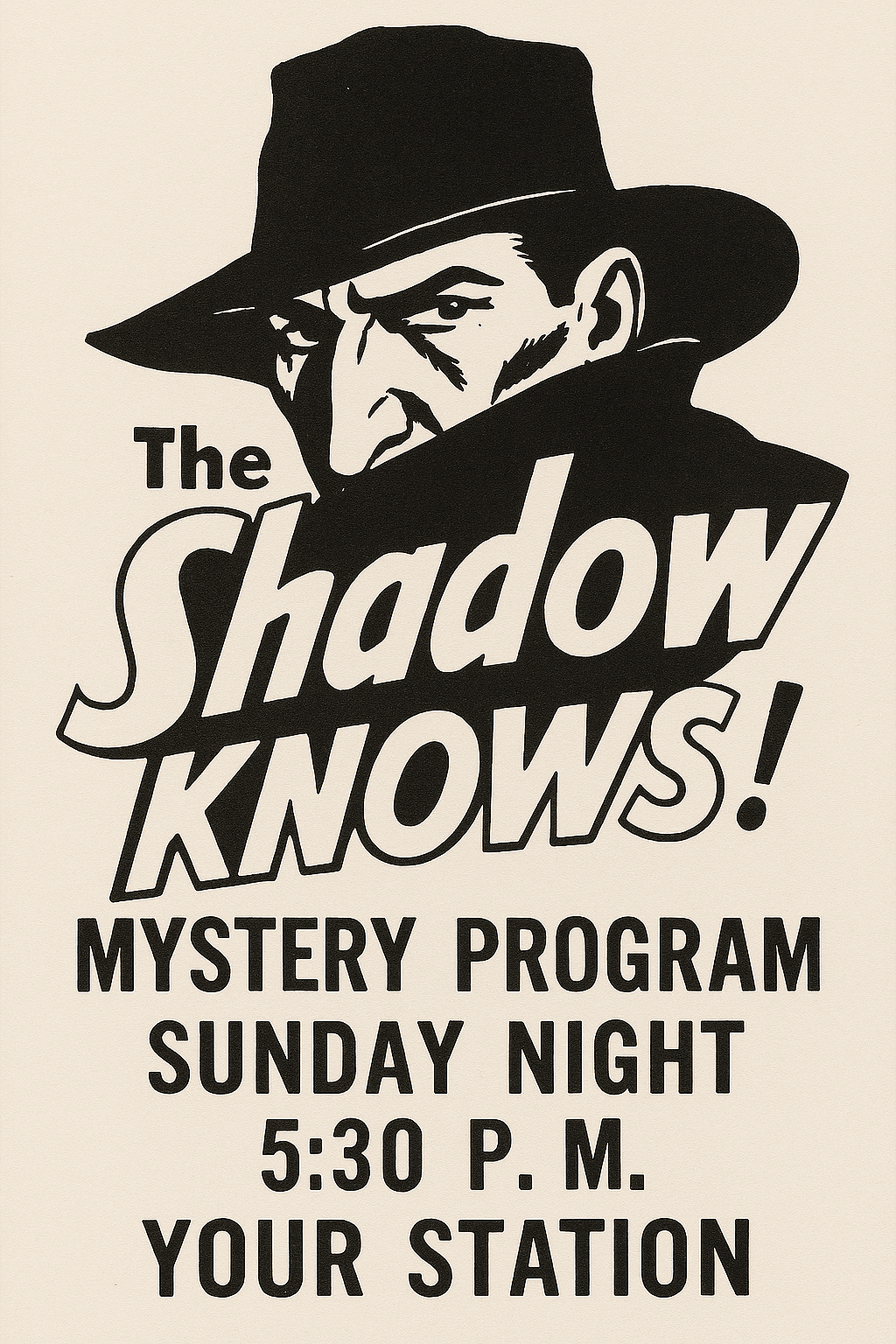
There were no other children in her house. She was very nice to me. I did puzzles, coloring books, and crafty things while she cleaned her house. Soap operas, variety musical shows, suspense, game shows, and comedy programs played on the radio all day in 15 or 30-minute segments. I remember Fibber McGee and Molly, One Man’s Family, Guiding Light, Kate Smith, The Aldrich Family, Baby Snooks, Bing Crosby, Jack Benny, various game shows, and The Shadow. They were the background chatter all day long. I don’t recall what they were about because, as a pre-schooler, I wasn’t listening very closely to them. I remember theme songs and bits and pieces of repetitive dialogue. I remember the spooky voice saying “The Shadow Knows”.
Fibber McGee and Molly were a married couple, sort of like Lucy and Desi. One thing that stands out in my mind was when Fibber opened his hall closet, and chaos rained down with the loudest clatter, bang, boom, squeak, and Molly would say, “Dear oh dear, Fibber, look at all that junk that fell out of your closet. When are you gonna clean it out? T’aint funny, McGee.” My craft closet reminded me of Fibber’s.
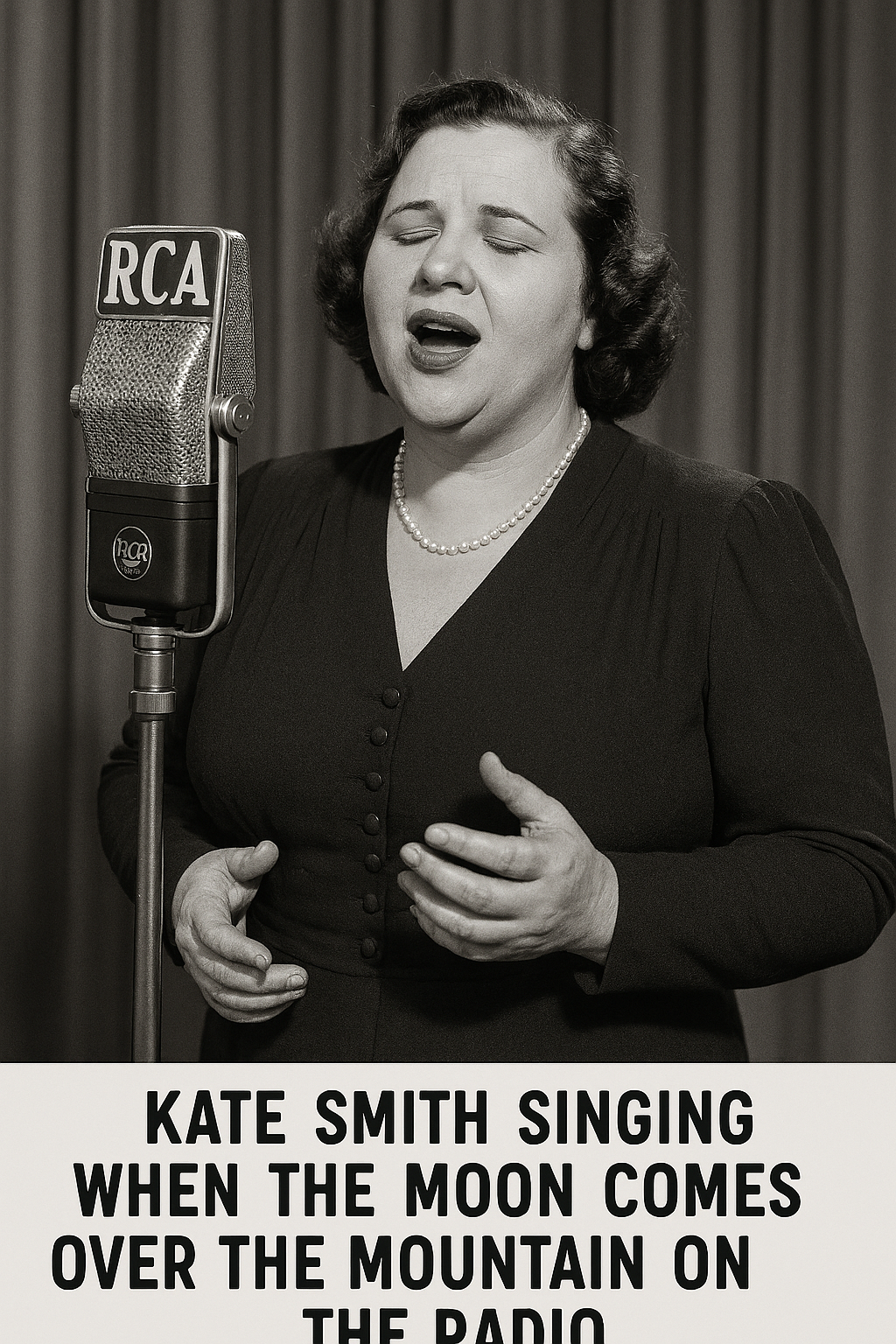
Additionally, a memory floated to the surface a few days later with a song from the same era as Fibber. I woke one morning with the inimitable Kate Smith singing in my head, “When the Moon Comes Over the Mountain”. The Kate Smith show was on every day at noon. That was when my babysitter would sit me down at the table for lunch. I’m sure she made a variety of things, but all I remember is home-made tomato soup and a grilled cheese sandwich. I don’t remember the lyrics of the song, but when I recalled the tune, I could taste tomato soup.
Through the magic of the internet, you can now listen to those old-timey programs.
Link to Kate Smith singing “When the Moon Comes Over the Mountain.”
This headline popped up on my phone and caught my attention.
The UN’s top court has opened a landmark case against Myanmar, accusing the country of committing genocide against its Rohingya (Muslim) minority. The case, filed by Gambia, alleges that Myanmar’s military launched a campaign of violence in 2017 that forced over 700,000 Rohingya to flee to neighboring Bangladesh. The population of Myanmar is predominantly Buddhist, with 90% Buddhist, 6% Christian, 4% Islam, and less than 1% Hindu.
The International Court of Justice (ICJ) in The Hague has begun the hearings, marking the first full genocide case it has taken up in over a decade. The hearings will span three weeks and will include oral arguments, witness testimony, and expert examinations. Gambia alleges the Rohingya community has been subjected to horrific violence and destruction, including atrocities such as gang rape, sexual mutilation and infanticide. The case is significant as it could set precedents for how genocide is defined and proven, and how violations can be remedied. The outcome of the case is expected to have broader implications, including potential repercussions for other genocide cases, such as South Africa’s petition against Israel over its war in Gaza.
Usually, I avoid political news, domestic and international, because it is painfully negative. But this headline stopped me cold because Myanmar is a Buddhist country being charged with genocide. That seems like a huge oxymoron, incompatible, incongruous. Buddhism is considered the most peaceful religion worldwide with its emphasis on non-violence, inner peace, kindness, and respect for nature. This doesn’t even seem real.
What is happening in our world? Riots in Persia, riots in Venezuela, riots in the U.S., riots in Uganda. Can’t we all get along? Give Peace a chance? I have a hard time believing the rioting is the fault of the religions because all the major religions preach peace. The scriptures of Islam, Christianity, and Judaism, all Abrahamic faiths, share messages that encourage unity and peace.
So, it means that bad actors in these countries are ginning up revolts based on criteria that they know will cause division within the population. I can’t say this is new news. It has happened over and over for centuries. Sometimes the issue is real, such as slavery in the U.S. Sometimes it is fabricated by lies like those that were the prelude to the hatred of Jews by a segment of the German population. How do we differentiate the real problems from those that are manufactured intentionally to cause internal strife within a country? What are the power struggles that motivate? Is it money, resources? I believe, more likely, it is an effort to consolidate power among the few to subjugate the many.
“Out of clutter, find simplicity. From discord, find harmony. In the middle of difficulty lies opportunity.” — Albert Einstein.
A good maxim to begin the new year. The world is and always has been in chaos. Disorder and disharmony reign at all times, somewhere in our world. It is the human condition. Try as we might, we creatures, supposedly endowed with reason to think our way through adversity, instead use hard times and harsh words as a springboard to lash out with uncontrolled emotion. Emotion, it seems, is our human vice and virtue. Too often it overcomes rational thought, rational action. It is the catalyst for hate and anger, as well as for love and empathy.
I try to find peace from within and let madness straggle down its own path away from me. No, I’m not sticking my head in the sand. I am acutely aware of what is going on. I am also aware that I am powerless to make it stop, in the worldwide sense. No one has been able to in the millennia of human existence. Many have tried to lead toward peace and were rewarded with more hate and even death. Hateful words only engender more hate. “Holding onto anger is like drinking poison and expecting the other person to die.” – Buddha. I can only contribute to my little corner of the world with my own actions and words.
Celebrating the joy that comes with every day brings calm. On the darkest days, there is always a little gem, a glimmer of happiness, if you pay attention. Watch for it. “Deceit is in the hearts of those who plot evil, but those who promote peace have joy.” (Proverbs 12:20) The connection between peacemaking and joy is clear; those who work towards peace experience fulfillment and happiness.
It is my prayer every morning. Let me be an instrument of peace. Find my balance. Make at least one person smile and be happy we had an encounter, whether in person, by writing, or by phone. Be grateful for every living spirit, for they all have a place in our world, a reason for being. Remember, forgiveness is the portal to peace. Don’t let petty or ignorant words muddle my day. Be kind, it costs nothing and is a blessing to others and to myself. It is the source of peace.
I don’t always achieve that goal, but it is uppermost in my mind to start my day. Distractions, annoying tech issues, physical discomfort, negative media (when I allow it in), and my own higgledy-piggledy thought processes can derail me from being present and conscious moment by moment. Joy gets lost in the commotion, but it usually resurfaces when I stop to recenter myself. I realize my very good fortune, the love surrounding me, and I’m grateful. I pray and, in my own tiny way, strive to help others find peace and joy in their days.
How do you find fulfillment in your days?
Some inspiring quotes by wise people, the Old Testament, the Quran, and the Bhagavad Gita:
“Peace comes from within. Do not seek it without.” – Gautama Buddha.
“If we really want to love, we must learn how to forgive.” —Mother Teresa
“Let us forgive each other – only then will we live in peace.” – Leo Tolstoy.
“The weak can never forgive. Forgiveness is the attribute of the strong.” – Mahatma Gandhi
“Forgiveness is the fragrance that the violet sheds on the heel that has crushed it.” – Mark Twain
“We seek peace, knowing that peace is the climate of freedom.” – Dwight Eisenhower.
“You must be the change you wish to see in the world.” – Mahatma Gandhi.
“The world is not a mere reflection of our thoughts; it is a reflection of our actions.” – Albert Einstein.
“And the servants of the Most Merciful are those who walk upon the earth easily, and when the foolish address them harshly, they respond with peace..” (Quran 25:63) Be a messenger of peace, even in adversity.
“How beautiful on the mountains are the feet of those who bring good news, who proclaim peace, who bring good tidings…” (Isaiah 52:7) Be a messenger of peace.
“We must come to see that at the end we seek is a society at peace with itself, a society that can live with its conscience.” – Dr. Martin Luther King Jr.
“But if you pardon, overlook, and forgive, then indeed, Allah is Forgiving and Merciful.” (Quran 64:14) Forgiveness is a divine trait and a means to achieve inner and outer peace.
“Turn from evil and do good; seek peace and pursue it.” (Psalm 34:14) Encourage an active pursuit of peace by making conscious choices to foster harmony.
“Delusion arises from anger. The mind is bewildered by delusion. Reasoning is destroyed when the mind is bewildered.” Bhagavad Gita
“Hate cannot drive out hate; only love can do that.” – Dr. Martin Luther King Jr.
“Nonviolence is the answer to the crucial political and moral questions of our time; the need for mankind to overcome oppression and violence without resorting to oppression and violence.” – Dr. Martin Luther King Jr.
“The disunited mind is far from wise; how can it meditate? How can it be at peace? When you know no peace, how can you know joy?” Bhagavad Gita
Prompt: Write a short poem, story, or essay in ten minutes using these five words: snooze, black, pocket, dollar-store, Egypt. This may be the beginning of a story when I get the nudge to continue it. I know next to nothing about pyramids, antiquities, or Egypt, so I’ll need to do a little research in order to continue the story.
As always, a prompt challenge tickles my brain in so many ways. This was quick fun. I admit I looked up the Egyptian script after writing the story in which I just wrote “his name was written in Egyptian script”.
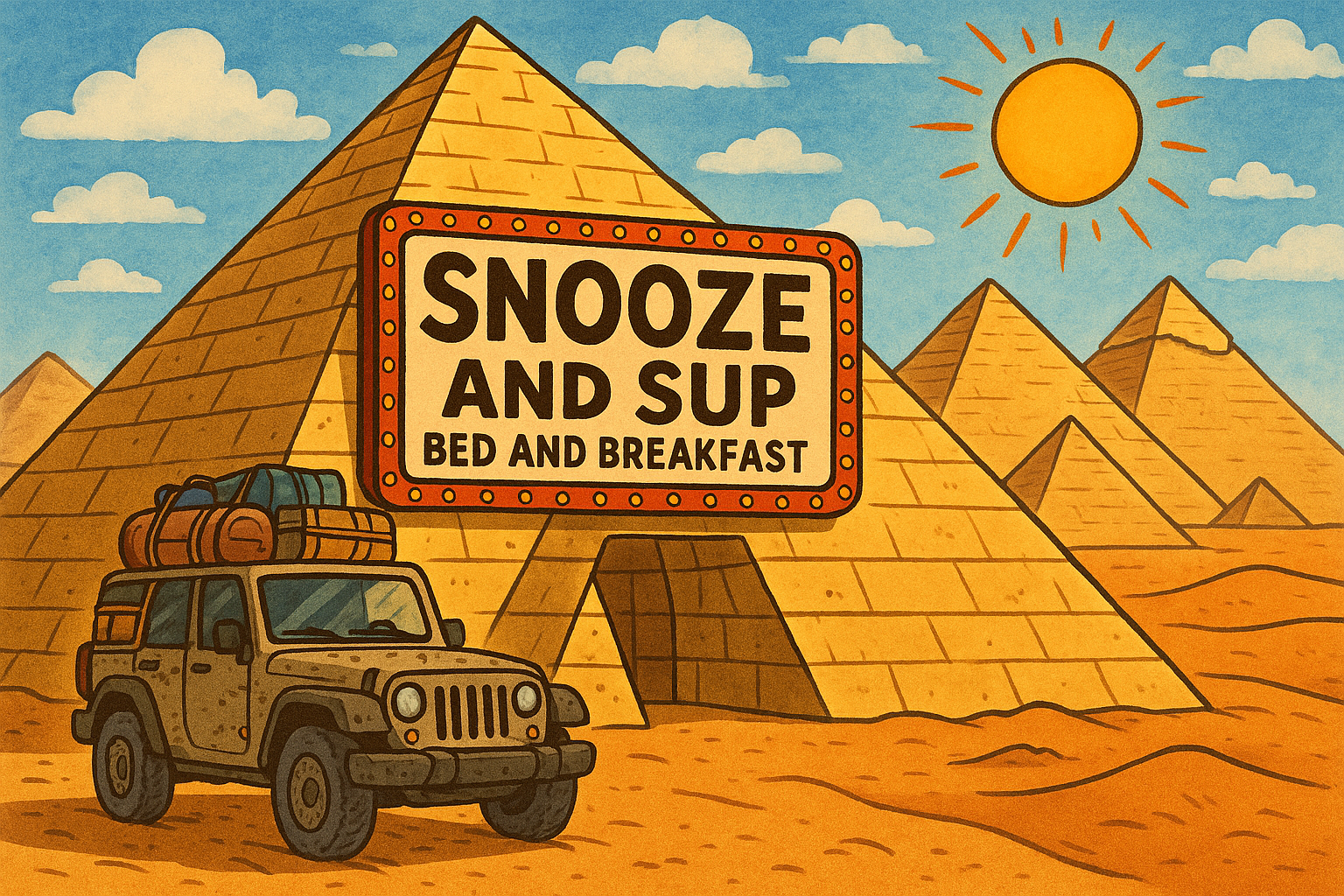
SNOOZE AND SUP BED AND BREAKFAST
Simon stepped off the plane in Cairo with a huge grin on his face. This was going to be a great summer. He had snagged a summer internship studying Egyptian pyramids. He was as excited as a six-year-old in the dollar store with ten bucks. He went toward baggage claim to collect his luggage and scientific toolbox. Standing there with a sign that read حرينومتساويين, and under that “Cairo Institute of Antiquities” was a swarthy man who stood about 4’6”. Simon walked up and bent his 6’3” body and said, I believe you are looking for me, I’m Simon. The diminutive man responded with a big white toothy smile and shining black eyes, “Salaam Ustaaz, My name is Asim. I’m so glad you found me. I hope I spelled your name correctly.”
“That’s supposed to be my name?”
“Ustaaz, I didn’t know how to spell it, but I did my best. I will take you to your accommodations.”
Asim led Simon to an old jeep that was covered in a 10-year layer of Arabian desert dust thick enough to be armor.
“Where will I be staying for the summer?”
“Ah, Ustaaz, you have great accommodations at the Snooze and Sup Bed and Breakfast in the Dhjoser pyramid.”
“At the pyramid?”
“Yes Ustaaz, they have a lovely bed and breakfast at the third level.”
“You use the pyramids for hotels?”
“That and other things.”
“But the pyramids are sacred antiquities to be studied and protected.”
“You see, we have so many, and most are not very interesting, so our government decided to put them to use. It has helped our economy since the US bullied its way into the fossil fuel market. Only two kilometers away from your bed and breakfast is the Pick a Pocket Casino, also in a pyramid. It is rated very highly by Conde Nast.”
Sure enough. Asim pulled up in front of a small pyramid with a marquee reading Snooze and Sup, Bed and Breakfast. He helped Simon take his bags and equipment into the lobby. There in front of him was a dimly lit tunnel with ramps crisscrossing up to the third level and beyond.






 wonkagranny