A continuation of the story of my trip to Europe in 1999 with my daughter, Shari. The first part was Adventure in Avignon, published in September 2024. We decided that carousels would be the focus of our adventure through the rest of Provence and the Côte d’Azur.
Carousels were conceived from tragedy. Jousting, initially a tournament sport in medieval times that tested skill and horsemanship among the nobility, began in the 11th century. It became a fixture at festivals throughout France and England. A jousting accident killed French King Henri II, Catherine de Medici’s husband, in 1559. She prohibited further jousts, compelling knights to create a safer alternative to these tournaments. They began riding a circular course, spearing suspended rings with their lances.
By the end of England’s Queen Elizabeth I’s reign in 1558, jousting was a thing of the past. Carousels powered by humans or animals took the place of that military exercise, becoming a family-friendly entertainment that spread throughout Europe and eventually the world. Many carousels are very elaborate and considered to be an art form. They were later mechanized and powered by steam, then by electricity.

Avignon
Avignon was once the seat of the Catholic papacy. The Palais des Papes was the residence of seven Catholic popes in the 1300s. It is a very short walk from the Palais des Papes to St. Pierre’s square outside the Basilica St. Pierre. And there is the lovely Avignon carousel.
After leaving Avignon in our tiny rental KA, we drove zigzag across the south of France, stopping to explore Nimes, Aix, Arles, Palavas-les-Flots, Carcassonne, and Perpignon headed to my niece’s house outside Barcelona, Spain. We took delight in searching for the carousels in each town. Not every town had a carousel.
Aix

One of the things I love about traveling in Europe is I feel I can step back in time. Roads, buildings, and bridges have withstood the ages, and even in the 21st Century, I sense the ancient history around me. Aix is no exception. It was founded by the Romans in the century before Christ and has been inhabited for all this time. Paul Cézanne was born in Aix, and many of his dreamy landscape paintings depict his hometown and the surrounding area.
Nimes
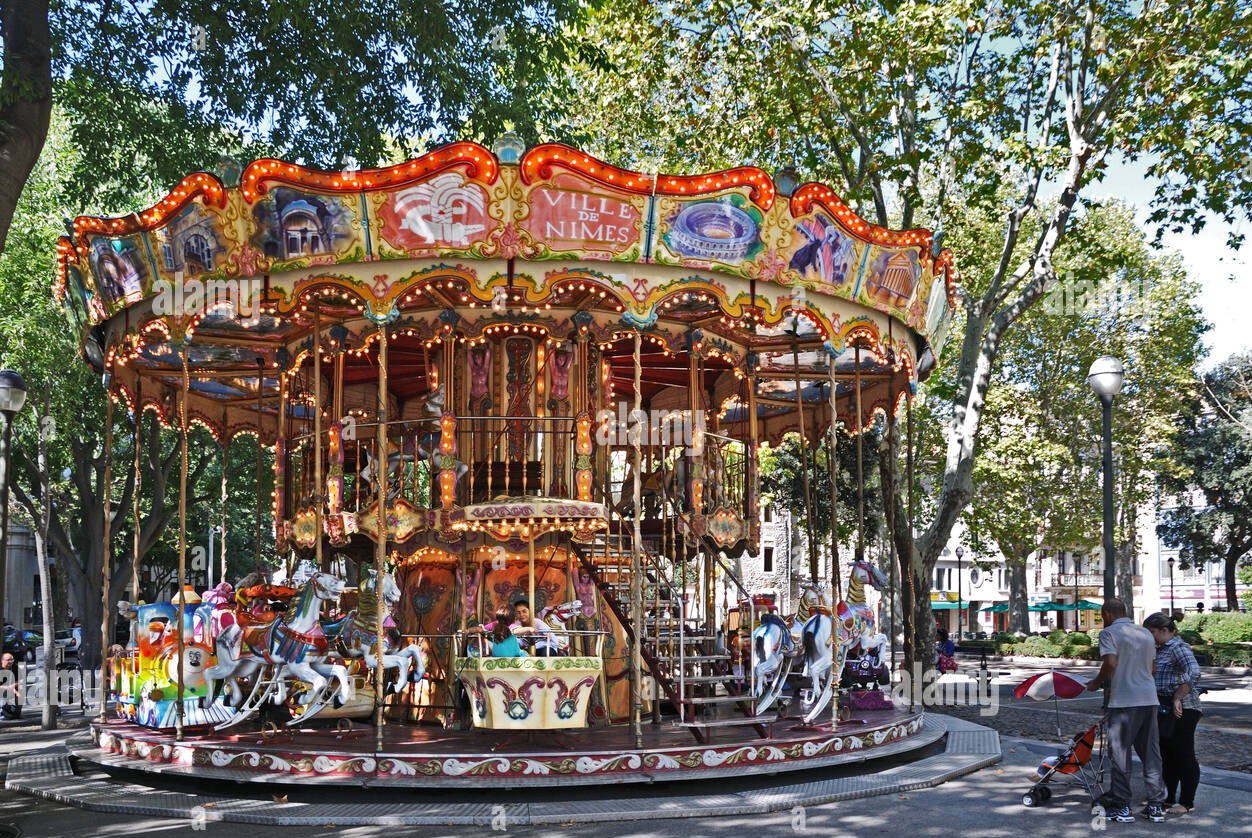
The Romans left significant evidence of their culture throughout France. Nimes is considered the Rome of France. There are the remains of a Roman aqueduct, an amphitheater still used today, and a Roman temple that date back before the birth of Christ. There is the cathedral of Notre Dame and Saint Castor that we briefly visited before our search for the carousel located near the center of town in the Esplanade de Charles de Gaul. The cathedral didn’t compare to so many of the magnificent churches in France, but the carousel did not disappoint.
Arles
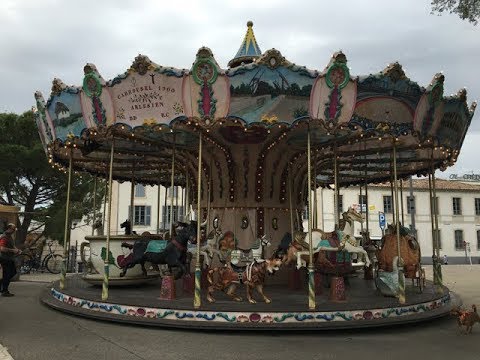
As Aix is associated with Paul Cézanne, so Arles is linked with Vincent van Gogh. Among the Van Gogh paintings representative of Arles are “Starry Starry Night” and “The Old Mill”. The city was an important Phoenician trading port hundreds of years before the Romans took over. There are many reminders of Roman culture, including a Roman amphitheater. They still conduct bullfights in the amphitheater, but the bull is not killed. Instead, a team of men tries to remove tassels from the bull’s horn without being injured. Arles once boasted a floating bridge, a pontoon type supported by boats that were secured in place by anchors and tethered to towers on the two riverbanks. It has been replaced in modern times. A short walk from the Amphitheater is the carousel called Le Manege d’Autrefois, which means Old Fashioned Merry-Go-Round.
Palavas-les-Flots

We drove into Palavas, a very small fishing village with a few hotels along the beach. Sand dunes separate two lakes along a canal with the Gulf of Lion and the Mediterranean right there. (The movie The Triplets of Belleville, a feature-length animated movie with lovely music, has a song about Palavas in it.) It was dusk approaching dark, and I didn’t want to drive in the dark. Things looked very quiet. We stopped at Le Grand Large Hotel to get a room for one night. We went into the big lobby, again remarking at how quiet it was. A man came to the front desk. In my very best Frenglish, I asked for one room with two beds for one night.
“Non, madame,” he replied with a sad face. His name was Gabriel. “Nous sommes fermé pour la saison, nous sommes désolés.” (No, madame, we are closed for the season, we’re very sorry.)
I continued in my butchered mongrelled language to inquire if other hotels were open. He, so politely and sadly, responded that they were all closed until Spring.

This little fishing village only had a few hotels to accommodate French vacationers during the summer. They received very few non-European tourists. August is the biggest month for European vacations, and we missed it by two weeks. The hotel had a skeleton staff, no rooms available, and no services. I told him that Shari and I were traveling through the south of France to see the beautiful countryside and that our destination was Barcelona to visit family. I explained how we had been in Avignon and had my purse stolen, but still rented a car, and wanted to see the carousels in southern France, and wanted to stay one night on the Cote d’Azur. He laughed at the way I told my story with one French word, then one English word, then a lot of gestures. I asked how far it would be to find a hotel open.
“Vous devrez retourner à Montpellier, une plus grande ville, pour trouver des hotels à cette période de l’année.” (You will have to drive back to Montpellier, a larger city, to find a hotel at this time of the year.)
It was now dark outside. I sighed. OK. I told Shari to get back in the car, and we’d drive to Montpellier, about a thirty-minute drive.
“Un moment,” he said and left the desk to go into a small office at the side of the lobby.
He came back. “Je peux vous proposer une chambre pour ce soir. Un lit. Mais il n’y a pas de services ici.” (I will offer you one room, one bed for tonight. But there are no services.) They offered no food services. We had no access to the spa or swimming pools, and we only had one towel each.
Super duper great, said I. No translation needed.
Shari and I got our small bags from the car. I parked where Gabriel indicated. We wondered if all the restaurants were closed too. Shari asked if there was a restaurant open nearby.
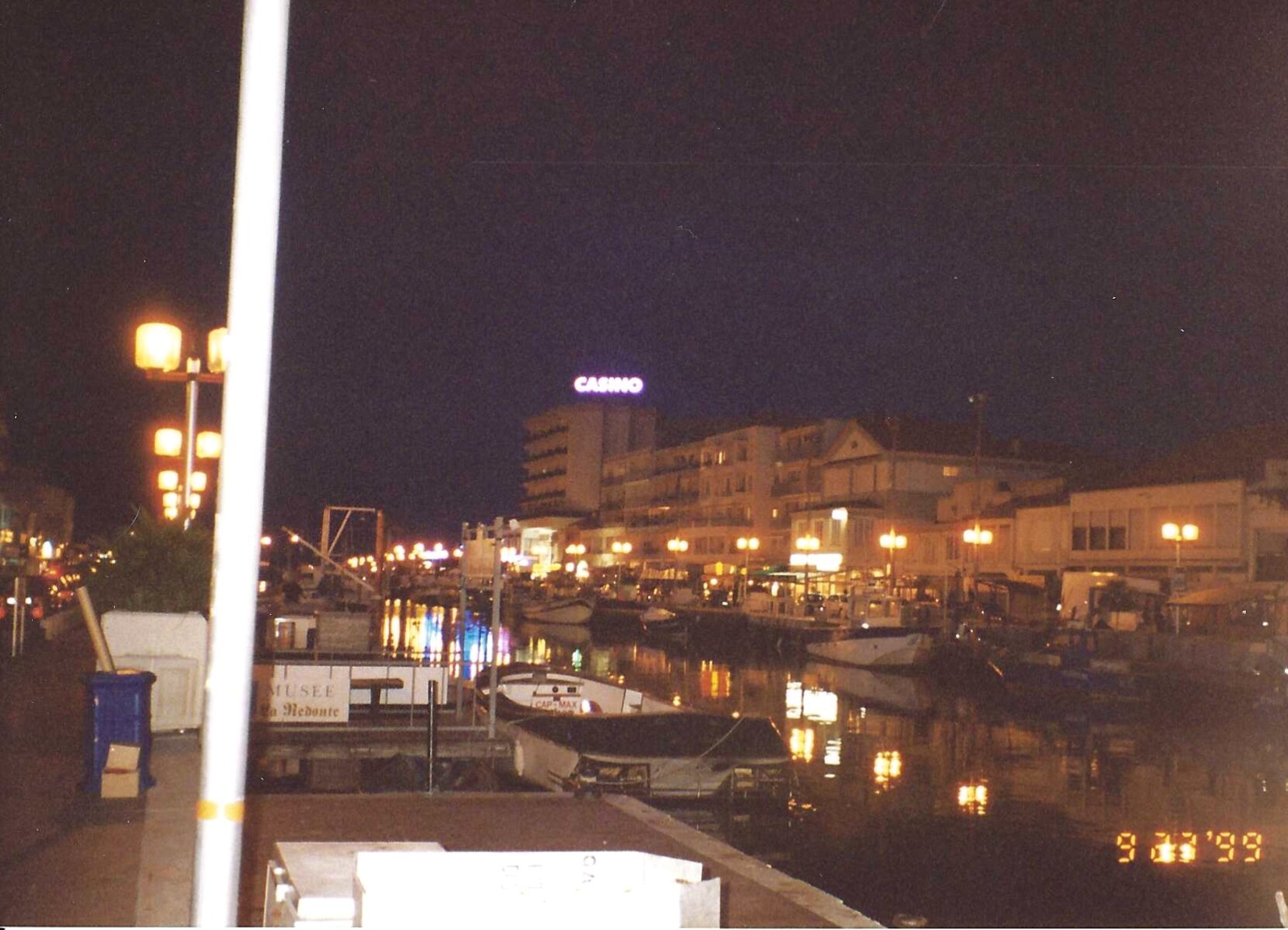
“Oui. Un excellent restaurant de fruits de mer au quai.” Gabriel pointed out the front door toward the beach. (Yes, an excellent seafood restaurant on the pier.) He said restaurants didn’t close for the season, just scaled back hours.
We trotted off across the beach to a long jetty along a canal. There were several restaurants open. La Marine Du Pêcheure was the one Gabriel suggested so we had a nice dinner there outside by the water. Shari is not a fan of seafood, but she found something she would eat on the menu. We were both ravenous and very relieved to have a place to stay. The next morning, we left to continue our journey after many declarations of gratitude to Gabriel. Un Grand Merci!!! There was no carousel in Palavas.
Carcassonne
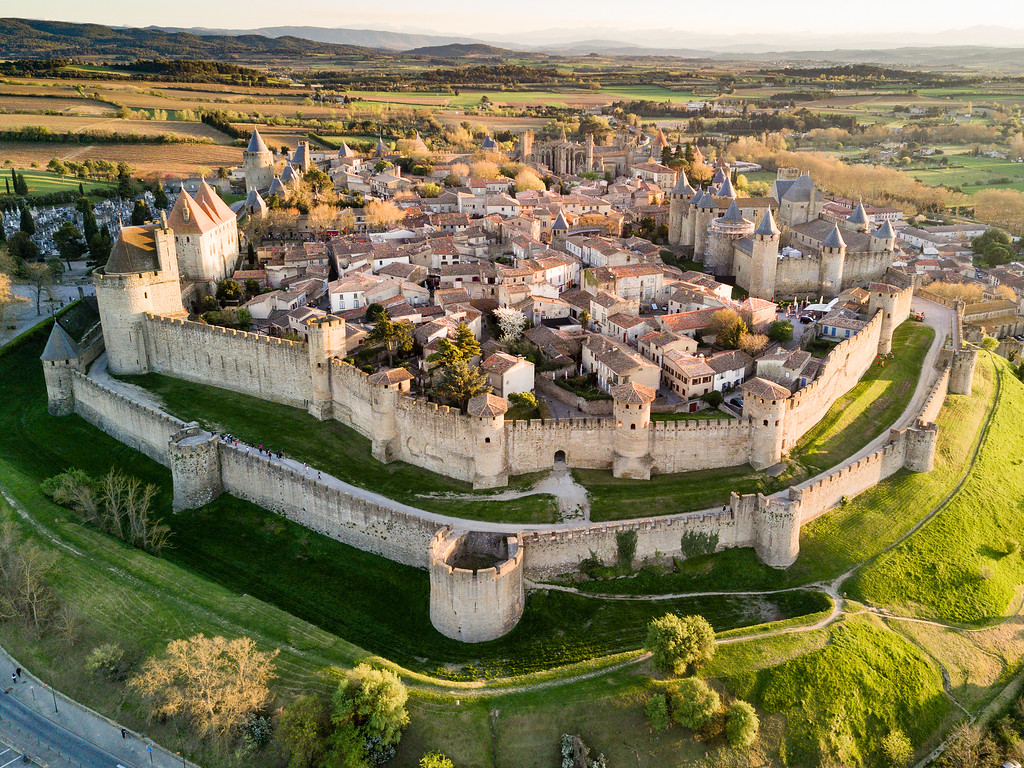
The ancient town of Carcassonne has a fascinating legend. Carcassonne was founded in the 3rd century by the Gauls and turned into a fortified town by the Romans. The legend takes place in the 8th century, during the wars between Christians and Muslims in the southwest of Europe. At the time, Carcassonne was under Saracen rule, and Charlemagne’s army was at the gates to reconquer the city for the French. A Saracen princess named Carcas ruled the city after the death of her husband. The siege lasted for five years with French forces surrounding the town. Charlemagne’s tactic was to starve the population into submission. Early in the sixth year, food and water were running out. Lady Carcas made an inventory of all remaining reserves. Then she demanded that the villagers bring her the last pig and the last sack of wheat. She force fed the wheat to the pig and then threw it from the highest tower of the city walls. Upon landing, it split open, and the invading soldiers could see it was stuffed with food. Charlemagne lifted the siege, believing that the city had enough food to the point of wasting pigs fed with wheat. Overjoyed by the success of her plan, Lady Carcas decided to sound all the bells in the city. One of Charlemagne’s men then exclaimed: “Carcas sonne!” (which means “Carcas rings”). Hence the name of the city.

I wish we had had more time to meander through the south of France, but we were on a timeline to get to Barcelona. It was like drinking through a firehose, gorging on everything we saw with thirsty eyes. We gulped as much of the countryside and towns as we could, hoping to return someday and spend more time.
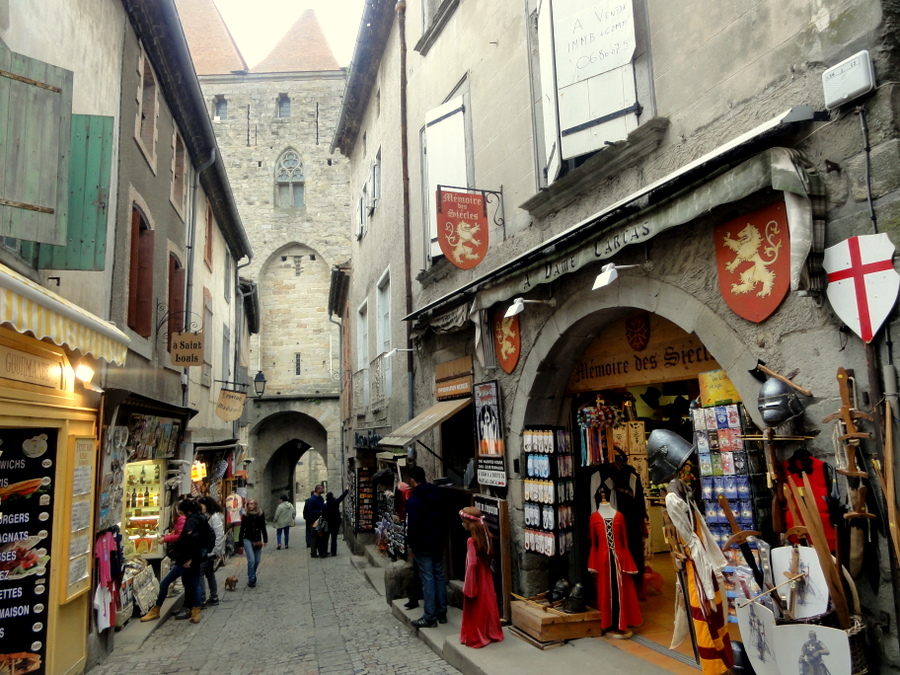
We walked through the tiny winding streets, looking into shops. We had a quick bite at a bistro as we browsed the markets. We bought a beautiful blue and yellow bowl, the colors of Provence, to take back as a gift to Karen, my oldest daughter. We found the carousel. Then got back into the car and headed for Spain, a three-hour drive.
Pérignon
We stopped briefly in Pérignon for ice cream, but we missed all the historical attractions and didn’t find a carousel. We were in a hurry to meet my niece in Barcelona. We cruised on to the border of Spain.
 wonkagranny