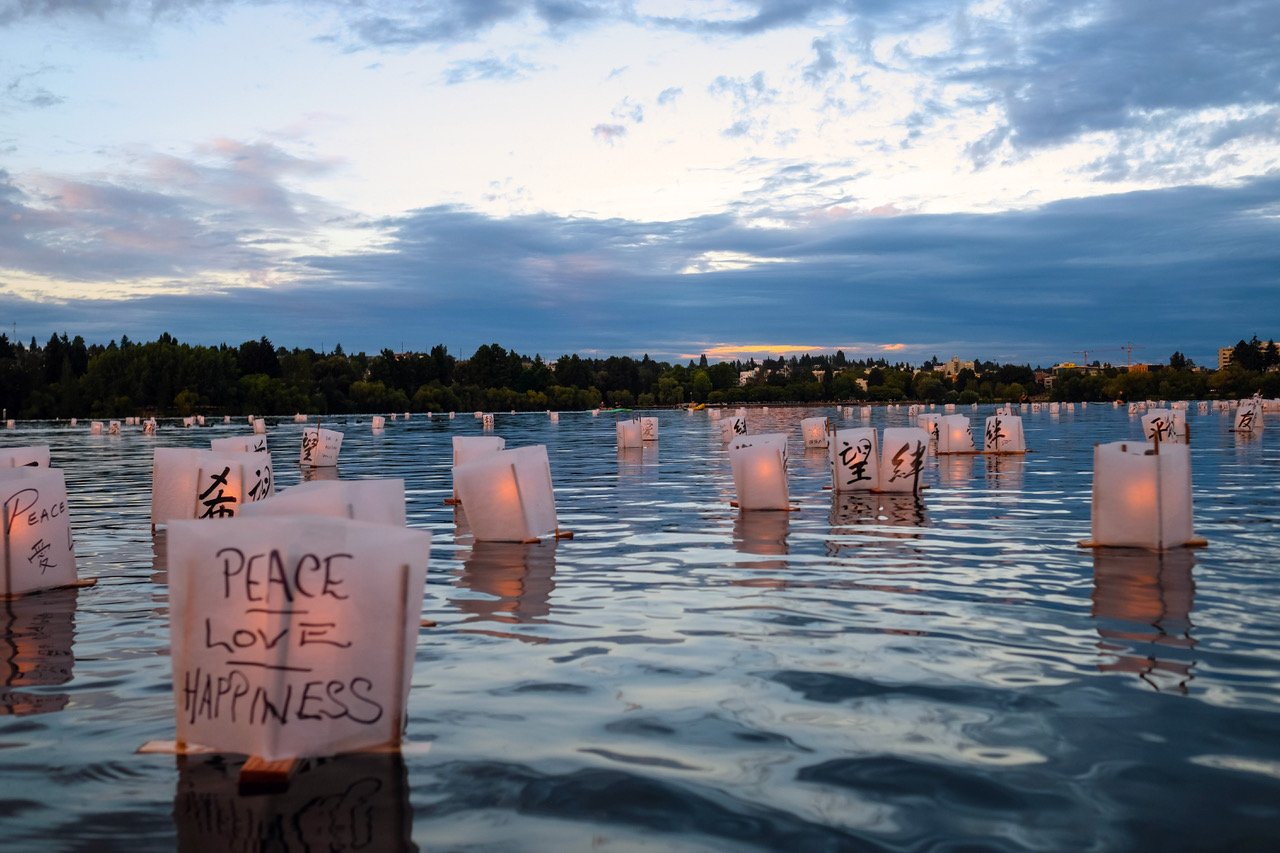
As a final episode in our tour of Seattle, I will take you to the Green Lake neighborhood. It is a quiet neighborhood that I love to walk around. Green Lake is 259 surface acres and was named because of the algae that formed, causing the lake to turn green. At times, it produced noxious odors. The algae caused rashes for many who tried to swim there. Attempts to clear the lake were unsuccessful until about twenty years ago. Now people can swim in it. Motorized boats are banned on the lake, but people still splash around in kayaks, canoes, and on paddleboards. There is a large open area for picnicking and nearly three miles of paved paths around the lake. Every year since 1984, a memorial lantern float is held to memorialize the victims of the Nagasaki and Hiroshima bombings.
At some point in the 1920s, a bathhouse with changing rooms and showers for bathers was built at the edge of the lake. That building now houses the Public Bathhouse Theater, one of the many public theaters in Seattle. It offers a wide variety of entertainments and is a starting place for actors.
Green Lake had an aquatic theater in the 1950s, where the Aqua Follies were produced. It was the site of concerts and live entertainment by some of the pros, such as Bob Hope, Led Zeppelin, and the Grateful Dead, among others.
Woodland Park Zoo is at the edge of the Green Lake neighborhood and connects through the park. It is over ninety acres of animals, exhibits, and family fun. When our kids were young, we spent many hours at the zoo and the children’s theater.
While a student at the University of Washington, our son lived in the attic of an old home just up the hill from Green Lake. Then he moved for a time to the Wallingford neighborhood across the I-5 from the University District. His house was actually tucked in under the edge of the elevated freeway. He and his buddies started a raucous rock band called Legacy. It quietly ended shortly after graduation.
Of course, the University District and The Ave hold a myriad of adventures and students who are in the active process of becoming. I spent many hours exploring my favorite emporium, The University Book Store on the Ave. On a couple of occasions, when my husband wanted to WOW me, he gave me a large dollar gift certificate to “the bookstore”, where I escaped into other worlds for hours in distracted bliss. The downside for him was that I came home laden with books that he then had to move from house to house each time we moved. He said he’s not moving them again, so I guess we’re here for the duration. Love me, love my books.
There is the Ravenna neighborhood that we bypassed, and the International District with great dim sum. You can lose yourself in the culinary delights from around the world. There are Rainier Beach and Sodo (South of Downtown) areas. There are the Roosevelt and Sand Point districts, Montlake, Phinney Ridge, toney Madison Park, and the exclusive, completely walled-in and gated neighborhood of Broadmoor. I went to a party in Broadmoor once, a political do as I recall, but the memory is vague – it must have been a very “good” party.
We passed by Beacon Hill in the southeast section of the city. It is the original headquarters of Amazon.com. Beacon Hill is primarily an Asian neighborhood, mostly residential. We sometimes shopped at an Asian import store on Beacon Hill. I brought a three-foot-tall laughing Buddha to Tucson with me as a reminder of that neighborhood. He happily reigns over our backyard in the desert.
We didn’t spend much time in downtown Seattle, the mega-mecca of everything big city. For a while, our eldest daughter lived on the eighth floor of a thirty-two-floor building in the high-rise forest of the mid-town business district within walking distance of her office and her place of worship, Nordstrom. Nordstrom began in Seattle as a family-owned shoe store in the 1920s. It transitioned to a big-time department store in the 1960s, expanding far beyond Seattle. I think its growth was financed, in large part, by our shoe-addicted daughter.
We’ve missed a significant portion of the waterfront where ferries ply their way across the Bay and Puget Sound to various islands and Victoria, Canada. Pier 56 is known as Fisherman’s Wharf. It is full of shops and entertainment opportunities. The Seattle Aquarium is underwhelming compared to other city aquariums we’ve visited. Not worth the money.
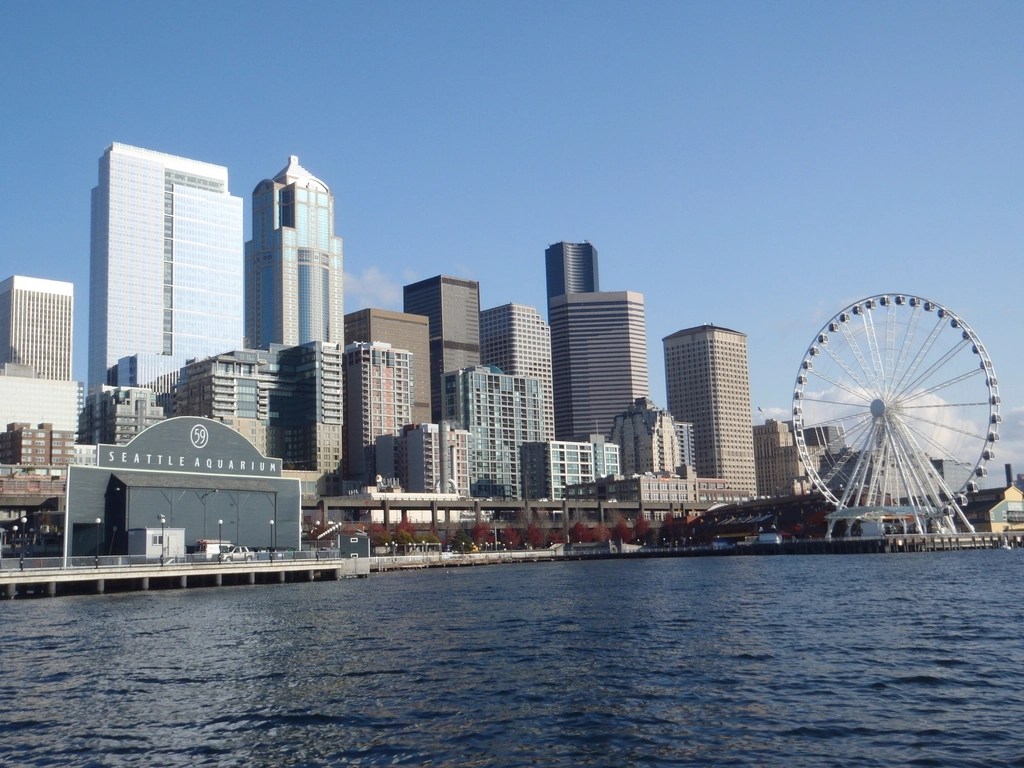
The Great Wheel is interesting. A Ferris wheel that is 175 feet high and extends 40 feet out over Elliott Bay has views of Seattle, the Olympics, and Puget Sound (on a clear day). They have a spectacular light show. Each of the forty-two climate-controlled gondolas holds eight passengers. There is one VIP gondola with special appointments that holds four passengers. The Wheel revolves three times in the twelve-minute ride. It doesn’t compare to the London Eye, which is 445 feet high, anchored in the Thames, but it is worth the $13 to experience, and you don’t have a twelve-hour flight to get there.
We bypassed the industrial part at the south end of Elliott Bay, where big tanker ships and commercial barges load and unload from ports around the world. It is less than elegant, but it does provide a comfortable living for those working the docks.
At various times, Seattle was named the most educated city in the US and the most literate city. But then, it has also been named the most livable city, and I’m sure whoever came up with that was smoking something stinky and missed all the suicides. It is a city of eclectic neighborhoods, each a little world unto itself. Some began as immigrant enclaves but changed in character as Seattle grew. When you travel around Seattle, it is like taking a trip to different lands, different customs, and cultures without needing a passport. You will have to come back with me again sometime and explore the places we missed.
In future posts, I will share some of our sailing experiences in the Puget Sound area. I will take you to Friday Harbor on San Juan Island during the Jazz festival, to the Victorian town of Port Townsend, harboring at Orcas Island, and the legendary Fluffy Duck cocktail, visits to Stuart and Sucia Islands, going through seaside customs on our way to the Gulf Islands of Canada. Killer whales played with our sailboat as we cruised the Strait of Juan de Fuca.
I’m not sure how Seattle informed me as a person during my 40 years of incarceration. I spent so much time resenting it that I really didn’t let Seattle in. My interior barriers blocked any positive influence that threatened my bias. I took a cue from my adorable little grandmother when she came from Kansas to visit for the first time. We took her up in the Space Needle. Her comment was, “Yes, it is beautiful from up here, but you can’t see anything when you’re down there because of those damn trees.” To each his own. To some, trees provide a beautiful landscape; to others, they are an impediment to seeing the horizon.
I enjoy going back to embrace Seattle for all its gifts, now that I know I can return to Tucson’s blue skies. My children, all born with gills and webbed feet, love Seattle and always have. They thought we lost our minds when, through my insistence, we made our escape to the desert twenty-eight years ago. Two of those Seattle-loving children presently live in sunshine, one in Texas and one in Tucson. Only one stubbornly remains in Seattle, her little webbed feet firmly planted in the muck. Seattle is a very watery, water-oriented place. Water – everywhere.
No more clammy feet, soggy clothes, frizzy Bozo hair and gray skies for me. If nothing else, Seattle taught me to appreciate blue sky, clear air, stars, and yes, even the heat, it’s a dry heat. I love Tucson. I will live 40 years in the desert to dry out and make up for all the years I endured Seattle…then, on to somewhere else, preferably Paris. I know the weather in Paris is not ideal either, but it is PARIS.


 wonkagranny