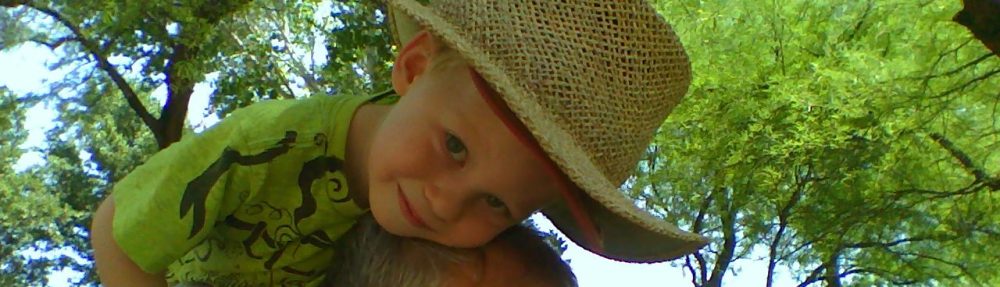
How the deep bond between a man and a boy, grandfather and grandson taught me about poetry.
Walter, my father-in-law suffered for five long years from Alzheimer’s disease. His dependency over that time became the elephant in our midst. He lurched from anger, to sadness to confusion and back to anger at his cognitive losses. During ever decreasing lucid moments, he would smile in fleeting recognition even though he forgot our names only to plunge again into no mans land where we couldn’t reach him. Day in and day out, he spent in front of the television even though he couldn’t understand what was going on. He dozed and nibbled snacks. He wouldn’t eat a full meal and forgot how to use a fork, so ate with his fingers. He became a dependant baby animal and lost touch with everything that made him human. Lost in the maze of a home in which he lived for over 20 years, his tortuous days and nights were filled with endless hours of not knowing who shared his world. At times he wept because he was frightened by his image who he called the man in the mirror.
Walt, always an active man, was still well built and muscular into his late-60’s. He initiated arm wrestling contests with his sons and grandsons and nearly always won. In his youth he mined copper in the rough and tumble town of Butte, Montana. He was proud of where he came from and what he achieved not only by his physical hardiness but also his strength of mind and character. He built a two story home for his family from the ground up in Butte. He built the family’s summer cabin at Georgetown Lake. He was carpenter, plumber and electrician all in one. As a true Finn, Walt felt it was necessary to add a sauna to every house they lived in as he moved his family from Butte to Anchorage to Seattle searching for a better life. With less than a high school education he pulled himself up out of the mines and into the business community. He always laughed when he said he went to the best university life had to offer, the school of hard knocks. By the age of 35 he was a city councilman and owned a grocery store uptown in Butte. He and his wife, Pearl, raised and college educated three children and delighted in their seven grandchildren.
The effects of his illness devastated our family. His physical death came three years later than the death of his soul. Walt, the man we loved, disappeared long before he was buried. The disease not only looted his mind, it took his spirit and left behind an infantile creature with dull eyes. Physically he withered to barely 100 pounds. Pearl, his wife of over 50 years, insisted on keeping him home to take care of him herself. The last few months of feeding, bathing, changing diapers and being on constant call wore through even her relentless patience. Her dejected face revealed the pain of watching her husband, lover, and companion grow ever more distant and helpless under her care. Family members took turns spending three or four hours at a time with him to give her a break. During those times he cried or snarled and mumbled incoherently because it took longer and longer to remember words to make phrases. When he finally put a few words together he demanded, “Where did mommy go?”
When he was hospitalized after a slight heart attack, we took turns staying with him at the hospital because the strange surroundings terrified him. He wouldn’t stay in bed unless he was occupied or distracted by someone. I took photograph albums and showed him pictures of his life in Butte, the only past he could recall. Occasionally a glimmer of recollection came, and he would struggle to name a name or describe a place. Since nurses couldn’t spend all their time with him my husband, Ken, stayed in his room all night every night because he awakened so often.
When Walt died, Casey, our son, was 18, a freshman at Washington State University, and a typical teen. Being both gregarious and shy, a charming, contradictory combination, made him popular with his peers. Casey’s best friend in 7th grade was still his best friend twenty years later, even though they chose different colleges and paths in life. He has a whole raft of friends who used our home and refrigerator as their own. In self-defense, I learned to dress immediately upon arising when Casey was home because often I stumbled over sleeping bodies when I went downstairs to let the dog out. I got caught a couple of times in my nighty by strangers who said Casey told them they could crash on our couch or family room floor after a late night or disagreement with parents. Casey spent hours on the phone. I believe he was the social secretary for his group since nothing was planned without his direct contact with each and every friend. When he was away from home, the telephone was his only means of communication with us, most commonly, a request for money. I was never totally positive that he even learned how to write.
Casey’s room resembled Nagasaki after the bomb. Momentos from rock concerts and Japan were strewn among dirty clothes, heaps of clean clothes lay scattered on the floor among school papers, matchbox cars, and stuffed animals. His walls were a collage of rock posters, sports souvenirs, photos of friends, and lists of the current top 100 rock tunes. The built-in desk, which went the length of one wall, had an assortment of unusual beer bottles, more stuffed animals and games lying on it and no room for studying, which was generally done in front of the TV in the kitchen. From his door to his stereo to his waterbed, there was a small, barely visible path amongst the rubble.
Casey had a reverence for ear-splitting heavy metal music along with an appreciation of such classics as the Beach Boys and the Beatles. He taught himself to play the piano, then learned guitar, which he refined daily in his room, hooked to his amplifier with his headphones so we couldn’t hear it.
In his 15th year, Casey grew from five feet to six feet and added an inch each year for the next two years. His weight never caught up. He was unbelievably thin at eighteen, weighing only one hundred twenty-five pounds. His shadow scrambled to stay visible when he turned sideways. He liked his hair long, but his brown locks curled so that, even when grown well below his shoulders, they kinked up tightly at the base of his neck, natural dreads. He wore a diamond stud in his ear, a personal affectation which gave his conservative father apoplexy. They negotiated. Casey didn’t wear his earring in his father’s presence. That changed over time as Ken learned to accept Casey’s personal sense of style.
Casey’s main passion, other than a current girlfriend, was and still is the University of Washington Husky football. Actually, I believe Husky football has, on occasion, come first. He played football and loved it at a younger age, but had the good sense to quit when his teammates got beefy while he stayed reedy. He is probably the only kid to sit in the enemy student section at Washington State University during the Apple Cup rivalry game, cheering for his beloved Huskys to beat WSU …and live to tell about it.
Casey’s second love was Japan, which he visited twice as a teen. It was the focus of his degree program in International Studies. Another of his diversions was magic. His blue eyes gleamed when he mastered yet another illusion to baffle his poor mom. All in all, Casey was a standard model for his generation, delightful and contrary.
Fishing with Walt was a highlight of Casey’s youth. He looked forward to annual trips to Westport with his dad and grandpa. Casey enjoyed Walt’s company and would sometimes get off his school bus at an earlier stop to visit his grandparents. Grandma fed him cookies, and then he’d go outside to help Grandpa in the yard or in his workshop. We lived only 10 blocks away, and his grandpa would give him a ride the rest of the way home after their visit.
During most of Walt’s final year, Casey was away at college. We kept him informed of Grandpa’s condition. The bond between Casey and his grandfather was long ago established in the mystical way that small boys and old men see themselves in each other. When Walt’s health began to wane, their connection was apparent in the way Casey watched out for grandpa when we took him somewhere. Before we were aware of his incipient illness, Walt and Pearl traveled to a Rose Bowl Game in Pasadena with us. After the Rose Parade, we walked toward the stadium for the game. In the mass of people at an intersection, Walt was somehow separated from us. He stood in the middle of the intersection, confused about which way to go. The traffic began to move and honk but he couldn’t find a direction. We were several yards ahead along the sidewalk when we realized he wasn’t beside us and focused on the commotion behind. Casey, then 12 years old, immediately ran to his side and didn’t let go of him for the rest of the day. Walt laughed it off, but it was the first real indication that his problem was more than mere forgetfulness. Casey appointed himself Grandpa’s guardian and protector for the remainder of that trip.
As Walt’s condition worsened, Casey was less and less comfortable being around him for very long. He refused to visit his grandparents. When Casey’s presence was required for family celebrations he glued himself to the TV and wouldn’t get involved when we had to help Walt eat or go the bathroom. The changes disturbed him. It was obvious he didn’t want to see his grandfather in that helpless condition.
What we didn’t know was that while away at school, Casey wrote poetry and sent it to his grandfather. We were shown the letters after Walt’s death. To say we were surprised is an understatement. Casey, who never wrote so much as a postcard to us. Casey’s phone bills were a testament to his inability to put pen to paper. Casey was always so caught up in sports and social activities that we couldn’t imagine his spending enough quiet reflective time or sitting still long enough to put poetic phrases together. But there was the proof. One rhymed and clever composition was sent to wish his grandparents a happy Halloween. It was an “over-the-river-and-through-the-woods” kind of poem about ghosts, goblins, and grandparents.
When we called with the news of Walt’s death, Casey made immediate arrangements to leave school. He took an overnight bus for 15 hours to get home. Pearl asked Casey to write a poem for the minister to read as part of the eulogy. Casey readily agreed. We were surprised because Casey didn’t like being put on the spot to perform, not even his music that he practiced day and night.
The day before the funeral, while everyone dithered about making arrangements and finding accommodations for visiting relatives, Casey slept. He slept on the couch. He slept on the floor. He slept anywhere there was a level surface. I begged him over and over to get busy writing his poem. He told me not to worry, it would be ready for the funeral.
The next morning, again I asked him if he had written his poem. He said no with a “don’t bug me” look and returned to his room, where he strummed his guitar and listened to AC/DC blasting on his stereo. I knew that he was going to disappoint his grandmother and add another sadness to the day, but the more I harassed him the more firmly he resisted. Finally, about an hour before we planned to leave for church, Casey came into the kitchen. As I prepared food for the reception to follow the funeral, Casey slumped his 6′ 2″ frame into a chair at the kitchen table. He tore a scrap from an envelope and started writing in his tiny cramped printing. When he finished he handed me two scraps of paper. On them was the poem. It was beautiful. He hadn’t labored over the words or created draft after draft. He slept and dreamed and played music and let the poem form in his heart. When it was ready, it flowed onto the paper complete and perfect. The poem recalled Walt’s strength, hard work, and devotion to his family. Casey urged us to be inspired by the kind of man his grandpa was. He acknowledged that grandpa was quick to see the good things in him and bloated his head with praise. He urged us to never forget what Walt tried to teach each of his grandkids – to try to be their best. He recalled a float in the 1982 Rose Parade with an old man and boy on it fishing. The float said “Gramps and Me”. When it passed by he and Walt looked at each other and smiled. He asked us all “to take some care and say a prayer and remember what’s been said”.
At the funeral, Casey chose to read the poem to his grandfather himself instead of giving it to the minister. All eyes welled with tears as he recited the love and respect that he felt for Grandpa. It was a simple poem, not rooted in rules of cadence and meter but brimming with a spirit and eloquence from deep within his human soul. In those moments, as Casey stood at the pulpit of the church, our son changed forever in my eyes. He grew from a lively, loving boy to a thoughtful man with the ability and willingness to share his deepest feelings in his own words. It was then, from our son, that I learned what poetry really was, not as I learned in school, but the unknowable stuff of Muses and spirit.

 wonkagranny