Saturday started in the usual way, up at 5 am as dawn cracked the horizon, then a walk through Vistoso Trails Nature Preserve, a 202-acre former golf course that backs to our property and connects with other open spaces in our town.
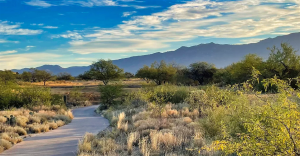
A rambling six-mile trail (former cart path) winds through open areas and trees offering beautiful vistas of the Catalina Mountains as well as local wildlife. Birds of all kinds chatter in the trees declaring the news of the day as we walk along. Roadrunners and rabbits skitter across the paths in a hurry to go to breakfast. Animals and humans stay a respectful distance from one another. The wildlife does not seem frightened or threatened by people passing through their home.
Yes, it is hot in southern Arizona in July, but not so hot that nature cannot be enjoyed in the early hours. We are lucky to live in this amazing environment. The trails are busy with walkers and a few bikers until about 9 am when temps start to climb and everyone retreats to air conditions homes. Monsoons are on the agenda for this month yet none have arrived. They will certainly be welcomed when they do. They bring drama to our Sonoran Desert and much needed rain.
Later in the morning, Sally and I met at our town’s newest bookshop, Stacks Book Club, a long-awaited addition to the Oro Valley Marketplace. Wow! We were impressed. The owners, Crispin and Lizzy, have done a great job creating a comfy ambiance, a gathering place. They are open from 7 am to 8 pm every day and offer a variety of coffee drinks, teas, energy drinks, beer, and wine – something for every time of day – plus an assortment of pastries and sandwiches, and BOOKS. Their opening weekend drew over 1,000 people. Crispin said it seriously reduced their inventory of books which they are busy upgrading. The bookshop is a real bonus for our community. I’m sure they will do very well. We plan to visit often. It is a great place for a writers’ group to meet to discuss individual projects and have a cuppa.
That was my day – from bobcats to books to baseball (on TV). Dodgers beat the Mets, Angels beat the Astros, and Tigers beat the Mariners. Then a happy hour hosted by our neighbors, Joyce and Rick. Perfect!
We live in a wild place. Our property backs to two hundred-plus acres of the Vistoso Nature Preserve, one of the many wildlife sanctuaries in Oro Valley. A variety of species of wildlife make their home in the Preserve from mule deer to javelina, coyotes, and bobcats. A mountain lion is sighted occasionally, and a black bear was reported in Big Wash preserve in our town. We are interlopers that they tolerate. Our town is bounded by the Catalina Mountains to the east and the Tortolita Mountains to the north. Animals retreat to the mountains during the hottest months of the year just as many people do. Come late summer, they return to the valley just like people do. It is common to take a walk in the neighborhood accompanied at a respectful distance by a family of javelina or a lone coyote. Bobcats pop in and out of yards, using fences as elements of their parcourse. Lizards and geckos are more prevalent than flies. I’ve not heard or read of a person being attacked by any of these animals in our town but people with small pets, cats, and dogs, have to be vigilant. Great Horned Owls and hawks have been known to carry off the little pets and a hungry coyote may attack a dog even if it is on a leash. We have a plethora of quail, rabbits, and lizards so you don’t see emaciated coyotes around here.
Ken and I have our cups of tea and coffee every morning on the back patio. Tea for me, coffee for him. Our open-air aviary attracts hundreds of birds daily. We enjoy the morning antics of tiny hummingbirds, small wrens, sparrows, and finches with the larger doves, mourning and white-wing. The variety of birds changes with the seasons. Dozens of Gamble Quail live in the underbrush at the edge of the Preserve all year around. They come as families to eat their share of the bird food we put out each morning. They squeak like a baby’s toy to call each other. In spring, they bring their offspring, eggs on legs, Ken calls them. The little ones can’t fly so they scurry around the ground, coming through the rail fence into the yard to chase each other until mama quail calls them back. They follow their mama in neat lines with papa as the shepherd bringing up the rear. There is always the renegade who goes his own way and makes papa double back to round him up.
Moxie
The winged visitor I enjoy most is the mockingbird. I named her Moxie. She was a steady visitor for a few years, sitting in a tree near our patio. Her conversation is amusing. Che-che-che, he-be, he-be, chirp, whistle, chitter-chitter, needer-needer, trill, click, twitter. She performs long soliloquies. We missed her for two years. I think she quarantined during covid, but she is back now. We noticed her delightful chatter a couple of weeks ago. She can scold like the cactus wren, clack like a roadrunner, and caw like a crow. When homes were being built near us a few years ago she would rat-a-tat-tat like the nail gun. She doesn’t join the feasting throng but sits in a tree above the crowd. Mockingbirds prefer insects and fruit to the seeds we provide. By 9:00 in the morning she goes on her way. I’m not sure about the lifespan of a mockingbird, so there may have been many over time, but I choose to believe it is Moxie again and again. I am very grateful she returned this year to entertain us.
Red
Another friend who joined us this year is Redtail Hawk. He sits high in the tallest tree. Mostly he is on the lookout for breakfast. When he soars in to take his watchful place all the birds, especially the doves, take off in a thunderclap of wings. He sends his squeaky greetings down to us as he sits preening. Gradually the birds reappear to continue eating. We discovered he is only interested in the doves. I think the smaller birds are too much trouble for the sustenance they provide. If a dove gets careless and returns too soon, Mr. Hawk is on it like white on rice. Doves are not quite bright and slow to boot, very easy prey for Red. He sometimes perches on one of the cinderblock fence posts with his catch and consumes it slowly. Soft grey feathers float into the breeze as he strips it down to the meaty parts. Not bothered by humans nearby, he concentrates on his meal. Then he too leaves the backyard for other daytime adventures and we are left with the twitters of the smaller birds. They are quiet during the afternoons, naptime, but start up again at dusk for a short time until dark. Resident bats come out at dusk. They are very quiet as they snap up flying insects. They are reclusive during the day. We are ever aware of the natural world in this place we call home.
I live in Oro Valley Arizona, the high Sonoran desert. When you hear the word desert you, of course, think sand, sun, and relentless heat. Maybe even camels. Let’s keep it that way. We of Oro Valley like to keep our secret. We live in a paradise. Oh, we have our share of prickly things like cactus and stingy things like Gila monsters. But we are also surrounded by the beauty of cactus flowers in a variety of delicate colors, Mexican bird of paradise, purple Texas rangers, hummingbirds by the thousands, and on and on – a never-ending panoply of nature’s color and texture. Our valley is bounded by the Tortolita Mountains to the north, the Catalinas to the east, and the Tucson Mountains to the west. Tucson lies south of us and has additional mountain ranges framing it.
View from my desk
Winter in our backyard
Red waterfall – monsoon season
My favorite season is the fifth season. We have the regulation winter, spring, summer, and fall as most in the world but we also have monsoon season which interrupts the hot summer with thrilling drama. You can see monsoon clouds gather to the east over the Catalinas like towers of whipped cream, bright and white. Then, when the mood strikes, they climb above us, turn dark grey and let loose a torrent from the sky. I didn’t really understand the word torrent until I experienced my first monsoon. I was driving through town on a sunny August day when bam! Suddenly I could not see the front end of my car. An opaque sheet of water enveloped me making it impossible to move. It was as if I had driven into a waterfall. Fortunately, the downpours only last seconds or a few minutes then rain continues to fall in a more civilized way – in drops. Monsoon rain is commonly ushered in by loud thunder and exciting lightning strikes but occasionally it creeps up and pounces like a bobcat without warning. In a recent downpour, we could not see the houses across the street. They disappeared behind a veil of water.
When we hear monsoon thunder begin, my husband and I open up the doors and sit either on the front patio or back covered-patio to watch the fireworks. The sound of angels bowling balls through the sky is accompanied by sheets of bright light illuminating the mountains with occasional zig-zag strikes. Monsoons are the greatest in the evening, at dusk or later when the light show can best be enjoyed. Then the rains begin. The fragrance of the desert unfolding to the rainfall is intoxicating.
As with any extreme of nature’s many facets, there is danger in monsoons. Flash floods occur regularly during these tremendous storms. Floods wash away cars and other property, even houses, and cause death. Too many times we read that people, unusually young men on a dare, go to the edge of the Santa Cruz river that runs through Tucson to challenge the waters. The Santa Cruz is dry most of the year and is a temptation when it flows. Flood waters descend from the mountains to claim property and lives in the foothills also. Nature is to be respected as well as admired.
To my amazement, summer is when the locals flee to cooler climes. They escape to summer homes in the north or to the nearby White Mountains. I would never choose this season to leave town. It is by far the most beautiful time of year and temperatures drop from the June 100s to the 90s during the day. At night, as soon as the sun retires over the western Tucson Mountains, temperatures fall twenty to thirty degrees. And during the spectacular storms, they fall into the low 70’s. The humidity climbs, however, and we no longer have dry heat. Our environment becomes tropical for ninety days or so. The desert blooms its finest colors. The mountains turn green. Glorious monsoons are nature’s gift to us.
I grew up in the northwest and skied in the Cascade Mountains east of Seattle. Now I live less than sixty miles from the southernmost ski resort in the continental U.S. In Washington, at Snoqualmie Pass, the altitude is around 3,000 feet at the base and rises to 5,600 feet. Oro Valley, itself, is at an altitude of 2,600 feet. In the Catalina Mountains, we have Mount Lemmon Ski Valley at 8,000 to nearly 9.000 feet. Granted you are only able to snow ski or snowboard during a short winter window, generally February and March. The rest of the year you can ride the ski lifts to see spectacular mountain and valley views.
Snow stays in the mountains where it belongs. No snow shovels required in Oro Valley. We can see it fall and enjoy a snowcapped mountain scene from our yard without having to drive on slippery icy roads or slush as it melts. We have actually had snow in our yard on a few occasions over the twenty-five years we lived here. Twice it fell on Easter morning (see photo above). Snow stays a few hours then becomes mere hydration for the plants. As soon as snow begins to fall, kids rush out to build snowmen in the yard or at the park. It is funny the next day to see a tall glob of snowman in the middle of a yard that is totally clear and dry. We look for hills with snow to slide down on makeshift sleds since no one owns a sled around here. It is brief fun – and no muss, no fuss, it’s gone. We don’t have earthquakes or tornados or hurricanes either. In short, we live in a five-season paradise. Shhh – but don’t tell anyone.
In our book Telling Tales and Sharing Secrets, we pay homage to nature in essay and poetry as our group explores various genres of writing.


 wonkagranny