The Night I Saw Santa

One Christmastime, my parents drove from Wichita to Longmont Colorado so we could spend Christmas with my mom’s family. We stayed at Grandma and Grandpa’s house. We were there a few days before Christmas. My grandparents’ home on Carolina Avenue was small. The routine during our stay was that I went to bed in grandma’s bed. Then when the adults went to bed, I was transferred to the living room sofa. My parents slept in the guest bedroom. I always went sound asleep, never sensing the move from bed to sofa.

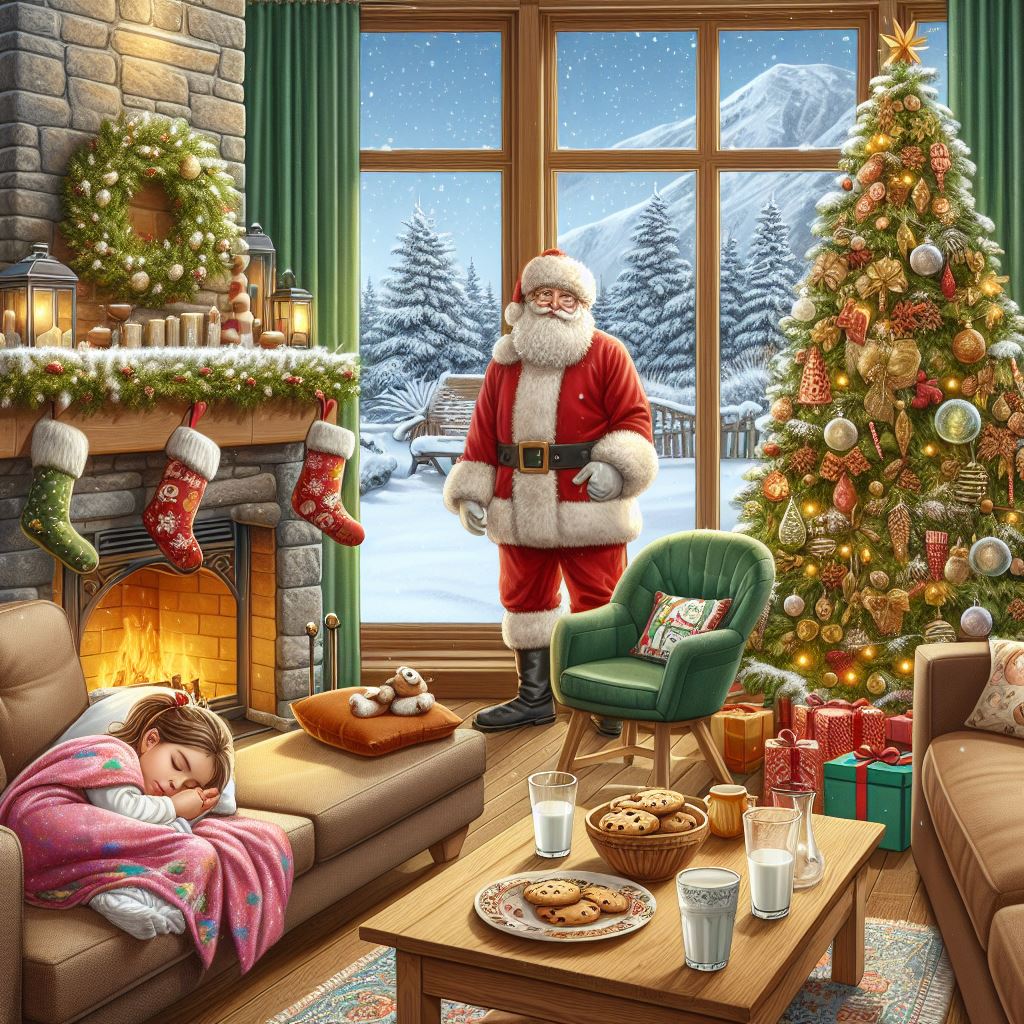
On Christmas Eve my aunt, uncle, and cousins came to visit with us. My cousins were much younger than me, so we didn’t play together. We had dinner then everyone helped decorate the tree. The bright lights cast a colorful glow around the room. There was a fire in the fireplace making the night cozy. The big picture window in the front room framed the snowy scene outside. Grandma had paper and crayons for me to draw pictures. I drew a picture of Santa and his reindeer to leave for Santa along with cookies and milk.

When my aunt and uncle left with my cousins it was time for me to go to bed. I worried that Santa would get burned by the fire when he came down the chimney. Grandpa assured me he would stay up to make sure the fire was out and the fireplace cool so Santa would be fine.  I told them I would stay awake until he got there just in case. And then, lights out.

In the morning I awoke when Grandma came into the living room to take the cover off of Mr. Thorndike’s cage. He was their blue and green parakeet. He started to jabber, jabber, jabber as soon as he saw daylight. Slowly I recognized where I was and looked first at the fireplace to check on the fire. It was out. Then I looked at the tree and saw presents all around it. Santa had come. The milk and cookies and my drawing were gone. I missed him – I slept through it all. Oh, how disappointing. But I couldn’t let anyone know I had not fulfilled my mission.

Grandma and Mom went into the kitchen to start breakfast. Grandpa came into the living room followed by my dad. They looked amazed at the tree and all the presents. Dad picked me up and Grandpa took the blankets and pillow off of the sofa so they could sit down.  I walked around the presents; everything was wrapped, and I didn’t know what was mine but I tried to guess. Grandpa said we’d open gifts after breakfast. Oooo, I didn’t know if I could wait so long. Grandma took me to the bathroom and helped me dress. I was so anxious. Grandpa picked one present from under the tree and told me I could open just one before breakfast. It was a china tea set with roses on the four small cups and saucers, and a teapot, sugar bowl, and creamer.

Then the question. Did you see Santa? Did you talk to him?

My four-year-old brain lit up. “Yes,” I said emphatically. “Santa came down the chimney and got his pants a little dirty. He saw me lying on the sofa and put a finger to his lips and told me not to talk. He ate the cookies and rubbed his tummy, mmm good. Then he laid out all the presents from his big red bag and blew me a kiss, took my drawing, and disappeared back up the chimney and I fell asleep really quick and didn’t look at the presents.”

“Oh, you’ll have to tell Grandma what you saw,” Grandpa said and called Grandma and my mom in from the kitchen.

I repeated my revelation and added that I heard the reindeer on the roof and their bells.

“You are one lucky girl,” said Grandma. “Not many get to see Santa.”

I did not notice the exchange of looks and winks that I’m sure darted around the room from adult to adult as I told my story. They accepted every word and repeated what a lucky girl I was.

Four years later, when my third-grade teacher told the class just before we left for the day and Christmas break, that although Santa wasn’t real, it was the spirit of giving that made Christmas special. A knot formed in my stomach. Santa, not real? How could that be? My throat went dry, a lump obstructed my swallowing. I couldn’t talk. I was devastated. I went home after school and asked my mom. She grumbled about the teacher telling the class about the myth of Santa but admitted that the teacher was right. Santa was the spirit of giving not a real man. The magic trickled out of the holiday like syrup slowly dripping off my Christmas waffles. It took me the whole Christmas vacation to accept that Santa was not a person, just the essence of giving. I couldn’t even talk about it to my best friend. The day before school began in the new year, I asked her if she knew about Santa before Mrs. Singer told us. She said yes, she was not surprised. Her parents never believed in Santa and told her and her brother not to talk about it to other kids who might believe. That really put the exclamation point on the lesson. I had no choice but to believe them.

Then I remembered my Santa sighting. Another whole dimension developed in my troubled brain. Now I knew, they knew I was telling a whopper of a tale when I described my visit from Santa. By then, I’d convinced myself that it was true. Not once did any of those grownups bring it up. Toward the end of my mother’s life, I asked her about it and she said my imaginative, impromptu story was the highlight of that Colorado trip.  I’ve told stories real and imagined since I was four.

Effie’s Trinket

When writing, to clear your mind, it is sometimes fun to find a prompt that stretches your imagination, gets you out of a rut, and lets your brain breathe. This story is what came to me instantly from a prompt to write a one-page story, poem, or essay about a trinket, a twenty-minute write. Now there are endless possibilities in that direction. What is a trinket? Is it a treasured bobble given you by your grandmother? Is it a fun reminder of a trip to the fair? or to Italy? Sometimes I need to be flexible about the one-page directive. Many stories are handwritten so the “one-page” doesn’t count because I transcribe them to computer. Then one–page can be fiddled by changing margins and font size unless otherwise restricted. The idea though is to be free, unloose your imagination. Let yourself go.

Effie’s Trinket

“Euphemia.  Euphemia. Come in for supper,” her mother called from the screen door into the backyard.

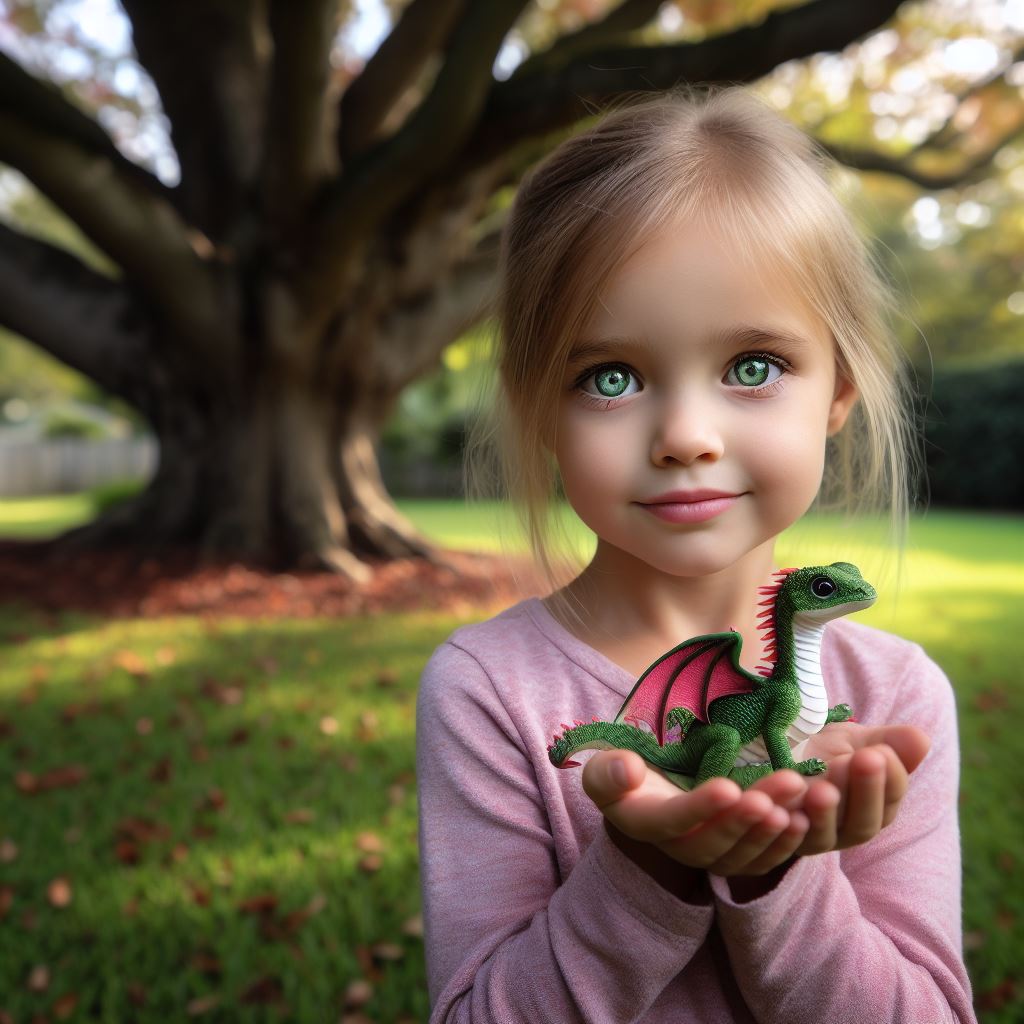
Effie scrunched down so she couldn’t be seen from the back porch. Old Elmer’s giant arms embraced her, fanning his huge green-gold and orange leaves to conceal the girl’s hideaway. Effie’s stomach gurgled. It had been hours since she ran away from home and maybe she was a bit hungry. She held Trinket in her two hands, cooing to him. “We don’t need food, Trinkie. We’ll live on moonlight and magic.” Trinket nuzzled his spikey head under her chin, his grey-blue eyes blinking as he stared up at her.

Effie’s mom went back into the kitchen, the screen door slamming behind her. “Go ahead, sit down. I’ll give her another five minutes and then we’ll eat,” she said to her husband Eustis and son Micah. The round oak kitchen table was set for four. Food waited on the stove top to be served. Glasses of honey mead, diluted by water for the children, were in place.

“Ma, I’ll go find her,” said Micah.

“You’ll stay just where you are,” Eustis proclaimed. “You’re the reason she walked out this afternoon. Why did you have to tease her again about her dragon?”

“Aww, Dad. She’s nine and too old to be carrying around a baby dragon. I’m embarrassed when my friends see her.”

“Well, son, you may be a mature fourteen-year-old now but it wasn’t all that long ago you rode your unicorn, Cool Whip, up and down the county road. I think you were about Effie’s age when you told us he took you over the moon one cloudless full-moon night.”

“Euphemia Jane. It’s time to eat. I made chicken pizza and mashed potatoes with butter and bacon bits.” Dorothy called again from the back door.

She scanned the yard for a sign of her daughter. Effie had a habit of running away when she was mad. She had never wandered beyond the boundaries of their two-acre property but there was always a first time. Dorothy looked at the shed, a common retreat. Blackberry vines that covered the building didn’t look disturbed. In summer, Effie would come in with scratches on her arms and legs from reaching for the ripest fattest berries. Her fingers, her mouth and tongue would be stained royal purple. But it was autumn, not the season for blackberries. She glanced up at Old Elmer. The tree sat halfway between the shed and the vegetable garden. There, about a quarter of the way up the seventy-foot colossus, she saw a glimmer of pink. Effie’s pale gold hair glowed pink in red rays of sunset.

“Euphemia Jane Charles, come down this instant. Bring Trinket with you. Your brother will leave him alone.”

The empty feeling in Effie’s tummy and her aching legs from being crouched for so long as well as her mother’s promise that Micah would leave Trinket alone persuaded her to shimmy down the tree with the baby dragon secured under her arm. “Thanks Elmer,” she said as her toes touched the soft cushion of fallen leaves beneath the tree and she set Trinket on the ground. She started to walk toward the house but the golden cord that tethered Trinket to her ankle became taut. Trinket cocked his head, lavender wings folded tightly against his body, refusing to follow her.

“Com’on, Trinkie, let’s give Micah one more chance. He didn’t really mean it when he said he would take you away and drop you at the end of the earth. I won’t let that happen even if I have to carry you always. You’ll be getting bigger and pretty soon he won’t be able to bully you. Your wings are almost strong enough to carry you where he can’t reach you. One of these days your fire starter will work and it will serve him right if you give him a little scorch. She bent down and picked Trinket up cuddling him close to her chest. He gave a little snort, a happy snort, waggled his pink and purple scales, and settled in her arms.

They went in for supper.

The End

I gave this story to a friend for comment, not about grammer but about the flow of the story. He is a serious writer/researcher.
His comment was, “So, is Trinket a stuffed animal? Or a cat?”
“What do you mean? Trinket is a dragon,” I replied. “It says it pretty clearly.”
“Oh,” says he, and that was the end of his comments.
It is useful to remember that a reader filters your stories through their experience. They may have a completely different interpretation of it than was your intent.

The whole idea of writing from a quick prompt is to exercise a separate part of your brain and give yourself the freedom to explore topics from different, hopefully, fresh angles. You may find a nugget of something useful to your main project in those musings.

I am blessed with dozens of people who live in my head. They are generally unobtrusive unless called upon to inhabit a story. I also don’t know where their names come from. I don’t recall ever hearing the name Euphemia or Effie before. Once these people have been let out, they become a part of my mind-family. I’m never lonely. I know them all so well. For instance, Eustis, in this story is a very real character to me. He has tomato-soup-red, short, curly hair, black-framed glasses, and is a scientist who works for a small chemical company in the mid-west. He always has a slight grin on his face as though he is observing life through bubble glass. He hums a little song frequently with part of the chorus “I got Memphis blues, right down to my shoes.” I don’t know if that is a real song or not. It just popped into his head. Although he is a minor character in this story, he may reappear in a different story at a different time with his unusual family. That is unless they all expire from his wife’s cooking. I cannot imagine serving such a meal to my family.

Another person I wrote a story about is Hannah, a black woman born in the late 1890s who is a baker in Wickenberg Arizona in the 1920s – 30s. I know all about her childhood and her family who were sharecroppers in Mississippi, and slaves, a generation before that. I know her journey to independence as a businesswoman. I’ve seen (in my imagination) the headstones of the family in the county cemetery. She has an amazing story to tell. One day I may put it on the blog. These people are very real to me but they are all born from my imagination. Sometimes I think I should put a disclaimer on my stories like the old TV shows that says, “Any resemblance to persons living or dead is purely coincidental”.

Change * My Last Post on A Way with Words blog

As my dear husband reminds me whenever I am flummoxed by events that modify my circumstances, “The only constant is change”. The world is always in flux. Change is life. We are not the same, day in and day out, because our lives are not static. We live in an ever-modifying world, shifting conditions and changing views. As we get older our bodies transform as do our wants and needs. Change brings growth even when we don’t immediately realize it. Change is a catalyst for learning about ourselves, others, and our world.

What I’m getting at is there is a change on the horizon with me and the A Way with Words blog. This is my last post as a regular blogger. With the permission of Sally and Jackie, I will occasionally be a contributor. Our friendship remains intact. I will always be grateful for their generous friendship and their mentorship. We spent many years learning to write together and now we are going separate ways as writers.

I established my own blog site Wonkagranny, a grandmother’s perceptions of the universe through stories, poems, and life observations. I will write posts on that site beginning September 1st.  I do not feel that I can maintain an effective presence on two blogging sites at the same time. I am writing short stories and essays that may or may not ever be published. Publication has never been a goal for me, but some of those stories and poems will be linked on my Wonkagranny site. My past posts from A Way with Words are archived on Wonkagranny.

I deeply appreciate all those who read and comment on our mutual website and I hope you will join me on my personal journey with words.

What I’m getting at is there is a change on the horizon with me and the A Way with Words blog. This is my last post as a regular blogger. With the permission of Sally and Jackie, I will occasionally be a contributor. Our friendship remains intact. I will always be grateful for their generous friendship and their mentorship. We spent many years learning to write together and now we are going separate ways as writers.

I established my own blog site Wonkagranny, a grandmother’s perceptions of the universe through stories, poems, and life observations. I will write posts on that site beginning September 1st.  I do not feel that I can maintain an effective presence on two blogging sites at the same time. I am writing short stories and essays that may or may not ever be published. Publication has never been a goal for me, but some of those stories and poems will be linked on my Wonkagranny site. My past posts from A Way with Words are archived on Wonkagranny.

I deeply appreciate all those who read and comment on our mutual website and I hope you will join me on my personal journey with words.

Truth and Facts

Originally posted on A Way with Words blog

Today I read a moving blog post about a friendship. The author wrote about her friend with the truth of memory, not necessarily the facts.  Raising the Dead ‹ BREVITY’s Nonfiction Blog ‹ Reader — WordPress.com.  I read another insightful blog post about current political turmoil in France. Out My Window ‹ Reader — WordPress.com. Somehow those two posts melded, although completely different in intent, and made me think about my reality and my memories.

To me facts are incontrovertible, they may be proven false later, but they are the concrete reality that can be proven at this point in time. Facts are objective, the absolute of what we know now through all our senses. Truth is subjective. It is the reality of facts filtered through our experience. We are all human and, as humans, subject to our own prejudices and emotional knowledge. Truth is facts of the heart, our day-to-day understanding of what is going on around us. As memoir writers it is important, on your journey to the truth, not to let facts be stumbling stones. While facts may be important they are not the sum total of the experience or the lessons you learn along the way.

I have a friend, a brilliant sculptor, who exhibits regularly at art shows around the country. I’ve watched her, in an hour or two, turn big lumps of clay into miniature animals – wolves, horses – so realistic that you expect them to move toward you at any moment. A magical experience. Many years ago, I traveled with her to an art exhibition in Montana that included her work. During our time there meeting artists and enjoying the art world, we had an on-and-off weeklong discussion on religion. What is the soul, what is spirit, can God be proven, etc? The discussion continued as we packed up and left Great Falls. I was driving her van. Somewhere along the highway, we passed a gas station where a large dog was sitting close to the edge of the road. We are both dog lovers.

I interrupted our discussion with “What kind of dog was that?” as we zoomed by.

“Dog?” she replied, “What dog?”

“The one we just passed,” I answered.

“We didn’t pass a dog, we just went by a Circle K,” she said.

“Ah, you didn’t see the dog, but it was there.”

“You’re making it up to change the subject.”

At the next turnable place, I maneuvered the van across lanes of the lightly traveled highway in a most illegal U-turn and headed to the gas station possibly five miles back, hoping the dog hadn’t been run over or run away. Sure enough, the dog was still sitting by the road.

“There,” says I, “that dog.”

“Oh, I guess I didn’t see it. It looks like a shepherd mix to me.”

“And that was my point,” I said returning to our discussion about belief. “Your reality is that the dog didn’t exist because you didn’t experience it.  Your truth is different from my truth. My truth could be based on an illusion or on my five senses, but it is my truth. It is what I know to be true and the same goes for you. Had I not turned the van around, we would have totally different memories of the same experience.”

What would my essay be today if the dog left, disappearing around the side of the building or into its owner’s car? It would be of a dog I swear I saw but then disappeared and her story would be of a crazy friend who made a U-turn in the middle of a highway to show her a phantom dog. Both would be true.

I write fiction primarily. Fiction contains elements of a writer’s truth. To my many memoir writing friends I want to say, write YOUR truth. There are no video or audio recordings of your day-to-day activities or relationships and the memories they engender. Your memory IS the recording and it IS filtered through your experience. Write what is in your heart because that is the truth and that is more important and much more interesting than all the facts listed in order as years evolve. Don’t let the fears of others block your truth. They cannot convey your story and should not arbitrate it. They are bit players, you are the star. What you learned is of value to those who are not able to express their story in words. Your truth may inspire or may help someone, even in your family, understand their world better. Write your story as it is for you. Don’t wait to let someone else tell it because it will then only be your story filtered through their experience, their story of you. Be Brave.

Our book Telling Tales and Sharing Secrets includes essays from each author’s truth as well as fiction short stories and poetry.

Wordsmithing

Originally posted on A Way with Words blog

Writing. Something I am doing almost all the time. Even in my dreams. I may not be physically committing words to paper but, in my head, stories are being created, or poems, or current events noted. At some time during the day, I try to find a space to scribe those thought forms with the symbols we call words.  

Every year a new list of words is published by a variety of sources including Oxford House and Webster. Last year ‘staycation’, ‘metaverse’, and ‘shrinkflation’ were offered in the listing of new terms. They were words I understood and may use. I’m particularly fond of ‘badassery’. Other words like ‘finfluencer’ (a financial influencer), ‘crunk’ (full of energy), and ‘ASMR’ (autonomous sensory meridian response) will probably never enter my lexicon of jargon.

I love to play with words, so welcome the expansion. However, I’ve noticed that some old words are being abandoned or profoundly changed. Some very nice old words at that. As our culture changes so do the words to describe it. One prime example is ‘gay’ used today to indicate a homosexual male and in the past to describe a happy, carefree feeling. ‘Literally’ used to mean something actually happening now but has been converted to a word of emphasis such as a ‘literal’ smash hit.

I believe the world is a sadder place without ‘nizzled’ (slightly intoxicated), ‘chuffy’ (haughty, puffed up), and ‘quixotic’ (absurdly romantic). I made myself a promise to discover some great old words and apply them in my next story.

A book I discovered last year is Dreyer’s English, an Utterly Correct Guide to Clarity and Style by Benjamin Dreyer. Great word ‘utterly’. Mr. Dreyer has taken Strunk and White, the absolute bible of English grammar, to a whole new level. While the little tome of Misters Strunk and White is in my portable writing folder at all times, I prefer to look things up in Dreyer’s bigger book that sits on my desk. He always has a good story to go along with the lesson. Anytime I can laugh as I learn, I learn much better.

Happy wordsmithing to all.

And so it goes…

Originally posted on A Way with Words Blog

It is almost like I’ve written this before. Maybe I have, maybe not. My stacks of journals are witness but I haven’t the patience to cruise them all – it would take hours, days, months, etc. The story as old as the ages. What age does. I’m seventy-seven. It is a startling revelation each time I say it aloud. I remember thinking sixty was the end game when I was thirty. What is seventy-seven? I know many people in my generation, my age group. Some are old, some not.  I put myself in the latter category. I certainly don’t feel old. My body does occasionally, but I disabuse it of that notion as quickly as it complains. ‘No, it’s not age, it’s what you ate-drank-did yesterday that is the cause of complaint,’ I tell the federation of bone, fat, and muscle that contains my spirit.  ‘Be more thoughtful in your choices’.

I read some time ago, old is ten years older than whatever age you are. When I was ten, twenty was freedom. When I was twenty, thirty was unimaginably far in the distance with countries like marriage, continents like parenting to explore. In my thirties, there were career challenges. There was so much to do between ten and twenty and between twenty and thirty and beyond.  Seeming lifetimes of choice were encapsulated in each decade. What did I know at fifty, that I didn’t know at forty? The blurrrrr of years, forties, fifties, sixties and now seventies, whizzed by. Here I am looking ten years down the road. What will eighty-seven bring? How will I evolve in that space of time? Who will I meet? What questions will be answered? What fresh questions will arise? What different territories will open? I am ever curious. Each day brings something new. Nothing is static when you are alive. Change is the only constant and change brings opportunity. Embrace each day for the treasure that comes with it. Even difficult days reveal nuggets of discovery, maybe more so.

Painting by Sally Rosenbaum

It is never too late for surprises in life. Not in a million years would I have thought I’d be a published author. A writer, yes, but not published. My stories and poems have always been for my own amusement. Yet here I am in league with two other writers having a published book, Telling Tales and Sharing Secrets, a journey of friendship through words. Published at age seventy-seven! It is a book I believe in because it is meant as an encouragement to those solitary writers who want to be heard by the world at large or those who want to have their voices heard in a smaller way. Writers’ groups can be a support for both.

A Place to Contemplate

Originally posted on A Way with Words blog

I recently came across a blog that I enjoyed immensely called Seams Like a Story, https://debravandeventer.com/. The author, Debra VanDeventer, is a writer in my hometown of Oro Valley. In fact, as it turns out, she is a neighbor. We met at the Oro Valley Writers’ Forum at our local library. I’m passing this along to our readers because I think you will like Deb’s take on life. She is a writer, seamstress, and grandmotherly adventurer among all the other titles accrued by a woman during a lifetime. She retired from teaching, but it is clear she is and always will be a teacher who looks at life as a learning opportunity. Her most recent blog is about a thing called Hygge – a Danish word that means “courage, comfort, joy.” In our tumultuous times, it is good to have a place to retreat, to contemplate and be comforted. That is what Deb promotes in her latest blog post. Give it a try.

I have commented on my love of writing and what my writing “place” means to me. It is my hygge place where I can retreat to write, read, and contemplate; where hours seem like seconds. I am surrounded by books, music, photos of my people, and pictures that speak to me of places I’ve been either in life or in spirit. It is also a place I share with three cats, my muses. It has taken a lifetime to curate the exact items that give my space that feeling of contentment. Everything in here has a meaning and a memory.  

Stories are born of imagination and experience. Telling Tales and Sharing Secrets is a collaborative memoir of our writers’ group as well as an anthology of the stories we three accumulated through our time together. Most of the writing and editing that I contributed to our book was done in this room at my desk. When we three could not be together in person, we met through Zoom to keep the project alive. Have a blessed day and enjoy your own hygge place.

A Weekend Project

Originally posted on A Way with Words blog

I recently read a poem by Tom Chester titled Sedimentology (Sedimentology – TURN-STONE) in which he more or less describes my writing room. I don’t know about all writers but some I know have a similar problem – collections of words that pile up in various forms to make hillocks and eventually mountains of paper, bound and unbound. I looked around my room and decided that this weekend would be dedicated to moving those mountains. Books were replaced on shelves where they belonged – the easiest task. It took the better part of two days, but I excised a Hefty bag full of detritus that has been collecting for weeks and months; piles on every horizontal surface including the floor. The remaining notes, papers, letters, and clippings were properly classified and tucked into labeled file folders, then housed in one of three file cabinets according to their category: business, personal, or writing references. I also have a small box of mementos that don’t fit in files but will reside on a shelf in a closet until I forget why I kept them.

These pictures are not MY writing room but a close proximity to what it looked like. I didn’t take a photo of my room in its disarray.

The file labeled Bits and Pieces is the thickest. It contains jagged pieces of envelopes and napkins, published thought-provoking articles, and scribbled lined-pages of half thought out ideas that didn’t make it into one of my notebook/journals. The journals, themselves, take up a couple of shelves in a bookcase. Much of the time spent in this exercise was rereading those precious scraps of writing, so urgently recorded that, at one time, seemed quite brilliant; tossing most. The saved ones are worthy of becoming a short story, a poem, or a blog post. I rediscovered letters from friends that need to be answered – better late than never. Of course, my three cat-comrades, Nunny Catch, Oliver, and Sadie, assisted by roaming among the sorted piles, and across my lap insisting on head rubs while I sat on the floor where they could easily reach me. It was labor, long overdue, and totally worth the effort. A cleansing of sorts. Now I can enter my tidy room and get right to my desk without moving or avoiding piles. Ahh, that feels good. The sad reality is that those mountains will rebuild over the next year – despite the best of intentions.

Why I Write

First posted on A Way with Words December 5, 2022

It’s about Power.

As a writer of fiction, I can create a city, a village, a country, a world. I can fill it with characters that I love or love to hate. I can imbue them with a certain amount of free will and, if I don’t like how they use it, I have the power of the eraser or delete key. The characters I create may be human or they may be animals, even mechanical beings, or a combination of these.  I can ride down a country road feeling the fluid strength of the steed beneath me, enjoying the bucolic scene of field and meadow, knowing that around the next bend there is a plot twist that will change my story, transform the world. I can change the weather from stormy to sunny and back again. In short, I am god.  I can wander through forests of words and chop down the one I want to take to a sentence I’m constructing. I can plunge into oceans of emotions to catch the one that will give my character motivation to propel the story forward.

Similarly, when I write memoir or creative non-fiction, I take an event from the headlines or from memory and, while sticking to the reality of it, invent or reimagine dialogue I did not hear or do not remember. I give the incident a spin to emphasize the part I think is important or transformative. It is my story told my way. This kind of writing does require research to authenticate it. I enjoy research because it opens the discovery of things I did not know and enriches knowledge that I then mine for other stories.  I prefer fiction and poetry because I am not bounded by facts, annoying facts that constrict my imagination.

Writing is an inexpensive form of entertainment and also therapy. The cost of a pencil and paper can set me up for hours and hours of diversion. I disappear into a world I create. Sometimes it is hard for me to resurface, to attend to my daily tasks and the real-life characters, human and animal, who live with me. I am glassy-eyed and slightly incoherent for a time when I leave my writing desk depending on how long I have been immersed in writing. My dear husband can attest to the state of suspended animation that surrounds me. I gave up the idea of writing the great American novel by the time I was thirty. I write for myself because I love to play god.

Hemingway and Me

Originally published on A Way with Words blog

I have always enjoyed writing. My first novel, written when I was seven, was called The Girlfriends. It was a mystery printed on ten wide-lined pages in pencil. I cannot remember the plot details because, alas, it was lost sometime in the last seventy years. These things happen in life. I know how Hemingway felt when his first unpublished masterpiece was lost in 1922 by his wife on a train in Europe. Did I just compare myself to Hemingway? Yes. Not that our significance to literary posterity is similar but because we both are scribblers, people who love words and live in them. That’s what this blog and our book, Telling Lies and Sharing Secrets, is all about – sharing our enchantment with words and the worlds they conjure.

Being a lover of words I have, at hand, books about words and grammar. My new favorite is Dreyer’s English, An Utterly Correct Guide to Clarity and Style by Benjamin Dreyer. Does that sound boring? I dare you to read more than a few pages without chuckling and eventually belly-rocking. Toss away your Strunk and White. Dreyer’s book is vastly more entertaining and equally edifying. It is a laugh-out-loud book of passion for the English language. I do not exaggerate. I read passages to several friends, non-literary types, and elicited the same response. Who knew a comma or an apostrophe, not to mention a preposition, could be so much fun? Just as Mary Poppins sang, “A spoonful of sugar makes the medicine go down in the most delightful way.”

Happy writing everyone. We hope you find your journey in writing is loaded with ah-ha moments you can share with a group of similarly minded friends, just as we have.