Standing on the brink of eighty, I have so much past and a diminished amount of future. I must keep reminding myself of that because I don’t feel a day over thirty-five, and my tomorrows still seem endless. I’m listening to friends and colleagues about all they are doing to prepare for their inevitable end. Things like clearing out closets and storage so their heirs are not overwhelmed with the detritus of their lives.
That’s a good idea even if you are not anticipating the Grim Reaper. It cleanses the mind to get rid of stuff instead of stuffing it in nooks and crannies. The same can be said of ideas and memories. They can be aired out, shared with the world, or discarded entirely.
I have so many wonderful remembrances to look back on, I don’t dwell on woes. Among my very happiest memories, besides my relationships, are my stories. I have written countless stories, character sketches, and poems over the years. Only in the last twenty years have I shared any of them. I wrote for myself. As a matter of fact, no one in my family even knew I was a writer. Of course, I didn’t call myself a writer then because to me that was an exalted status far above my humble reach. You know Hemingway, Huxley, du Maurier, Woolf, Rowling, Fitzgerald, Austin, Dickens, and so many more I admire. When I took my first writing class, I was told that if I write, even in secret, I AM a writer. Hallelujah! Now I can say it out loud.
When we moved from the Pacific Northwest to Southern Arizona, I tossed out volumes of diaries, journals, and notebooks of my writing. I figured I’d never have any reason to revisit them. It was my secret life. By chance, some were overlooked, so I have dribs and drabs of my early reflections on life, including my senior year of high school. I would love to look through all those old notebooks again to see how my perspective may have changed.
I started blogging as a marketing tool for a book I co-authored three years ago. It was fun. I was hooked. I started asking my husband to read stories I write for my critique group and blog. He was surprised that I wrote. Fortunately, he likes my writing. At least he says he does. He is not a literary critic, only a reader. He has never liked reading books, so my short essays or reminiscences are just the ticket. Longer projects I have written require an editorial type of review. For now, I’m enjoying the interaction I receive from readers at the Oro Valley Writers’ Forum, my critique group, and my online blog.
I encourage EVERYONE who likes to put pen to paper or tap away on a computer to consider themselves A WRITER. Find a writers’ group that agrees to read and critique your stories. It is a way of strengthening your skills and receiving feedback for your ideas. Writer groups are formed in writing classes given through Pima or the U. of A. The Oro Valley Writers’ Forum at the Oro Valley Library is another place to meet writers and share ideas. It is never too late to share your perspectives with the world. Everyone has a story. Every day is a story. Don’t live in a secret world. Clear out your closet of ideas and reveal your insights through fiction stories, non-fiction, memoir, or poetry. Your voice is an important thread in the fabric of humanity. We have so much more in common than in opposition.
I apologize to anyone who was misled by the title of this piece, thinking there might be some delicious salacious tidbits in the offing. Eighty years have been filled with a myriad of highs and lows, disappointments, and missteps. My deepest, darkest secrets are still locked away in my journals. Some are delicious in retrospect. They may see the light of day at some point.
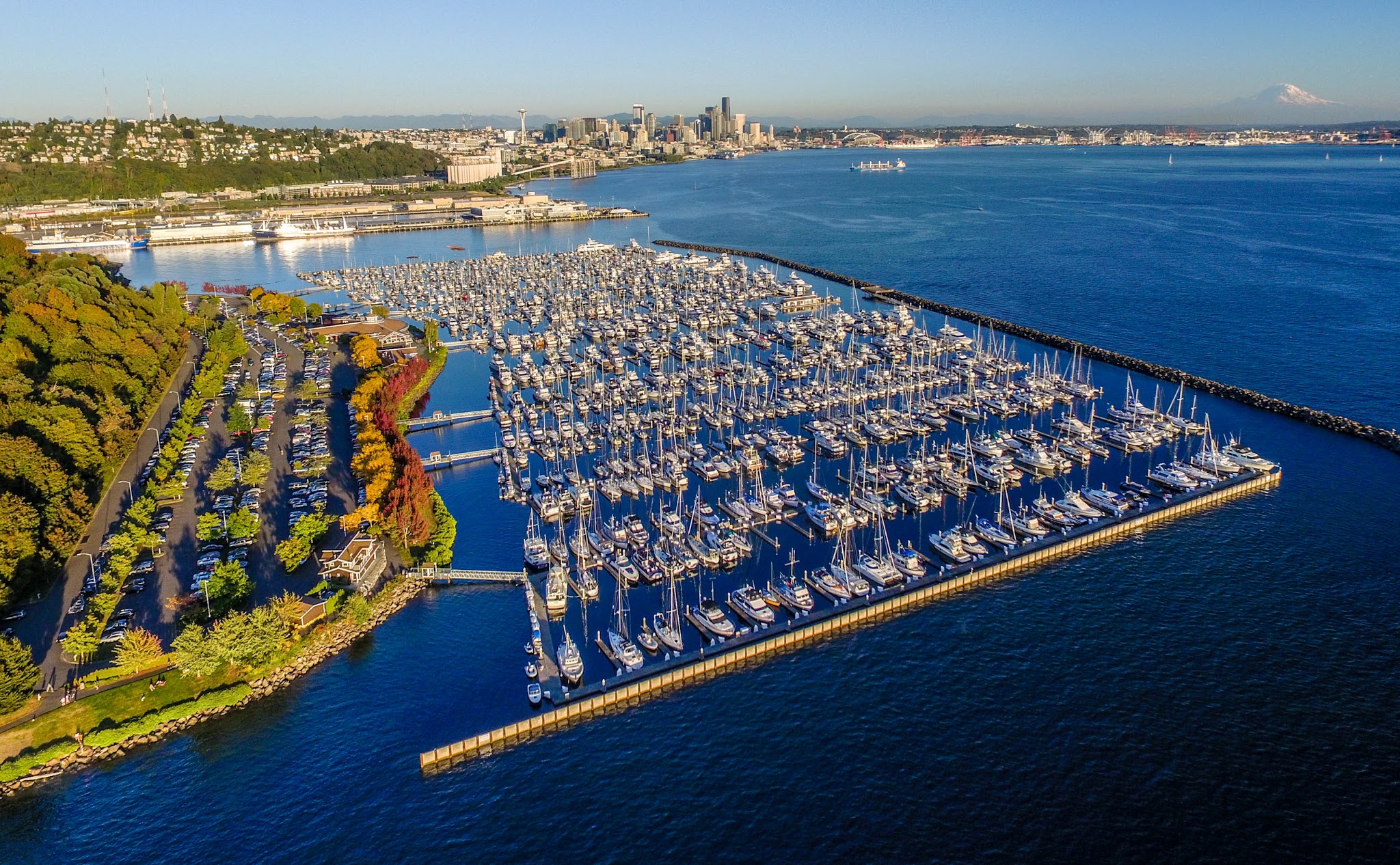
Today is one of those not-quite-sunny-but-definitely-not-raining days, so we’ll go to another part of Seattle where I once worked, Leschi. It is on the east border of Seattle along Lake Washington, just north of the Lacey V. Morrow floating bridge (the second longest floating bridge in the world, next to the other Lake Washington Evergreen Point Bridge further north on the Lake, which is the longest in the world). Lake Washington is a navigable body of water about 22 miles long. It is deep enough for ocean-going vessels to enter its ports through the canal, then down to the south end. Across Lake Washington, further east of Seattle, are Bellevue and Medina, where my family lived.
Leschi is a mix of beautiful homes, from craftsman bungalows built in the early 1900s to stately Tudors and contemporary homes built later. It was originally a place for summer cottages, but now it is an enclave for multi-million-dollar lakefront properties. I remember the day when, in one of those million-dollar waterfront mansions at Leschi, Kurt Cobain shot himself in the head, leaving Nirvana headless. Sorry, bad joke.
In the late 80s, I worked for two companies at 120 Lakeside Avenue in Leschi. Both were headed by multi-millionaires. First, I worked for a venture capitalist S.S. Besides being a successful entrepreneur, he was a philanthropist. He owned a mall in north Seattle and a prominent grocery chain, which became part of Kroger. He donated to various charities and supported an inner-city elementary school with a $1 million per year endowment. There were only five of us in the office. I was hired as a secretary/receptionist with general office duties. He didn’t have much work that challenged me, and I had time on my hands. It was while working in his office that I taught myself computer skills – back in the day of DOS.
One story about S.S. that I remember was when my husband and I decided to purchase a boat. I told S.S. we were looking around for a modest sailboat. He owned a sailboat, did a lot of cruising, and had some good advice. One piece of advice though, depicts the difference between his place in the world and ours. Speaking very earnestly, he told me to be sure the sailboat had a washer and dryer onboard so that when we were out cruising for weeks, we could have clean clothes. I know my mouth gaped when he said it, but I recovered and thanked him for his advice. His idea of a sailboat was more YACHT than boat. On neither of the boats we eventually owned was there room, let alone hookups, for a washer and dryer. Nor did we cruise for more than ten days at a time. Oh well, a girl can dream.
Later, I went to work for his friend T.L., who, with his partner D.S., managed the upscale commercial building of offices, retail, a marina, and gas dock on the shore of the lake. S.S. bragged to T.L. about my computer skills, and T.L. was just beginning to get savvy about computers for his company. He offered me a job with challenge and a better salary, so I left S.S. We all remained friendly. T.L.’s offices were downstairs from S.S. Cabin cruisers, yachts, fishing boats, kayaks, commercial hauling boats, ski boats, and sailboats paraded past the lakeside windows of my office daily. I managed and leased office space and kept books for the dock facilities. I also set up their computerized accounting system. Those who know me will laugh. I am terrible with numbers, but I do understand computerized systems. Well, I did then when they were less complicated than today.
Let’s have lunch at BluWater; it used to be the Leschi Café when I worked there. They had the very best clam chowder in town. Well, maybe second best next to Duke’s. It’s a nice enough day so we can sit on the patio with a jacket on, watch the boats, and look across the lake to the city of Bellevue, connected to Seattle by the floating bridge. Until the 1940s, the only way to get across Lake Washington was by ferry boat. You can now zip across quickly in your powerboat or go across one of two bridges.
Our son and his friend Mike sometimes skipped a class in high school on a nice day and drove Mike’s speedboat across the lake to my office. I treated them to lunch at the pizza restaurant downstairs in our building before they went back to school. I was not a terribly strict mother. I’ve always felt that experience trumps classroom learning. I occasionally practiced the art of experiential learning as a high school student.
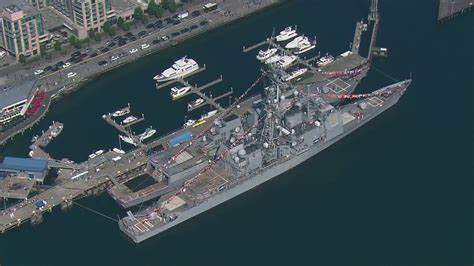
Big Ships at dock during Fleet Week
The last week of July is the celebration of SeaFair, with SeaFair royalty and pirates in the torchlight parade, boat parades on Lake Washington, Navy Blue Angels exhibitions, Boeing airshows, Fleet Week in Elliott Bay with tours of big naval ships, and all manner of hilarity. The size of those naval ships is astonishing. Both of my mother’s brothers were in the Navy during WWII. My Uncle Johnny described his harrowing experience in the Battle of Leyte Gulf and recommended a book, The Last Stand of the Tin Can Sailors. It is about a different naval battle, but he said it brings the feelings to life. In his later years, he talked about it rather matter-of-factly, but I sensed the emotions it brought back.
Hydroplane races on Lake Washington during SeaFair
One of the most exciting things I remember about SeaFair is the hydroplane races. Flat-bottom boats with powerful airplane engines race each other around a course reaching 200+ mph, lifting off the water. It is thrilling to watch their explosive water fantails shoot high in the warm August air. Just as in car races, their roar is so loud you remain deafened for a few hours afterward. SeaFair was a highlight of my youthful summers, I think, because it was usually such a nice weather week with so many diversions.
To continue our Seattle tour, we’ll drive up and over First Hill, one of the original seven hills of Seattle, which we called “pill hill” because of three big hospitals located there. Now we’re in the Central area, the most ethnically diverse neighborhood. It started as a Jewish settlement and is still the home of Temple de Hirsch Sinai, the largest Jewish congregation in Washington. Rabbi Raphael Levine was the leader of that congregation when I lived in Seattle and he was a towering presence throughout the 60s, 70s, and 80s, fighting for civil rights and brotherhood. A Buddhist Church is nearby as well as a Japanese Congregational Church. The Central area had the highest population of blacks in Seattle. The Central area was the childhood home of Jimi Hendrix, Dave Lewis, Quincy Jones, and Bruce Lee, and a staging area for the Black Panther movement in the 60s.
I remember the Central area most because that is where I often went when I skipped school in my senior year. One of the high schools in the area is Garfield. Garfield’s basketball, track, and football teams made the championships every year in the 50s and 60s. In 1963, they had a jukebox in their lunchroom. One of my friends, Kelly, had a car, and her boyfriend, John, was a basketball player on the Garfield team. Kelly and I would leave our school in Bellevue at about 11:30 in the morning and drive across the lake to Garfield to dance to the music and eat our lunch with John and his friends. We got back to our school in time for last period and went home at the proper time. We had friends in the attendance office who made sure we were marked present officially during that time. Can’t get away with that these days.
One time, Kelly and I were walking the halls of Garfield on our way to the lunchroom when a phalanx of large – think football player – young black men with their arms across each other’s shoulders blocked the hall, wall to wall. They wore serious eye-squinting faces as they marched toward us. There was no escape except to go through them. We did. We ducked under their arms. They broke out in laughter. Hearts pounding, we were relieved it was a prank, not a threat.
My French teacher was suspicious and called my house one day when I missed her class one time too many. Usually, that was no big deal because both of my parents worked, so she would not have reached anyone. This was in ancient days before cell phones and message machines. Just my luck, my father was home sick that day, and she told him I missed French class several times in a few weeks. When I got home at the regular time, my father greeted me at the door.
“Where were you all day?” he asked. “School,” I said with total truthfulness, I left out that I had been in two different schools. “Miss D called to say you were not in class today and had been absent several times.” At that point, I was speechless. I thought I had everything pretty well covered. “I’ll ask again. Where were you?” “I was at school,” I insisted, but then admitted, “At lunchtime, Kelly and I went to Garfield to see John. When we got back, it was too late to go to French, but I did get to my last class.” “Don’t do it again,” he admonished, but I could see he was stifling a grin, knowing that was an empty directive. “I told her you came home and weren’t feeling well. She’s watching you.” Then, as an aside, “And don’t let your mother know, you know how she is.” Dad always had my back.
That was the end of the conversation and the end of the episode. Miss D didn’t give up trying to catch me, and I strived to get back in time for her class when we skipped for lunch. I got a B in French (a class I really liked). In retrospect, I think Miss D was one of the teachers who actually cared about my future. She tried her best to give me advice, even keeping me after class to explain how I was cheating myself and that I had so much potential. I blew it off, but I remember her now as a mentor, a failed mentor, but not from lack of trying. It was not the end of my “experiential learning”. My mother never learned about my truancy until I told her years later, after my dad died, that he had been a co-conspirator in my escapades. Her remark was, “That sounds like your dad.”
I graduated with a respectable B average and was accepted to Washington State University for the fall. I liked school and classes, but I enjoyed being a little rebellious, too. I do not think I learned a lesson or reaped the consequences for my misdeeds. Although my college career was short-lived, it was a fun year. That is another story entirely.
On our next tour, we will visit Discovery Park in Magnolia, Elliott Bay, and Queen Anne. I will tell you a little about living on our sailboat.
This poem was written six years ago after the death of a dear childhood friend. Years accumulated without contact between us. In her final months, she reached out to me, a tender reminder of the bond we formed over sixty years before as twelve-year-old girls. Our families both relocated to Bellevue, Washington the summer before our 7th grade year at school; hers from Oregon, mine from Kansas. We were the newbies so naturally clung to each other as we learned how to navigate a new school and integrate into a new community of teens. She will always be a happy memory. Today is her birthday – Happy Birthday, Gerry.
Continuing our tour, we go north to Capitol Hill, one of the most interesting, in my opinion, of Seattle’s varied neighborhoods. It is the center of the gay, lesbian, and transgender population of Seattle. Punk hipsters with tattoos, pink mohawks, and multiple piercings are commonplace, sharing the streets and sidewalks with men wearing business suits and carrying briefcases.
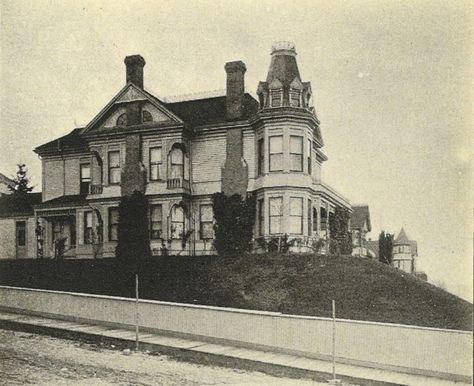
Capitol Hill has the steepest streets in Seattle, a few plummeting as much as 21% grade, and some swanky residences line Millionaire’s Row. The Row is a National Historic Landmark District with homes built at the turn of the 20th Century.
Harvard Exit Theater Lobby
It is the home of grunge music and my favorite movie house, the Harvard Exit. The Harvard Exit was formerly The Women’s Century Club. The century referred to is the 19th Century. It was opened during the last decade of that century by Carrie Chapman Catt, a suffragist who succeeded Susan B. Anthony as leader of the national organization. The building was sold to a theater operator in the 1960s who converted it to a two-screen movie house. It became a favorite place for movie aficionados who like eclectic, off-beat movies. When the movie house closed, long after I left, the Mexican Consulate leased the building. The Exit was allegedly haunted by a woman who hung herself in the upstairs theater. I never met the ghost personally, but the possibility was titillating. The other great old theater nearby was once a Masonic lodge that became the Egyptian Theater. These two theaters put on the Seattle Film Festival every year, screening weird and wonderful films. I never missed it. There was a wonderful bakery on Capitol Hill called Bella Dolce. I used to order cakes for special occasions there, and they are incredible – yum. I haven’t checked to see if it is still there.
Capitol Hill is the location of Lakeview Cemetery, where Bruce and Brandon Lee are buried. An inscription at their grave site is one that I like, “The key to immortality is first living a life worth remembering”.
Our eldest daughter called Capitol Hill home for a year after she moved out of our house in the mid-80s. It was near her work, and there was a dance group that she joined. She moved away from Capitol Hill because the constant day and night activity, including gun shots, made it hard for her to sleep.
Capitol Hill has several aged Catholic churches and was once the center of Seattle’s Catholic population. It is also where St. Mark’s Episcopal Cathedral stands regally on a hilltop, a cliff actually. It is a massive and beautiful old cathedral with a rose window on its east wall that makes the interior glow during the day, even in light-challenged Seattle. As a child, my family went to our neighborhood Episcopal Church in Bellevue each week, but we attended Christmas services every year at St. Mark’s Cathedral. Their Compline Choir is world famous. I felt so holy in that place. Many years later, our daughter performed in the Christmas service at St. Mark’s with the Seattle Girl Choir. The annual Christmas service is televised in Seattle.
This neighborhood is where our son, age eight at the time, learned what a prostitute was. Our daughters were members of the Seattle Girl Choir in the 70s. We took our younger daughter for a choir rehearsal at St. Mark’s. While she rehearsed, my husband, son and I walked down a couple of blocks to get dinner. On a corner, we encountered a very obvious prostitute looking for her next customer. Under his breath, my husband made a comment about her choice of business location, only a block from St. Mark’s, and our son overheard. “What does she do?” Casey asked. “She’s a hooker,” said my husband. “What’s that?” Casey needed more information. “She sells her body for a price.” I enlightened our son. “Oh.” And that was the end of the conversation. When we returned to the Cathedral after dinner, we walked down the same street. I totally forgot our before-dinner conversation. “She must have gotten her price,” said Casey when we passed the corner. “What are you talking about?” asked Ken. “The hooker. She must have gotten her price because she’s not here anymore.” A brief lesson in Capitalism on Capitol Hill.
Tucked in just south of Capitol Hill is First Hill, referred to as Pill Hill because of the number of hospitals and medical facilities housed there. My only connection to it was the times I spent visiting family members in hospital. Not the best memories.
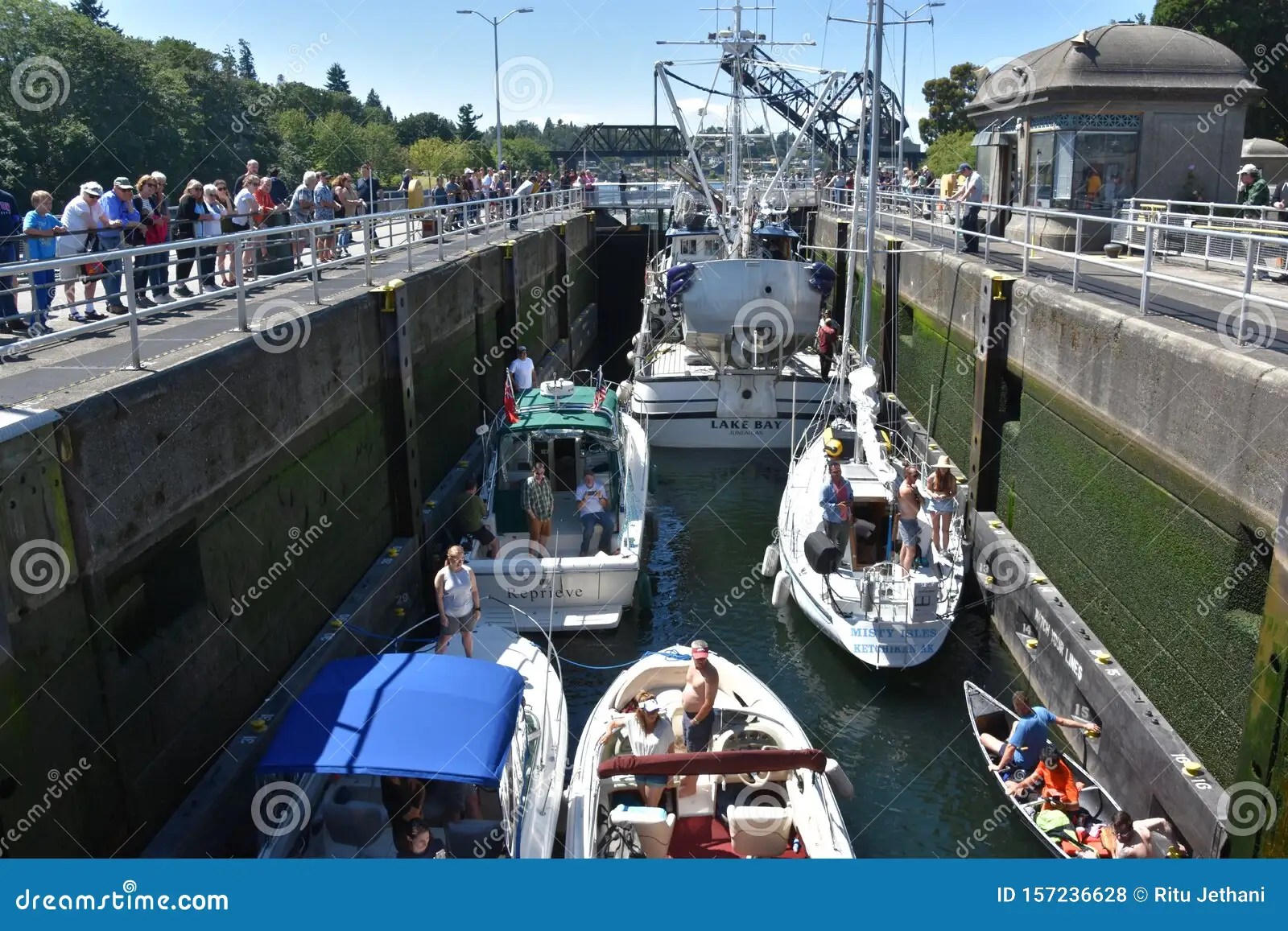
Chittenden Locks raise boats from sea level to the freshwater level of Lake Washington
After Capitol Hill, we go north and a little west to Fremont, another of my favorite places. It is bordered on the south by the ship canal that was dug in 1911 to connect Lake Union and Lake Washington to Puget Sound. West of Fremont in the Ballard area are Chittenden canal locks that you have to take your boat through to get from the fresh water lake to the salt water Sound and visa versa. We took our sailboat through a few times. It is an interesting but nerve-racking experience.
Most interesting at the locks is the fish ladder. Salmon are hatched in freshwater lakes and rivers then make their way to the open sea. When it is time to lay their eggs, they return home. The fish ladder has twenty-one “steps” to help the salmon migrate from sea level to the higher level of Lake Washington. Local sea lions can be seen supervising the gates to the fish ladder, looking for a quick meal. We loved to take a Sunday afternoon to watch the boats go through the locks, walk the surrounding park, and, from the underground viewing room, watch the fish swim up the ladder.
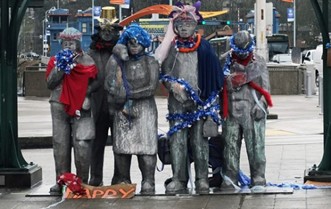
Waiting for the Interurban
Fremont is the artist community of Seattle. It is sometimes called the People’s Republic of Fremont, and their motto is “De Libertas Quirkas,” which means, loosely translated, “the freedom to be quirky”, I think. A sixteen-foot statue of Lenin was bought by a resident of Fremont after the fall of the communist government in Czechoslovakia. It was installed in the Fremont neighborhood in the 1990s. Another sculpture called “Waiting for the Interurban” stands in the middle of a thoroughfare near the Fremont Bridge, where no public buses pass. It is six people and a dog with a human face waiting for public transportation. The people of Fremont dress the sculpture inhabitants appropriately for the seasons – Hawaiian shirts or scarves and mufflers.
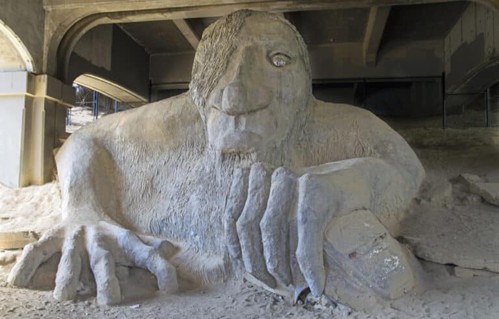
Another sculpture in Fremont is under the Aurora Bridge. It is the Fremont Troll. There was a legend of the troll under the Aurora Bridge, similar to the old Norwegian Fairy Tale about the three Billy Goats Gruff. As a result of an art competition and to keep random drug paraphernalia away from the bridge, an eighteen-foot-tall concrete sculpture of the troll appeared. He is crushing a Volkswagen Beetle that he grabbed from the bridge above in his left hand. The car in his left hand is an actual VW bug encased in cement. It contains a time capsule.
The Fremont Troll
Fremont is an eccentric mix of businesses, shops, and residences, very free form. They have a Summer Solstice Pageant every year with nude cyclists. I go to Fremont just for fun. Other than fun, my Fremont connection is negligible. I took a one-semester off-campus Seattle University class in that neighborhood in the 70s; and my husband and I went to a Fremont hypnotist to lose weight one summer.
Our tour continues with a little bit of history. Seattle is built on seven hills: Beacon Hill, First Hill, Capitol Hill, Queen Anne Hill, Cherry Hill, Yesler and Denny Hill, with Magnolia Hill, West Seattle, and Mount Baker as later annexed inclines. You get the point – it is a very hilly city. Things are built on slopes, some notoriously precarious. Landslides are a geological gamble in Seattle. Whole neighborhoods have slid into Puget Sound. In fact, one of the original hills, Denny Hill, a total of 62 city blocks, slid slowly but steadily into Elliott Bay between the years 1903 and 1928. Denny Hill is now the Denny Regrade. The Bay accepted the transfer of soil with equanimity, being over 300 feet deep in places. I will take you to some of the hills that had meaning to me.
There is a rich Native American heritage in Seattle. Mainly, the Salish, Snoqualmie, and Duwamish peoples settled where the city is now. A couple of dozen tribes along the coast left their imprint on the area. Totem poles are in evidence throughout the Northwest as symbols of native traditions and storytelling.
My high school mascot was a totem pole. I was in the first sophomore class at the new school. The students voted for the mascot. I voted for the cougar as a mascot, being an animal lover. However, the cougar was the mascot of Washington State University, and living in western Washington, the home of the U.W. Huskies, cats weren’t popular. I got on board with the totem because it honored the Native Americans who first inhabited the area. As a legacy for the school, our senior class had a red cedar totem pole carved to stand proudly in front of the school.
For fifty years, we were the Totems until the enlightened ones decided that a totem pole is a form of cultural appropriation and “can possibly cause psychological harm to Native American children”, instead of being a sign of respect for the native culture. The mascot was changed to the Redhawks. A Redhawk, of course, is a Ruger double-action revolver. Could it be that the powers-that-be prefer a firearm rather than a totem to symbolize a high school? I hesitate to guess the inner motives of bureaucrats. Maybe they meant to honor the red-tail hawk, which is prevalent in the Pacific Northwest, as indeed the picture of their mascot is an angry-looking red-headed bird. Who knows?
Pow Wow celebrations of Native American culture and heritage are held throughout the state. The SeaFair Celebration, held annually in late summer, has a Native American Pow Wow component. I will talk about SeaFair in a later post.
Seattle lies on a fault line that runs under the west coast of the US. The roller coaster effects of earthquakes are another thrill that residents of Seattle have an opportunity to experience. Most are minis reaching no more than 1 or 2 on the Richter scale, but they do upset the equilibrium. A BIG one hasn’t happened in Seattle since the 7.1 in 1949, but Alaska and California have felt the effects of 8+ earthquakes, so it may be just a matter of time. Our napping teenage son was once shaken out of slumber and off the couch by 5+ seismic event.
The combination of earthquakes and damp, saturated ground poses a constant threat of landslides. Yet, many of the most expensive homes are built on bluffs above the water with expansive views of Puget Sound and the Olympic Mountains. Duh. It is like building along the coast of Florida, where hurricanes are omnipresent. “Youse rolls the dice and youse takes yer chances,” as an enterprising Irishman once said.
Steep streets are a challenge when slippery wet. Many a manual-transmissioned car has slid backward down a slope or into other cars when piloted by an inexpert driver. I’ve seen it happen.
We will continue our tour by going to Pioneer Square near downtown Seattle and Skid Road. Its real name was Yesler Way. In early days the road had wooden planks (skids) laid along it, covered with grease to help the oxen or horses pull the heavy loads of lumber to the port. It was the dividing line between the affluent part of town and the sketchier mill-worker part. During the depression, it became Skid Row, demarcating the area where the downtrodden resided. One didn’t want to be seen south of Yesler, the grittier side of town.
I can recommend a book about Seattle during its formative years called “The Mercer Girls” by Libbie Hawker. Women were recruited in the 1860s after the Civil War by Asa Mercer, a member of one of the pioneer families of the area. He advertised in the East and Midwest for high-minded women of good character to come to Seattle to “elevate” the male population. At the time, there were ten men for every woman in the city, mostly lumberjacks and fishermen. Asa was the first president of the University of Washington and a member of the State Senate. A large residential island in Lake Washington is named for his family, as well as a principal street in Seattle.
North of Yesler is Pioneer Square, where the original white settlers started the town after they left Alki Point. It is a more sheltered part of the bay, better for their commercial objectives. Now it’s a historic district where, in 1914, the tallest building west of the Mississippi, the Smith Tower, was built. The Tower has been dwarfed by countless skyscrapers built within the last fifty years. Smith Tower is the only building in town that still has elevator operators who wear uniforms and white gloves and have to maneuver the elevator cage with a dial lever to just the right spot at each floor before they can open the glass door, then the multi-hinged metal guard to let people on and off. The elevator shaft is enclosed by glass so you can watch the elevator ascending or descending from floor to floor. There are no call buttons, only the elevator operator’s watchful eyes as he or she passes the floors. It’s fascinating. It is tempting to stay on the elevator for hours just to watch the expertise of a bygone era. *This anachronism may not exist due to a spate of modern safety regulations. It was a joy to behold when I lived there.
Captain Vancouver, an Englishman, explored the Pacific Northwest in the late 1700s, giving impetus to the idea that the land west of the Rocky Mountains had possibilities for commerce. Lewis and Clark did their inland exploration in the early 1800s. Euro-American invaders followed to settle the northwest in earnest. A group of entrepreneurs led by George Yesler and another by the Denny brothers, Arthur and David, homesteaded and settled at Alki Point in the 1850s. They recognized the potential value of the western port. They soon moved across Elliott Bay to an area now known as Pioneer Square in Seattle, where the Bay was deeper. They each headed competitive lumber operations. Seattle grew at tide level. It was a town that mainly shipped lumber, raw or finished, from its harbor. The Alaska Gold Rush of the late 1890s further encouraged white people to move West.
The timber industry flourished, and Seattle grew on the tidelands at the edge of Elliott Bay. Sawmills were constructed. Wagon loads of timber from the abundant surrounding forests were transported to the sawmills, then loaded onto ships for export around the world. Seattle was built with wood. Buildings, sidewalks, even water for plumbing was sometimes transported through wooden ducts.
The forward-looking capitalists of Seattle heard of indoor toilets – the White House had one installed in 1853. In 1881, Seattle was one of the first cities in the US to receive a bulk supply of Crapper Toilets. Over time, it became apparent that having the city built at tide level was a mistake. Sewage that was supposed to flow down into the Sound was sluicing back into the streets. Toilets backed up, creating fountains of effluent in homes twice a day during high tide. Streets were infamously turned to mud by rain and tides.
Pioneer Square was devastated by the Great Seattle Fire of 1889, which burned twenty-nine city blocks, destroyed what was then the central business district. Since it was apparent that having the city at tide level was a mistake, the city fathers decided to rebuild ten feet higher. Seattle was rapidly rebuilt and nearly doubled in size, due in part to all the new construction employment. Instead of wooden buildings, zoning codes required brick and stone buildings to be erected. After the fire, the streets were raised and built over the area that had been at tide level.
Now, there is an underground tour, ten feet below the current street level, that you can take to see the original storefronts and streets of the old city. You will see toilets mounted on pedestals like thrones to lessen the tidal backwash. I encourage any resident or visitor to take the fascinating tour.. Ghosts even haunt the underground.
Speaking of toilets. Seattle has some impressive “salles de bains” at the Columbia Tower. The 967-foot Columbia Tower has seventy-six floors with 360 ° views of Seattle, the Olympic and Cascade mountains, and Puget Sound. The Tower is the tallest building in the State of Washington. The first three floors offer retail and restaurants. The remaining seventy-three floors are luxury offices for discerning companies. The 75th floor is the Columbia Tower Club, an exclusive private club for members or invitees only. Besides having excellent gourmet food, you are treated to the poshest potties in the world.
We were invited by Janice and Jack, who were members, to join them at the Club for dinner and the city fireworks display on the 4th of July. When we arrived, Janice suggested that she and I go to the ladies’ lounge before we sat down to dinner. She stood back as I entered the lounge to watch my reaction. The room was luxurious, well-appointed with plush carpet, cushioned chairs, dressing tables, and chaise longues, but the startling feature was the individual toilet stalls along the outside wall. Each had a floor-to-ceiling window that looked out over the city. I gasped. How do you do potty business with the wide-open sky in front of you and the city at your feet?
Of course, I had to show Ken. We went back to our table, and I urged Ken to follow me to the ladies’ lounge. He demurred, but Jack encouraged him to go. Jack had seen the sight, as had other male club members. It was common for men to discreetly look in the “Ladies'”. The men’s room had no such marvel. Seattle has come a long way from the erupting Crappers on tidewater flats in 1881.
The fireworks were the second most interesting part of the evening. We were perched on the observation floor high above the loftiest rocket sent skyward that night, so we looked down on fireworks instead of up. An unusual sensation.
The tour of Seattle continues in my next post, featuring a lady of the evening and a troll.
Recently, I visited Seattle, where I have not lived for over 28 years. It was a short, impromptu visit to see our daughter. The weather was atrocious, but the company was great. She and I had a nice long time to share memories and reconnect. However, I was reminded of the reason Ken and I fled to southern Arizona.
This essay, which I will publish in several parts, is based on memory and journal notes from the years when I lived there and shortly thereafter. The Seattle we left is not the same as the present-day city. None of the reports from people who live there are especially favorable about the conditions in the city, relating stories of homelessness and crime. I witnessed a few of the changes in the days I was there. Traffic is abominable – a moving parking lot, very like LA. I have no desire to return. I’d rather live with lovely memories of what was.
SEATTLE
I want to tell you about a city I hated, but grudgingly learned to appreciate. I was a captive for nearly 40 years under gray, drizzly skies, wrapped in its suffocating blanket of onshore flow and tedious droplet-laden air. How does one breathe when the air is saturated with water? Seattle has an enormous diversity of smells, sights, and textures, but the overriding constant is wet, moldy dampness. During the day, the vibration of color is muted because of the lack of light, sunshine. Color doesn’t exist without light. Everything is enveloped in dimness. When you look up, you see a dull white sky. Haze covers the bright orb we were told was the sun. A clear blue sky is rare. Seattle has one of the highest rates of suicide in the US. I can certainly understand why. It has the distinction of being the US city with the highest sales of sunglasses. You use them on a sunny day, then by the time another sunny day arrives, the sunglasses have been lost or seriously misplaced, and you must buy another pair. Mine were found once in the freezer…but that’s another story.
Contrary to common thought, it doesn’t really rain in Seattle; it fatally mists you. It would be a welcome change if rain actually fell, fat full drops in quantities of a tipped-over horse trough. But no, gloomy clouds hang low overhead, spritzing gauzy water day and night. The average rainfall in Seattle is less than in Little Rock, Arkansas, Atlanta, Georgia, Lexington, Kentucky, or New York City. In those places, rain falls with intent – the intent to make things wet. In Seattle, you can walk around all day in the vaporous fog and never have a single drop of rain slide down your face, but you are damp nonetheless from the outside to the bone. You can walk between raindrops in Seattle and be saturated by the artifice of rain.
My father accepted a transfer with Boeing to Seattle in 1957. I was ripped from the wide open sunny plains of my Kansas home as a child of eleven and whisked off to the Pacific Northwest, boxed in by low clouds and lofty, dark, sentry-like evergreens. You cannot see many vistas or horizons in Seattle because of those damn giant black-green trees. I became a victim of Stockholm syndrome. I learned to identify with and, grudgingly, admire the city that was my captor.
Now that I am liberated from its bondage, I visit the city with an entirely different attitude. I appreciate its energy, its diverse population, and its distinct neighborhoods. I still do not admire the weather. There are approximately five sunny days sometime between late July and late August, and then another five in February. On those rare days, the city is stunningly beautiful – a dazzling jewel nestled at the base of the snowcapped Cascade Mountains between Lake Washington on the east and the cerulean sparkle of Puget Sound to the west. On clear days, you can see Mount Baker to the North, and Mount Rainier looms up over the city to the South.
Let me take you on a virtual tour of my Seattle, some of the places that have meaning and memory for me.
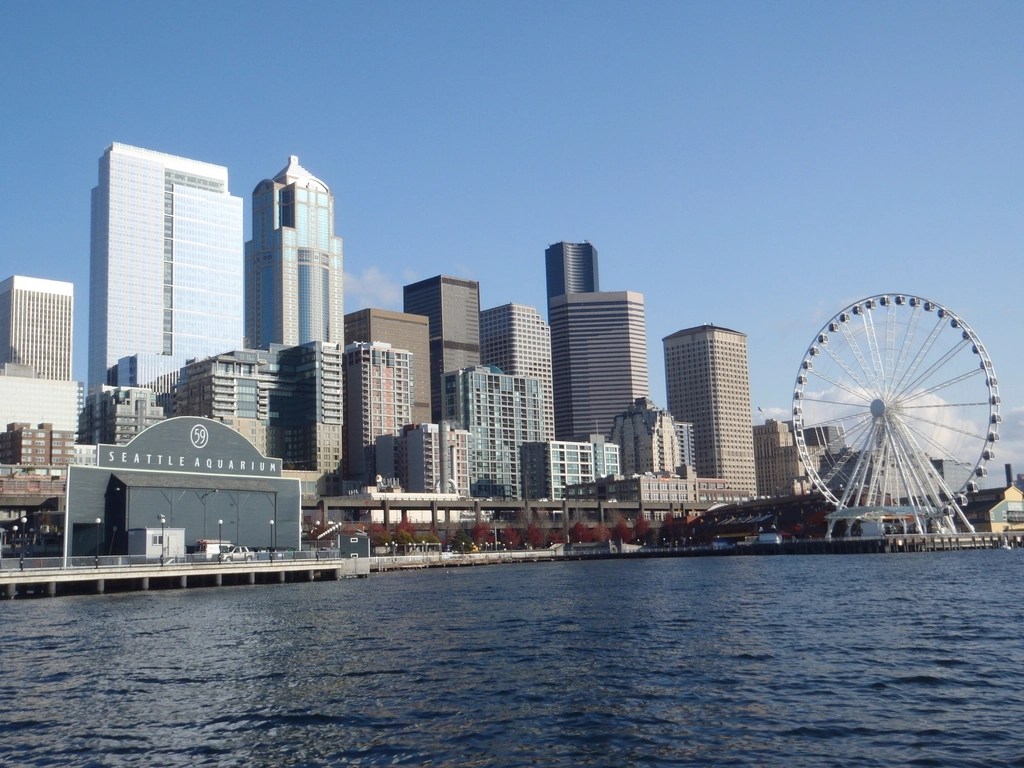
Our tour begins. It is a liquid, dark September night, and light from building signs reflects on the drenched black asphalt of Pine Street. The street shimmers with smears of circus colors like a Monet painting in front of the Inn at the Market, where I stay when visiting, and Sur La Table next door. Pine Street slides with a 9% grade downhill west. From the front of the hotel, you see over the top of the Pike Place Market at the end of the block to the waterfront and Puget Sound beyond. We are on the western edge of downtown Seattle proper.
Jazz music flows from The Pink Door in Post Alley, playing deep into this night. The Alley, just above the Market, is where the Market Theater and the gum wall are. The gum wall is a brick wall of chewed gum in a variety of colors, grape, cherry, lime, and plain gray spearmint, originally created by people who stood in line to go to the theater. Years of ordinance after ordinance failed to keep that wall clean. It became a bizarre tourist attraction that turned up in the movie “Love Happens”.
You can’t talk about Seattle without mentioning Starbucks. Starbucks started here near Pike Place Market in the 1970s. Now, it’s an international megalith for coffee worshipers. The Starbucks at Pike Place still has the original logo with the bare-breasted Norse maiden in the middle of the medallion. I’m generally a tea person. A nice cup of double-strength Irish Breakfast Coffee is my morning wakeup. I prefer Seattle’s Best for coffee because it doesn’t seem as bitter. Coffee, anyone?
Seattle is a city of frenzied days fueled by Starbucks (one on every corner with kiosks mid-block), people traveling up and down endless rain-slicked hills, and long nights lubricated by microbreweries like Pike Brewing Company and Elliot Bay Brewery, and lots of good music. We’ll stop by Kell’s Irish Pub for a short one and then turn in. The tour will continue tomorrow.
Good morning, we’ll start our tour here near the famous Pike Place Market where “flying fish” are sold. I’m sure you have all seen this well-known marketplace on TV or the internet. The owner and staff of the Pike Place Fish Market made a video of their shop and developed a motivational training program for employees who work with the public based on the Fish Philosophy of “Play, Be There, Choose your Attitude and Make Their Day”. The fish sellers have great fun with shoppers at the Market, throwing whole fish back and forth to each other like footballs over the heads of wary customers, using rhyme and signals to let each other know a fish is coming their way. An unsuspecting patron often nearly gets hit by a fish thrown in his direction, but caught at the last possible second by one of the fishmongers. A massive slippery open-mouthed monkfish lures you close and then jumps at you. Pike Place Market is a destination for most Seattle tourists. The high-jinks are worth the trip.
If you have the time, enjoy this six-minute video of the Fish Philosophy.
Pike Place Market exudes tantalizing aromas of newly picked farm produce, the woody, musky tang of incense, and the sweet bouquet of flowers, plus the salty ocean smell of fresh fish.
My favorite shop in the Market is Tenzing MoMo. An intense potpourri of frankincense, myrrh, ylang-ylang, patchouli, and sandalwood beckons you into the dark, magical, Asian inspired apothecary. They deal in herbs, tarot cards, chai tea, brass bells, ear candles, essential oils, and all manner of other necessities. It is deep in the belly of the Market which is built on a cliff plunging three stories down from the street. The top floor, at street level on the east side, looks westward across Elliot Bay toward Puget Sound. My favorite restaurant at the top level is a French bistro, Maximilien’s, with a terrace that allows a 180-degree view of the Sound. I cannot resist the Croque Monsieur.
Pike Place Market was created in the first decade of the 1900s as a fresh produce co-op market for local farmers. It retains that promise but has expanded to include buskers, homemade baked goods, handmade clothing and jewelry, antique dealers, restaurants, comic-book vendors, and crafts – something for everyone. The Market also houses a senior center, a childcare center, a medical clinic serving the working poor, elderly, and HIV-positive patients, and has HUD-subsidized housing for about 500 people. Rachel, a big brass pig, nearly three feet tall, greets visitors at the front of the Market. Her snout is rubbed for luck. She is a giant piggy bank that collects coins for charities supported by the Market.
In the early 80s, I worked six blocks from the Market up the insanely steep hill on Pine Street at the Bon Marché Department Store in their construction department. Often on my lunch hour, I negotiated the incredible downhill to the Market, roaming the nine acres of vendor stalls for something delish for lunch. My family was treated to the farm-fresh produce for dinner. Then I trudged up the hill with my treasures, back to work – my exercise for the day.
Next time, I will take you through a little history of Seattle, a smidge of the underground tour, and The Seattle Toilet History (a remarkable story).
I recently encountered an individual who said they were in pursuit of happiness. They had experienced some setbacks in life and were feeling low and had been counseled to make happiness a priority.
I posited, on the contrary, the pursuit of happiness is a hollow pursuit. Happiness is a feeling, a mood. Happiness is insubstantial, subjective. It comes and goes. It is transitory.
Gratitude, on the other hand, is concrete. With an attitude of gratitude, you cannot help but be happy. You look around you to sense the beauty of nature or reflect on the objects in your home that you bought or have been gifted, and remember the why, when, and who of each object. Remember the happiness that each object brought when it was newly purchased or received. Gratitude for friendship. Gratitude for family. Gratitude for the people who serve us in our daily activities, from the grocery store to medical professionals to our military and law enforcement, who keep us safe.
You can use your God-given senses to appreciate and be grateful for – the spring smell of blossoms or the scent of your lover’s warm skin; the taste of chocolate or the first cup of coffee in the morning; the softness of a kitten’s fur or the feel of an embrace; the sound of birds calling or a favorite song that makes you want to sing; a wonderous sunset in a desert sky or glistening raindrops that inch down a window pane. Gratitude for being alive in this tangible world is what actual happiness is. Beyond this world, the spiritual realm conveys meaning to life. The comfort of God or whatever spiritual practice you observe is a specific conduit to happiness.
I think of my friend Diane, who told me one day many years ago that she was diagnosed with ALS, a death sentence. Not just a death sentence, but a torturous journey through advancing body paralysis. The prospect she looked toward was months, possibly a couple of years of her body slowly becoming frozen while her mind remained alert. That sounds like torture of the worst kind, being fully coherent as body parts are rendered useless, slowly dying piece by piece. Diane was the most vibrant, energetic person I knew. She could do anything.
She decided to master the grand piano at the age of 40, having never played piano before, and she did it. She set a goal in May of her first year of lessons to give a caroling party by Christmas, and she met that goal. She printed out the words of each carol for all the participants. Each year her playing became more powerful, proficient, and complex. We loved hearing her advancing abilities. Her friends coveted invitations to her Christmas caroling parties. Over the years, she became more skilled and her repertoire more sophisticated, so that she was invited to piano competitions across the country.
She made it a point to tell me that she was going to be happy until the end. She was going to be GRATEFUL for every day she had and for every little thing that she could do day by day. She was an amazing inspiration. She traveled with her family and went on cruises. She continued to practice the piano until she could no longer make her fingers do her bidding. She had parties at her house until she was incapable of managing it. She played golf until she couldn’t stand and walk. She kept in touch with friends until the only part of her body that moved was her eyes. She could only speak through a computer that she manipulated with her eyes. She was always grateful to have people around her and, to the end, said people were what meant the most to her. She created her happiness from her gratitude for every small thing.
I remember when I was sidelined by two broken ankles. I realized how much walking, moving myself from place to place, meant to me. Even though I had a scooter, it was not the same as the independence of standing and walking on my own. I was very jealous of people I saw walking past my house or on the street as Ken drove me around. Then and there, I promised myself that when my ankles healed, I would not only walk every day, but I would appreciate each step. Still today, I am so grateful to Dr. Ty for his surgical skill, his encouragement, and his humor as I recovered step by agonizing step to be fully functional again. I’m grateful for a body that healed so well. I’m grateful to Ken for his care and patience as I rehabbed. I am not a patient patient, so I’m sure my mood was not the best, but he persevered and encouraged me when I was exasperated.
Today I am grateful for Ken’s commitment to his own therapy. As a man with Parkinson’s Disorder, he works two or three hours, sometimes more, each day to stave off the impact of the mayhem being perpetrated on his body by his own brain. He is learning to overcome some of the effects by retraining his brain. Automatic functions like walking, speech, and swallowing are diminished day by day with this disorder. He must fight to consciously instruct each part of his body to do his bidding. He has to walk, each step with intent. He has to talk, each word with intent. Nothing is taken for granted because those abilities are slowly eroding. He is exhausted at the end of a short walk, not because of weak legs or feet but because his brain has to work so hard to create each movement. Talking wears him out because he has to force his voice to be at a level he can be heard. He must enunciate each word slowly in order to be clear. Parkinson’s robs him of volume and makes his words slur into a jumble of incoherence unless he articulates each one carefully. His throat muscles are compromised so coughing and choking are ever present. His physical therapy includes muscle rehab and balance training. There are days when I know the struggle is enormous. His attitude is “never give in”. He is rewarded by being able to do as much as any 80-year-old can do. He’s not 17 anymore, but still enjoys his life. For all the effort he makes,I am grateful.
Gratitude is an affirmation of life. Stay grateful and happiness will be the consequence.
Picture prompt: Write a story about this magazine picture. The picture feels like peace. The quiet of a deserted beach on a warm sunny day. The serenity of aloneness. Who is this woman? Why is she so far away from anyone? Does she treasure her aloneness? Is she escaping from her life? What will the remainder of her day hold?
I am reminded of a time when I needed to withdraw to peace and quiet for a while. It was April 1981, during an energy crisis, recession, and an explosive inflationary period (sound familiar?) with mortgage rates up to 18% (much higher than today). A very tense time for everyone. I worked for a small homebuilding company. We were having trouble selling our inventory of homes. The carrying costs were mounting, removing any hope of profit and the ability to continue building homes. I had been in some intense negotiations on behalf of my company with a bank that threatened to foreclose on a major loan. We couldn’t continue business without renegotiating the terms of the loan for a year. I was tapped to represent the company by my boss, Rob, who owned the company. Over a period of two weeks, I met with different officers of the bank to discuss our position, our new marketing plans, and the benefits of maintaining our relationship with the bank. It worked. I don’t know how, but I was able to convince them to extend our loan with promises for the future and evidence of our past success.
At the end of negotiations, Rob told me to take some time off. My husband, Ken, knew how frazzled I was and urged me to go away on my own to regroup. He said he could manage our three kids and all their activities for a week. He thought I would go to see my best friend in Atlanta. She was my go-to when I needed a boost. Even though we lived across the country from each other then, we were still as close as we had been as neighbors during our school years.
I thought about it. Michele would be working while I was there. She had a husband and two kids. They were all busy with their lives. I would be an intruder and a needy intruder at that. I decided I couldn’t impose on them in that way. I didn’t call her even though I knew she would have encouraged me to come. Instead, I called our travel agent. Seattle was at its drizzly best. I needed quiet and sunshine.
“Where can I go to sit in the sun; where is it quiet and I can be alone for a week?” I asked.
“Does a beach sound good?”
“I’m not a fan of water, but if it is quiet I’ll try.”
“You can be on the beach without going into the water, you know,” Sheila said. “When do you want to leave?”
“Tomorrow. And it can’t cost too much.”
“Oh, that makes a difference. No planning, eh?”
“No, just a get-away for a week.”
“I can get you on a flight to Puerto Vallarta and an inexpensive but nice hotel on the beach tomorrow morning at 9 am. I’ve been there and can recommend it.”
“Sold,” I said.
When my husband came home from work that evening, he asked if I had talked with Michele.
“No. I’m going to Mexico.”
“What? By yourself?”
“Yes. Sheila said it is a nice place. She’s been there. It is quiet and not too expensive. I will be able to be alone with no agenda. It is perfect. The reservation is made. Will you take me to the airport?”
The next morning, Saturday, he took me to the airport, still apprehensive.
“You will come back, right?”
“Of course. Don’t be silly.”
Saturday: I arrived in Puerto Vallarta and took a taxi to the hotel, Playa Las Palmas. It was right on the beach, as advertised, in the center of the crescent of Banderas Bay. I could step out of my room and walk a few yards across the pale sand to the startling blue water. I was nearly blinded by the midday sun. What a change from gray, cloudy Seattle. I went to the restaurant to see when dinner was to be served and perused the menu. Lots of fresh seafood. And margaritas. Perfect! I went to my room to change clothes so I could sit on the beach. I decided to lie down for a few minutes first. I threw myself across the bed and when I woke, it was 9:00 am the next morning. I was still in my traveling clothes. I missed dinner and margaritas. I slept from 3:00pm the day before, 18 hours. I didn’t know anyone could sleep that long.
I called Ken to let him know I’d arrived ok and slept through the afternoon and night. I told him I’d call in a couple of days. This was before cell phones. I was quite alone. No one could contact me except through the hotel. I called Michele to tell her I had escaped to Mexico. She was in shock too. I took a shower, changed, and went for breakfast, my first ever Huevos Rancheros; then to the beach. I had a notebook and pen to write my journal and two books to read. That was how I intended to spend my days. There were a few people scattered around the beach. This was not the high season so everyone was spread out. I alternated between the beach and the shade of the cabana/beach cafe all afternoon, reading and writing a little or watching the water and the people. Beach vendors wandered across the beaches from hotel to hotel selling their wares, colorful handmade wooden toys, beautiful scarves, churros, and locally made pottery among them. Hotel staff would sometimes shoo the vendors away, but they returned each day. I didn’t think they were intrusive or aggressive but they may have bothered others.
I ate a late lunch at the cabana and talked with two women I had seen on the beach. They were best friends from Minnesota, Betty and Janna, who planned a getaway together to a warm destination every year. We had a nice chat and they asked if I’d like to join them for dinner at 7:00. I agreed. But first, I said I’d go to my room for a little nap. I don’t know why I was still so tired.
Sunday: The next thing I knew, it was 8:00 am. I slept from 3:00 pm until 8:00 am. I missed dinner again. I met the two women later that morning. They said they came to my room and knocked several times but no answer. They thought I’d changed my mind and went somewhere else for dinner. They said they were taking a tour to the jungle on the mountain above Puerto Vallarta and asked if I wanted to join them. I declined, needing to be solitary for a while. I spent that day mostly in my room, reading. I walked along the beach a few times but stayed to myself. I had a quiet dinner alone, and then a normal night’s sleep.
Monday: Day three of my adventure put me out on the beach again, soaking up the sunshine. I noticed a boat pulling people into the air with a kite. Parasailing. I’d never heard of such a thing. It looked like so much fun. I asked about it and soon had a reservation for that afternoon. Amazing!! Two crew members picked me up in a small rowboat on the beach and took me to a wooden deck out in deeper water. They hooked me into a sling-type harness. I launched off the deck pulled by a motorboat – no water involved. It was wonderful. I soared under a big, curved kite around the bay for about twenty minutes. It felt like two minutes. They told me I sailed 250 feet above the water and land. It was delightful. They landed me softly near the shore in knee-deep water. One of the crew was waiting and helped unhook me from the harness and off they went to take another para-sailor aloft. I talked with some beach sitters who witnessed my ride. I had a quiet dinner alone and went to sleep.
Tuesday: The next day I decided to go on the jungle tour that the Minnesota ladies told me about. It was a great half-day ride through the mountainous jungle above Puerto Vallarta. We had a small bus or tram that held about twenty people. We were told to be on the lookout for jaguarundi and margay which are small wild cats, but I didn’t see any. There were a few monkeys spying on us from the treetops. I believe they were called spider monkeys. We saw the place where the movie, Night of the Iguana with Richard Burton, Debra Kerr, and Ava Gardner had been filmed. The tour guide filled us in on gossip from the movie set. It had been filmed nearly twenty years earlier in 1963-64 when Burton and Elizabeth Taylor were having their notorious affair. Lots of gossip. We saw women washing clothes in a river we crossed. The poverty of the people around Puerto Vallarta was evident. I had dinner that evening with a husband and wife from San Diego who I met on the tour. They told me they were going to a nightclub that night at the edge of the city where it was reported there was a good band and dancing. They asked if I wanted to join them, and I declined. Needing more quiet time.
Wednesday: The following day I walked the beach from my hotel toward town. It took a little over an hour to get up from the beach into the old town. I walked all around looking into churches and shops. I bought a sandwich and soft drink for lunch as I strolled through the village. It was very small, only a few streets. I think the population was around 20,000 give or take, including the surrounding area. Two things that stuck in my mind were the children walking to school and going home in the afternoon. They wore white shirts and dresses. I mean white, white. I don’t remember ever seeing such clean children. The townspeople looked like they were very poor, but their children were impeccably dressed. After witnessing the women washing clothes in the river, I was surprised at how snowy the clothes were. I guess sunshine had something to do with it. The other thing I noticed was armed police or guards outside banks and other businesses. They weren’t menacing but they were present. It seemed odd in so small a town. Sidewalks were uneven or missing in places. The townspeople that I spoke with were courteous and friendly, few spoke any English so we had interesting conversations with Spanglish and gestures. Those were things I noted in my journal. I walked the entire day and went back to the hotel tired. I’m sure I had dinner but I didn’t note it in my journal.
Thursday: The sixth day I met up with Betty and Janna and agreed to go with them that night to the dance club I heard about two days before. They were leaving the next morning, Friday. I don’t recall what I did during the day, but I’m sure I was either on the beach or in my room reading. That night at 9:00 we took a taxi to the nightclub, a fifteen-minute ride up the mountain out of town. There was a fun salsa band. Several of the local men and women showed us three Americanas how to salsa. The band played contemporary rock and roll tunes as well and everyone danced. I danced with Betty and Janna and whoever asked me and had a grand time. I also drank margaritas until 1:00 in the morning. My two friends left around 11:00 saying they needed to be ready to go to the airport in the morning. I asked someone, maybe the club manager, to get a cab for me, but he said the cabs were done for the night by 12:00. He offered to call a friend. Hmmmm. If I hadn’t had all those margaritas, I’m sure I would have been more judicious. I wouldn’t have stayed longer than my friends. I wouldn’t have been without a ride to my hotel. But here I was. It was pitch black outside. I mean you couldn’t see anything, not even outlines of trees when you were away from the building lights. I didn’t know my way down the mountain to the beach and my hotel on dirt roads. I was stranded. By the way the manager offered a ride, I am sure I was not the first American who made that mistake. I agreed to the ride offered. Two local fellows in a broken-down sedan, no spring in the backseat, came to pick me up. They asked where I wanted to go. I told them and asked how much they charged. They gave me a figure that was reasonable and away we went. They did not speak English with any proficiency, and I don’t speak Spanish, so they talked to each other as I sat mute in the back, praying I’d get home to Seattle in one piece. I did not have to worry. They were very kind young men. They took me directly to my hotel; I paid them and gave them a nice tip that reflected my relief that I hadn’t been kidnapped. I said gracias many times and threw in a merci and a thank you for good measure. They laughed and drove off, having done their good deed for the day.
Friday: The seventh day was my last day. I had somewhat of a headache when I woke up so the day was very low-key. I had a late breakfast and said goodbye to Janna and Betty as they left for the airport. They asked how I got back to the hotel. They told me they were concerned but needed to get back earlier than I wanted to. I assured them that I was well taken care of. The remainder of the day I spent reflecting on my trip. It was meant to be a recovery trip, and I guess it was. I slept more hours in that week than I had in months. I felt ready to resume my everyday life. In fact, I was eager to get home. I met several very nice people; some I talked with in fits and starts through different languages. I tried a new sport. I had only been in the ocean once for a few minutes after my parasail. I ventured into a jungle (albeit with a whole group of travelers) and I walked the beach and town for a day feeling very much at home in the strange environment. My alone time had been interspersed with many people and it all felt perfect. I guess being completely solitary is not something I can do. I need people.
Saturday: Ken met me at the airport when I returned. Everyone at home survived my retreat just fine. All was well. I was happy and refreshed. Ready for my next challenge.