I do not appreciate jewelry, new clothes, furniture, cars, etc. I love to travel. I like to look at those beautiful things, but I don’t want to own them. I would much rather spend a dollar on an experience than on acquisitions. Well, books may be the exception. Give me a trip to someplace, anyplace, and I’m a happy woman. I’ve been fortunate to have traveled a bit in my life, and it is never enough. I want to go, go, go, see, see, see, learn, learn, learn.
One of my earliest memories is a plane trip from Wichita to Denver when I was five years old. Back in those glory days, shortly after the dinosaurs disappeared, a plane trip was fun. Today, I think of it as a laborious task and a necessity in some instances. In 1950, my parents walked me out across the tarmac to the plane, and I was handed over to a gracious stewardess (flight attendant, before the term “flight attendant” was coined) in full uniform and high heels, who treated me like a visiting princess. I was safely delivered to my grandparents at the end of the trip in Denver. Plastic flight wings were awarded to me on each flight, and once I was taken to the cockpit to sit on the captain’s lap and pretend I was flying the plane. There were no lines, no TSA, no restrictions on preflight parental supervision at the departure lounge. I was offered food appropriate for a child, coloring books, and small toys to keep me entertained. The stewardesses were all very kind (no stewards in those days). I was showered with attention. I was usually the only kid on the plane, and for sure, the only solo kid. Unimaginable today – a five-year-old flying alone with no worries. I spent four summers with my grandparents from age five to eight, and all but one of those round trips were by plane.
I learned to love flying then and continued to love it until about twenty years ago. The rigmarole, the security checks, and the hassles, plus the too-small seating, make flying uncomfortable and tedious. Don’t get me wrong, after 9-11, I’m happy there are some rules in place now to prevent disasters. I question, however, the efficacy of TSA after reading some of the reports.
My father was in the Army Air Corps during WWII, and maybe my love of flying was transferred from him. He certainly endorsed my trips by air to visit my grandparents. I’m sure his experiences as a gunner on a B-24 Bomber were not nearly as pleasant as mine on Continental Airlines as a child.
During one of my summers in Colorado, my grandmother and I rode a train from Denver to Cheyenne, Wyoming, to visit some old friends of my grandparents. My grandfather was on the train too, but he was working. He was a brakeman for the Union Pacific. I remember the gold UP pin on the lapel of his jacket. I’m not sure what he did, but he was very impressive in his wool uniform and his flat-top, squared UP cap with Brakeman on it. I felt very special when Grandpa came through the cars to visit with Grandma and me. As I recall, he rode in the caboose of the train, and his job was considered dangerous. His best friend, the one we visited in Wyoming, was also a brakeman and was killed a few years later. Then my grandfather retired.
Since then, I have traveled by train, short distances between European cities and the U.K., never overnight. Even the Eurostar trip through the Chunnel, UNDER the English Channel, from London to Paris was interesting. I was skeptical at first, but it turned out to be enjoyable. We were underwater for less than twenty minutes. Who can’t hold their breath that long?
My three children and I took a train trip from L.A. to San Diego in 1977. Our family rode the Durango–Silverton narrow-gauge train in the Colorado Rockies in 1984. All are very pleasant memories. I’ve longed to take a trip by rail to see parts of our country.
We love road trips. Ken and I will get in the car for a day trip at the drop of a hat. We are not opposed to weeklong trips either. I’ve written before of our family’s fourteen-month 1984-1985 odyssey through the continental United States by van, when we went to every contiguous state at least once, also visiting parts of Canada and Mexico. That is a highlight of my entire life, the trip of a lifetime. We did that before cell phones and Google Maps. All communication was by payphone, and we navigated with AAA TripTiks. Two adults, three kids, and two dogs – we were off the grid. And some prophesied, out of our minds.
Finally, I love boat trips. One of the side excursions during our U.S. odyssey was a 7-day Caribbean cruise. We went to Cozumel, Grand Cayman, and Jamaica. We had a ball. I love ferry rides from Seattle to Victoria or the surrounding islands in Puget Sound.
Later, Ken and I invested in a sailboat and cruised for several years around Puget Sound and the Canadian Gulf Islands. My mother once remarked, “Why are you buying a sailboat? You hate being in water.” My reply was, “That is WHY we’re buying a boat, so I don’t have to be IN the water, I’ll be on it.”
I guess I can throw parasailing, white-water rafting, and skydiving into the travel bucket. Bottom line is, travel, in whatever form, is my go-to expense when I have an extra buck or two. Put me on wheels, wings, or waves, and I’m happy.
A short post to acknowledge all who died in service to our country. God Bless. Not a holiday to say “happy”, but a day to remember those who protected us. They gave their lives so we could live ours in peace.
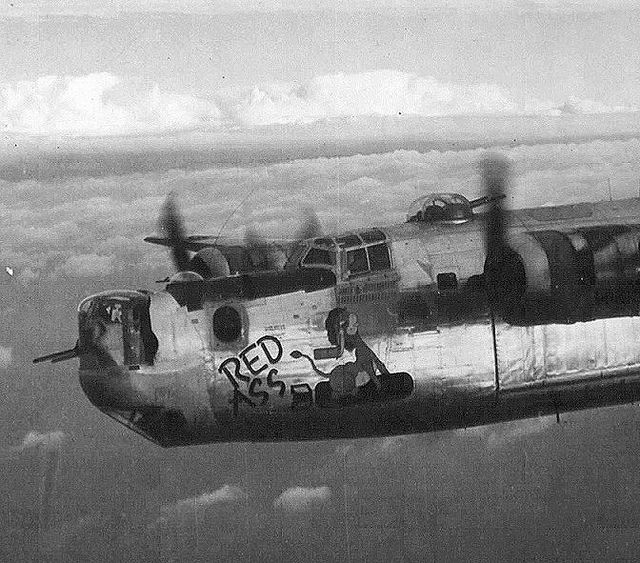
Red Ass, B24 Liberator
I especially want to thank my father, Jesse Dale Davis who served honorably in WWII as a gunner aboard B-24 Liberator bombers, especially The Red Ass that led the entire 8th Air Force from England to Normandy, France on the D-Day invasion. He was wounded during his twenty-eight bombing raids across Germany, and occupied France, and Holland. He recovered from the physical wounds. The emotional scars remained for his entire life. He provided a comfortable life for his family until his death at age 52. He covered the trauma left in his psyche with wit and humor and never talked about his wartime experiences. Thank you, Dad. I miss you daily and wish we could have talked about your war experiences.
I also want to remember and honor contemporaries who gave their lives in Vietnam – their destiny cut short. They served our country with an innocence of belief in what our leaders said was important. Both were barely 21.
Paul Michael Gregovich DOB: 6/16/46. He died on July 15, 1967, in Vietnam Quang Tin province.
Dennis Quentin Zambano DOB: 10/14/46. He died on October 15, 1967, in South Vietnam Bing Dinh Province.
And to the thousands of others who we don’t call by name, Thank You for your sacrifice.
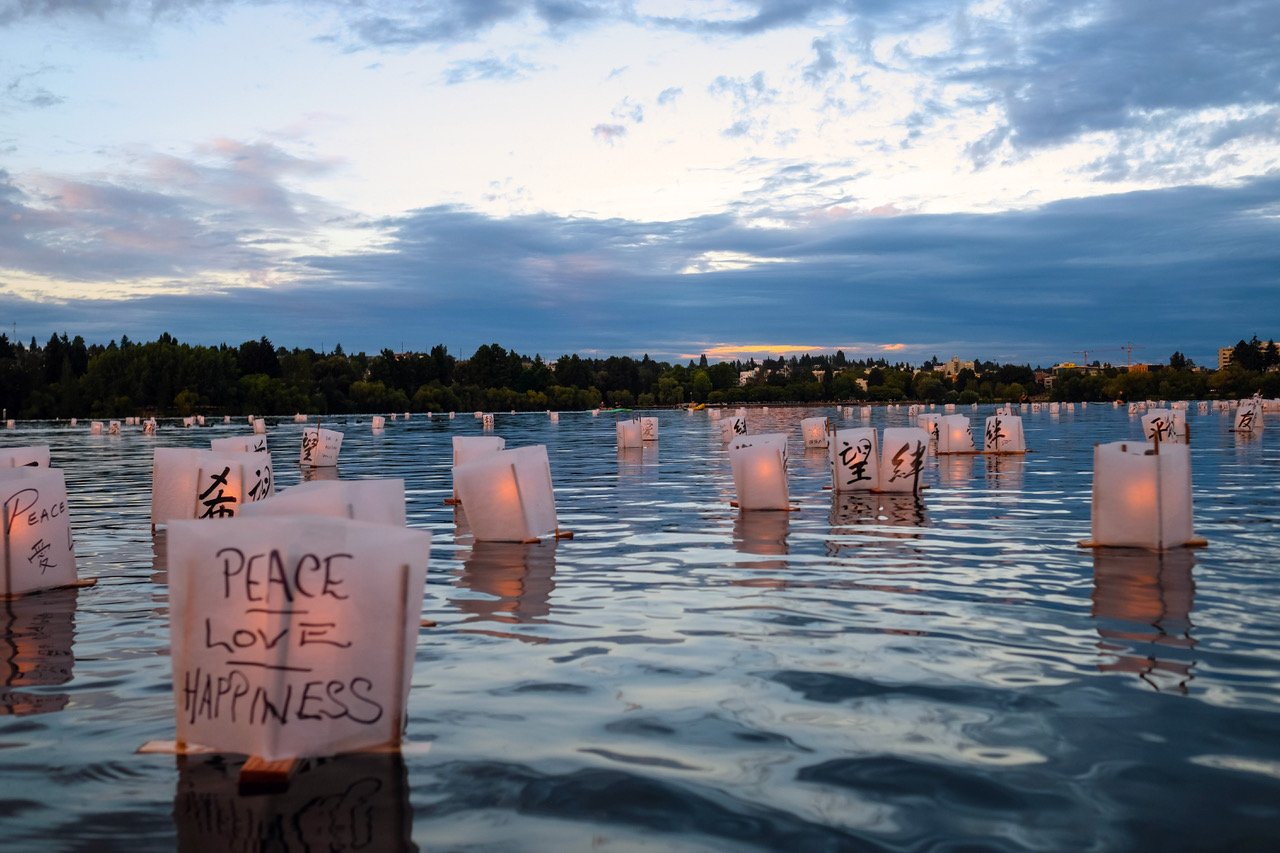
Green Lake Memorial Lantern Float photo by Vuong Vu
As a final episode in our tour of Seattle, I will take you to the Green Lake neighborhood. It is a quiet neighborhood that I love to walk around. Green Lake is 259 surface acres and was named because of the algae that formed, causing the lake to turn green. At times, it produced noxious odors. The algae caused rashes for many who tried to swim there. Attempts to clear the lake were unsuccessful until about twenty years ago. Now people can swim in it. Motorized boats are banned on the lake, but people still splash around in kayaks, canoes, and on paddleboards. There is a large open area for picnicking and nearly three miles of paved paths around the lake. Every year since 1984, a memorial lantern float is held to memorialize the victims of the Nagasaki and Hiroshima bombings.
At some point in the 1920s, a bathhouse with changing rooms and showers for bathers was built at the edge of the lake. That building now houses the Public Bathhouse Theater, one of the many public theaters in Seattle. It offers a wide variety of entertainments and is a starting place for actors.
Green Lake had an aquatic theater in the 1950s, where the Aqua Follies were produced. It was the site of concerts and live entertainment by some of the pros, such as Bob Hope, Led Zeppelin, and the Grateful Dead, among others.
Woodland Park Zoo is at the edge of the Green Lake neighborhood and connects through the park. It is over ninety acres of animals, exhibits, and family fun. When our kids were young, we spent many hours at the zoo and the children’s theater.
While a student at the University of Washington, our son lived in the attic of an old home just up the hill from Green Lake. Then he moved for a time to the Wallingford neighborhood across the I-5 from the University District. His house was actually tucked in under the edge of the elevated freeway. He and his buddies started a raucous rock band called Legacy. It quietly ended shortly after graduation.
Of course, the University District and The Ave hold a myriad of adventures and students who are in the active process of becoming. I spent many hours exploring my favorite emporium, The University Book Store on the Ave. On a couple of occasions, when my husband wanted to WOW me, he gave me a large dollar gift certificate to “the bookstore”, where I escaped into other worlds for hours in distracted bliss. The downside for him was that I came home laden with books that he then had to move from house to house each time we moved. He said he’s not moving them again, so I guess we’re here for the duration. Love me, love my books.
There is the Ravenna neighborhood that we bypassed, and the International District with great dim sum. You can lose yourself in the culinary delights from around the world. There are Rainier Beach and Sodo (South of Downtown) areas. There are the Roosevelt and Sand Point districts, Montlake, Phinney Ridge, toney Madison Park, and the exclusive, completely walled-in and gated neighborhood of Broadmoor. I went to a party in Broadmoor once, a political do as I recall, but the memory is vague – it must have been a very “good” party.
We passed by Beacon Hill in the southeast section of the city. It is the original headquarters of Amazon.com. Beacon Hill is primarily an Asian neighborhood, mostly residential. We sometimes shopped at an Asian import store on Beacon Hill. I brought a three-foot-tall laughing Buddha to Tucson with me as a reminder of that neighborhood. He happily reigns over our backyard in the desert.
We didn’t spend much time in downtown Seattle, the mega-mecca of everything big city. For a while, our eldest daughter lived on the eighth floor of a thirty-two-floor building in the high-rise forest of the mid-town business district within walking distance of her office and her place of worship, Nordstrom. Nordstrom began in Seattle as a family-owned shoe store in the 1920s. It transitioned to a big-time department store in the 1960s, expanding far beyond Seattle. I think its growth was financed, in large part, by our shoe-addicted daughter.
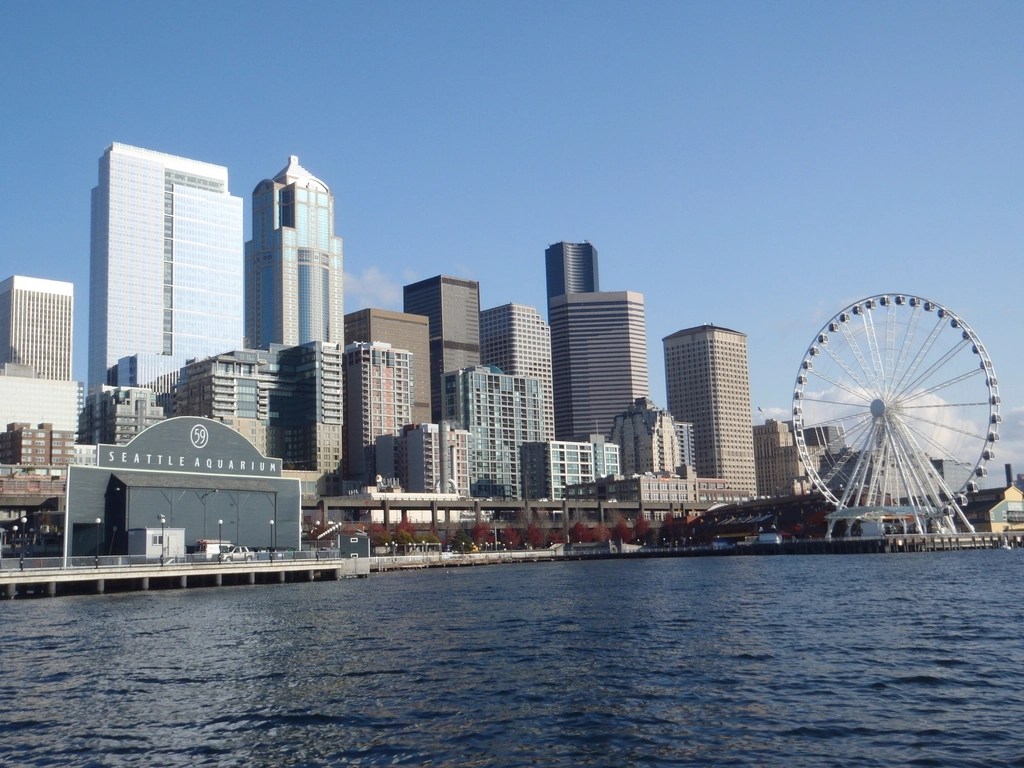
We’ve missed a significant portion of the waterfront where ferries ply their way across the Bay and Puget Sound to various islands and Victoria, Canada. Pier 56 is known as Fisherman’s Wharf. It is full of shops and entertainment opportunities. The Seattle Aquarium is underwhelming compared to other city aquariums we’ve visited. Not worth the money.
The Great Wheel – Seattle
The Great Wheel is interesting. A Ferris wheel that is 175 feet high and extends 40 feet out over Elliott Bay has views of Seattle, the Olympics, and Puget Sound (on a clear day). They have a spectacular light show. Each of the forty-two climate-controlled gondolas holds eight passengers. There is one VIP gondola with special appointments that holds four passengers. The Wheel revolves three times in the twelve-minute ride. It doesn’t compare to the London Eye, which is 445 feet high, anchored in the Thames, but it is worth the $13 to experience, and you don’t have a twelve-hour flight to get there.
We bypassed the industrial part at the south end of Elliott Bay, where big tanker ships and commercial barges load and unload from ports around the world. It is less than elegant, but it does provide a comfortable living for those working the docks.
At various times, Seattle was named the most educated city in the US and the most literate city. But then, it has also been named the most livable city, and I’m sure whoever came up with that was smoking something stinky and missed all the suicides. It is a city of eclectic neighborhoods, each a little world unto itself. Some began as immigrant enclaves but changed in character as Seattle grew. When you travel around Seattle, it is like taking a trip to different lands, different customs, and cultures without needing a passport. You will have to come back with me again sometime and explore the places we missed.
In future posts, I will share some of our sailing experiences in the Puget Sound area. I will take you to Friday Harbor on San Juan Island during the Jazz festival, to the Victorian town of Port Townsend, harboring at Orcas Island, and the legendary Fluffy Duck cocktail, visits to Stuart and Sucia Islands, going through seaside customs on our way to the Gulf Islands of Canada. Killer whales played with our sailboat as we cruised the Strait of Juan de Fuca.
I’m not sure how Seattle informed me as a person during my 40 years of incarceration. I spent so much time resenting it that I really didn’t let Seattle in. My interior barriers blocked any positive influence that threatened my bias. I took a cue from my adorable little grandmother when she came from Kansas to visit for the first time. We took her up in the Space Needle. Her comment was, “Yes, it is beautiful from up here, but you can’t see anything when you’re down there because of those damn trees.” To each his own. To some, trees provide a beautiful landscape; to others, they are an impediment to seeing the horizon.
I enjoy going back to embrace Seattle for all its gifts, now that I know I can return to Tucson’s blue skies. My children, all born with gills and webbed feet, love Seattle and always have. They thought we lost our minds when, through my insistence, we made our escape to the desert twenty-eight years ago. Two of those Seattle-loving children presently live in sunshine, one in Texas and one in Tucson. Only one stubbornly remains in Seattle, her little webbed feet firmly planted in the muck. Seattle is a very watery, water-oriented place. Water – everywhere.
No more clammy feet, soggy clothes, frizzy Bozo hair and gray skies for me. If nothing else, Seattle taught me to appreciate blue sky, clear air, stars, and yes, even the heat, it’s a dry heat. I love Tucson. I will live 40 years in the desert to dry out and make up for all the years I endured Seattle…then, on to somewhere else, preferably Paris. I know the weather in Paris is not ideal either, but it is PARIS.
Discovery Park takes up a major part of the land on Magnolia Bluff. It is the largest park in Seattle with trails, forest, meadow, and beaches for a diverse outdoor experience. Magnolia was misnamed by a military surveyor back in the 1800s because he thought that the red-barked Madrona trees that cover the hill were Magnolias.
A caveat of the Treaty was the promise that any surplus military land would be returned to the original owners. Following the Korean War, Fort Lawton was considered surplus land. In 1970, there was a nonviolent demonstration for four months by indigenous peoples led by Bernie Whitebear with supporters such as Jane Fonda and the Black Panthers to increase national attention to the cause. The result of the negotiation was that the Fort would be turned over to the City of Seattle for a public park, and the United Indians People’s Council would receive a ninety-nine-year lease for twenty acres to become a cultural center. The Daybreak Star Indian Cultural Center was completed in 1977 and is a cultural and educational magnet for visitors.
Like every piece of land in Seattle, Magnolia belonged for eons to Native Americans. The native Americans considered themselves custodians of the land. A gathering place for possibly 10,000 years. Archaeological evidence shows sustained settlements in the area with tools, homes, canoes, etc. The Euro-white invaders forced the indigenous population to reservations by the 1855 Treaty of Point Elliott with promises (still not kept) regarding healthcare and economic opportunities. The land was turned over to the military and became Fort Lawton until the 1970s.
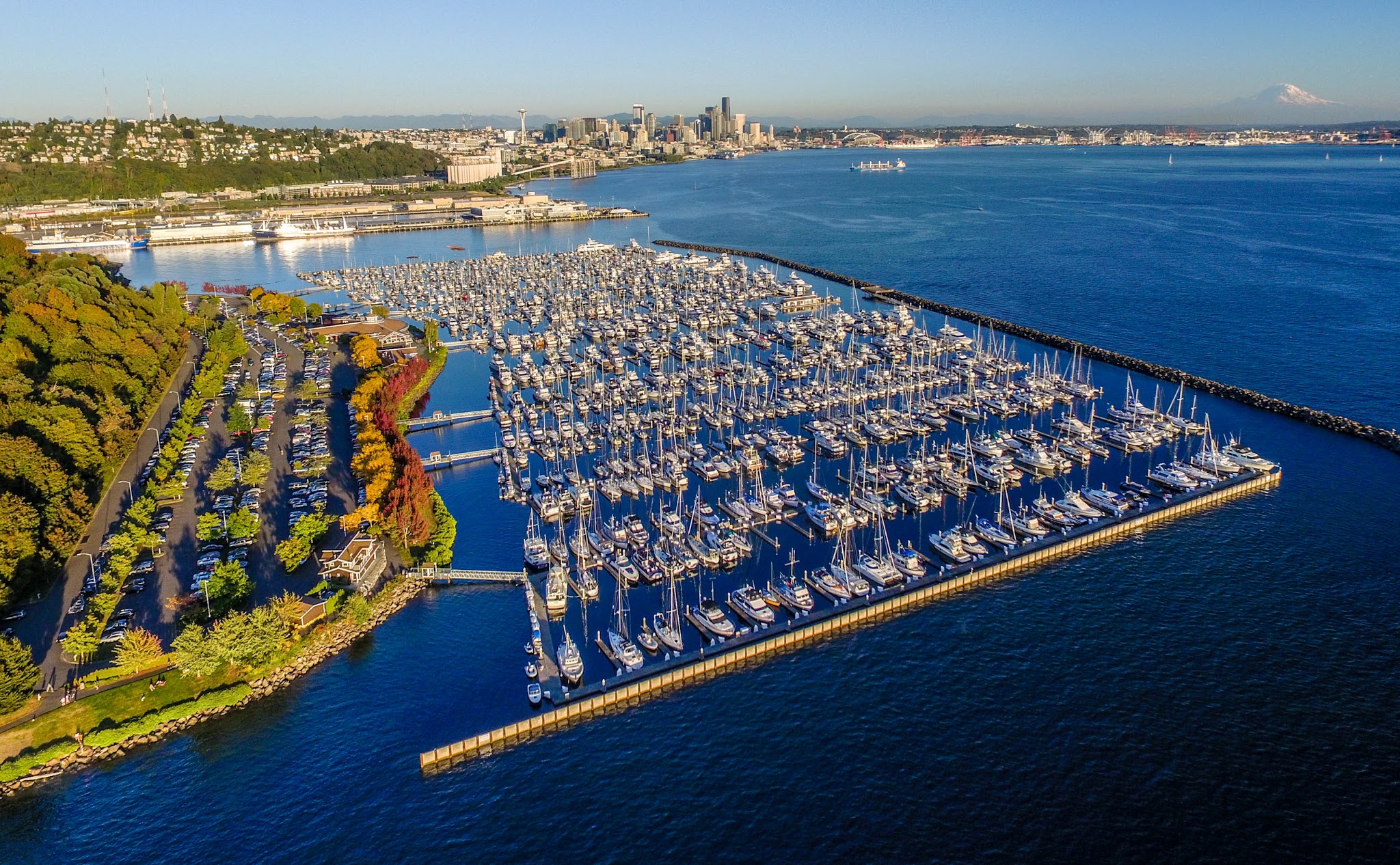
At the base of Magnolia Hill is Elliot Bay Marina where we moored our sailboat for years. It has a magnificent view to the east of downtown Seattle across the Bay, spectacular views of Puget Sound to the west, and Mount Rainier to the South. We lived aboard our boat for part of a summer while we had our house remodeled – a six-week project became three months. I remember sitting on the aft deck with a glass of wine in the evenings, the boat swaying gently with the tide, puffs of crisp sea air coming off the Sound, watching the moon rise over the Cascade Mountains and Seattle, thinking there couldn’t be a prettier sight – one of my Stockholm hostage moments. Reflection of the setting sun on windows in the city made a warm copper glow emanate from some of the buildings. Lights in the skyscrapers cast multicolored rippled beams across the water of the Bay as the sky grew darker and darker. Adorable harbor seals swam into the marina and barked at each other and boat dwellers. They are creative beggars, slapping the water to get attention and rolling on their backs, inviting gifts of food. Eagles swooped down over our boat from the tops of the madrona trees on their way hunting or fishing. Idyllic. Inner city peaceful.
Elliott Bay Marina
Palisades restaurant at the marina is one of my favorites in the city, and their Mangorita is the best. Maggie Bluffs Café is unmatched for Sunday brunch. The king crab Benedict is unbeatable. Fisherman’s Terminal is another great spot for dining on the freshest fish. One undeniable benefit of Seattle is the fresh seafood, especially my favorite, crab. From our earliest days in Seattle, a friend of ours gave us crab that he caught near his house north of Seattle. We had mountains of crab and salmon in the refrigerator and freezer all the time. I took it for granted, even said I was tired of it. Now I crave it. I must stop the restaurant tour because I’m making myself too hungry.
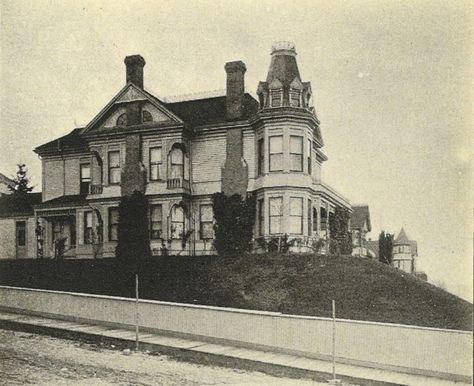
From Magnolia, we drive back southeast to Queen Anne Hill, the grand dame that looks down over Seattle and the Bay. Queen Anne is the highest hill (but not the steepest slopes) and has many of the earliest mansions built by Seattle pioneers. Lavish old homes perch on hillside lots with rounded tourettes, bric-a-brac details, and gingerbread that place them in a bygone era. Even newer built homes echo some of those details. At the base of Queen Anne to the east is Lake Union. Lake Union is lined with restaurants (which we will not visit on this trip due to hunger concerns) and nautical businesses. It is the freshwater mid-point on the canal between the Sound and Lake Washington.
A friend of ours rehabbed an old Conoco gas station into a lovely two-story home on Westlake Avenue on the hill above Lake Union with views up and down the Lake. She was one of the most creative, imaginative people I’ve known. She was also a gourmet cook and owned a restaurant in Seattle. I would extoll her varied and unique menu, but sadly, her restaurant is no more. Besides lovely lake views and boat watching, she had a view of the floating houses moored on the west edge of Lake Union. They are a unique living concept and, I’ve heard, some can be rented for a Sleepless in Seattle experience.
Lower Queen Anne on the south side of the hill is the location of the Seattle Center, the Opera House, the Seattle Repertory Theater, the Pacific Science Center, sports arenas, a live theater district, and the famous Space Needle. Ken took me to the revolving restaurant atop the Space Needle for my eighteenth birthday, and gave me a diamond and pearl ring – a promise to get engaged. And here we are sixty-two years later.
Our younger daughter lived in an apartment on Upper Queen Anne for several years. It is a distinguished neighborhood with a significant part of cultural Seattle at your feet within walking distance. I loved her apartment, embedded in an old mansion that had been rehabbed into a multiple dwelling building. It had character and charm, a perfect setting for a young writer of romance novels. Alas, she didn’t write romance novels.
Lower Queen Anne, on the south side of the hill, is the location of the Seattle Center, the Opera House, the Seattle Repertory Theater, the Space Needle, the Pacific Science Center, sports arenas, and the live theater district. It was the site of the 1962 Seattle World’s Fair. Elvis fans will remember he made a movie there…sigh. Kurt Russell was in the film, It Happened at the World’s Fair, as a little boy who kicked Elvis in the shin. Not to be missed is the Chihuly Glasshouse. If you haven’t seen the genius of Dale Chihuly glass, this is the place to explore. The Center holds so much magic it takes days to explore it all. At the edge of the Center is the Experience Music Project, now called MoPop, a spectacularly ugly structure originally dedicated to music, mostly rock and roll, but now includes symbols of modern pop culture. A monorail connects the Center to the main part of downtown. It is the location each year of the Bumbershoot Festival and Taste of Seattle. I could go on for pages about The Center. It takes days to explore it all.
Time is short, and the pages are long, so we’ll leave now. We’ve missed West Seattle and Alki Point, where our best friends lived, and the actual birthplace of Seattle. We passed by Ballard, the Scandinavian part of town, where Shilshol Bay is. Ballard is the home of all the fishermen in Seattle, and they have funny accents. Maybe that’s a little stereotyped, but it’s true, ya sure, you betcha. I’ve skipped Belltown, a waterfront neighborhood just north of Pike Place Market with lots of good restaurants and nightspots. Belltown is also the home of the P-Patch, where public gardening is offered. The next post is the last in the tour. We will visit Green Lake and the University District, and I’ll tell a smidge about our sailboat life. There will probably be other posts in the meantime. Lots of things swirling in my mind.
Standing on the brink of eighty, I have so much past and a diminished amount of future. I must keep reminding myself of that because I don’t feel a day over thirty-five, and my tomorrows still seem endless. I’m listening to friends and colleagues about all they are doing to prepare for their inevitable end. Things like clearing out closets and storage so their heirs are not overwhelmed with the detritus of their lives.
That’s a good idea even if you are not anticipating the Grim Reaper. It cleanses the mind to get rid of stuff instead of stuffing it in nooks and crannies. The same can be said of ideas and memories. They can be aired out, shared with the world, or discarded entirely.
I have so many wonderful remembrances to look back on, I don’t dwell on woes. Among my very happiest memories, besides my relationships, are my stories. I have written countless stories, character sketches, and poems over the years. Only in the last twenty years have I shared any of them. I wrote for myself. As a matter of fact, no one in my family even knew I was a writer. Of course, I didn’t call myself a writer then because to me that was an exalted status far above my humble reach. You know Hemingway, Huxley, du Maurier, Woolf, Rowling, Fitzgerald, Austin, Dickens, and so many more I admire. When I took my first writing class, I was told that if I write, even in secret, I AM a writer. Hallelujah! Now I can say it out loud.
When we moved from the Pacific Northwest to Southern Arizona, I tossed out volumes of diaries, journals, and notebooks of my writing. I figured I’d never have any reason to revisit them. It was my secret life. By chance, some were overlooked, so I have dribs and drabs of my early reflections on life, including my senior year of high school. I would love to look through all those old notebooks again to see how my perspective may have changed.
I started blogging as a marketing tool for a book I co-authored three years ago. It was fun. I was hooked. I started asking my husband to read stories I write for my critique group and blog. He was surprised that I wrote. Fortunately, he likes my writing. At least he says he does. He is not a literary critic, only a reader. He has never liked reading books, so my short essays or reminiscences are just the ticket. Longer projects I have written require an editorial type of review. For now, I’m enjoying the interaction I receive from readers at the Oro Valley Writers’ Forum, my critique group, and my online blog.
I encourage EVERYONE who likes to put pen to paper or tap away on a computer to consider themselves A WRITER. Find a writers’ group that agrees to read and critique your stories. It is a way of strengthening your skills and receiving feedback for your ideas. Writer groups are formed in writing classes given through Pima or the U. of A. The Oro Valley Writers’ Forum at the Oro Valley Library is another place to meet writers and share ideas. It is never too late to share your perspectives with the world. Everyone has a story. Every day is a story. Don’t live in a secret world. Clear out your closet of ideas and reveal your insights through fiction stories, non-fiction, memoir, or poetry. Your voice is an important thread in the fabric of humanity. We have so much more in common than in opposition.
I apologize to anyone who was misled by the title of this piece, thinking there might be some delicious salacious tidbits in the offing. Eighty years have been filled with a myriad of highs and lows, disappointments, and missteps. My deepest, darkest secrets are still locked away in my journals. Some are delicious in retrospect. They may see the light of day at some point.
Continuing our tour, we go north to Capitol Hill, one of the most interesting, in my opinion, of Seattle’s varied neighborhoods. It is the center of the gay, lesbian, and transgender population of Seattle. Punk hipsters with tattoos, pink mohawks, and multiple piercings are commonplace, sharing the streets and sidewalks with men wearing business suits and carrying briefcases.
Capitol Hill has the steepest streets in Seattle, a few plummeting as much as 21% grade, and some swanky residences line Millionaire’s Row. The Row is a National Historic Landmark District with homes built at the turn of the 20th Century.
Harvard Exit Theater Lobby
It is the home of grunge music and my favorite movie house, the Harvard Exit. The Harvard Exit was formerly The Women’s Century Club. The century referred to is the 19th Century. It was opened during the last decade of that century by Carrie Chapman Catt, a suffragist who succeeded Susan B. Anthony as leader of the national organization. The building was sold to a theater operator in the 1960s who converted it to a two-screen movie house. It became a favorite place for movie aficionados who like eclectic, off-beat movies. When the movie house closed, long after I left, the Mexican Consulate leased the building. The Exit was allegedly haunted by a woman who hung herself in the upstairs theater. I never met the ghost personally, but the possibility was titillating. The other great old theater nearby was once a Masonic lodge that became the Egyptian Theater. These two theaters put on the Seattle Film Festival every year, screening weird and wonderful films. I never missed it. There was a wonderful bakery on Capitol Hill called Bella Dolce. I used to order cakes for special occasions there, and they are incredible – yum. I haven’t checked to see if it is still there.
Capitol Hill is the location of Lakeview Cemetery, where Bruce and Brandon Lee are buried. An inscription at their grave site is one that I like, “The key to immortality is first living a life worth remembering”.
Our eldest daughter called Capitol Hill home for a year after she moved out of our house in the mid-80s. It was near her work, and there was a dance group that she joined. She moved away from Capitol Hill because the constant day and night activity, including gun shots, made it hard for her to sleep.
Capitol Hill has several aged Catholic churches and was once the center of Seattle’s Catholic population. It is also where St. Mark’s Episcopal Cathedral stands regally on a hilltop, a cliff actually. It is a massive and beautiful old cathedral with a rose window on its east wall that makes the interior glow during the day, even in light-challenged Seattle. As a child, my family went to our neighborhood Episcopal Church in Bellevue each week, but we attended Christmas services every year at St. Mark’s Cathedral. Their Compline Choir is world famous. I felt so holy in that place. Many years later, our daughter performed in the Christmas service at St. Mark’s with the Seattle Girl Choir. The annual Christmas service is televised in Seattle.
This neighborhood is where our son, age eight at the time, learned what a prostitute was. Our daughters were members of the Seattle Girl Choir in the 70s. We took our younger daughter for a choir rehearsal at St. Mark’s. While she rehearsed, my husband, son and I walked down a couple of blocks to get dinner. On a corner, we encountered a very obvious prostitute looking for her next customer. Under his breath, my husband made a comment about her choice of business location, only a block from St. Mark’s, and our son overheard. “What does she do?” Casey asked. “She’s a hooker,” said my husband. “What’s that?” Casey needed more information. “She sells her body for a price.” I enlightened our son. “Oh.” And that was the end of the conversation. When we returned to the Cathedral after dinner, we walked down the same street. I totally forgot our before-dinner conversation. “She must have gotten her price,” said Casey when we passed the corner. “What are you talking about?” asked Ken. “The hooker. She must have gotten her price because she’s not here anymore.” A brief lesson in Capitalism on Capitol Hill.
Tucked in just south of Capitol Hill is First Hill, referred to as Pill Hill because of the number of hospitals and medical facilities housed there. My only connection to it was the times I spent visiting family members in hospital. Not the best memories.
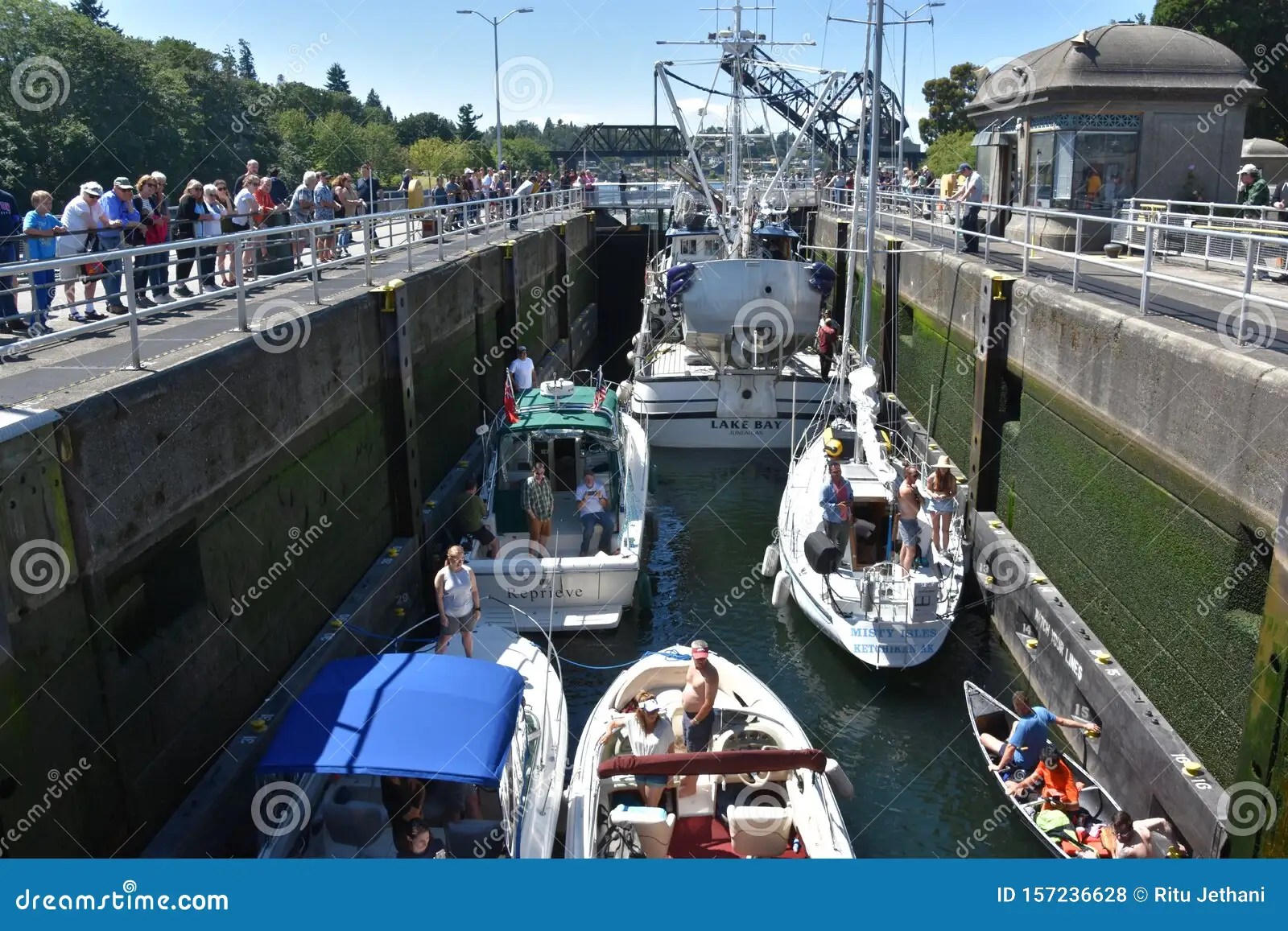
Chittenden Locks raise boats from sea level to the freshwater level of Lake Washington
After Capitol Hill, we go north and a little west to Fremont, another of my favorite places. It is bordered on the south by the ship canal that was dug in 1911 to connect Lake Union and Lake Washington to Puget Sound. West of Fremont in the Ballard area are Chittenden canal locks that you have to take your boat through to get from the fresh water lake to the salt water Sound and visa versa. We took our sailboat through a few times. It is an interesting but nerve-racking experience.
Most interesting at the locks is the fish ladder. Salmon are hatched in freshwater lakes and rivers then make their way to the open sea. When it is time to lay their eggs, they return home. The fish ladder has twenty-one “steps” to help the salmon migrate from sea level to the higher level of Lake Washington. Local sea lions can be seen supervising the gates to the fish ladder, looking for a quick meal. We loved to take a Sunday afternoon to watch the boats go through the locks, walk the surrounding park, and, from the underground viewing room, watch the fish swim up the ladder.
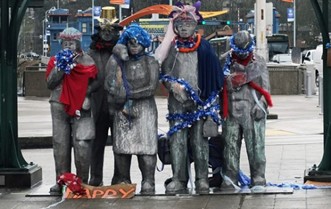
Waiting for the Interurban
Fremont is the artist community of Seattle. It is sometimes called the People’s Republic of Fremont, and their motto is “De Libertas Quirkas,” which means, loosely translated, “the freedom to be quirky”, I think. A sixteen-foot statue of Lenin was bought by a resident of Fremont after the fall of the communist government in Czechoslovakia. It was installed in the Fremont neighborhood in the 1990s. Another sculpture called “Waiting for the Interurban” stands in the middle of a thoroughfare near the Fremont Bridge, where no public buses pass. It is six people and a dog with a human face waiting for public transportation. The people of Fremont dress the sculpture inhabitants appropriately for the seasons – Hawaiian shirts or scarves and mufflers.
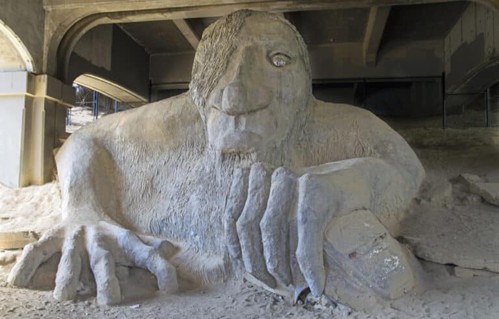
Another sculpture in Fremont is under the Aurora Bridge. It is the Fremont Troll. There was a legend of the troll under the Aurora Bridge, similar to the old Norwegian Fairy Tale about the three Billy Goats Gruff. As a result of an art competition and to keep random drug paraphernalia away from the bridge, an eighteen-foot-tall concrete sculpture of the troll appeared. He is crushing a Volkswagen Beetle that he grabbed from the bridge above in his left hand. The car in his left hand is an actual VW bug encased in cement. It contains a time capsule.
The Fremont Troll
Fremont is an eccentric mix of businesses, shops, and residences, very free form. They have a Summer Solstice Pageant every year with nude cyclists. I go to Fremont just for fun. Other than fun, my Fremont connection is negligible. I took a one-semester off-campus Seattle University class in that neighborhood in the 70s; and my husband and I went to a Fremont hypnotist to lose weight one summer.
Our tour continues with a little bit of history. Seattle is built on seven hills: Beacon Hill, First Hill, Capitol Hill, Queen Anne Hill, Cherry Hill, Yesler and Denny Hill, with Magnolia Hill, West Seattle, and Mount Baker as later annexed inclines. You get the point – it is a very hilly city. Things are built on slopes, some notoriously precarious. Landslides are a geological gamble in Seattle. Whole neighborhoods have slid into Puget Sound. In fact, one of the original hills, Denny Hill, a total of 62 city blocks, slid slowly but steadily into Elliott Bay between the years 1903 and 1928. Denny Hill is now the Denny Regrade. The Bay accepted the transfer of soil with equanimity, being over 300 feet deep in places. I will take you to some of the hills that had meaning to me.
There is a rich Native American heritage in Seattle. Mainly, the Salish, Snoqualmie, and Duwamish peoples settled where the city is now. A couple of dozen tribes along the coast left their imprint on the area. Totem poles are in evidence throughout the Northwest as symbols of native traditions and storytelling.
My high school mascot was a totem pole. I was in the first sophomore class at the new school. The students voted for the mascot. I voted for the cougar as a mascot, being an animal lover. However, the cougar was the mascot of Washington State University, and living in western Washington, the home of the U.W. Huskies, cats weren’t popular. I got on board with the totem because it honored the Native Americans who first inhabited the area. As a legacy for the school, our senior class had a red cedar totem pole carved to stand proudly in front of the school.
For fifty years, we were the Totems until the enlightened ones decided that a totem pole is a form of cultural appropriation and “can possibly cause psychological harm to Native American children”, instead of being a sign of respect for the native culture. The mascot was changed to the Redhawks. A Redhawk, of course, is a Ruger double-action revolver. Could it be that the powers-that-be prefer a firearm rather than a totem to symbolize a high school? I hesitate to guess the inner motives of bureaucrats. Maybe they meant to honor the red-tail hawk, which is prevalent in the Pacific Northwest, as indeed the picture of their mascot is an angry-looking red-headed bird. Who knows?
Pow Wow celebrations of Native American culture and heritage are held throughout the state. The SeaFair Celebration, held annually in late summer, has a Native American Pow Wow component. I will talk about SeaFair in a later post.
Seattle lies on a fault line that runs under the west coast of the US. The roller coaster effects of earthquakes are another thrill that residents of Seattle have an opportunity to experience. Most are minis reaching no more than 1 or 2 on the Richter scale, but they do upset the equilibrium. A BIG one hasn’t happened in Seattle since the 7.1 in 1949, but Alaska and California have felt the effects of 8+ earthquakes, so it may be just a matter of time. Our napping teenage son was once shaken out of slumber and off the couch by 5+ seismic event.
The combination of earthquakes and damp, saturated ground poses a constant threat of landslides. Yet, many of the most expensive homes are built on bluffs above the water with expansive views of Puget Sound and the Olympic Mountains. Duh. It is like building along the coast of Florida, where hurricanes are omnipresent. “Youse rolls the dice and youse takes yer chances,” as an enterprising Irishman once said.
Steep streets are a challenge when slippery wet. Many a manual-transmissioned car has slid backward down a slope or into other cars when piloted by an inexpert driver. I’ve seen it happen.
We will continue our tour by going to Pioneer Square near downtown Seattle and Skid Road. Its real name was Yesler Way. In early days the road had wooden planks (skids) laid along it, covered with grease to help the oxen or horses pull the heavy loads of lumber to the port. It was the dividing line between the affluent part of town and the sketchier mill-worker part. During the depression, it became Skid Row, demarcating the area where the downtrodden resided. One didn’t want to be seen south of Yesler, the grittier side of town.
I can recommend a book about Seattle during its formative years called “The Mercer Girls” by Libbie Hawker. Women were recruited in the 1860s after the Civil War by Asa Mercer, a member of one of the pioneer families of the area. He advertised in the East and Midwest for high-minded women of good character to come to Seattle to “elevate” the male population. At the time, there were ten men for every woman in the city, mostly lumberjacks and fishermen. Asa was the first president of the University of Washington and a member of the State Senate. A large residential island in Lake Washington is named for his family, as well as a principal street in Seattle.
North of Yesler is Pioneer Square, where the original white settlers started the town after they left Alki Point. It is a more sheltered part of the bay, better for their commercial objectives. Now it’s a historic district where, in 1914, the tallest building west of the Mississippi, the Smith Tower, was built. The Tower has been dwarfed by countless skyscrapers built within the last fifty years. Smith Tower is the only building in town that still has elevator operators who wear uniforms and white gloves and have to maneuver the elevator cage with a dial lever to just the right spot at each floor before they can open the glass door, then the multi-hinged metal guard to let people on and off. The elevator shaft is enclosed by glass so you can watch the elevator ascending or descending from floor to floor. There are no call buttons, only the elevator operator’s watchful eyes as he or she passes the floors. It’s fascinating. It is tempting to stay on the elevator for hours just to watch the expertise of a bygone era. *This anachronism may not exist due to a spate of modern safety regulations. It was a joy to behold when I lived there.
Captain Vancouver, an Englishman, explored the Pacific Northwest in the late 1700s, giving impetus to the idea that the land west of the Rocky Mountains had possibilities for commerce. Lewis and Clark did their inland exploration in the early 1800s. Euro-American invaders followed to settle the northwest in earnest. A group of entrepreneurs led by George Yesler and another by the Denny brothers, Arthur and David, homesteaded and settled at Alki Point in the 1850s. They recognized the potential value of the western port. They soon moved across Elliott Bay to an area now known as Pioneer Square in Seattle, where the Bay was deeper. They each headed competitive lumber operations. Seattle grew at tide level. It was a town that mainly shipped lumber, raw or finished, from its harbor. The Alaska Gold Rush of the late 1890s further encouraged white people to move West.
The timber industry flourished, and Seattle grew on the tidelands at the edge of Elliott Bay. Sawmills were constructed. Wagon loads of timber from the abundant surrounding forests were transported to the sawmills, then loaded onto ships for export around the world. Seattle was built with wood. Buildings, sidewalks, even water for plumbing was sometimes transported through wooden ducts.
The forward-looking capitalists of Seattle heard of indoor toilets – the White House had one installed in 1853. In 1881, Seattle was one of the first cities in the US to receive a bulk supply of Crapper Toilets. Over time, it became apparent that having the city built at tide level was a mistake. Sewage that was supposed to flow down into the Sound was sluicing back into the streets. Toilets backed up, creating fountains of effluent in homes twice a day during high tide. Streets were infamously turned to mud by rain and tides.
Pioneer Square was devastated by the Great Seattle Fire of 1889, which burned twenty-nine city blocks, destroyed what was then the central business district. Since it was apparent that having the city at tide level was a mistake, the city fathers decided to rebuild ten feet higher. Seattle was rapidly rebuilt and nearly doubled in size, due in part to all the new construction employment. Instead of wooden buildings, zoning codes required brick and stone buildings to be erected. After the fire, the streets were raised and built over the area that had been at tide level.
Now, there is an underground tour, ten feet below the current street level, that you can take to see the original storefronts and streets of the old city. You will see toilets mounted on pedestals like thrones to lessen the tidal backwash. I encourage any resident or visitor to take the fascinating tour.. Ghosts even haunt the underground.
Speaking of toilets. Seattle has some impressive “salles de bains” at the Columbia Tower. The 967-foot Columbia Tower has seventy-six floors with 360 ° views of Seattle, the Olympic and Cascade mountains, and Puget Sound. The Tower is the tallest building in the State of Washington. The first three floors offer retail and restaurants. The remaining seventy-three floors are luxury offices for discerning companies. The 75th floor is the Columbia Tower Club, an exclusive private club for members or invitees only. Besides having excellent gourmet food, you are treated to the poshest potties in the world.
We were invited by Janice and Jack, who were members, to join them at the Club for dinner and the city fireworks display on the 4th of July. When we arrived, Janice suggested that she and I go to the ladies’ lounge before we sat down to dinner. She stood back as I entered the lounge to watch my reaction. The room was luxurious, well-appointed with plush carpet, cushioned chairs, dressing tables, and chaise longues, but the startling feature was the individual toilet stalls along the outside wall. Each had a floor-to-ceiling window that looked out over the city. I gasped. How do you do potty business with the wide-open sky in front of you and the city at your feet?
Of course, I had to show Ken. We went back to our table, and I urged Ken to follow me to the ladies’ lounge. He demurred, but Jack encouraged him to go. Jack had seen the sight, as had other male club members. It was common for men to discreetly look in the “Ladies'”. The men’s room had no such marvel. Seattle has come a long way from the erupting Crappers on tidewater flats in 1881.
The fireworks were the second most interesting part of the evening. We were perched on the observation floor high above the loftiest rocket sent skyward that night, so we looked down on fireworks instead of up. An unusual sensation.
The tour of Seattle continues in my next post, featuring a lady of the evening and a troll.
Picture prompt: Write a story about this magazine picture. The picture feels like peace. The quiet of a deserted beach on a warm sunny day. The serenity of aloneness. Who is this woman? Why is she so far away from anyone? Does she treasure her aloneness? Is she escaping from her life? What will the remainder of her day hold?
I am reminded of a time when I needed to withdraw to peace and quiet for a while. It was April 1981, during an energy crisis, recession, and an explosive inflationary period (sound familiar?) with mortgage rates up to 18% (much higher than today). A very tense time for everyone. I worked for a small homebuilding company. We were having trouble selling our inventory of homes. The carrying costs were mounting, removing any hope of profit and the ability to continue building homes. I had been in some intense negotiations on behalf of my company with a bank that threatened to foreclose on a major loan. We couldn’t continue business without renegotiating the terms of the loan for a year. I was tapped to represent the company by my boss, Rob, who owned the company. Over a period of two weeks, I met with different officers of the bank to discuss our position, our new marketing plans, and the benefits of maintaining our relationship with the bank. It worked. I don’t know how, but I was able to convince them to extend our loan with promises for the future and evidence of our past success.
At the end of negotiations, Rob told me to take some time off. My husband, Ken, knew how frazzled I was and urged me to go away on my own to regroup. He said he could manage our three kids and all their activities for a week. He thought I would go to see my best friend in Atlanta. She was my go-to when I needed a boost. Even though we lived across the country from each other then, we were still as close as we had been as neighbors during our school years.
I thought about it. Michele would be working while I was there. She had a husband and two kids. They were all busy with their lives. I would be an intruder and a needy intruder at that. I decided I couldn’t impose on them in that way. I didn’t call her even though I knew she would have encouraged me to come. Instead, I called our travel agent. Seattle was at its drizzly best. I needed quiet and sunshine.
“Where can I go to sit in the sun; where is it quiet and I can be alone for a week?” I asked.
“Does a beach sound good?”
“I’m not a fan of water, but if it is quiet I’ll try.”
“You can be on the beach without going into the water, you know,” Sheila said. “When do you want to leave?”
“Tomorrow. And it can’t cost too much.”
“Oh, that makes a difference. No planning, eh?”
“No, just a get-away for a week.”
“I can get you on a flight to Puerto Vallarta and an inexpensive but nice hotel on the beach tomorrow morning at 9 am. I’ve been there and can recommend it.”
“Sold,” I said.
When my husband came home from work that evening, he asked if I had talked with Michele.
“No. I’m going to Mexico.”
“What? By yourself?”
“Yes. Sheila said it is a nice place. She’s been there. It is quiet and not too expensive. I will be able to be alone with no agenda. It is perfect. The reservation is made. Will you take me to the airport?”
The next morning, Saturday, he took me to the airport, still apprehensive.
“You will come back, right?”
“Of course. Don’t be silly.”
Saturday: I arrived in Puerto Vallarta and took a taxi to the hotel, Playa Las Palmas. It was right on the beach, as advertised, in the center of the crescent of Banderas Bay. I could step out of my room and walk a few yards across the pale sand to the startling blue water. I was nearly blinded by the midday sun. What a change from gray, cloudy Seattle. I went to the restaurant to see when dinner was to be served and perused the menu. Lots of fresh seafood. And margaritas. Perfect! I went to my room to change clothes so I could sit on the beach. I decided to lie down for a few minutes first. I threw myself across the bed and when I woke, it was 9:00 am the next morning. I was still in my traveling clothes. I missed dinner and margaritas. I slept from 3:00pm the day before, 18 hours. I didn’t know anyone could sleep that long.
I called Ken to let him know I’d arrived ok and slept through the afternoon and night. I told him I’d call in a couple of days. This was before cell phones. I was quite alone. No one could contact me except through the hotel. I called Michele to tell her I had escaped to Mexico. She was in shock too. I took a shower, changed, and went for breakfast, my first ever Huevos Rancheros; then to the beach. I had a notebook and pen to write my journal and two books to read. That was how I intended to spend my days. There were a few people scattered around the beach. This was not the high season so everyone was spread out. I alternated between the beach and the shade of the cabana/beach cafe all afternoon, reading and writing a little or watching the water and the people. Beach vendors wandered across the beaches from hotel to hotel selling their wares, colorful handmade wooden toys, beautiful scarves, churros, and locally made pottery among them. Hotel staff would sometimes shoo the vendors away, but they returned each day. I didn’t think they were intrusive or aggressive but they may have bothered others.
I ate a late lunch at the cabana and talked with two women I had seen on the beach. They were best friends from Minnesota, Betty and Janna, who planned a getaway together to a warm destination every year. We had a nice chat and they asked if I’d like to join them for dinner at 7:00. I agreed. But first, I said I’d go to my room for a little nap. I don’t know why I was still so tired.
Sunday: The next thing I knew, it was 8:00 am. I slept from 3:00 pm until 8:00 am. I missed dinner again. I met the two women later that morning. They said they came to my room and knocked several times but no answer. They thought I’d changed my mind and went somewhere else for dinner. They said they were taking a tour to the jungle on the mountain above Puerto Vallarta and asked if I wanted to join them. I declined, needing to be solitary for a while. I spent that day mostly in my room, reading. I walked along the beach a few times but stayed to myself. I had a quiet dinner alone, and then a normal night’s sleep.
Monday: Day three of my adventure put me out on the beach again, soaking up the sunshine. I noticed a boat pulling people into the air with a kite. Parasailing. I’d never heard of such a thing. It looked like so much fun. I asked about it and soon had a reservation for that afternoon. Amazing!! Two crew members picked me up in a small rowboat on the beach and took me to a wooden deck out in deeper water. They hooked me into a sling-type harness. I launched off the deck pulled by a motorboat – no water involved. It was wonderful. I soared under a big, curved kite around the bay for about twenty minutes. It felt like two minutes. They told me I sailed 250 feet above the water and land. It was delightful. They landed me softly near the shore in knee-deep water. One of the crew was waiting and helped unhook me from the harness and off they went to take another para-sailor aloft. I talked with some beach sitters who witnessed my ride. I had a quiet dinner alone and went to sleep.
Tuesday: The next day I decided to go on the jungle tour that the Minnesota ladies told me about. It was a great half-day ride through the mountainous jungle above Puerto Vallarta. We had a small bus or tram that held about twenty people. We were told to be on the lookout for jaguarundi and margay which are small wild cats, but I didn’t see any. There were a few monkeys spying on us from the treetops. I believe they were called spider monkeys. We saw the place where the movie, Night of the Iguana with Richard Burton, Debra Kerr, and Ava Gardner had been filmed. The tour guide filled us in on gossip from the movie set. It had been filmed nearly twenty years earlier in 1963-64 when Burton and Elizabeth Taylor were having their notorious affair. Lots of gossip. We saw women washing clothes in a river we crossed. The poverty of the people around Puerto Vallarta was evident. I had dinner that evening with a husband and wife from San Diego who I met on the tour. They told me they were going to a nightclub that night at the edge of the city where it was reported there was a good band and dancing. They asked if I wanted to join them, and I declined. Needing more quiet time.
Wednesday: The following day I walked the beach from my hotel toward town. It took a little over an hour to get up from the beach into the old town. I walked all around looking into churches and shops. I bought a sandwich and soft drink for lunch as I strolled through the village. It was very small, only a few streets. I think the population was around 20,000 give or take, including the surrounding area. Two things that stuck in my mind were the children walking to school and going home in the afternoon. They wore white shirts and dresses. I mean white, white. I don’t remember ever seeing such clean children. The townspeople looked like they were very poor, but their children were impeccably dressed. After witnessing the women washing clothes in the river, I was surprised at how snowy the clothes were. I guess sunshine had something to do with it. The other thing I noticed was armed police or guards outside banks and other businesses. They weren’t menacing but they were present. It seemed odd in so small a town. Sidewalks were uneven or missing in places. The townspeople that I spoke with were courteous and friendly, few spoke any English so we had interesting conversations with Spanglish and gestures. Those were things I noted in my journal. I walked the entire day and went back to the hotel tired. I’m sure I had dinner but I didn’t note it in my journal.
Thursday: The sixth day I met up with Betty and Janna and agreed to go with them that night to the dance club I heard about two days before. They were leaving the next morning, Friday. I don’t recall what I did during the day, but I’m sure I was either on the beach or in my room reading. That night at 9:00 we took a taxi to the nightclub, a fifteen-minute ride up the mountain out of town. There was a fun salsa band. Several of the local men and women showed us three Americanas how to salsa. The band played contemporary rock and roll tunes as well and everyone danced. I danced with Betty and Janna and whoever asked me and had a grand time. I also drank margaritas until 1:00 in the morning. My two friends left around 11:00 saying they needed to be ready to go to the airport in the morning. I asked someone, maybe the club manager, to get a cab for me, but he said the cabs were done for the night by 12:00. He offered to call a friend. Hmmmm. If I hadn’t had all those margaritas, I’m sure I would have been more judicious. I wouldn’t have stayed longer than my friends. I wouldn’t have been without a ride to my hotel. But here I was. It was pitch black outside. I mean you couldn’t see anything, not even outlines of trees when you were away from the building lights. I didn’t know my way down the mountain to the beach and my hotel on dirt roads. I was stranded. By the way the manager offered a ride, I am sure I was not the first American who made that mistake. I agreed to the ride offered. Two local fellows in a broken-down sedan, no spring in the backseat, came to pick me up. They asked where I wanted to go. I told them and asked how much they charged. They gave me a figure that was reasonable and away we went. They did not speak English with any proficiency, and I don’t speak Spanish, so they talked to each other as I sat mute in the back, praying I’d get home to Seattle in one piece. I did not have to worry. They were very kind young men. They took me directly to my hotel; I paid them and gave them a nice tip that reflected my relief that I hadn’t been kidnapped. I said gracias many times and threw in a merci and a thank you for good measure. They laughed and drove off, having done their good deed for the day.
Friday: The seventh day was my last day. I had somewhat of a headache when I woke up so the day was very low-key. I had a late breakfast and said goodbye to Janna and Betty as they left for the airport. They asked how I got back to the hotel. They told me they were concerned but needed to get back earlier than I wanted to. I assured them that I was well taken care of. The remainder of the day I spent reflecting on my trip. It was meant to be a recovery trip, and I guess it was. I slept more hours in that week than I had in months. I felt ready to resume my everyday life. In fact, I was eager to get home. I met several very nice people; some I talked with in fits and starts through different languages. I tried a new sport. I had only been in the ocean once for a few minutes after my parasail. I ventured into a jungle (albeit with a whole group of travelers) and I walked the beach and town for a day feeling very much at home in the strange environment. My alone time had been interspersed with many people and it all felt perfect. I guess being completely solitary is not something I can do. I need people.
Saturday: Ken met me at the airport when I returned. Everyone at home survived my retreat just fine. All was well. I was happy and refreshed. Ready for my next challenge.
It started in September 2024. I was notified that my Windows program would soon be orphaned, no longer supported by Microsoft within one year. My computer was four years old and beginning to show its age. I remember when my home computer lasted six or seven years, but they seem to have shorter life spans now. When we owned our real estate company, I purchased, installed, and connected all the computers and printers in our office for agents and staff. I replaced them every two years so our agents had the advantage of the latest and speediest technology. Our home computers didn’t require as much attention.
I decided to replace my computer and printer with the latest, greatest I could find at a reasonable price. I chose HP as the provider. Henrietta, my new laptop, was a snap to set up. I’m not a tech wizard by a long shot, but I can do the plug-and-play kind of setup. The printer, Oscar, was easy too.
About three weeks after setup, Oscar decided, on his own, to go offline. He wouldn’t print anything Henrietta sent to him. I fiddled around for a couple of hours and coaxed Oscar into a working relationship with Henrietta. All was well. I use my laptop and printer daily for my writing projects. I rely on their compliant participation in my efforts. I usually do the creative part of writing with a pencil and paper but transfer my work to the laptop for editing and legible printing.
A few weeks later, Oscar decided to take a vacation again leaving me and Henrietta without a way to share our work. I tried to persuade him to reconnect, but he was recalcitrant. I decided to call on the HP techs to help. I spoke with Brian. He said he’d walk me through the steps to reconnect. Steps I might add, I’d already done on my own. But who knows? A tech may have a fresh approach to the problem. After he and I worked on Oscar and he still was uncooperative, Brian asked to do a hands-on try. I gave over my computer to him via a sharing app. He took virtual control of the laptop and printer. It took about four hours from start to finish for Oscar to reconnect with Henrietta. Brian and I had a lot of time to get acquainted over the phone as he manipulated Oscar’s stubborn psyche.
We sailed along for a few days, THEN… Oscar, in his obstinacy, stopped working again. I just didn’t have the patience to charm him back, so I left him alone for a day. My thought was he just needed a bit of time off and would come back in a day or two on his own. Maybe a spa break. Really, Diana?
Finally, I went to my office to tackle the problem that was Oscar. I checked all the settings. I disconnected, reconnected, uninstalled, reinstalled, on and on, a number of times. Again, I decided to call on HP for help. I started with the chat bot, escalated to a human bot. I followed instructions, I redid, undid, and did-did over and over with the same result. Bupkis! The printer had gone offline willy-nilly three times in three months causing hours of my time placating it back to its job. Not acceptable. I “chatted” with Rachel, then Jamison, then Ricardo over a period of two days. It restarted one day, then quit the next morning. Enough! This printer is under warranty, and it definitely is not working. I want it repaired or replaced. I told them I was a writer and needed a printer pronto. I told Ricardo that I was keeping a copy of the chat-texts and maybe they would be the basis of my next novel – a murder mystery.
My last helper was Shannah, the warranty maven, on the phone. She said that in order to process a warranty claim, she had to lead me through a process to document the trouble.
Oops! A bridge too far.
“No,no,no,” says I. “I have done all the processes and procedures I am going to do. I’ve tried for hours with and without tech support. I can send you all the chat texts. I will NOT go through it again. Just send me a new printer.”
Poor Shannah. She entered the drama after seven hours as I dangled dangerously on the ragged end of a fraying rope. I tried not to be harsh, but I was done dealing with processes and procedures and printers. I realize Shannah is not responsible for my dilemma. She barely speaks English and is on the lowest level of competency. She is an order taker and can only perform her job using a script, a mindless automaton. I quoted to her the last text I received from Jose who stepped in as the supervisor when I demanded service. He wrote, “Escalate to HP Warranty Support since your printer is under warranty, request a case escalation directly to HP Warranty Services. Provide the serial number and product number when contacting them. Ask explicitly for a replacement under warranty due to the persistent issues and failed troubleshooting attempts.”
She said she would place the order. She saw I had an account with HP and asked me to verify my contact information. It was all my business info from years ago. Since I am now retired, it was all wrong and needed to be updated. I gave her my current information. She said they would send me the new printer in two weeks, and I could send the defective one back in the same box.
“Two weeks?” I responded in a not-kindly tone. “I use the printer daily. What am I going to do for two weeks?”
I could tell she was unsettled by my retort. “Maybe, you could ask a friend to print for you,” she offered sheepishly.
“Seriously? “ I scoffed.
“Well, I could expedite it for a fee and you could have it in five days.”
“I will not pay one more red cent for this pile of junk. I want it replaced tomorrow.” My voice lost all semblance of sanity.
“I’m so sorry for your inconvenience, but that is the best I can do.”
Evil thoughts entered my mind, but I controlled myself. “I’ll figure something out.”
She wished me a better day and weekend and thanked me for being an HP customer. I hung up, poured a glass of wine, went immediately to the Amazon website, and ordered an HP printer to be delivered free by 6:00pm. I have 30 days to return it and will use it until my replacement warrantied printer is delivered. Even OLD foxes can be wiley.
Afterword: My new printer was delivered at 5:30pm that day and I set it up immediately. It WORKS! The next morning when I returned from my walk, there was a box on the porch. HP said the box. Inside was the replacement printer. Hmmmm. Maybe my message was received. One-day service. Now I just need to summon the calm demeanor to connect the printer one last time. A memo from HP was sent to my old office email address as confirmation of the delivery. One of my former agents saw the email and forwarded it to me. I guess I’m lucky the printer wasn’t delivered to the old address. Oh, well, win some, lose some. I’ll be setting up the replacement printer tomorrow and returning the new printer well within 30 days for a refund.
Keeping my fingers crossed. As always, thank you for reading. Have a nice day.





 wonkagranny