The Gift I Took for Granted

Walking is prayer. Each day I try to walk for at least an hour and sometimes two hours. During that time I pray, meditate, listen to music or an audiobook. It is MY time to unload my stress, reload my gratitude, and fill my senses with God’s creations. I don’t use it to make plans for my day or my life. It is time for me to be present in each moment, not jump into the future or review the past.

Each walk starts with a prayer. I thank almighty God for giving me a healthy body and the ability to walk. I continue my thanks giving for all the blessings in my life, friends, family, and the beauty of the day. Once in a while one of the characters from a story I’m writing comes to take up space in my head as I amble along. I firmly let them know I’ll get back to them later after I get home but I try to remember what they tell me so I can write it down when I’m back at my desk.

I appreciate the gift of biped perambulating because five years ago I was couch-bound for over three months. I broke both of my ankles (one at a time prolonging recovery time – that’s another story about life lessons) and couldn’t do the simplest thing – walk. As a one-year-old, I learned, as most of us do, to move my body balancing from foot to foot, and took for granted that ability to move myself would always be with me. I was shocked when I couldn’t get up and walk. I used a scooter to get from place to place in the house, but I couldn’t WALK. I began noticing all the people who had walking limitations, using crutches, scooter, cane, staff, and walker. I developed great empathy for them. Until then I really didn’t notice them. I recognize now how hard it is to get oneself up, showered and dressed, and ready for the day when you cannot walk; what willpower it takes to get to the grocery store, to a job or do anything around the house.

I became very jealous of people who walked by or even worse jogged or ran by. Ken would take me for car rides to get me out of the house and I found rage bubble as I saw people walking. It struck me that unless I took myself in hand and made rehab my primary daily activity, I could possibly end up using a walker, cane or God forbid even a wheelchair for the rest of my life. Walking became an obsession.

I walked or jogged as a casual activity for decades never realizing what a gift it was. It was ho-hum, I guess I’ll go for a walk or go running at the track. I have strong legs and can walk miles without aches or pains. Not because of anything I’ve ever done, but because I am blessed with a sturdy body – hearty peasant stock.  I sometimes walked over seven miles around my town, to become familiar with neighborhoods. I hiked many trails around Tucson. Several times I hiked the nine-mile trail loop to the top of Wasson Peak in Saguaro National Park of the Tucson Mountains. I got winded by the 2,000-foot elevation change, but my legs never gave out. I’ve hiked various trails in the Catalina Mountains and the sandy trail at the bottom of Honey Bee Canyon.  I don’t know at what point my legs would get tired. I always feel I can do more, go farther. I haven’t explored my limits.

We built our house at the edge of Vistoso Golf Course so we would have open space behind us. The golf course owner went bankrupt and had to sell the property. Because of the town plan and zoning, it was hard to find a buyer for a defunct golf course. Without significant legal maneuvers, it couldn’t become housing. Finally, the Town of Oro Valley along with the Nature Conservancy group purchased the property as a Nature Preserve. Bonus! Not only would it remain open space but there would not be those annoying golf carts and maintenance vehicles roaming around our backyard.

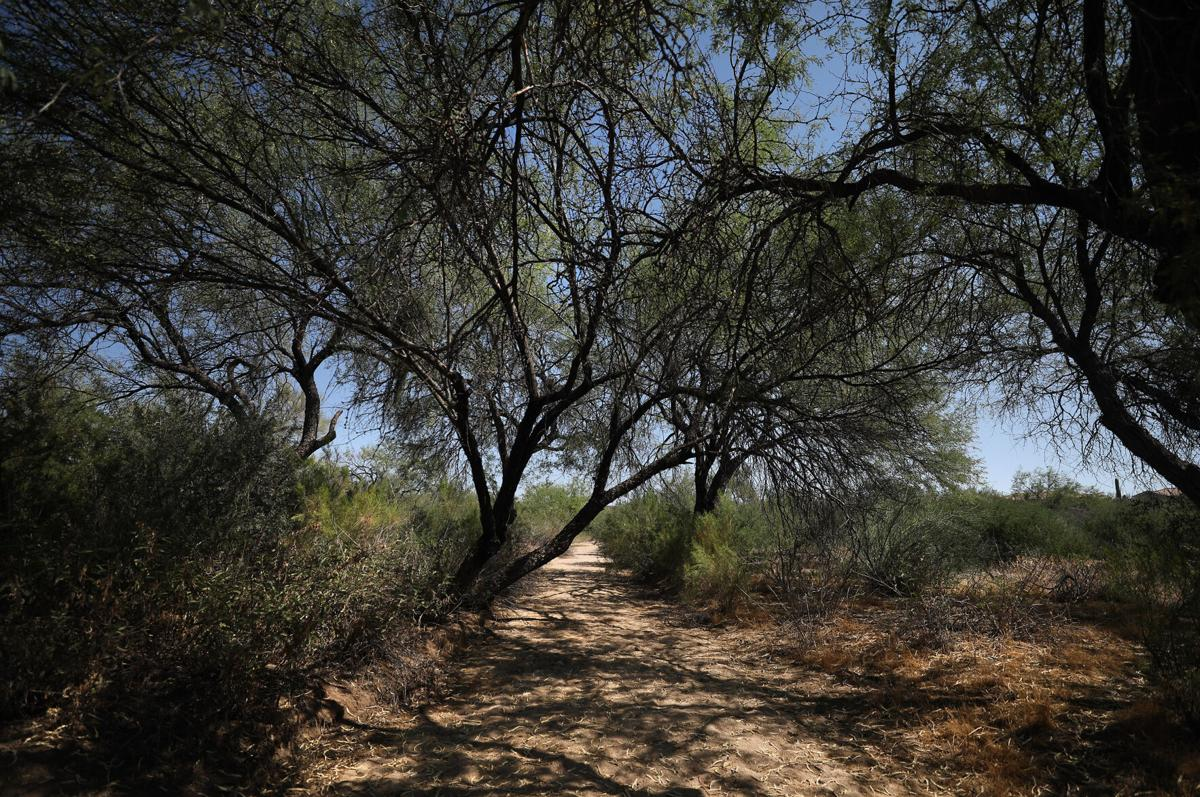
The Preserve is 202 acres with 6.2 miles of concrete trails (former cart paths) and many more miles of dirt trails crisscrossing open spaces. If you stay on the concrete path it takes about two hours to walk the loop. The wonderful thing is you don’t have to stay on the path. You can walk across meadows and through tree-lined washes making your own track. Foot traffic through these open areas has created alternate routes over the past couple of years.

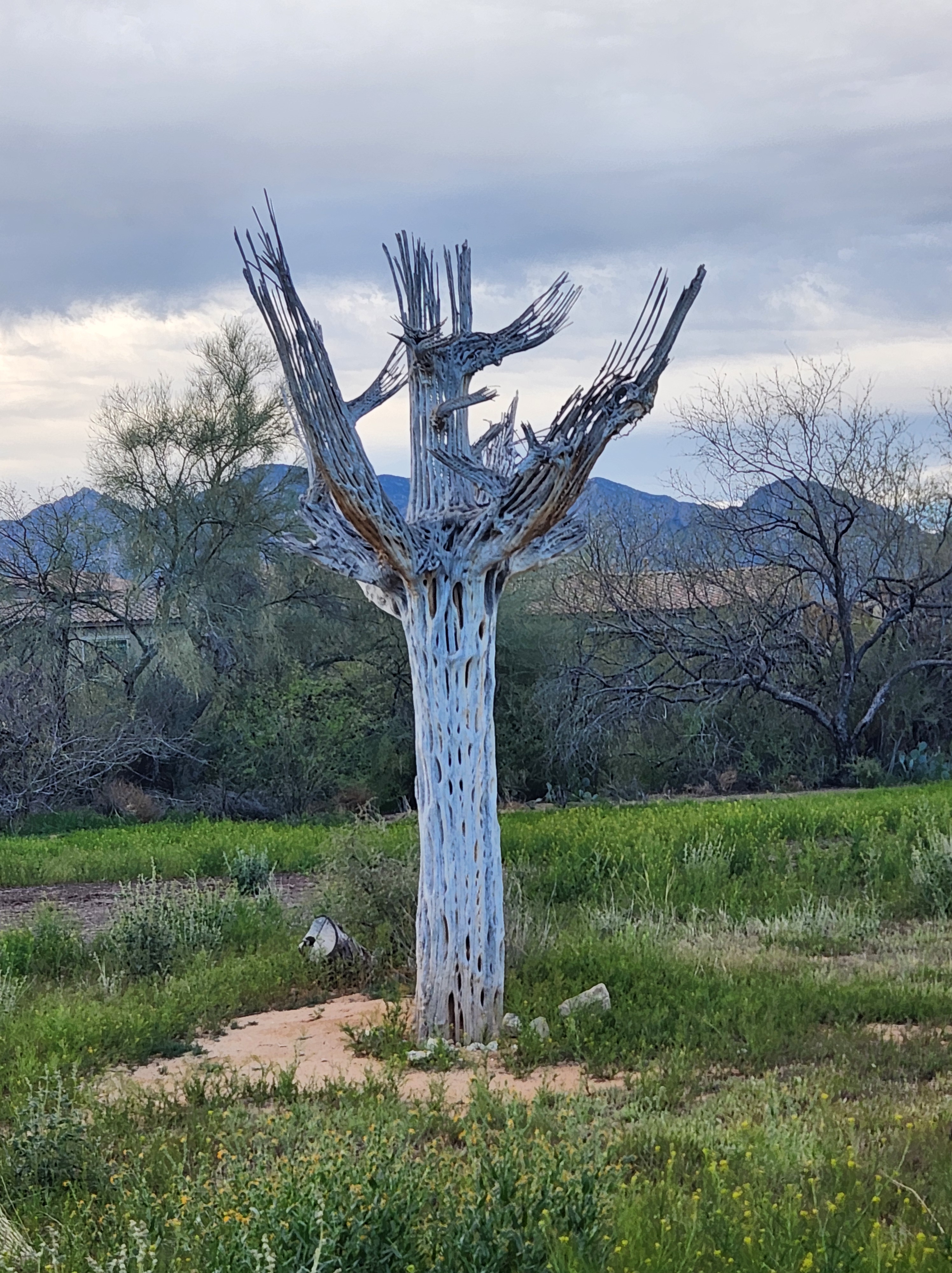
Ghost Saguaro

I am now so familiar with the Preserve that I’ve named each hill along the trail. For example, there is Castle Hill in the foothills of the Tortolita Mountains with a view of a castle-like rock formation. From this elevated part of the trail, you can see the Tucson Mountains to the west and the Catalina’s to the east.  Playground Hill passes the park in the CenterPoint neighborhood; Shady Wash Hill starts from a big shaded wash and climbs to a wide open field; Number Seven Hill where the seventh tee of the old golf course was and the marker remains. Meadow Hill climbs up to a big open meadow where I have seen coyotes romping through tall grass. There are among others, Ghost Saguaro Hill, and Petroglyph Hill. And on and on. I haven’t counted how many hills are on the trail, but I look forward to each one as I come to them on my rambles through the Preserve.    

I walk alone for at least an hour each day. My friend Roxanne walks with me for two hours on Saturday morning. I encounter many of the same people who live in the area and walk the trails daily as I do. We nod, smile, and say good morning, make short comments and observations on the day or the wildlife we see. There are couples, and dog walkers, but most are solitary as am I. A few ride bikes through the Preserve. I feel sorry for them because they whiz by all the beauty and natural wonders so quickly and miss observing the animals entirely. We dress in shorts or sweats depending on the season and t-shirts, and possibly a jacket in the winter, very casual since it is our neighborhood, home is nearby.

There is one group I come across almost every week. I call them the Imports. They are definitely not from the neighborhood. They wear backpacks and look like serious hikers. They have a leader who talks and points as they walk. I think they are part of an ecology group. They start in a close group, but I noticed, when I come across them later on the trail, that they become separated with stragglers sometimes fifty yards behind the leaders.

Wildlife is abundant. In other posts, I’ve listed all the animals that live in my neighborhood. Or rather I recognize that I live in their neighborhood. I’m grateful they haven’t gotten pissed off and left but instead stayed to share the area with us human invaders. Sometimes a deer or javelina will go by our backyard fence and look in at us sitting on the patio. It is as if they are taking a stroll through their environment, and we are the ones behind the bars of our fence like critters in a zoo. Although they are wild things they do not threaten or challenge us. I’ve had coyotes trot alongside me as I walk. They get within about twenty feet and match my pace. They are wary and keep an eye on my movements. I get no sense of threat from them. 

Bobcats don’t come as close when I’m walking but they have slept on our front patio, even on the chaise in our backyard.  Once while holding our two-year-old grandson’s hand I walked to the end of our cul de sac and nearly stumbled over a sleeping bobcat who blended so well with the vegetation that I didn’t see him until he stood up, stretched, and moved away into the wash. A bobcat slept unnoticed in our neighbor’s backyard wooden play structure and only left when the kids in the pool made a big racket and woke him. I know enough to keep a good distance from wild things especially if they have their babies with them. They can be dangerous if they feel threat.

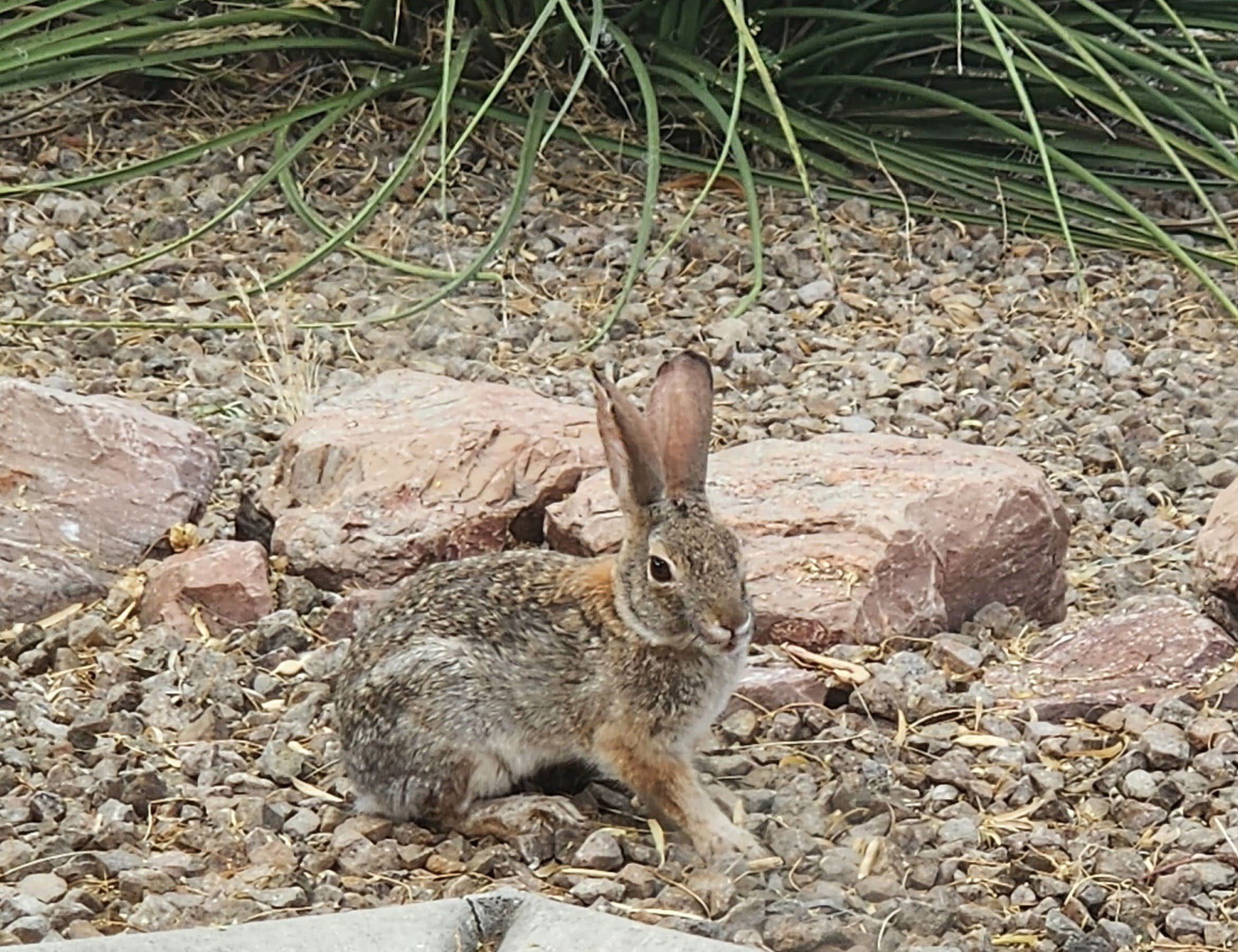
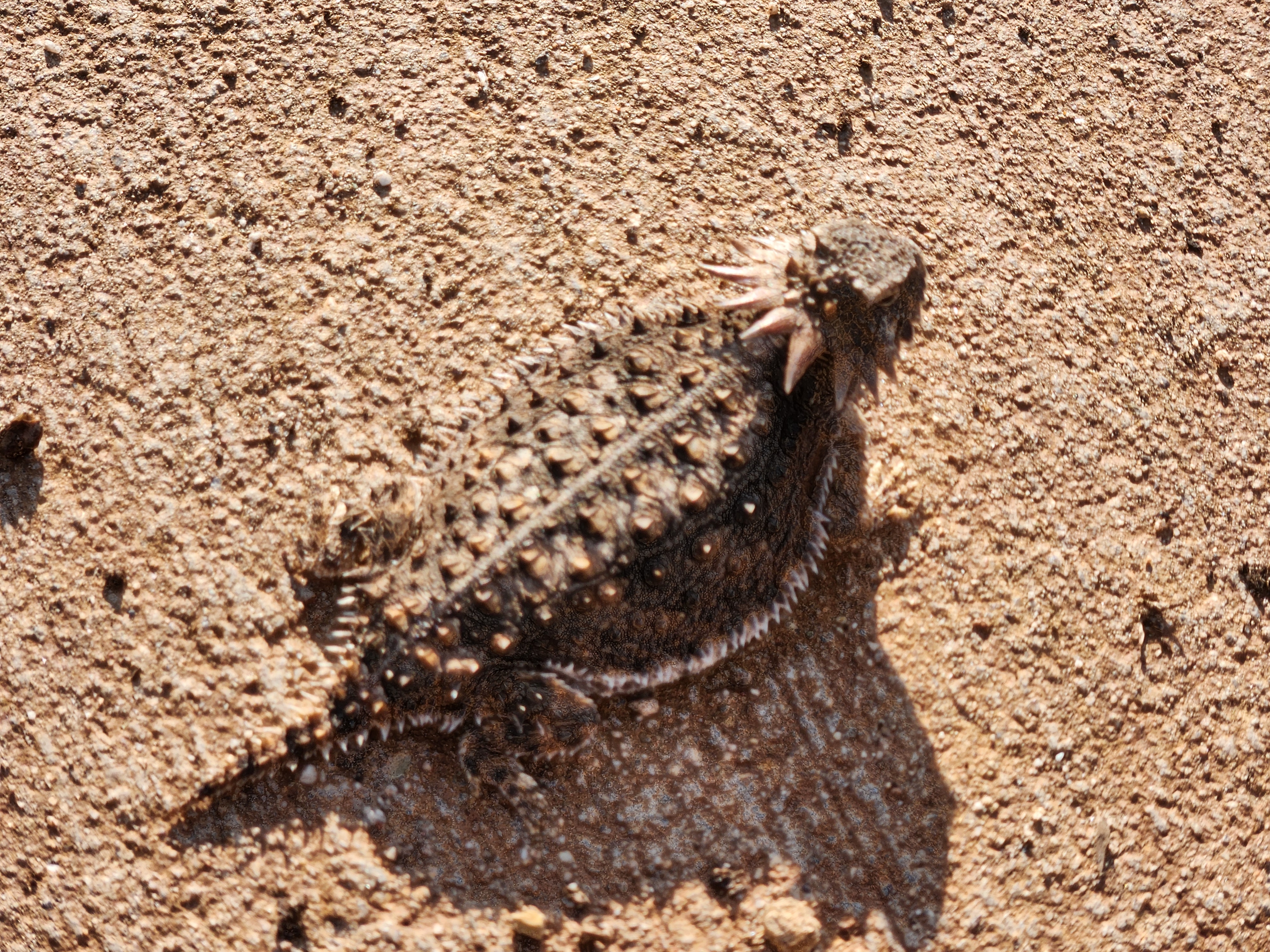
Mostly I see a plethora of bird beings, in all varieties.  Bunnies and lizards/geckos of all shapes and sizes zip here and there in the underbrush or across the trails. Summertime means many of the animals retreat to the mountains and our valley is left with those that don’t travel. When cooler weather begins, the animals show up just as human snowbirds do. But honestly, the animals are more welcome because they don’t clog the streets and byways or crowd the restaurants and library. They add variety to my daily walks. They listen to my prayers.

Monsoons

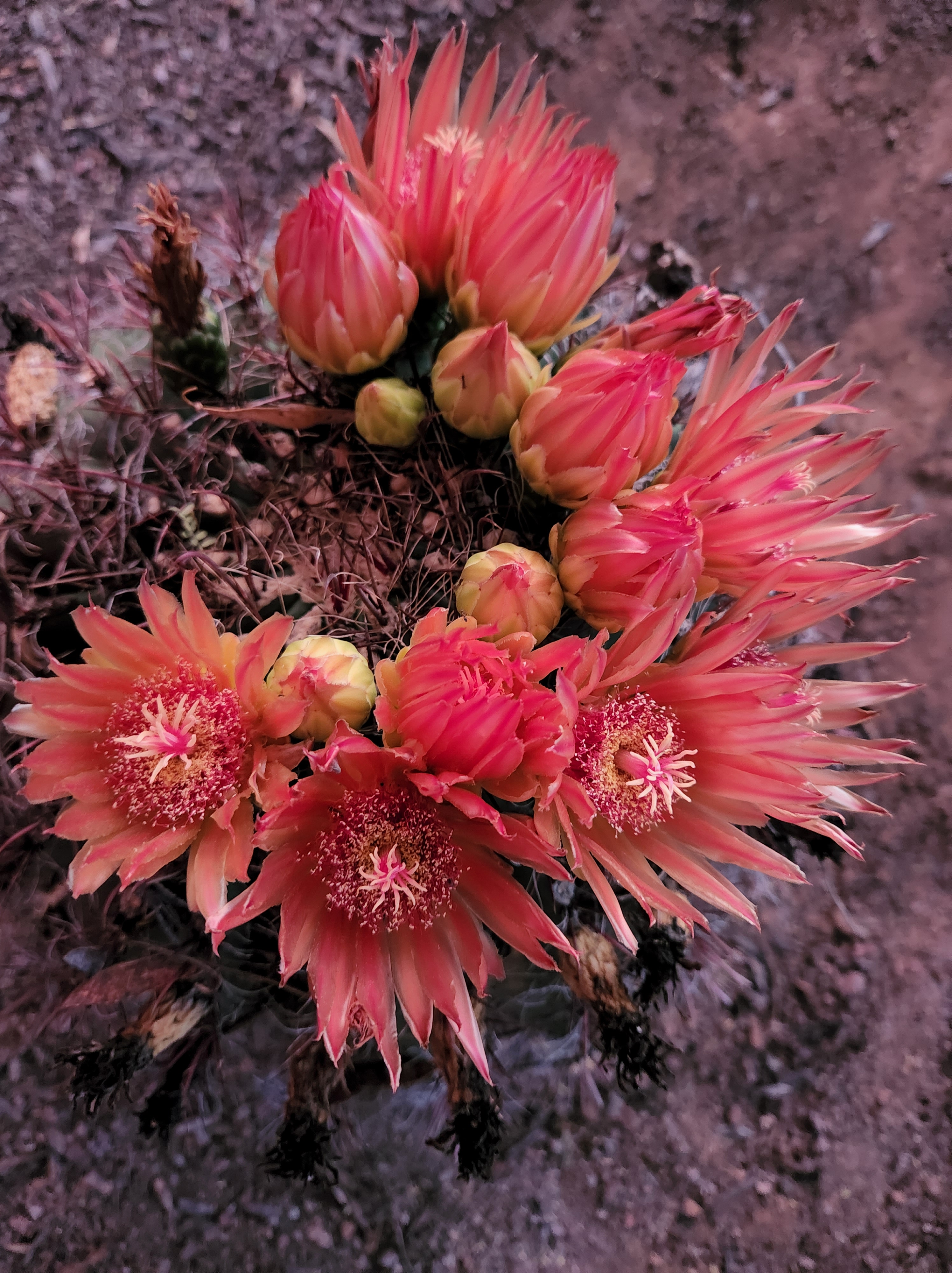
Late Summer 2024. This is the best time of all in the desert when luxurious rain drenches the parched earth. Rivers and washes flow. The hills and mountainsides turn dark green. In summer most places in the U.S. dry out, the earth turns yellow and brown. But Tucson blooms. The delicate trumpet flowers of Texas Rangers flaunt various shades from the soft lavender of a morning sunrise to deep purple vibrations of a shiny eggplant. Succulent plants flower, pink, orange, red, and white.

Texas Rangers

This is the time I love the most. I have never understood why people head for the north country during summer in the desert. It is absolutely the most glorious time. The desert comes alive. Yes, it is hot, very hot. People don’t stay outside in 103 degree heat just as they don’t stay outside in 15 degree cold. Our hottest month is June and it tapers off through September. Only 50 or 60 out of 365 days are unbearably hot. Those are mercifully interspersed with cooler days of monsoon or mini-soons. We have become soft and civilized. Natives of this land lived and survived outside for generations. We leave an air-conditioned home, get in an air-conditioned car and go to the air-conditioned place of choice. Unbearable days are spent in air-conditioned homes, stores, restaurants, and offices. Movie theaters are kept at icy temperatures requiring a sweater as you watch your favorite stars act up on the screen.

I walk in our nature preserve almost every day, rain or shine, hot or cold. In summer, I set off early before the sun takes full command of the sky. I pause in shady places to examine the trees, meadow, and flowers around me. I come home drenched in sweat but so happy to witness the changes in the desert. In winter, I leave later in the morning and eschew all the shadows to take full advantage of the warm sunshine.

Most humans are comfortable with temps in the 60s. Anything below 80 degrees makes me shiver and requires long underwear. It is not because I have adapted to Southern Arizona. I’ve always been this way. I froze in Seattle for forty years, with temps rarely above the 60s. I’ve come to my comfort zone in Tucson.

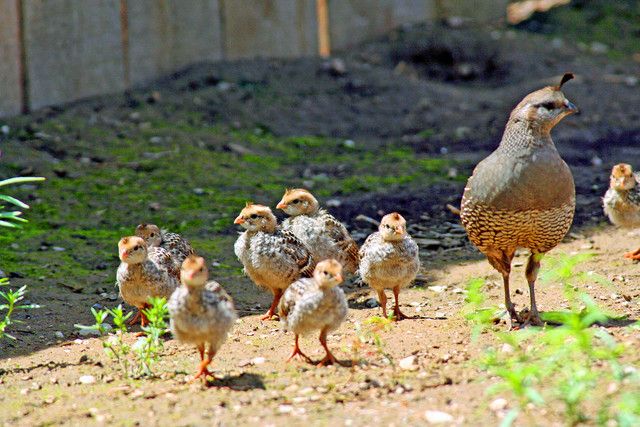
Mama Quail with her brood

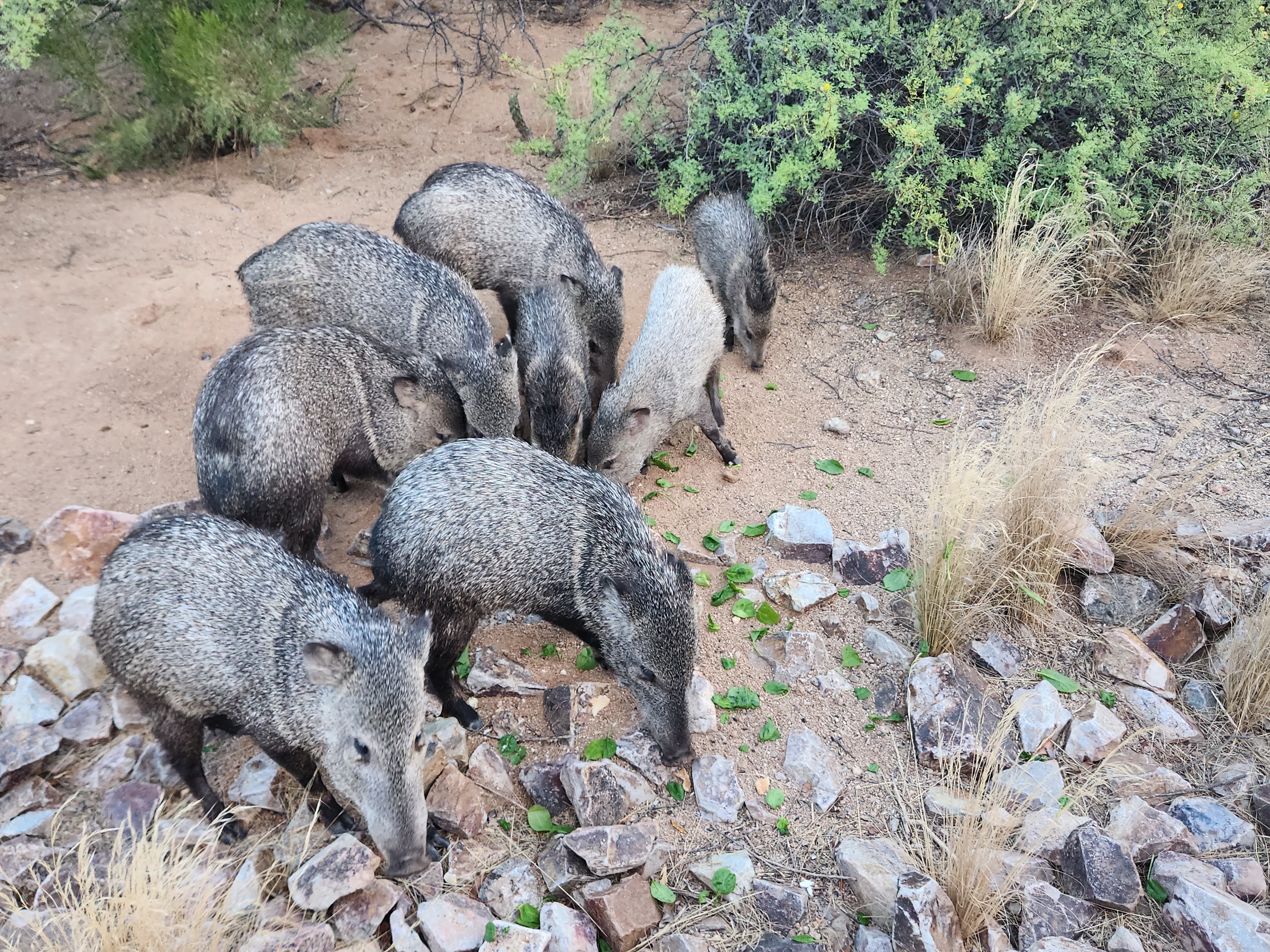
Bunnies become fat and sassy. Therefore, the coyotes have wonderful feasts and fill out their bellies as well. Plump quail parents shepherd their tiny eggs-on-legs babies across the path. Snakes are out warming their cold blood along paths and walkways. Best to avoid them although most are harmless. We do have the occasional rattler. Happy lizards and geckos of many types skitter through the brush. I stop to take photos of any cooperative critter. Javelina are most amenable to pose for me, so I have scores of javelina family photos.

Funny Bunny posing
Javelina Family

Ooooo – clouds have gathered, thunder booms, the branches of our big mesquite are bowing in the wind outside my window, and fat drops of rain splatter the walkway. The temperature fell from 101 to 78 in 30 minutes and humidity went up from 14% to 51%. I’ll go now to enjoy the show.

Cactus Flowers
Rattle Snake sunning on path
Horny Toad

The Encounter

Recently I was on my way into one of the mega hospitals in Tucson to visit a sick friend. At the entrance are two sets of sliding glass doors. I was entering the outside set and could see a woman holding an infant carrier coming out through the inside set of doors. I readied my smile and words of congratulations on her little treasure. As she came closer the words died in my mouth and my smile faded when I looked into her face. It was a mask of infinite sorrow. I’m sure she didn’t even see me through the tears that threatened to overflow onto her cheeks. I glanced into the infant carrier and saw only a wadded pink blanket. My mind began clicking away at the incongruity of the baby carrier and the sad face when I saw the sign inside the lobby. This hospital is a Safe Haven newborn drop-off site. A place where an infant less than 30 days old can be left, anonymously, no questions asked. The baby is cared for, then placed into the arms of a loving family who wants it.  Arizona passed the law in 2001 authorizing such safe places to avoid unwanted infants being abandoned to die.

This was a hard post to write. Understanding the difficult reality for other people takes me out of my secure, happy existence and makes me once again realize how very fortunate I am. That encounter lasted less than 30 seconds and a dark blue cloud hung over me the rest of the day and, in fact, I still feel it when the memory passes my mind. I harbor a deep sadness for the infant who was put in a Safe Baby box, instinctively aware that the mother she had been a part of for at least nine months was no longer with her. I felt empathy for the woman who made the heartbreaking decision only she could know and understand that she had to give up the child she carried inside, under her heart for nine months. I am grateful for compassionate lawmakers who sanctioned these safe places to save innocent infants, giving them an opportunity to thrive in families that want to raise a child. A mixed blessing.

Taking Time for Gratitude

When I wake each day, I spend a few moments thanking God for another day and counting my blessings. Well, not every day. There are those days when I sling shot into the morning with six things to do before breakfast. But then I try to slow down, take a breath, and remember to be thankful. Thankful that I have six things to do and can do them. Also, I’m thankful that as a retiree I have the luxury of slower mornings.

On Saturday I walk five to seven miles on the trails through Vistoso Nature Preserve, a two-hundred-acre open space that borders our backyard. In every direction, I see the glorious mountain ranges that surround us. Their solid majesty guardian of our valley. I’m grateful for the beautiful Preserve where wildlife is abundant and free to roam. I am grateful they share their space with us, invaders in their world. Today a young coyote crossed the trail about twenty feet in front of me. She stopped on the other side, paused to look at me, and then ambled into the underbrush and trees. Within seconds she disappeared, as animals do, melding into her environment. A couple of miles later, two cavorting coyotes came to the edge of the trail from an open area, noted my presence, then played on chasing each other, leaping and disappearing into the tall grass. They looked like a couple of dolphins breaching from beneath the sea.

Bird song accompanied my walk. I felt I was being passed along from song to song, bird by bird. I’m not a birder so I couldn’t identify the avian varieties, but their songs were a lovely accompaniment to the walk. Rabbits, large and small, scampered alongside trails busy in their bunny ways. They would halt to give me a look, then go about their business.

I am grateful to be able to walk. A few years ago, I broke my ankle and had to have the shattered bones screwed and plated back together. I spent weeks on the sofa unable to take even a single step on my own. Thank God for Dr. Ty who did a wonderful job of putting Humpty Dumpty back together. I so looked forward to walking across the family room into the kitchen. But… Immediately upon healing, I broke the other ankle. Don’t ask. It’s a dumb story and one for another day. I believe God saw I had not learned the lesson He intended and decided I needed more time immobilized. So again, I had to have surgery and spend more time on the sofa unable to walk.

During that long recovery period, Ken would pack me into the car for little excursions to get me out of the house and lift my spirits. What it mostly did was make me jealous of people I saw walking. Such a simple thing. We learn as babies to stand on two legs and claim our freedom to get from one place to another on our own. I did not appreciate that freedom until suddenly I was anchored down for three months. I swore that once mobile I would walk every day and appreciate each step. I have and I do. My daily walks are one to four miles and each step is blessed.

Ken still accompanies me on daily walks for up to a mile. He cannot walk further right now but hopes to increase his mobility in the near future. I’m cheering him on as he works to improve. I’m grateful that he is making every effort.

Most Saturdays I walk with my friend Roxanne, but she has been away visiting her son in Oregon, so I go alone. When we walk together, we talk, talk, talk for two hours. We solve the problems of the world and a few of our own. When I walk alone, of course, I’m really not alone with all the critters in the Preserve or friends from the neighborhood I meet along the way. My time walking alone during the week is for quiet contemplation, writing poems in my head, thinking about situations a character in one of my stories faces, or sometimes listening to music or a book on my phone. I am grateful for all those opportunities – alone or with friends.

Haiku from today

Silly woodpecker
Rapping on the metal pipe
What is he thinking?

At the Diner

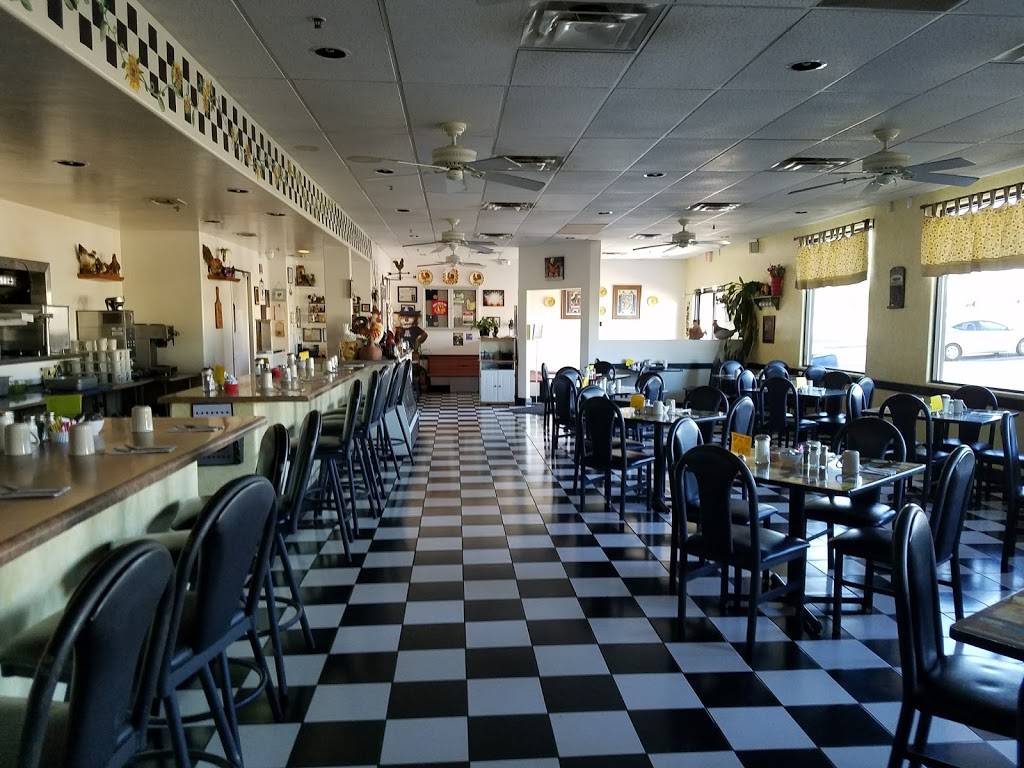
We had lunch at a local diner, one sunny February afternoon. We frequent that diner because it is nearby, has very friendly staff, homestyle cooking, generous portions, and reasonable prices.  The diner is open daily for breakfast and lunch. The décor is Midwest farm kitchen. There are pictures and photographs throughout of farm life, fields, and animals. There is a plethora of chicken and rooster statuettes everywhere. The main room has two dozen tables and a lunch counter with another dozen stools. There are two extra rooms for overflow, used mostly on Sunday mornings or when clubs have meetings. We are so grateful that the diner was able to stay open for the two years of the covid panic. So many mom-and-pop businesses had to close.

Just after we were seated at a table by the window, I observed a woman, 60ish, cross the parking lot and come into the diner alone. She was short, pear shaped and wore a dress with a leafy green on green print and brown “sensible” shoes. She carried a pink purse, a blue hardbound book, and a plastic grocery bag that looked packed with something. It could have been clothes or trash, I don’t know, but it was tied up. She placed her book and purse on the counter and went to the bathroom with the grocery bag. I assumed by her casual leaving of her belongings that she was a regular. I often see solo diners eat at the counter, but I’ve never seen a lone woman there. She returned without the plastic bag and assumed her tall chair, ordered iced tea and lunch, and opened her book. I saw from my table across the room that it was a Patricia Cornwell mystery – big letters on the cover.

My husband and I talked about our niece who was visiting from Montana as we waited for our food.

A tall man, over six feet, also in his 60s, possibly 70 entered the diner. He had on a blue plaid wool long-sleeve work shirt, blue jeans, boots and wore a camo ballcap that he didn’t remove. Lanky would adequately describe him, loose limbed and thin.  He passed by the woman. Neither acknowledged the other. He threw his leg over a counter chair, two seats away from the woman. He looked very much at home at the counter. The waitress took his drink and lunch order. Both the man and woman faced straight ahead. The woman reading her book. It looked like she had just started it – only a few pages in. When their waitress brought their lunches, they began to eat, still not looking at one another.

I glanced over to them as I ate my lunch. After a couple of bites of sandwich, the man looked at the woman and made a comment. Since I was across the room, I have no idea what was said. The woman acknowledged his question or comment and continued eating her sandwich and reading her book without turning to look at him. Again, he said something and again she answered without looking his way. He continued to eat and talk looking in her direction. After about five minutes she looked up and smiled at him. She said something in return. Encouraged, he turned his swivel chair so he directly faced the woman. His talking became more animated. He used his hands, then his arms with broad gestures, to illustrate what he said. She looked up at him more often and the conversation became mutual – a back and forth dialogue. Finally, she closed her book and gave her full attention to the man.

I watched this human interchange from across the room as it slowly unwound. It was enjoyable to see the two people, who I assumed were strangers, find something in common to talk about as they ate their lunches.

“What’s going on?” my husband queried when he saw me chuckling quietly while I watched the couple at the counter.
“I am watching two people getting acquainted.”

He looked up for a moment then, uninterested, returned to his sandwich.

The waitress gave each of them their bill as they finished their meals. They continued to talk for a minute or two then the man got up, paid, and left the restaurant. The woman followed a few minutes later after buying a sweet from the pastry display cabinet to take with her. My husband and I left also.

I felt I had watched an entertaining play unfold before me during lunch. I suppose I could make up the dialogue but the scene, even without words, was enough. It was like watching a silent movie.

That’s what writers do. We observe. Stories, scenes, and characters come from everyday incidents. Imagination fills in the blanks, the dialogue, the prologue and the epilogue. I’m sure the two people I saw that day will join the many other characters who live in my mind’s village and have a story of their own one day. What was in that plastic bag?? Could their story be a mystery? a little romance? a fantasy? a political thriller?

What have you observed either at a restaurant, in line at a grocery store, or walking in the park? Stories are born from these scenes. You don’t have to know the dialogue, that’s what your fertile imagination will create.

Our Town

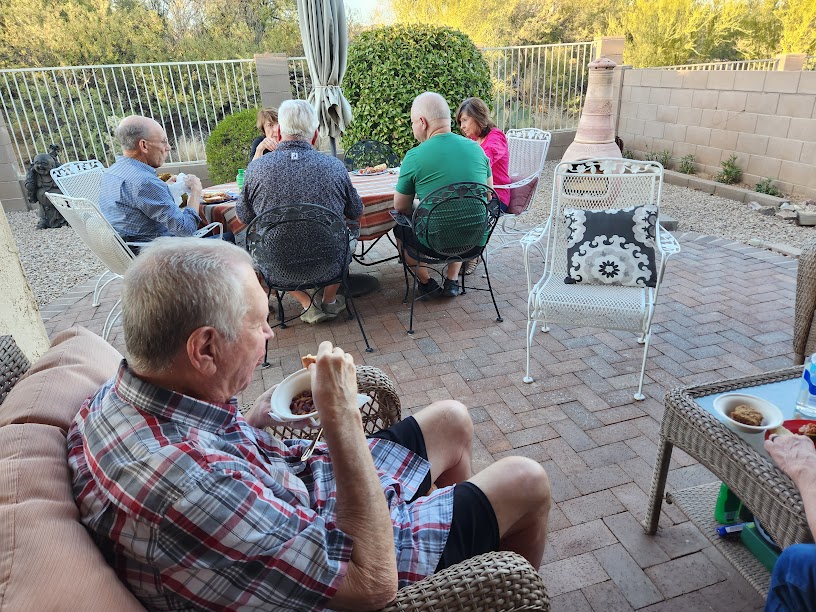
On November 5th we hosted a pot-luck Texas Hold ‘Em poker party for a group of long-time friends. We ate outside on the back patio then went in for the card game. Our poker parties go back many many years. As couples, we used to meet regularly. When covid hit the parties became sporadic but we still met on occasion. In total, there are seventeen of us. Not everyone makes every party, but we try. The ladies of the group also gather monthly for dinner at a restaurant to celebrate a birthday. When there is no birthday that month we meet anyway to celebrate friendship. In October there was a garden party hosted by a couple who built a greenhouse during the pandemic. The incentive for that gathering was to show all the beautiful plants and vegetables they propagated during the last two years. Everyone left with a small basket of fresh veggies to make soup at home.

Ken and I owned a real estate company and, in 2002, hired our first agent. During the next couple of years, we added more agents. We met their spouses and became friends. We added some of our clients to the group and, over twenty-plus years, an enduring bond of friendship and support was created. That friendship continued even after we retired. We all managed through covid, vaxed or unvaxed. Two couples moved away for several years, one to California and the other to Minnesota, but returned and were immediately brought back into the fold. In 2021 one of our friends died but he is still very much in our thoughts and part of our conversations.

Potluck is our preferred kind of party, even if it doesn’t include poker. Everyone brings a favored dish to share. Just as potluck is a combination of foods, our group is a combination of individual talents. Each person contributes to the whole with their uniqueness. All are blessed with the knack of friendship – they listen, they make others feel comfortable. We poke fun at one another in gentle ways and in memory of all the good times together.  Laughter is a big part of every gathering.

The day after our party the 1940 film, Our Town was shown on TCM. I remember reading Thornton Wilder’s play in our 11th-grade English class taught by Mrs. Lupton. The play was performed by our high school drama club. Then again years later, Ken and I saw it performed by the Seattle Repertory Theater. Even though I am an oldy film buff, I had never seen the movie. The play takes place in the early 1900s and its human themes resonate today. I reflected on our party. As friends, we have known each other, not since childhood, but through years that included births (of grandchildren), love, divorce, marriage, illness, and death. We attended baby showers and followed the milestones of each grandchild. Now one of those grandsons is in basic training for the Air Force and there are still toddlers in the group. Life moves at a breathtaking pace. I am ever grateful for their continued friendship as we compare old veiny hands and the inconveniences of aging. We discuss travel plans, artistic endeavors, beloved pets, children’s achievements, the highlights of grandchildren, and celebrate each accomplishment. Poker is fun too and we all (yes, even Larry) cheer the winner.

Our Town was knocking on my consciousness. This post began life as an entry in my journal several weeks ago. Within days of my journal entry, I started and finished reading the novel Tom Lake by Ann Patchett in which a “character” in the story is the play Our Town. Hmmm, a coincidence? My journal is much longer and more detailed, but I decided to pare it down and post it since the play seems to be all around me from a movie to a novel and the sense of my own community around me. Funny how that happens – recurring themes. The life of a writer.

Five Easy Pieces

In 1970 when the movie Five Easy Pieces was released, I was a grownup suburban matron with three children. Such was my disguise, cloaking the heart of a rebel. Jack Nicolson embodied that rebel spirit and I adored him. That movie was one of my favorites at the time although now I don’t remember the plot or much about the movie. I do remember the scene at a restaurant when he orders a side of toast with his omelet and the waitress says they don’t have side orders. So he orders a chicken sandwich on whole wheat toast, hold the mayo, hold the lettuce, and hold the chicken. That reaction to nonsensical rules comes back to me often.

We recently went to a restaurant and our grandson ordered a grilled cheese sandwich. “What kind of cheese?” asked the waitress.”American,” he responded. I was surprised because he has a fairly sophisticated pallet for cheese and I don’t think of American as a favorite. The order took longer than expected (no doubt, the exotic cheese choice) and forty minutes later everyone had their meal except our grandson. How hard is a cheese sandwich? He finally received his order. It was a simple sandwich with a thin layer of cheese painted between two slices of toast.

When we received the bill, we were charged for the sandwich plus 50 cents for the cheese. I laughed. Pay extra for cheese in a cheese sandwich? What next? Extra for ice in iced tea or cheese in a cheeseburger? The server’s response was equally nonsensical. She said the management was terrible and they were understaffed. What has that to do with a separate charge for cheese.? I’m very sorry for the overworked, unappreciated staff but…
Fifty cents is not the issue. It’s blindly following some rule that says if cheese is ordered it’s extra.

I fear the sheep in our society are multiplying rapidly. Compliant, unquestioning followers – not leaders who look above the fray, see daylight, and search for reason. No offense intended to sheep.

That’s my observation for today.

The Wall

I have a tiny piece of it – The Wall. The wall whose demolition I thought signaled hope and the end of division. The wall that came down in Berlin on November 9, 1989. Unlike other days that are seared into memory with feelings of foreboding, like J.F. Kennedy’s assassination, Elvis’ death, M.L. King’s assassination, Bobby Kennedy’s assassination, 9-11, this was a day of global celebration. I very clearly remember where I was the day when hundreds of people smashed that wall to pieces. I watched the event on TV in a hotel while at a business conference with my husband, feeling a sense of gratitude and relief that the symbol of oppression was destroyed. A friend was in Berlin when it came down and brought a piece of it to me. I can’t recall who he was. His face and name are lost in the labyrinths of my mind. But I still have that remnant of the wall in a small, bejeweled keepsake box in the top drawer of my dresser. It used to sit in a tray on top of the dresser where I could see it every day, but my cats taught me that anything visible could easily become invisible if they decided to swipe it; especially a small thing even if it represents a much bigger thing.

The Berlin Wall separated families physically by only a few feet but by deep canyons of ideology. We are still in that place. Walls are taken down only to have other walls built. Walls have been built forever – to keep people in as the Berlin wall, and to keep people out as the wall being built on our southern border, and the Great Wall of China that was designed in the 7th century BCE to keep out the invading Mongol hordes. People crash through walls at their own peril when what is on the other side is perceived to be more enticing than what is on their side. The world has been crashing our borders to get into a country that is labeled by some as racist, homophobic, oppressive, and discriminatory. The rapidly eroding American Dream. It is a country many still believe is better than what they left. Some European countries are attacked with the same fervor.

Humans build walls. That’s what we do. It is a conundrum. We build walls but we don’t like walls, so we tear them down. We surround our property, farms, ranches, and suburban plots with walls or fences. Office spaces are defined by boundaries. Even the homeless mark out their plots to squat. What is that all about?

I am not naïve as I once was, believing we could all live together in peace and harmony if we would only try. Seventy-odd years of life swept that dream away. Sorry Martin Luther King. In the timeless myth of King Arthur, the king explained that when Merlin, the wizard, turned him into a bird, he flew high above the land and could not see where one county ended and another began because the earth doesn’t designate boundaries, only people do. John Lennon wrote about a world without boundaries in the song Imagine. “Imagine no countries, it isn’t hard to do. Nothing to kill or die for and no religion too.” A world to wish for but, despite our rhetoric, that is not what human beings do. It’s sad but it is human nature. In the words of another King, Rodney, who in 1992 survived a brutal police beating and subsequent riots in his name, “Can’t we all just get along?”

I can only do what I can do to make others feel welcome and accepted provided they do not threaten me with harm. Their religion, nationality, sexual proclivities, or political beliefs are of no interest to me if they are friendly and interesting to talk with. I confess I have a wall around my backyard too. It keeps out the deer, javelina, and coyotes who have not yet figured out how to open the gate. The bobcats and quail, however, jump the wall and the bunnies squeeze through the weepholes. I’m okay with that. We live in harmony.

Telling Tales and Sharing Secrets

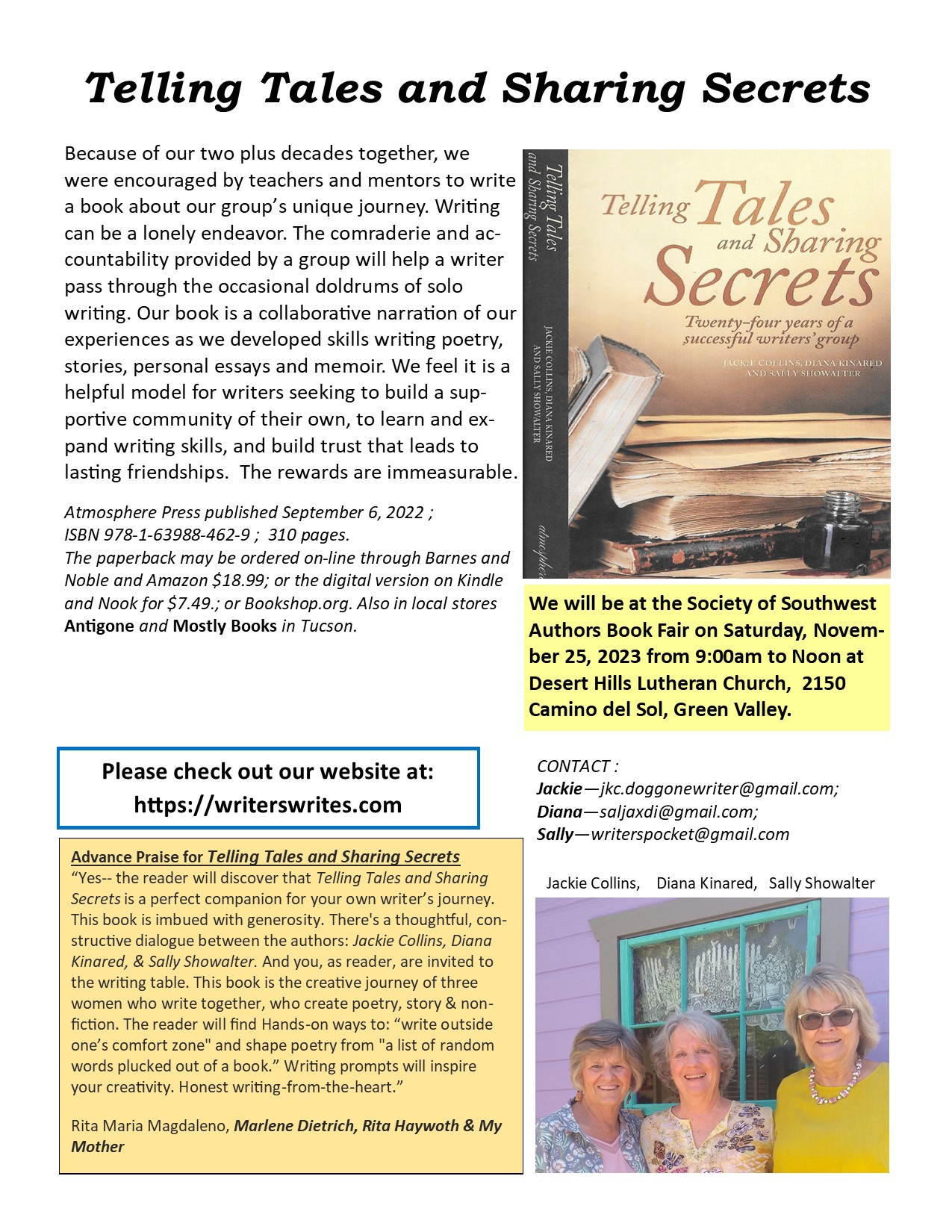
Our writers’ group published a book a year ago, Telling Tales and Sharing Secrets, about the fun and challenges of being a writers’ group. It is a collaborative memoir that spans two-plus decades of friendship and writing. Besides being a memoir, our book includes prompt ideas, tips to keep a group together, stories, poems, and essays by the three of us. This coming Saturday, November 25, Sally and I will be at the Society of Southwest Authors Book Fair to meet and greet, sell, and autograph books. Previously we were invited to participate in the Tucson Festival of Books last March 2023. It was fun talking with folks who read our book, learning how they used our tips with their groups. We get a big kick out of sharing our story and encouraging other writers to start support groups like ours that will further their writing goals. The third member of our writing trio lives in Colorado and is not able to be with us this time. If you are in the Tucson vicinity, please come join us at Desert Hills Lutheran Church in Green Valley between 9 am and noon. There will be other local writers with a variety of books to sell. Below is a link to our book on Amazon and Barnes and Noble. It can be purchased digitally or in paperback.

Odyssey of the Mind

Odyssey: A long and adventurous journey or experience.

Homer wrote the epic poem The Odyssey 700 years before Christ was born. Poor Odysseus is beset by many challenges as he wends his way home after the Trojan Wars. The theme of a hero’s homeward journey of discovery has been reimagined many times since Homer. James Joyce echoed the themes as his hero Ulysses negotiated life in Dublin at the turn of the 20th Century. The Cohen Brothers rewrote the story in their film O Brother Where Art Thou? in the year 2000. Themes from the story have been reworked many times.

Our family experienced an odyssey for fourteen months, driving across the U.S. in 1984-1985, an adventure of a lifetime. I wrote a little about that trip in my blog post Technology for the Baby Boomer. Our grandson, born twenty-three years later, led me into another Odyssey. He came home from kindergarten one day and told his mother he wanted to join a group called Odyssey of the Mind. She asked what it was, and he told her there was a meeting of parents to learn about it that he wanted her to attend. She enlisted Ken and I to go along. A teacher from school explained the program which is an annual international problem-solving tournament for kids from kindergarten through college. They compete according to grade level. At last count, twenty-five countries participate.

The motto of OM is that for every problem, there is a solution. They believe learning should be fun and that there are always new uses for old items. The idea is to encourage creative problem-solving. The simplest explanation of the program is that each year, there are five categories of challenges issued by the International Odyssey of the Mind Association. Within each category are six problems to be solved. A team of five to seven kids chooses their problem and they work from October to February to come up with a solution that is presented to judges in late February at the first of three competitions. Teams are created by an Odyssey coordinator at the school. Team meetings are as often as the coach and kids decide, generally starting at once a week and becoming almost daily toward the end of the five months. In that time the kids conceive a solution to the problem they choose, create a script/story to explain their solution, each team member assumes a role, makes their own costumes and props, create a set that can be constructed on stage within perimeters set by the rules, and present the solution to the judges in an eight-minute skit. Easy? Not so much.

Power tools

Adults are not allowed to assist in ANY portion of the process. Teams are penalized if a mom or coach even brushes someone’s hair before the performance. Any suggestion is automatically discarded if it comes from someone outside the team. The team takes great pride in not sharing their story or their work with anyone until the dress rehearsal when families are invited to preview their performance. In elementary school, the costumes were cobbled together with items found at Goodwill or in the back of closets. Tape, glue, and staples were used in the construction of costumes since none of the kids could sew. An adult is allowed to show the team how to use certain tools. Ken helped them learn how to use power tools safely, but we could only watch as they used them.

A coach’s job is to guide the kids, not with ideas, but with questions such as “what if…? How would you make or do that? How could you tell that story? How can you adapt an item or make something to do that job? How can you make that funny or more interesting?” The adult coach may NOT offer solutions during the creative process, only guidance in following the rules of the program. There is a whole book of rules aimed at keeping competition fair. As the team starts developing their solution, the coach asks if they are on track to answer the problem and if the plan can be performed on a stage twelve feet by fifteen feet.  As I said, this is an international competition. It is judged at a world final in March of each year. Each team enters a local competition, then if they are chosen first or second place, they enter a state competition and finally, if they win, they are invited to the world competition where they meet teams from all over the globe who have won their divisions. A spontaneous competition is held on the same day as the skit competition. Each team is taken into a room without their coach and given a problem they must solve in ten minutes. That instant problem-solving skill is practiced throughout the year as the team works on their big presentation. Creative thinking, team building, and cooperative problem solving are skills that people need throughout their lives. Odyssey of the Mind builds great problem solvers.

Since our daughter was a single mom and full-time breadwinner, she did not have time to be a coach. Henry turned to me. “Grandma”, says he, “will you be a coach?” Can I turn down any request by my grandson?  So I became a coach. I jumped in with both feet, having no idea what I was doing or what I would learn along the way. I fell in love with the competition and with each one of my team members. I coached four different teams in four years through four very different problems. It was a true odyssey – a journey of discovery. One year, Henry did not participate so I volunteered as a judge at the local competition. I learned how very inventive young minds are. If adults are not directing them, the sky is the limit. Adult minds can put brakes on imagination. The kids come up with amazing, creative solutions, costumes, props, and backdrops on their own – beyond anything I could imagine.

A month before competition each year I was sure my team would not be able to complete their task because something was missing in their presentation. I felt they were sailing their ship right off the edge of the earth. I racked my brain for strategies to help them find their way from the brink and stood helplessly watching the disaster unfold. I read and reread the rules to them, asking them to reevaluate their presentation. Each year they continued to work diligently toward the goal. They didn’t seem to feel the pressure. I didn’t sleep the whole week before the competition, knowing how disappointed they would be to not complete their task after all the time spent on it. I was riddled with anxiety, reevaluating each step in their progress. Each year, they proved me wrong. They found a way to make it happen every time. They always surprised me. At the end of each competition, I was in awe of my team’s abilities. By the fourth year, I learned to relax and have complete confidence in the team.

Wonder Newcast: Alex, Liam, Henry, Ava, Molly, & Addison

In 2018 the team, Team Wonder, did a presentation taking the Alice in Wonderland story in a new direction. They created a newscast that included an interview with the White Rabbit and the Cheshire Cat. The question was who stole the Queen’s tarts with the flamingo as the hidden camera. They had a news anchor, an interviewer, the White Rabbit and Cheshire Cat, a flamingo, and a commercial pitchman selling Wonka bars. It was hilarious.

Team Wonder
Back: Coach Diana, Bethany Papajohn (Principal) Front: Emmy, Steven, Henry, Sierra, Zaylei and Peter

One year the team came in third in the OM local competition and didn’t get to go on to state. Their problem was to recreate Leonardo Da Vinci’s workshop and conceive a new invention Leonardo may have devised. Their story took place in two time periods, modern daand the 1400’s. They had so much fun with their skit they begged me to ask if they could present it to the school at an assembly. I asked the principal who said she would consider it. The auditorium had many uses. It was occupied most of each day. Assemblies were carefully scheduled, and it was near the end of the school year. Finally. the last week of school the principal agreed to let the team make the presentation. She said it would not be a mandatory assembly, so each teacher had discretion about bringing their classes. My team was over-the-moon excited. Ken and I hauled all the costumes, props, and set fixtures (mostly made of cardboard) to school. It had been two months since the OM competition, and they had not had a practice. We did one practice session before the assembly. I told them they might have only a few in the audience. As the auditorium began to fill we realized that most of the school came. I sat in the audience to watch not knowing how it would go after so much time passed. The team got on stage and recognized they were not bound by the eight-minute time limit. They began to riff and improvise on their skit. I looked at Ken in astonishment. They were having so much fun. The applause was loud, and the kids were in their glory. They may have been third in the official competition, but they won the hearts of their schoolmates.

Team Time Twister: Leonardo’s Workshop Emmy, Sierra, Zaylei, Steven, Henry, Oliver
Improv – creating the script
The Thinkerton Detective Agency

The last year that I coached, the team chose to solve the heretofore unsolved mystery of the Mary Celeste, a ship that was found in 1872 abandoned in the Atlantic without its crew, but otherwise intact with its cargo. What happened to the crew? They created the Thinkerton Detective Agency to investigate and find an answer. At the end of five months of hard work, the team presentation was timed at nine minutes. They tried and tried to do it faster, to get it shorter. No amount of magical thinking could change the clock. Teams are penalized for each second over eight minutes and it will generally take a team score out of contention. Dress rehearsal the night before competition was a calamity. My cousin, a school teacher, was visiting and watched the preview. She shook her head and looked at me. “How are they going to get this together?” I just smiled knowing that somehow they’d pull it off. I won’t say there weren’t tremors in my gut, but I had learned to ignore them. Early on the morning of competition, we gathered at the high school where judging took place, and they went over their skit in the parking lot – still over time. Right then and there they decided what to take out. They improvised a new script, they practiced twice, and it came in under eight minutes. They presented their improvised story at the competition. Of course, the judges would never know it was not the original script. At the beginning of their skit, a part of the backdrop/scenery broke, and they had to repair it on the fly. I caught my breath. They prepared in advance for mishaps by having extra parts, tape, scissors, and wire available on set. It was a true example of preparation and situational spontaneous problem solving just like MacGyver– exactly what Odyssey of the Mind teaches. Seamlessly, repairs were made and the skit continued without pause. They won the competition.

Our team was invited to the state competition. It was the beginning of covid and the tournament was in chaos because it is a hands-on, in-person event. Rules changed, everything changed, and the judging was to be by video. The team chose not to participate. They took their win and trophy for the school.

WINNERS! Back: Connor, Henry, Mandeep Front: Sierra, Emmy, Zaylei

I am forever grateful for the time I spent with all the children I coached in Odyssey of the Mind, they were my teachers.  I know each of them will be better equipped for their future after participating in OM, learning the tools of creative problem-solving.

I think of life as my soul’s odyssey through this earthly existence on its way home. We all have adventures and challenges along the way. At this point I can look back and see how very fortunate I am. My life has been fulfilling and good times are abundant, but I’ve come to realize that it is during the tumultuous times that the most valuable lessons are learned. No one gets out alive so enjoy the voyage and pay attention to the lighthouses along the way that guide you through rough seas and through the shoals.