The Wall

I have a tiny piece of it – The Wall. The wall whose demolition I thought signaled hope and the end of division. The wall that came down in Berlin on November 9, 1989. Unlike other days that are seared into memory with feelings of foreboding, like J.F. Kennedy’s assassination, Elvis’ death, M.L. King’s assassination, Bobby Kennedy’s assassination, 9-11, this was a day of global celebration. I very clearly remember where I was the day when hundreds of people smashed that wall to pieces. I watched the event on TV in a hotel while at a business conference with my husband, feeling a sense of gratitude and relief that the symbol of oppression was destroyed. A friend was in Berlin when it came down and brought a piece of it to me. I can’t recall who he was. His face and name are lost in the labyrinths of my mind. But I still have that remnant of the wall in a small, bejeweled keepsake box in the top drawer of my dresser. It used to sit in a tray on top of the dresser where I could see it every day, but my cats taught me that anything visible could easily become invisible if they decided to swipe it; especially a small thing even if it represents a much bigger thing.

The Berlin Wall separated families physically by only a few feet but by deep canyons of ideology. We are still in that place. Walls are taken down only to have other walls built. Walls have been built forever – to keep people in as the Berlin wall, and to keep people out as the wall being built on our southern border, and the Great Wall of China that was designed in the 7th century BCE to keep out the invading Mongol hordes. People crash through walls at their own peril when what is on the other side is perceived to be more enticing than what is on their side. The world has been crashing our borders to get into a country that is labeled by some as racist, homophobic, oppressive, and discriminatory. The rapidly eroding American Dream. It is a country many still believe is better than what they left. Some European countries are attacked with the same fervor.

Humans build walls. That’s what we do. It is a conundrum. We build walls but we don’t like walls, so we tear them down. We surround our property, farms, ranches, and suburban plots with walls or fences. Office spaces are defined by boundaries. Even the homeless mark out their plots to squat. What is that all about?

I am not naïve as I once was, believing we could all live together in peace and harmony if we would only try. Seventy-odd years of life swept that dream away. Sorry Martin Luther King. In the timeless myth of King Arthur, the king explained that when Merlin, the wizard, turned him into a bird, he flew high above the land and could not see where one county ended and another began because the earth doesn’t designate boundaries, only people do. John Lennon wrote about a world without boundaries in the song Imagine. “Imagine no countries, it isn’t hard to do. Nothing to kill or die for and no religion too.” A world to wish for but, despite our rhetoric, that is not what human beings do. It’s sad but it is human nature. In the words of another King, Rodney, who in 1992 survived a brutal police beating and subsequent riots in his name, “Can’t we all just get along?”

I can only do what I can do to make others feel welcome and accepted provided they do not threaten me with harm. Their religion, nationality, sexual proclivities, or political beliefs are of no interest to me if they are friendly and interesting to talk with. I confess I have a wall around my backyard too. It keeps out the deer, javelina, and coyotes who have not yet figured out how to open the gate. The bobcats and quail, however, jump the wall and the bunnies squeeze through the weepholes. I’m okay with that. We live in harmony.

Odyssey of the Mind

Odyssey: A long and adventurous journey or experience.

Homer wrote the epic poem The Odyssey 700 years before Christ was born. Poor Odysseus is beset by many challenges as he wends his way home after the Trojan Wars. The theme of a hero’s homeward journey of discovery has been reimagined many times since Homer. James Joyce echoed the themes as his hero Ulysses negotiated life in Dublin at the turn of the 20th Century. The Cohen Brothers rewrote the story in their film O Brother Where Art Thou? in the year 2000. Themes from the story have been reworked many times.

Our family experienced an odyssey for fourteen months, driving across the U.S. in 1984-1985, an adventure of a lifetime. I wrote a little about that trip in my blog post Technology for the Baby Boomer. Our grandson, born twenty-three years later, led me into another Odyssey. He came home from kindergarten one day and told his mother he wanted to join a group called Odyssey of the Mind. She asked what it was, and he told her there was a meeting of parents to learn about it that he wanted her to attend. She enlisted Ken and I to go along. A teacher from school explained the program which is an annual international problem-solving tournament for kids from kindergarten through college. They compete according to grade level. At last count, twenty-five countries participate.

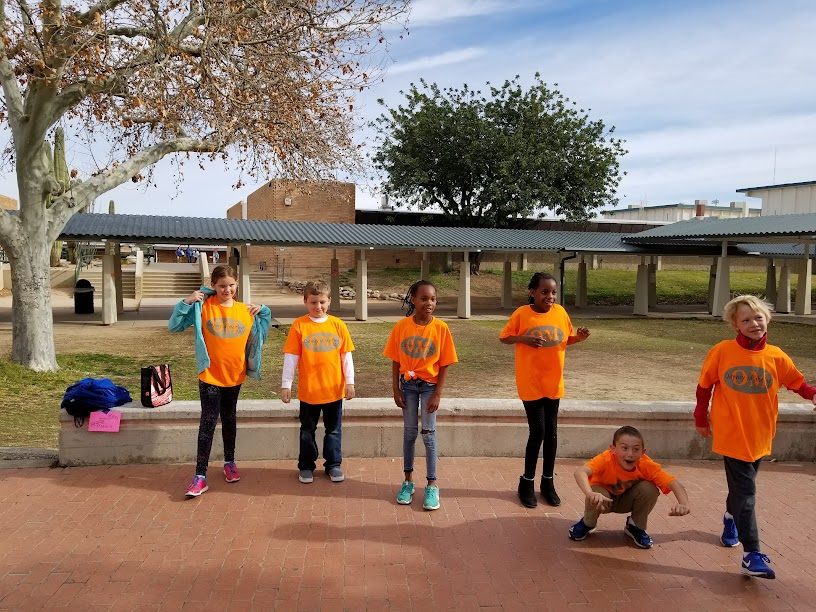
The motto of OM is that for every problem, there is a solution. They believe learning should be fun and that there are always new uses for old items. The idea is to encourage creative problem-solving. The simplest explanation of the program is that each year, there are five categories of challenges issued by the International Odyssey of the Mind Association. Within each category are six problems to be solved. A team of five to seven kids chooses their problem and they work from October to February to come up with a solution that is presented to judges in late February at the first of three competitions. Teams are created by an Odyssey coordinator at the school. Team meetings are as often as the coach and kids decide, generally starting at once a week and becoming almost daily toward the end of the five months. In that time the kids conceive a solution to the problem they choose, create a script/story to explain their solution, each team member assumes a role, makes their own costumes and props, create a set that can be constructed on stage within perimeters set by the rules, and present the solution to the judges in an eight-minute skit. Easy? Not so much.

Power tools

Adults are not allowed to assist in ANY portion of the process. Teams are penalized if a mom or coach even brushes someone’s hair before the performance. Any suggestion is automatically discarded if it comes from someone outside the team. The team takes great pride in not sharing their story or their work with anyone until the dress rehearsal when families are invited to preview their performance. In elementary school, the costumes were cobbled together with items found at Goodwill or in the back of closets. Tape, glue, and staples were used in the construction of costumes since none of the kids could sew. An adult is allowed to show the team how to use certain tools. Ken helped them learn how to use power tools safely, but we could only watch as they used them.

A coach’s job is to guide the kids, not with ideas, but with questions such as “what if…? How would you make or do that? How could you tell that story? How can you adapt an item or make something to do that job? How can you make that funny or more interesting?” The adult coach may NOT offer solutions during the creative process, only guidance in following the rules of the program. There is a whole book of rules aimed at keeping competition fair. As the team starts developing their solution, the coach asks if they are on track to answer the problem and if the plan can be performed on a stage twelve feet by fifteen feet.  As I said, this is an international competition. It is judged at a world final in March of each year. Each team enters a local competition, then if they are chosen first or second place, they enter a state competition and finally, if they win, they are invited to the world competition where they meet teams from all over the globe who have won their divisions. A spontaneous competition is held on the same day as the skit competition. Each team is taken into a room without their coach and given a problem they must solve in ten minutes. That instant problem-solving skill is practiced throughout the year as the team works on their big presentation. Creative thinking, team building, and cooperative problem solving are skills that people need throughout their lives. Odyssey of the Mind builds great problem solvers.

Since our daughter was a single mom and full-time breadwinner, she did not have time to be a coach. Henry turned to me. “Grandma”, says he, “will you be a coach?” Can I turn down any request by my grandson?  So I became a coach. I jumped in with both feet, having no idea what I was doing or what I would learn along the way. I fell in love with the competition and with each one of my team members. I coached four different teams in four years through four very different problems. It was a true odyssey – a journey of discovery. One year, Henry did not participate so I volunteered as a judge at the local competition. I learned how very inventive young minds are. If adults are not directing them, the sky is the limit. Adult minds can put brakes on imagination. The kids come up with amazing, creative solutions, costumes, props, and backdrops on their own – beyond anything I could imagine.

A month before competition each year I was sure my team would not be able to complete their task because something was missing in their presentation. I felt they were sailing their ship right off the edge of the earth. I racked my brain for strategies to help them find their way from the brink and stood helplessly watching the disaster unfold. I read and reread the rules to them, asking them to reevaluate their presentation. Each year they continued to work diligently toward the goal. They didn’t seem to feel the pressure. I didn’t sleep the whole week before the competition, knowing how disappointed they would be to not complete their task after all the time spent on it. I was riddled with anxiety, reevaluating each step in their progress. Each year, they proved me wrong. They found a way to make it happen every time. They always surprised me. At the end of each competition, I was in awe of my team’s abilities. By the fourth year, I learned to relax and have complete confidence in the team.

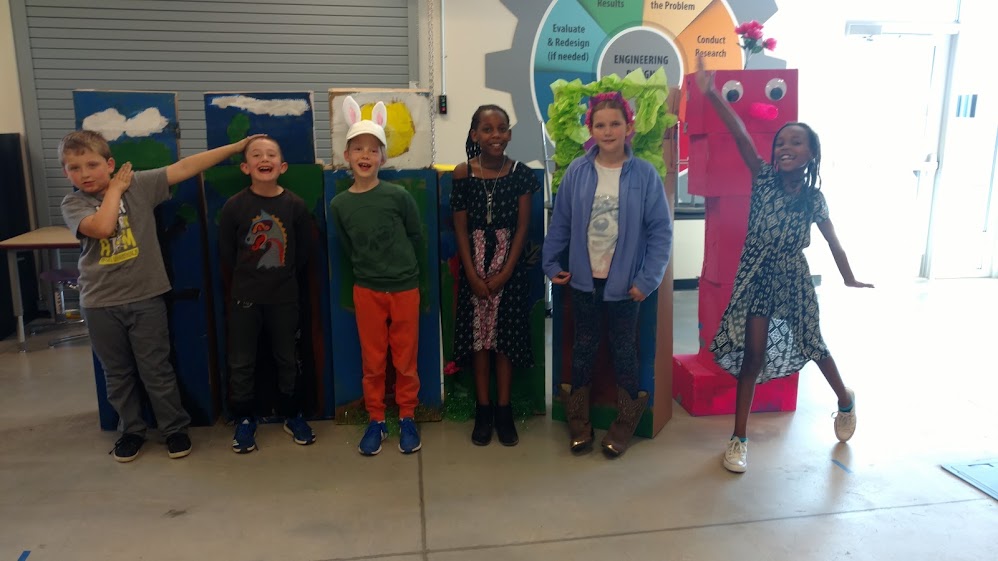
Wonder Newcast: Alex, Liam, Henry, Ava, Molly, & Addison

In 2018 the team, Team Wonder, did a presentation taking the Alice in Wonderland story in a new direction. They created a newscast that included an interview with the White Rabbit and the Cheshire Cat. The question was who stole the Queen’s tarts with the flamingo as the hidden camera. They had a news anchor, an interviewer, the White Rabbit and Cheshire Cat, a flamingo, and a commercial pitchman selling Wonka bars. It was hilarious.

Team Wonder
Back: Coach Diana, Bethany Papajohn (Principal) Front: Emmy, Steven, Henry, Sierra, Zaylei and Peter

One year the team came in third in the OM local competition and didn’t get to go on to state. Their problem was to recreate Leonardo Da Vinci’s workshop and conceive a new invention Leonardo may have devised. Their story took place in two time periods, modern daand the 1400’s. They had so much fun with their skit they begged me to ask if they could present it to the school at an assembly. I asked the principal who said she would consider it. The auditorium had many uses. It was occupied most of each day. Assemblies were carefully scheduled, and it was near the end of the school year. Finally. the last week of school the principal agreed to let the team make the presentation. She said it would not be a mandatory assembly, so each teacher had discretion about bringing their classes. My team was over-the-moon excited. Ken and I hauled all the costumes, props, and set fixtures (mostly made of cardboard) to school. It had been two months since the OM competition, and they had not had a practice. We did one practice session before the assembly. I told them they might have only a few in the audience. As the auditorium began to fill we realized that most of the school came. I sat in the audience to watch not knowing how it would go after so much time passed. The team got on stage and recognized they were not bound by the eight-minute time limit. They began to riff and improvise on their skit. I looked at Ken in astonishment. They were having so much fun. The applause was loud, and the kids were in their glory. They may have been third in the official competition, but they won the hearts of their schoolmates.

Team Time Twister: Leonardo’s Workshop Emmy, Sierra, Zaylei, Steven, Henry, Oliver
Improv – creating the script
The Thinkerton Detective Agency

The last year that I coached, the team chose to solve the heretofore unsolved mystery of the Mary Celeste, a ship that was found in 1872 abandoned in the Atlantic without its crew, but otherwise intact with its cargo. What happened to the crew? They created the Thinkerton Detective Agency to investigate and find an answer. At the end of five months of hard work, the team presentation was timed at nine minutes. They tried and tried to do it faster, to get it shorter. No amount of magical thinking could change the clock. Teams are penalized for each second over eight minutes and it will generally take a team score out of contention. Dress rehearsal the night before competition was a calamity. My cousin, a school teacher, was visiting and watched the preview. She shook her head and looked at me. “How are they going to get this together?” I just smiled knowing that somehow they’d pull it off. I won’t say there weren’t tremors in my gut, but I had learned to ignore them. Early on the morning of competition, we gathered at the high school where judging took place, and they went over their skit in the parking lot – still over time. Right then and there they decided what to take out. They improvised a new script, they practiced twice, and it came in under eight minutes. They presented their improvised story at the competition. Of course, the judges would never know it was not the original script. At the beginning of their skit, a part of the backdrop/scenery broke, and they had to repair it on the fly. I caught my breath. They prepared in advance for mishaps by having extra parts, tape, scissors, and wire available on set. It was a true example of preparation and situational spontaneous problem solving just like MacGyver– exactly what Odyssey of the Mind teaches. Seamlessly, repairs were made and the skit continued without pause. They won the competition.

Our team was invited to the state competition. It was the beginning of covid and the tournament was in chaos because it is a hands-on, in-person event. Rules changed, everything changed, and the judging was to be by video. The team chose not to participate. They took their win and trophy for the school.

WINNERS! Back: Connor, Henry, Mandeep Front: Sierra, Emmy, Zaylei

I am forever grateful for the time I spent with all the children I coached in Odyssey of the Mind, they were my teachers.  I know each of them will be better equipped for their future after participating in OM, learning the tools of creative problem-solving.

I think of life as my soul’s odyssey through this earthly existence on its way home. We all have adventures and challenges along the way. At this point I can look back and see how very fortunate I am. My life has been fulfilling and good times are abundant, but I’ve come to realize that it is during the tumultuous times that the most valuable lessons are learned. No one gets out alive so enjoy the voyage and pay attention to the lighthouses along the way that guide you through rough seas and through the shoals.

Technology for a Baby Boomer

Here I am after more than three-quarters of a century looking back at some of the changes that occurred during that lifetime. The biggest technical change is the explosion of personal data devices. I did not get a cell phone until about twenty years ago. I was one of those people who said, “I’ll NEVER have a cell phone!!” I considered them an intrusion. I resisted and resisted. Then it became obvious that a cell phone was a necessary accompaniment to my daily lifestyle.

At the time my mother had moved to Tucson and was in need of close attention. She lived on her own but was in her 80s and had moved from the town where she lived for most of her life, away from lifelong friends and familiar places. She needed contact not only for personal needs and information about how to get around a new town, but also for company. My work took me out of the office, so I was not always available by landline. I believed she would find friends fairly quickly but, in the meantime, I was her social link, her sounding board, her complaint department, her connection to the world.

I discovered I needed a cell phone for business. Ken and I had just started a property management and real estate company and the need for quick exchanges of information became evident. So there I was, a new and reluctant cell phone user.

Looking way back…In the mid-1980s my family of three teenagers, two dogs, my husband and I, left our home in Bellevue Washington to travel the country. We journeyed through the forty-eight contiguous states plus a couple of Canadian Provinces and Mexican states for fourteen months. We took two of our kids out of high school (the third had just graduated). They wanted to keep up their studies while traveling so they could stay up in grade with their friends when we returned. That was accomplished with a study program coordinated by the University of Missouri and Bellevue High School. Correspondence courses were mailed (years before email) to us by the University and then back to the University as they completed each section and results were reported to their high school. All communication was by public phone in phone booths across the country and by mail, snail mail. Lots of postage. We had no cell phone and no computer. We were off the grid so to speak. Amazingly they were able to complete their studies in English, History, Math, and Social Studies – the basics, while learning firsthand about our beautiful country, its regions, its national parks, its varied cultures and languages (English has many nuances), history and geography. We took advantage of public libraries and museums along the way. Being teenagers imprisoned with their parents 24/7 for fourteen months, traveling in a van, living in a travel trailer, was indeed a sentence few would volunteer for. The only “device” they had for entertainment were Walkman cassette players with earphones. Those were revolutionary in that time. It was their means of escape into personal head space. I must give them all credit for their stalwart determination to survive. I’m sure it felt to them akin to traveling by covered wagon across the country. We crisscrossed the country from sea to shining sea four times in our quest to visit every state. How did we manage without a cell phone, GPS, the internet?

My how times have changed. Now the idea of leaving my house without a fully charged cell phone makes me quake with anxiety. What if something breaks down, what if my (fill in the blank) _________, husband, friend, daughter, grandson, needs to talk to me, an emergency, what if I get lost and need direction? What if, what if, what if?  I can hardly believe the intense change from being a NEVER-CELLPHONER to being a NEVER-BE- WITHOUT-A-CELLPHONER.

Technology has certainly changed my life. For better?

Autumn – a seasonal complaint

I am the ONLY person I know who does not sing the praises of Autumn. All my friends look forward to the cessation of our desert heat when the humidity drops to single digits. They express endless gratitude for the crisp cool air and colors of fall. Me – not so much. Each season does have good points, but for me the darkening of days, the cooling air, the descent into winter does not herald a positive trend.

Along with this is the churning of time. I don’t mean the minutes that ebb from my life, a steady drip into the bucket of forever. I’m talking about the changing of clocks. One reason I love Arizona is that this state did not get sucked into the folly of daylight “savings” time. Our clocks remain the same through all the months of the year. However, because everyone else in the U.S. changes time, I must remember which time zone they have switched to. Annoying. I’m sure someone sometime had a savvy presentation with charts and graphs to justify the idea. But as a wise old Native American was once credited with saying: “Only a white man would cut two inches off the bottom of his blanket and sew it to the top and think the blanket is longer”. That sums up the ridiculousness of daylight-saving time. What are we saving? Which bank is it in? Can we spend it when we really need it? Daylight is one of nature’s gifts and follows the tilt of the sun and earth according to seasons, not a man-made device. No matter how you slice it we have the same amount of daylight. It is shorter in the winter in the northern hemisphere and longer in the summer, but the number of hours can’t be expanded by moving the hands of a clock.

I am a warm-weather sunshine person. My husband agreed to move to Tucson so I could warm up after living forty years in the Pacific Northwest in a constant state of chill and I don’t mean the trendy kind. We’ve lived here twenty-seven years so I’m beginning to thaw. However, when temperatures dip below 80°, I put on long underwear. No kidding, even in Tucson – you can ask my husband. I get frosty to the bone very easily. No, it is not a medical condition, it is a mental condition. Thankfully the sun shines here most of the time in all seasons thus providing us, the cold-blooded creatures, with a modicum of warmth during each day. Darkness does not overtake us as it did in Seattle.

In the Pacific Northwest, fall and winter are not only colder and wetter than summer, they are also darker. Daylight is barely nine hours. We got up in the dark and came home from work in the dark. Dull skies muffled in blankets of gray clouds during what was said to be daylight hours did not allow a smidge of sun to peek through. Sunshine was as rare as a Corbin Carroll home run in the 2023 World Series. Depression – your name is Seattle winter.  

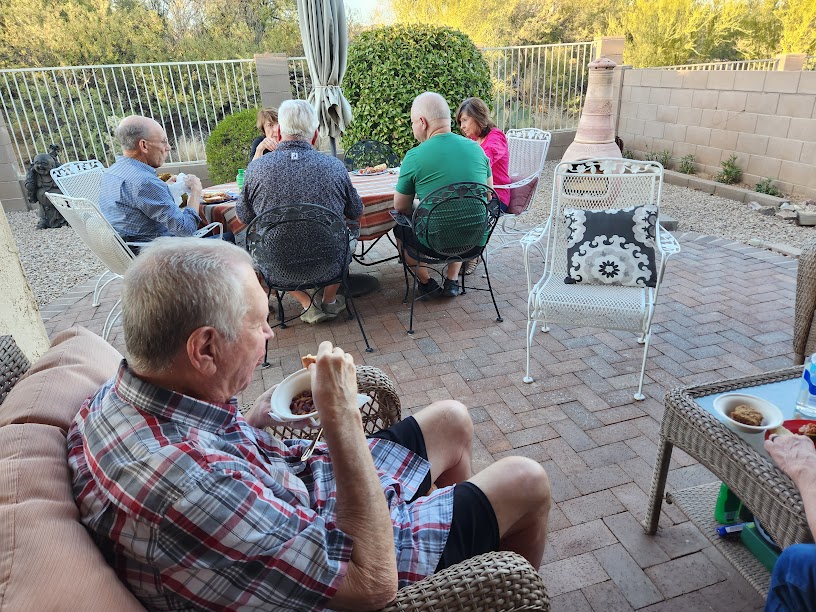
Thanksgiving is my favorite holiday so that is the plus for Autumn.  In Tucson, we serve our big Thanksgiving meal about 4:00 on the patio. We usually have twelve or more family and friends join us. The doors stay open and people go in and out. Turkey is cooked on the barbeque and all the trimmings are set out on the counter so the hungry can help themselves. They choose to sit inside in the dining room or out on the patio tables. Most often outside is favored. After dinner (when the sun retires leaving a beautiful sunset) we put on a sweater or light jacket to sit outside with a glass of wine and good conversation and watch the stars blink on. We build a fire in the chimenea for atmosphere. It is a beautiful celebration with friends. The weather doesn’t cooperate one out of four years. Then we serve dinner inside just like those unfortunate people who don’t live in the Sonoran Desert.

It Isn’t Lost !

I have volumes of stories about my children and some of their friends as they encountered life in their first years. One of my favorites is about our middle child, our second daughter, the quiet one.

Shari attended morning kindergarten at the elementary school around the corner from our house. Our backyard abutted the playfield. After school she would come home for lunch and tell about her day. Several times a week my husband came home for lunch also. His office was not far from our house and he liked to spend lunchtime with Shari, our three-year-old son Casey, and me. On this particular day in October, Shari’s class went to a pumpkin patch. Each child was to bring a quarter to buy a pumpkin to bring home. Shari arrived home without a pumpkin. Ken arrived at the same time, and this was their exchange.

“Hey Shar, did you have fun at the pumpkin patch?”

“Yes Daddy, I saw lots and lots of biiiiiig punkins.”

“Did you bring one home?”

“Nope. I didn’t have my quarter.”

Ken made sure she had a quarter before he left for work that morning.

“You lost your quarter?”

“No. I didn’t have it.”

“I gave you a quarter this morning.”

“I know Daddy, but I didn’t have it to buy the punkin.”

“You lost your quarter,” he said.

“No.”

“If I gave you a quarter and you didn’t have it, you lost it.”

“No, I DIDN’T lose it.” she said with emphasis.

“Do you still have it?”

“No.”

“Then it is lost.”

“It isn’t lost. I know ‘xactly where it is. It fell between the bus seat and the bus wall. I know where it is, but I can’t get it. It ISN’T lost.”

Case closed. No quarter, no pumpkin but the quarter is NOT lost. I was sure she would grow up to be Clarence Darrow. Her logic was flawless; her argument, decisive. Even her daddy could not shake her. She knew what lost meant and she didn’t waiver.

I am entranced by little people. Any child between birth and eight years old, I find enchanting. I can spend hours watching and talking with them. At one time I wanted to be a second-grade teacher like Miss Jones, with whom I felt a special rapport. Instead, I became a mother. Although those years between birth and eight didn’t last as long with my own children as they would have with year after year of new students in school, I thoroughly enjoyed those times. After the age of eight, children are lured into our larger social structure through school and activities, and they lose that innocent view of the world. Much of the awe is exchanged for a comfort with the reality around them.

I am so privileged to have been a stay-at-home mom. I was able to experience the day-to-day wonder as each child began their journey. Now I think it is a rare privilege. It seems that mothers these days are required to work outside the home for financial reasons or choose to do so because of career choices.

My own mother was a working mom, through choice as much as necessity. I resented that for many years even though I know what she sacrificed to keep both sides of her life humming along. I wanted her to be home with me as all the other kids had their moms at home. My parents did their very best to provide in-home daycare for me. I never went to an outside babysitter or daycare center. Even though I had terrific nannies who I remember with fondness, it still wasn’t Mom. My husband and I agreed that when we had children, I would be home with them. He often worked two jobs to make sure we could provide that lifestyle. Thus, I was able to be a part of those special moments in each child’s life. Many I recorded in journals and many more I have probably forgotten but the echo of that special time remains.

Then and Now – Perspectives of War

Erica began to tremble. I was seated next to her at our table on the restaurant patio. It was a beautiful spring Tucson day in 2018. We were having lunch at a popular restaurant with three other women volunteers from the hospital surgery center. I noticed a flash of unease cross her face.

“Erica, are you all right?”

“It’s nothing,” she replied.

“You were trembling just now. Are you cold?”

“No, it is an old body memory that I can’t stop.”

“Body memory of what?”

“The war,” she said. “I start shaking when I hear a plane overhead.” 

I hadn’t even noticed the sound but did hear it faintly as the plane flew away.

A native of Germany, Erica emigrated to the US with her husband in the 1950s. They established a business and home in the Midwest and raised their son as an American citizen.  Erica was a widow, now in her mid-eighties. I knew that much of her story. She volunteered one morning a week at the surgery center of our local hospital, as did I. We occasionally had lunch together. I liked hearing about the customs and recipes she brought from Germany. She made luscious baked goods to share with hospital staff. I enjoyed her wit and positive attitude – always available to help someone.

At lunch that day we talked more about her experiences growing up in a small village in central Germany. During WWII, Allied bombing raids passed over their farm on their way to targets unknown by those on the ground. Bombs were dropped on nearby towns. If she was outside she would run to shelter fearing death from the sky at any moment. The imprint of terror stayed with Erica from the time she was nine or ten throughout her long life in the United States. A teenage brother was killed in one of the bombings, wrong time, wrong place. Even with the lasting repercussions of war for her and her family, Erica had no animus against the men who “did their duty”, or the country that directed those bombers. She was taken in as an immigrant and her family thrived here. She had nothing but gratitude to the U.S.

Many times, I read my father’s journal of his twenty-eight bombing missions during WWII from December 1943 through July 1944. He was the waist gunner on the plane that led the entire Eighth Air Force in the invasion of Normandy on zero day – D-Day June 6, 1944. Unlike bombs dropped on Warsaw, Helsinki, Hamberg, Nagasaki, Hiroshima, London, and Stalingrad that killed thousands of citizens of those cities, none of the bombing raids by his crew were directed at civilian populations. Their targets were strategic military installations and industrial war factories. Of course, civilians were in those places as well, but residential areas were not the focus according to his journal entries.

Dad’s plane, The Red Ass

My dad never talked about his wartime experiences, and I didn’t find out about them until many years after he died at the age of fifty-two. I was proud of his part in securing victory over the Axis Powers in Europe. Never once did I consider the fear that must have sprouted and flourished in the psyche of those helpless folks on the ground who heard the giant purveyors of doom swooping in overhead. They experienced daily the trauma of the unknown – would it be their town or farm this time?

Talking with Erica gave me an entirely different perspective on what war was like for the nameless faceless people who had to endure the decisions made by the powerful. Even after more than seventy years, Erica still visibly trembled at the sound of an airplane overheard. Truly innocent human beings, who wanted to live with their families in peace, became victims of war. A war that had to be endured in the best way possible to survive. It became very personal and was made vivid to me because of her stories. My pride in my dad is tempered by the realization of the physical and psychological damage inflicted even without dropping a bomb. The weapon is terror.

I’m left with the unanswerable question. Why do human beings war with each other?  There has not been a time in recorded history that we have not had wars somewhere. Even oral traditions celebrate war and victories over enemies.  Our instinctive tribal nature divides us. The reach for power continues to exploit that instinct. When will we learn? As the song says, “There is no profit in peace.” 1  Until unelected oligarchs in our country and around the world, who wield the cudgel of dominance behind the scenes with endless supplies of money, cede power (not likely), or are ousted from power, war is inevitable. George Orwell described in his novel, 1984, how a small minority benefits from war and must keep the general populace dumbed down and compliant by force and fear. Is that the purpose of continuing to divide and segment us by our differences rather than uniting us in our common humanity? Hmmmm. That is the moral question.

  1. Profit in Peace by Ocean Colour Scene

Thursday is Tuesday?

I know it is probably one of those “age” symptoms. It could also be related to the fact of retirement when weekdays don’t have the same definition as when I was employed or with kids in school. I believe many retired people can relate. However, I think more than anything there is a missing cog in my brain.  I have trouble keeping days of the week in their proper sequence, time in steady check, and my location relative to my destination.

Thursday is designated clean-up day at our house. I was sitting on the patio enjoying this beautiful morning unfold at sunrise, watching the birds and having my tea thinking of the quiet day ahead and Ken said, “We better get started for our walk. I want to get back so I can get the vacuuming done early.”  

Clean up? Today? It’s Thursday again? I was thinking it was Tuesday. What happened to Tuesday? Oh, yeah – it was a busy day and flew by very quickly. Then Wednesday happened and here we are at Thursday with things to do and dinner plans with friends.

I wrote a post last November about weekends. In it I wrote about the dowager Countess on Downton Abbey played so brilliantly by Maggie Smith. The family was having a discussion about the weekend and she piped up, “Weekend? What is a weekend?” Of course, in her world each day had its own significance related to social duties, but they were not put in categories of weekday and weekend days. Days were all the same – another day. I’m not a countess and I struggled to manage life within those weekday boundaries, but I slipped those bonds since retirement.

Ever since I can remember, I have had a tenuous relationship with time and space, so keeping track of days, times, and place are a challenge for me. Ken, who I labeled Steady Eddie in an earlier post, has always been my tether to those things that are assigned the when and where in our life. He reminds me of earthbound values that I easily forget in my spacey way. He likes to be places early and I am apt to be late. Between us we are usually on time. He knows the directions to every place he has gone before and magically knows how to find his way to destinations he’s never been to before. It is difficult for me to find my way out of our cul-de-sac. You can ask any/all of my friends and family who fall into two categories. They either laugh with me being lost or late, or they get very annoyed. Fortunately, we laugh – a lot. If I am the designated driver, I always need a co-pilot to navigate even to places with which I am familiar or I will most definitely be late.

So here we are at Thursday. I did enjoy Tuesday; and, Wednesday was a quiet day, reading and writing. Tomorrow, I have an appointment mid-day that Ken won’t let me forget. It will be Friday.

Things That Matter

Originally posted on A Way with Words blog

In the hustle bustle of our everyday life, we lose sight of things that matter, even if they are right in front of us.  I was attempting to clean up my office area in the library/cat grotto. It is one of those tasks that never really ends, just begins – again and again. I get it mostly done then find something I meant to read or something I want to ponder or write and there goes an hour or two. By the time I’ve come back to the task, I’ve lost momentum and the remaining mess is shuffled to a corner until tomorrow or mañana, whichever comes first.

Along the way, I rediscover treasures. They are treasures of the heart. Part of the beauty of having a special place of my own to write, read, and think is that I surround myself with what my husband calls stuff. Photos, cherished books, posters, artwork, and objets d’art that have meaning for me. If piled all together they wouldn’t have the market value of a head of lettuce.

On the wall above my desk is a homemade birthday card from my grandson when he was eight or nine. Homemade in every respect. He made the paper and then printed the greeting on it. It reads Happy Birthday Grandma. You have a heart of pure – there he glued some gold fragments in the middle of the paper. It is signed Love Henry. There is no currency that can equal the value of that piece of handmade paper.  

On the wall next to it is one of Ben’s Bells that I found one evening when I was out with friends. It is a pay-it-forward symbol of intentional kindness. The story behind it is of a two-year-old boy who died suddenly in 2002. His grieving mother and family began making ceramic wind chimes to heal their grief. They were joined by others who helped. Four hundred bells were made and distributed around Tucson in random places on the first anniversary of Ben’s death. The one I found was hanging on a tree branch in a restaurant parking lot – it says “Be Kind”. Thousands of people joined the effort to make and distribute the bells. The movement grew as a non-profit educational program of kindness in schools and businesses all over the world. Every school I’ve been to around Oro Valley has a kindness program with the Ben’s Bells logo at the center of it. The green Be Kind symbol is displayed on school walls as a reminder. Awards are given at the end of the year to students who have displayed kindness toward others.

Those are just a couple of items that make my fortune more valuable than gems, or gold, or silver.

The Sound of Freedom

Originally posted on A Way with Words blog

Several days before July 4th we were invited by dear neighbors to attend a showing of the movie, The Sound of Freedom, with them on our nation’s birthday. It is not a movie I considered attending had Suzanne not extended the offer. I avoid TV shows and movies with violent topics in order to save my peace of mind. It is not that I am unaware of the terrible scourge of human trafficking, it’s that I feel helpless to do anything so prefer to bury my head in my pillow and dream sweet dreams. This movie gave me hope and a way to help. It is well done with no gratuitous scenes that make you turn your head away.

I did not know that the movie is the true story of an American hero. It is a genuine heart-thumping thriller, the story of a necklace that connects two children with their rescuer. I am so very glad I went and extremely happy to tell everyone I meet to see the movie. It is an amazing story and one that should be shouted from the mountaintops.

The movie was written and directed by Alejandro Monteverde. I read that it surpassed Indiana Jones on July 4th at the box office, with $14.2 million for Freedom vs $11.6 million for Indie. It was an uphill battle to get the movie made and distributed. It was dropped by 20th Century Fox and Disney Studios and finally taken up by Angel Studios. It took more than ten years to get the movie to the public. It has been virtually ignored by the press and main media outlets.

Quote from Jim Caviezel who portrays Tim Ballard in The Sound of Freedom.

“I want this to be so huge that they’re forced to look at this. I lost my agents over this. Yep, 17 years, 15 years. I lost my lawyer over this, and now I understand why all these actors didn’t want to do the movie because of this. Listen, you do Schindler’s List fifty years later, you’re a hero. Try doing Schindler’s List when the real Nazis are right there. Understand how that becomes more dangerous? I don’t understand why people are willing to let children be hurt, but in this time, Hollywood says, ‘No, no, let’s kick that down fifty years from now and then [see where we’re at]. That’s crap.”

The Nitty Gritty. There are 40.3 million trafficked persons globally today and 25% of them are children. * Sources: Child Liberation Foundation, International Labour Organization. Every year approximately 350,000 children are reported missing and an estimated 100,000 of them are being trafficked; reported in all 50 states. *Source: National Center for Missing and Exploited Children.  According to the 2021 Human Trafficking Report, 57% of human trafficked victims are minors. The U.S. is one of the top destinations for human trafficking and among the largest consumers of child sexploitation. Human trafficking is a $150 billion-per-year business, more than the NFL, NBA, MLB, and NHL combined. It has overwhelmed the illegal arms trade. The U.S. current border situation makes it even easier for children to be trafficked. God’s children are NOT for sale.

Tim says that he would not have been able to start O.U.R. if it wasn’t for the unwavering support of his wife Katherine. Actors Jim Caviezel and Mira Sorvino portray the couple in the movie.

Tim Ballard initially worked for the CIA for a year, then for twelve years as a special agent working at the border for the newly formed Department of Homeland Security. At one point he quit his job in order to complete his mission to save children. Without giving away the beautiful, tearful ending to the movie, I just want to say Tim Ballard is an American hero. At the time the movie was made, Tim and his wife Katherine were the parents of six children. Now they have nine, two of whom were adopted after Tim helped in their rescue. He and his wife founded an organization called O.U.R. – Operation Underground Railroad, a non-profit organization to search out and rescue children who are victims of this vicious global business that turns innocent children into commodities. If you go to their website, linked below, it tells how you can help. Stay until the very end of the movie to see photos of the real heroes and to download a QR code to participate in “pay-it-forward”, an opportunity to pay for someone who cannot afford to go to the movie. This movie needs to be seen by as many people as possible. It is a cautionary tale for parents and children. Not all their stories have happy endings as this one does (spoiler alert).

End Child Trafficking | Operation Underground Railroad (ourrescue.org).

Sound of Freedom vs. the True Story of Tim Ballard (historyvshollywood.com).

Fathers and Daughters

Originally posted on A Way with Words blog

I have written about memories of my dad. Although dead for over five decades, he is a constant in my life. As I contemplated what to write about this week, I read an essay and poem by Tom Chester. The essay was published yesterday on Father’s Day in the Arizona Daily Star. The poem is published on Tom’s website. I found both to be very moving and a fitting tribute to fathers on their special day.

Tom Chester

A Father’s Letter

On Father’s Day, people often write letters and essays about their own fathers. In contrast, I want to offer a father’s perspective in this letter to my two daughters.

To my daughters,

On this Father’s Day, I want to tell you how proud I am to be your father. While there is often a close relationship between fathers and daughters, I write this letter to tell you about ours, for after all, ours is special. There is much to say, but I want to avoid any temptation toward sentimentality. Our connection is better than that.

As I compose this letter, I think about my own father, dead now for three decades. I still have a letter from him, likely the only one he ever wrote to me. It is from the summer I turned 19 when I was working away from home for the first time. The letter is mundane, advice on the best route to take when I drove back after my job ended. Yet, it is one of the most intimate connections I still have with him. He exists now only in a few mementos like that letter, some occasional memories that arrive unexpectedly into my conscience, and glimpses of him when I look into a mirror.

Just as I see traces of my father in my features and my personality, so I see reflections of me in both of you. The similarities have been refracted enough by genetics, though, so that we are different in many ways. I wonder what memories you will have of me thirty years on. I am sure there will be brief scenes of family events and I hope thoughts about my values, my views on life, and my ideas on how to engage the world.

Perhaps those things matter little, however. Rather than consider my legacy to you, it seems more fitting to think about what you have given me and the ways you have changed me as a person. I am much different than I would have been had you two not come into my life. You have taught me much about myself, too much to describe in a short letter like this. You also have taught me about life itself. When you were born, you were totally dependent on me (and on your mom as well, of course). As you grew, you began to separate yourself from me, becoming your own persons until you finally broke away and started your own lives independent from mine. I increasingly realize that the process continues and will evolve until our roles will have completely reversed, and in my old age, I will likely become dependent upon you. Already I often seek your advice and help on things.

Being your father has been damned hard — not because of you but because of my emotional connection to you. Someone once wrote that having children means becoming a hostage to fate. Even though you are adults I am still a hostage because I understand clearly that well-being is tenuous and that the vagaries of fate swirl around to intrude without warning.

I know I have made many mistakes in raising you, as with all parents, but I did my best. Fortunately, you are resilient and have not suffered too much from the experience. Despite the temptations, I mostly have avoided giving you advice. I have come to realize that you know more about yourselves and your world than I, and that much of my advice would not apply. Moreover, I have made many errors by following my own advice, enough so that I want to avoid causing you to make mistakes in yours. Finally, I have tried to raise you to think for yourself, so my giving advice would be hypocritical.

It is common for a parent to say to a child, “I love you,” and I certainly feel that way toward you two. Just as important, though, is that I like you. I respect you and admire your character. I trust you with my wellbeing. I trust you with my life, too. As I age, I am comforted by the agreement I have with each of you that at the end of my life you will treat me like a beloved dog—keep me comfortable and if necessary when the time comes, have me put down. I know that either of you would do that without compunction or regret. You understand.

I am proud that our relationship is one of mutual respect and admiration, but also one that accepts that we all three suffer from the foibles and imperfections of our species. I have tried to imbue in you a sense of living intently and intentionally. I hope you will carry a memory of that. I hope also that your memories of me will be touched by laughter and that you will have many stories to tell about your Old Man.

I hold you in my heart.

Poppa

Local Opinion: A Father’s Letter (tucson.com)

The following is a poem about a father’s legacy that Tom wrote and posted on his website TURN-STONE – Observations on life, society, and how to be human and humane in a complex world dominated by technology. I highly recommend reading some of his other observations on life.

Bequest

Let us talk of legacies,
What my father left me
And what I will pass on to you,
A notable estate.

I mourned for my father
When he died so long ago.
I grieved as he slipped
Through the fingers of memory.

He is with me still, though.
As I glance in the mirror
I see him looking back,
A half smile on his lips.

I hear him speak through me,
His words and phrases on my lips.
I feel him looking through my eyes
At a world long lost to him.

Although your memories
Of me will blur and fade as well.
You won’t be done with me,
Nor I with you.

I will be there in your words
And in stories you tell over wine.
I, too, will hide behind the mirror
To slip unbidden into your reflection.