Le Mot Juste

Writers are always in search of the right word, le mot juste. Words are two dimensional objects, flat symbols on a page, that writers use to express thought. A writer selects words that make a scene leap up from the page and come alive, three-dimensionally, in the mind of a reader or listener; words that create a character the reader can relate to; words that elicit an emotional response to make a reader think more deeply, laugh or cry. Words convey meaning and ultimately tell a story. It is the job of the writer to carefully choose words that activate imagination. Whether written or spoken, words are vehicles of communication; the transportation of ideas from one mind to another.

I learned about words from my father. He may not have been a writer, but he was a reader and he loved language. He was witty and enjoyed telling stories. When I think of him, I always think of books. He had a dictionary, along with stacks of books on the table and on the floor beside his chair at all times. They weren’t necessarily books of profound thought or philosophy, although many were. Often they were the paperbacks current in the 50s – a Mickey Spillane mystery, an Ian Fleming thriller. He read like most people breathe, constantly. He wasn’t limited to any particular genre or author. He just read.

We got our first TV in 1957 but he rarely watched it. Some of my favorite memories of my dad, however, were centered around one TV show, Omnibus.  It was a staple in our home every Sunday afternoon. I remember my father calling me into the living room and sitting beside me on the sofa to watch the live presentations devoted to the humanities. It was hosted by Alistair Cooke, a cultured, erudite British journalist. They recreated scenes from Shakespeare and other playwrights starring popular actors of the 50s such as Orson Wells, Helen Hayes, and Christopher Plummer. Cooke interviewed prominent public figures and historians. The shows provided analysis of opera with Brenda Lewis, a history of music with Leonard Bernstein, interpretations, and examples of dance by performers like Gene Kelly and Agnes de Mille. My dad made sure we watched that program together so he could explain to me, a six-year-old, the importance of the works highlighted. I don’t remember how many seasons the show ran but I know we watched it for several years.

I’m sure that was when my love of words was born. I know my love of Shakespeare’s plays came from those programs and my dad. He was a reader, so I was a reader; checking out books from our school library and devouring books my parents bought for me. I wrote my first novel at the age of seven on school lined paper with a #2 pencil. It was called the Girl Friends Mystery. I wish I still had it. It must have been a pip. From that time on I wrote in diaries, journals, and on odd bits of paper, notes with story ideas or comments on life.

When we moved to Tucson in 1997, I took a writing class and joined a group that wrote stories and poems that we shared with each other. Two years ago, I started writing a blog to share my reflections, stories, and poems, with a larger community. It has been so much fun. I love getting feedback. The comments of others always spark new thought and new ideas for writing – a continuum of word exchanges and the search for le mot juste.

Home

Last week our writing group had a discussion about place. Where do you consider your home?

I identify as a Kansan even though I haven’t lived there for over sixty-five years. It still feels like home. I have family in several towns across the state from Missouri to Colorado. Whenever I am in Kansas, I am home. I grew up with a large extended family around. Some were city folks, some farm folks. The common meeting place was my great-grandparents’ house where generations gathered for Sunday dinners or family celebrations. My widowed grandmother lived with and took care of her parents in their declining years. After my great-grandparents died, two of her sisters, one a divorcee and one a widow, moved in with her. Then their brother who was also widowed joined them. It remained THE family home for many more years. Oh, the stories that house on High Street could tell. It will always be home even though it passed from family ownership decades ago. There is something that is intrinsically Midwest in my bones.

I spent many summers of my youth with my grandparents in a small town in Colorado. No parents – just doting grandparents. My grandfather was a trainman on the Union Pacific Railroad and was out of town overnight sometimes on runs to Green River, Wyoming. I got to sleep in his bed when he was gone. They had twin beds in their bedroom and I had a big double bed in my room. I loved the cozy twin next to my grandmother. Grandma had a vegetable garden and canned her summer harvest. She had a flower garden that filled my senses with colors and smells. I sat under the weeping willow in the front yard to play with a neighbor girl. Summer at the base of the Rockies was glorious. We fished at Estes Park (Grandpa baited the hook). We always caught enough to cook and eat there with some left to take home for breakfast. The wriggly rainbow trout were put in his woven basket that hung in the water at the edge of the river letting cool water flow through so they were fresh when he cooked them on the portable gas grill. Grandma packed potato salad, buttermilk biscuits, fresh fruit, and cookies for our riverside picnics. Back in their neighborhood, I took long walks with Grandpa, stopping at the ice cream shop for candy cane ice cream. We took trips to the big city of Denver to visit aunts, uncles, and cousins. Grandma and Grandpa listened to baseball every night on the radio. It was a great place to visit, but it wasn’t home.

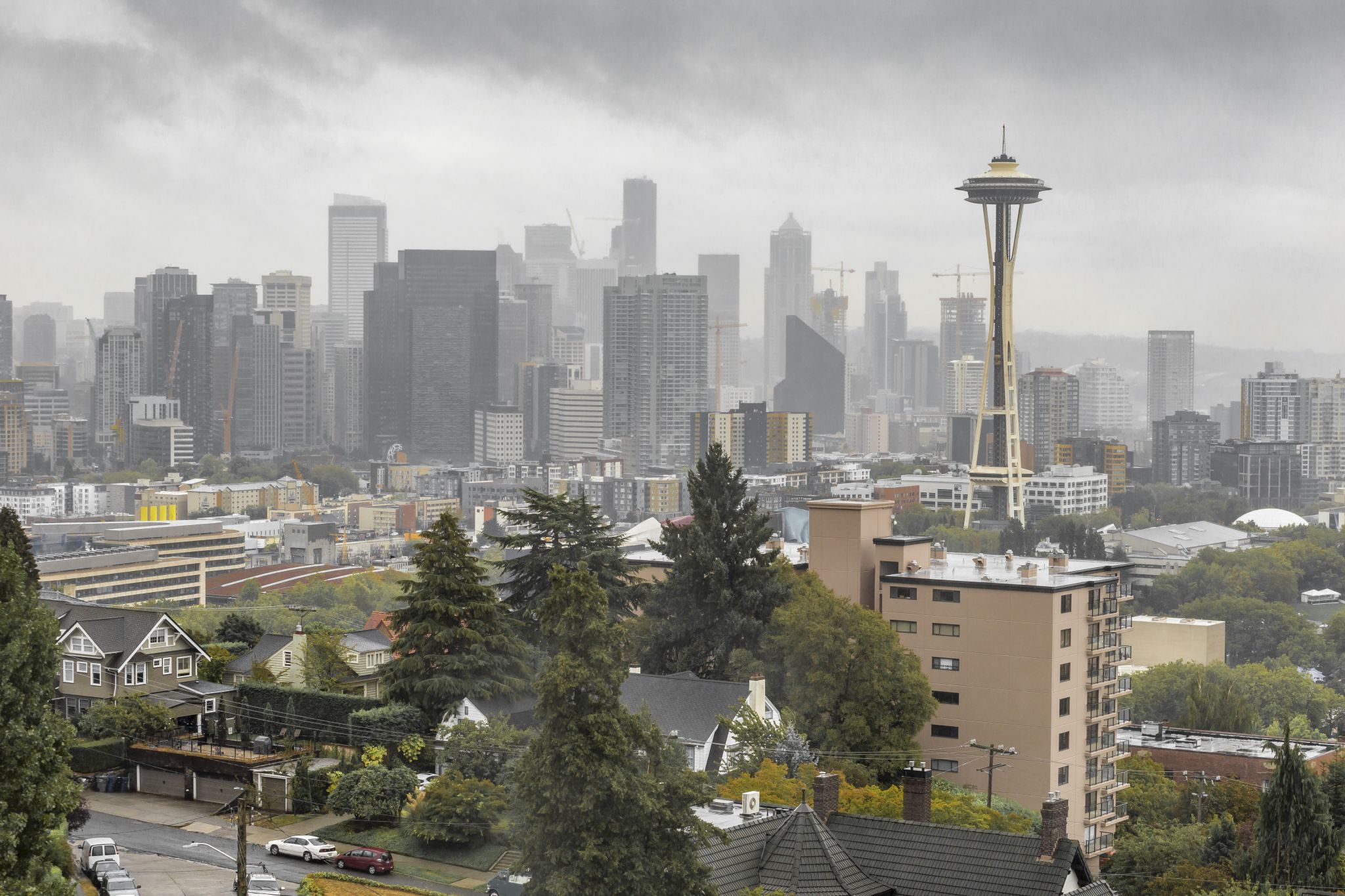
Seattle in clouds

The bulk of my adult life, over forty years, was spent in the Pacific Northwest where I remained a stranger, an outsider.  Even though it was there that I met my beloved, created a family, and had a boatload of friends, it was never home. I love the city of Seattle because of the variety of world cultures that settled and thrive there. You are never far from a festival, an event to celebrate people from far-flung lands. I love my many Seattle area friends. I loved being able to snow ski Mount Rainier and sail Puget Sound, horseback ride and play tennis, most of the year in mild temperatures. Wonderful ethnic food, an enormous variety of world-class arts –  museums, theater, music – play a big part in Seattle’s identity. I once wrote a twenty-page paper on the City I Love to Hate – extolling its history and all its virtues and why I suffered in its bounty. I was claustrophobic, confined, imprisoned by the environment. A blue sky is sporadic, appearing a few times a month (occasionally never making an appearance for weeks) and rarely bringing warmth. Clouds hung like Damocles’ sword, low overhead, threatening gloom. My feet never felt dry, my hands never warm. A pervasive smell of mold clung to everything. Trees obscured the horizon and all potential vistas of mountains and lakes. People were closed as tightly as their coats and sweaters, bundled for safety, cliquish.

Santa Catalina Mountains

During our adventure traveling through the contiguous forty-eight states for fourteen months in 1984-1985, we found a place that felt like it could be another home. Tucson. It is ringed by five mountain ranges, not snowy like the Rockies, but rugged and beautiful, rising from the Sonoran Desert. The Santa Catalinas, the Tortolitas, the Rincons, the Santa Rita, and Tucson ranges. These mountains display a mind-blowing range of color at sunrise, sunset, and when clouds filter the desert light. I have photos of them dressed in reds, oranges, blues, purples, and golds. During monsoon season they flaunt a verdant green as vegetation awakens in the nearly tropical heat and humidity. But we still had a life (family and work) in Bellevue, Washington; but when the kids were raised and it was time for retirement we headed south. I am grateful every morning I wake up to the sunshine. I even learned, after many years, to treasure rain again. It was such a curse in Seattle. Anxiety no longer attacks me when dark rain clouds appear on the horizon. They are temporary. I know they will make the cacti and fruit trees blossom, wildflowers erupt into blankets of color and sate thirsty desert critters. I welcome monsoon season like a native. My feet are firmly planted in this place. Breathing clear air, embracing dark skies at night with diamond-bright galaxies shifting overhead, walking trails and communing with desert animals that cross our path or visit our yard, make this place home.

This poem is about the four places that influenced me from childhood until now. Home is more than just an address, a dot on a map. It is a place where your soul can breathe.

Where I Am From

I am from the traveling wind, deep roots,
Wide blue skies, far horizons, and waving wheat,
Great-grandma’s raw onions by her supper plate,
Great-grandpa’s spittoon beside his rocker,
Refrigerator on the back porch and dirt fruit cellar,
Fireflies on summer nights.

I am from deep dark earth and snowy mountain highs
Grandpa’s railroad uniform smelling of wool and tobacco
Fishing at Estes Park, summer night baseball,
Honeysuckle, snapdragons, and putting up the beans
A ringer on the washing machine
Cold fried chicken, white bread with butter and sugar

I am from endless gray skies, armies of black-green sentinel fir trees
Reaching to the smothering clouds
A city where art and music blend past and present
A thousand cultures mingle like flavors in a stew
The drizzle of cold, the smell of mold
Wind in the sails, islands in the fog

I am from the knife-edged peaks with mysterious crevices
Rising from the desert floor.
Dark starry nights, quiet as serenity
Deer, coyote, and javelina share their space.
The soul-filling scent of the creosote bush after a summer monsoon.
The endless blue of sky and translucent flower of prickly pear.

Age Appropriate

It has been said to me several times in the last year, “Wow, publishing your first book at the age of seventy-seven. That’s a big deal.”  I beg to differ. My age has nothing to do with writing other than I hope I have improved over the years. It’s as if my life culminated in this book. No, it hasn’t. If truth be told I have written enough over the years to compile as many volumes as the Encyclopedia Britannica. Publishing was never a priority or even a thought. I have written for seventy-eight years, no actually seventy-one years because my first novel was at the age of seven.

When we moved from Bellevue, Washington to Tucson in 1993, I jettisoned my journals, notebooks, and pages of writing to lighten the load. Boy, how I wish I had some of that back to fill in memories that are hazy now. Teen diaries with social events prominent, newlywed adventures, then pages of notes on my children as they grew up. Some pages were complaints, some were gratitude, some were hopes, some were sorrows – most were filled with the joy I felt watching my kids grow.

Of course, as writers do, I accumulated more journals, notebooks, and loose pages of writing in the intervening twenty-six years. They are not systematic or categorizable. I grab a notebook or journal when the spirit urges and start writing not caring what came before. I have journals with entries from 1997, 2005 and 2020. They are not in order because I start writing on whatever blank page I open to, so a 2017 entry may be before a 2005 one and heaven forbid if there is any theme articulated. This unstructured whimsy pattern is my life. My brain cannot do linear for more than a few minutes at a time.

Is there a right and wrong to writing? Absolutely not. Writers have to write. It is like breathing. It is an imperative to living. Age is not a factor in writing. There is nothing that says you can’t write after you are fifty or seventy or one-hundred. You don’t need an MFA or be on the best-seller list to write. Until I moved to Tucson the only writing class I had was a Freshman 102 class at WSU. A young professor tried to introduce newbie English majors to the idea of creative writing.

After we were settled in Tucson, I saw an ad for a writing class that sounded interesting and I thought it would also be a way of meeting people in my new town. I had no idea that class would introduce me to many other adults who loved to write “just because”. Indeed, I thought I’d be the only one there who wrote just for myself because “writer” meant a higher level of achievement than what I felt I had. Thankfully, I was wrong.

I met several people who love words and love putting them in some kind of order to tell stories. Our writers’ critique group was formed from a few people in that class and four of us stayed together for over twenty-five years. The book we wrote is to encourage other writers to create and maintain critique groups as a way of expanding and enhancing their writing experience. Creativity stays with you throughout your life.

Getting back to the age issue, I once knew a woman who dressed “inappropriately” for her age. She was in her late sixties, then early seventies when I knew her. She wore medium-heeled shoes with lacey bobby socks, fancy dresses that barely touched her knees and her long grey hair was done in braids, ponytail, or pigtails with ribbons and delicate butterfly clips depending on her whim and the time she took to get ready in the morning. She was petite, with a trim figure and her clothes looked good on her body, but they would have been more “appropriate” on her granddaughter. She was the hostess at a high-end restaurant in the town where we lived. She was courteous, on the ball, and did her job with confidence. She was NOT a nutcase. She was an individual. She loved people and it showed in her manner, her care with customers. I’m sure the first time people saw her, they were taken aback. I know I was. But after observing her over several years I knew she was authentic, not an act. I moved from that town so I’m not sure how long she remained in her job. I do know she had plenty of energy and enthusiasm for it and did it better than women who were in their twenties.

My point is people age differently, some are old at forty while others maintain their lust for life well into their eighties, even nineties. My grandmother was an example of someone who never let age determine her life trajectory. She was widowed at fifty-eight. She had no pension and social security was minimal. She went to live with and care for her elderly parents who lived into their nineties. When her parents passed away, two of her sisters (a widow and a divorcee) and a brother (a widower) moved in to share the family home and expenses. Four siblings in their seventies and eighties acted like four siblings in their teens. They teased, argued, hassled each other, and laughed in equal amounts. It was hilarious to visit them. If you overheard their conversations, you would never believe they were senior citizens. They all sounded like fourteen-year-olds.

Grandma developed congestive heart failure later in life, but it didn’t hold her back. She was a woman of boundless faith. The day she died she had been out helping her “old people”, those friends in their sixties and seventies (ten to twenty years younger than she) who relied on her to drive them to appointments and shopping. She went home after a busy day and said she didn’t feel well enough for dinner. She was taken to the hospital later and died of heart failure that night. Not once in my life did I ever hear her say anything about her age or infirmities. They were just not significant factors in her life. She created the best of each day she was given without excuses. I adored her for many reasons, her kindness, her generosity, her “get on with it” spirit, and aspire to be like her. She embraced the gift of each day. Age is a number not a state of being. A spirit cannot be defined by age.

Goshen Children’s Care and School near Kampala

My brother is organizing a fundraiser for this school in Uganda. Please donate if you can. He and his wife are planning a trip in the near future to visit the school and I hope to get some of the stories of the children he meets. This go fund me was posted a few days ago.

https://gofund.me/61f3607a

Please Help…before The Goshen Children’s Care and School is closed down…maybe forever!

It’s a distressing story. Goshen is located in Seeta, Uganda, near Kampala. The school has been operating out of a rental home for several years. However, just in the last month the local government decided the school may no longer operate from a house. It must operate from a “school structure”. Godfrey, the founder and director of Goshen, had a quick solution. With the property owner’s permission, he and his small team built a 3-room “school structure” at their current location. The total cost was just $1700, which was donated by a church in the US. Amazing! They built that structure in just 2 weeks! Double Amazing!

The very next week after completion, the property owner informed Godfrey that he was selling the property! The school must close! This is very cruel to the 20-25 children from this severely impoverished area. Without the Goshen school, those children will no longer continue their education. The families just can’t afford even a few dollars for the minimal tuition.

However a true blessing is available! A vacant lot right across the street from the current school is for sale. Godfrey can buy this property and build another school very inexpensively. The whole project is approximately $15,000.

There is urgency! The new school term starts in early March. If the school is not built by then, the parents may lose faith, and the children probably may not return. In this impoverished town, education is the only way to find opportunities.

Please donate right now! $20, $50, $100

Any amount will help!

Here’s a quote (in broken English) from the director, Godfrey.

“This idea for the academy I had it 7 yrs back. By faith I decided to implement it. I have 5 volunteers who help me. This academy is free, When the youth come we feed them with breakfast and lunch and also print them materials.This week we will start skills session where we will teach them computer skills, art and craft skills and music. Though I don’t have the materials I will use what is available, am grateful that families are giving me youth. Yesterday there are families who brought 10 youths, and my heart was where are they going to sit, what about food, and I said Holy Spirit take control, continue praying for us thank you so much”

Thank you for reading.

At the Diner

We had lunch at a local diner, one sunny February afternoon. We frequent that diner because it is nearby, has very friendly staff, homestyle cooking, generous portions, and reasonable prices.  The diner is open daily for breakfast and lunch. The décor is Midwest farm kitchen. There are pictures and photographs throughout of farm life, fields, and animals. There is a plethora of chicken and rooster statuettes everywhere. The main room has two dozen tables and a lunch counter with another dozen stools. There are two extra rooms for overflow, used mostly on Sunday mornings or when clubs have meetings. We are so grateful that the diner was able to stay open for the two years of the covid panic. So many mom-and-pop businesses had to close.

Just after we were seated at a table by the window, I observed a woman, 60ish, cross the parking lot and come into the diner alone. She was short, pear shaped and wore a dress with a leafy green on green print and brown “sensible” shoes. She carried a pink purse, a blue hardbound book, and a plastic grocery bag that looked packed with something. It could have been clothes or trash, I don’t know, but it was tied up. She placed her book and purse on the counter and went to the bathroom with the grocery bag. I assumed by her casual leaving of her belongings that she was a regular. I often see solo diners eat at the counter, but I’ve never seen a lone woman there. She returned without the plastic bag and assumed her tall chair, ordered iced tea and lunch, and opened her book. I saw from my table across the room that it was a Patricia Cornwell mystery – big letters on the cover.

My husband and I talked about our niece who was visiting from Montana as we waited for our food.

A tall man, over six feet, also in his 60s, possibly 70 entered the diner. He had on a blue plaid wool long-sleeve work shirt, blue jeans, boots and wore a camo ballcap that he didn’t remove. Lanky would adequately describe him, loose limbed and thin.  He passed by the woman. Neither acknowledged the other. He threw his leg over a counter chair, two seats away from the woman. He looked very much at home at the counter. The waitress took his drink and lunch order. Both the man and woman faced straight ahead. The woman reading her book. It looked like she had just started it – only a few pages in. When their waitress brought their lunches, they began to eat, still not looking at one another.

I glanced over to them as I ate my lunch. After a couple of bites of sandwich, the man looked at the woman and made a comment. Since I was across the room, I have no idea what was said. The woman acknowledged his question or comment and continued eating her sandwich and reading her book without turning to look at him. Again, he said something and again she answered without looking his way. He continued to eat and talk looking in her direction. After about five minutes she looked up and smiled at him. She said something in return. Encouraged, he turned his swivel chair so he directly faced the woman. His talking became more animated. He used his hands, then his arms with broad gestures, to illustrate what he said. She looked up at him more often and the conversation became mutual – a back and forth dialogue. Finally, she closed her book and gave her full attention to the man.

I watched this human interchange from across the room as it slowly unwound. It was enjoyable to see the two people, who I assumed were strangers, find something in common to talk about as they ate their lunches.

“What’s going on?” my husband queried when he saw me chuckling quietly while I watched the couple at the counter.
“I am watching two people getting acquainted.”

He looked up for a moment then, uninterested, returned to his sandwich.

The waitress gave each of them their bill as they finished their meals. They continued to talk for a minute or two then the man got up, paid, and left the restaurant. The woman followed a few minutes later after buying a sweet from the pastry display cabinet to take with her. My husband and I left also.

I felt I had watched an entertaining play unfold before me during lunch. I suppose I could make up the dialogue but the scene, even without words, was enough. It was like watching a silent movie.

That’s what writers do. We observe. Stories, scenes, and characters come from everyday incidents. Imagination fills in the blanks, the dialogue, the prologue and the epilogue. I’m sure the two people I saw that day will join the many other characters who live in my mind’s village and have a story of their own one day. What was in that plastic bag?? Could their story be a mystery? a little romance? a fantasy? a political thriller?

What have you observed either at a restaurant, in line at a grocery store, or walking in the park? Stories are born from these scenes. You don’t have to know the dialogue, that’s what your fertile imagination will create.

Haiku Month

February is National Haiku Month. There is a month for everything, I guess. I’ve never been much for writing haikus. I was intimidated by the 5—7 – 5 restriction: three lines – the first with five syllables then seven and finally five in the last line. I didn’t tackle them. Our Writers’ Forum has a haiku contest each year. We have some natural haiku artists. Haikus spill from their brains seemingly without effort.

I decided to try it this year. Now I’m writing haikus in my head as I walk each day. I walk in the natural environment of a nature preserve or a town park, sometimes just around the neighborhood, as I practice the 5 – 7 – 5 mantra.  Traditionally haikus are written about nature. I found myself composing more about human nature. These are a few I came up with. I didn’t submit any of these for the contest, saving that until February 22.

Soft lips spoke lies as
Crystal drops rained from her eyes
In thorny goodbye.

His side undisturbed
Grief o’er flows her hollowed heart
Their bed as witness

Bodies in congress
Rhythmic movements of urgent
Longing and loving

Sunrise unwraps bright
Spires dressed in layered colors
Grand Canyon morning

I’m still wrestling with one that I cannot make fit the haiku scheme.  Any ideas?

A nun’s story                                  4
Nineteen to thirty                            5
Lost in hopeless addiction             7
Found change of habit                   5

Our Town

On November 5th we hosted a pot-luck Texas Hold ‘Em poker party for a group of long-time friends. We ate outside on the back patio then went in for the card game. Our poker parties go back many many years. As couples, we used to meet regularly. When covid hit the parties became sporadic but we still met on occasion. In total, there are seventeen of us. Not everyone makes every party, but we try. The ladies of the group also gather monthly for dinner at a restaurant to celebrate a birthday. When there is no birthday that month we meet anyway to celebrate friendship. In October there was a garden party hosted by a couple who built a greenhouse during the pandemic. The incentive for that gathering was to show all the beautiful plants and vegetables they propagated during the last two years. Everyone left with a small basket of fresh veggies to make soup at home.

Ken and I owned a real estate company and, in 2002, hired our first agent. During the next couple of years, we added more agents. We met their spouses and became friends. We added some of our clients to the group and, over twenty-plus years, an enduring bond of friendship and support was created. That friendship continued even after we retired. We all managed through covid, vaxed or unvaxed. Two couples moved away for several years, one to California and the other to Minnesota, but returned and were immediately brought back into the fold. In 2021 one of our friends died but he is still very much in our thoughts and part of our conversations.

Potluck is our preferred kind of party, even if it doesn’t include poker. Everyone brings a favored dish to share. Just as potluck is a combination of foods, our group is a combination of individual talents. Each person contributes to the whole with their uniqueness. All are blessed with the knack of friendship – they listen, they make others feel comfortable. We poke fun at one another in gentle ways and in memory of all the good times together.  Laughter is a big part of every gathering.

The day after our party the 1940 film, Our Town was shown on TCM. I remember reading Thornton Wilder’s play in our 11th-grade English class taught by Mrs. Lupton. The play was performed by our high school drama club. Then again years later, Ken and I saw it performed by the Seattle Repertory Theater. Even though I am an oldy film buff, I had never seen the movie. The play takes place in the early 1900s and its human themes resonate today. I reflected on our party. As friends, we have known each other, not since childhood, but through years that included births (of grandchildren), love, divorce, marriage, illness, and death. We attended baby showers and followed the milestones of each grandchild. Now one of those grandsons is in basic training for the Air Force and there are still toddlers in the group. Life moves at a breathtaking pace. I am ever grateful for their continued friendship as we compare old veiny hands and the inconveniences of aging. We discuss travel plans, artistic endeavors, beloved pets, children’s achievements, the highlights of grandchildren, and celebrate each accomplishment. Poker is fun too and we all (yes, even Larry) cheer the winner.

Our Town was knocking on my consciousness. This post began life as an entry in my journal several weeks ago. Within days of my journal entry, I started and finished reading the novel Tom Lake by Ann Patchett in which a “character” in the story is the play Our Town. Hmmm, a coincidence? My journal is much longer and more detailed, but I decided to pare it down and post it since the play seems to be all around me from a movie to a novel and the sense of my own community around me. Funny how that happens – recurring themes. The life of a writer.

Officer Hershey times three

In the space of two years, Officer Hershey came into my life three times.

In the 1990’s, we lived in a neighborhood at the top of a hill in Bellevue, Washington. On this particular morning, after my husband left for work, I ate breakfast, played with the dog, did some housework, and got ready for work. I’ve never been a morning person. I don’t get my head working much before 9 am. I was late two out of five mornings. I tried to make it up by being early at least once a week. Luckily, I worked for an old friend who put up with me.

I looked at the clock and, oh my, I had ten minutes to make the fifteen-minute drive to work. I jumped in the car and started down the long winding road from the top of the hill to Main Street. The speed limit was 25 because it was so curvy and, in places, steep. My foot never touched the accelerator, only the brake as I drove down the hill. This morning I didn’t pay attention to speed.  I was traveling between 40 and 45 mph when I saw the motorcycle cop behind me with his lights and siren. I pulled over. Darn, now I’d really be late and with a traffic ticket on top.

I rolled down the window and in my sweetest tones, “Good morning, Officer. I must have been going a bit fast.”

The officer had a big grin on his face like he’d caught the fish of the year. His badge said Officer J. Hershey. “May I see your license and registration young lady.”

I pulled the license from my wallet and the registration from the glove box and handed them to the policeman.

“You live on this hill,” he said.
“Yes, sir, Officer Hershey.”
“Then you travel up and down this hill a couple of times a day, don’t you?”
“Yes, sir.”
“You know the speed limit here, right?”
“Yes, sir.”
“You know this is a dangerous road when it’s raining or icy, right?”
“Yes, sir and it’s a beautiful day today.”
“Are you on your way to work?”
“Yes, sir.”
“Do you love your husband?” His face became serious.

Now that one knocked me back. What was he getting at? That didn’t sound like a traffic citation question. I looked up and tried to see his eyes through his dark motorcycle goggles.
“Yes, sir.” I said with hesitation.

“Well, this is what I want you to do. When you get to work, call your husband. Tell him you love him and want to take him out to lunch. That lunch will cost about the same as the ticket I should be giving you. Apologize for driving too fast down this hill because it is not safe and tell him you won’t do it again.”

I let out a big breath. “No, ticket?” I asked.
“Not this time but I patrol this road so don’t let me catch you again.”
“Yes, sir. Thank you, sir.”

I did exactly as he instructed. I told Ken the impossible story of how I barely avoided a traffic ticket over our lunch.

A few months later, on a Saturday, I was in a traffic jam on one of the main streets in town. I was in the middle of three lanes inching forward little by little on my way to the mall. In my rear-view mirror, I saw a motorcycle cop working his way between the slow moving cars and when he got to my car, he put on his siren and lights. He gestured for me to move out of traffic into the parking lot of a business. Disgruntled, I signaled and began traversing the road through traffic. Other drivers were also made unhappy by this movement. I glanced again at the cop and realized it was Officer Hershey. What the heck? I couldn’t have been speeding, I was barely moving. Why was he pulling me over?

I parked in the lot. He got off his motorcycle and came to my window. “Please give me your license and registration,” he said.
He took a second look at me and said, “Oh, you again”.
“Yes sir. I couldn’t have been speeding. What’s wrong?”
“Please step out of the car.”

I did as I was asked wondering if he was going to give me a sobriety test or something. Very confused. The traffic on the street picked up a little as the light changed but it was still very congested.

“Come back here.” He gestured to the rear of my car.
“You don’t have a current license tag. You are out of compliance; your car license is expired.”

I looked and sure enough. The new stickers were not on my car.
“You’re right. I have the new stickers in the console. I asked my son to put them on for me last weekend, but I didn’t check. The little bugger didn’t do it.”
“How old is your son?”
“Fifteen.”
“Yah. That’s sounds about right. Get them out of the car.”
I did as he asked and handed them to him so he could see they were up to date.

He took a cloth from his jacket pocket and wiped off the license plate then took the sticker and put it on. Then he did the same for the front plate.
“Have a good day.” He said and touched his cap as he got on his motorcycle and moved back into traffic.
“Thank you again, Officer Hershey.”

Nearly a year later the tranquility of a Sunday morning in our hilltop neighborhood was shattered by a violent soundscape. Adults yelling. Young children screaming and crying. Car doors slamming. The crack of gunshots. A car engine roaring. Tires squealing. A car racing down the street. Ken and I looked at each other puzzled and he said, “I better go check what’s happened.” Out the front door, he went. A few minutes later he came back with our neighbor, Maryann, bloody, trembling in her pajamas, barefoot, with a coat thrown over her shoulder.

“She’s been stabbed. There’s blood everywhere inside and outside the house,” Ken said and went to call the police.

I took her into the bathroom to address her wounds. Fortunately, nothing was spurting or flowing. (I faint at the sight of blood). She told me how her estranged husband showed up uninvited and demanded to take the kids. They argued and he snatched the kids and took them to the car. Then he returned to the house and assaulted her with a knife, stabbing her several times before she could grab a gun from a kitchen drawer and shoot him.

Maryann and her family had moved into the rental house next door a few weeks before this incident and we’d only met them casually. We didn’t even know her husband had left the family.

Within minutes the doorbell rang. I answered and who stood before me but Officer Hershey. “Officer Hershey, come in,” I said in surprise.
“It’s Detective Hershey, now,” he answered, a serious look on his face as he entered the house with two other officers.

I sat with my arm around a quavering Maryann as she told her story to Detective Hershey. Ken was questioned by one of the other officers. Then the police took Maryann back to her house to continue investigating the scene. That was all we heard until we were called as witnesses at Maryann’s trial for attempted murder.  

As it turned out, Maryann was crazy, threatening her family when her husband moved out of the house. He wanted to get the children away before they were harmed. She knew he was coming over to get the kids and she staged the fight so she could have a motive for shooting him. She inflicted stab wounds on herself. Luckily she wasn’t a good shot. She wounded him in the neck, but he was able to get to the hospital for treatment and was okay. Maryann was sent to an asylum for the criminally insane.

We moved from the neighborhood soon after, not because of the shooting, but because it was a planned move. I never saw Officer/Detective Hershey again, but he remains a sweet memory. I looked him up online. In 2017, he retired as a Captain after 35 years in the police force with commendations and kudos from dozens of citizens in the city, especially high schoolers who appreciated his common sense approach to teens, his humanity.  He had a significant impact on young people in the city. He was called a legendary gentleman by one citizen. Bellevue was blessed with his service. Exemplary man and policeman. Thank you, Captain Hershey!


Look at that happy face. You can’t help but smile back.

Five Easy Pieces

In 1970 when the movie Five Easy Pieces was released, I was a grownup suburban matron with three children. Such was my disguise, cloaking the heart of a rebel. Jack Nicolson embodied that rebel spirit and I adored him. That movie was one of my favorites at the time although now I don’t remember the plot or much about the movie. I do remember the scene at a restaurant when he orders a side of toast with his omelet and the waitress says they don’t have side orders. So he orders a chicken sandwich on whole wheat toast, hold the mayo, hold the lettuce, and hold the chicken. That reaction to nonsensical rules comes back to me often.

We recently went to a restaurant and our grandson ordered a grilled cheese sandwich. “What kind of cheese?” asked the waitress.”American,” he responded. I was surprised because he has a fairly sophisticated pallet for cheese and I don’t think of American as a favorite. The order took longer than expected (no doubt, the exotic cheese choice) and forty minutes later everyone had their meal except our grandson. How hard is a cheese sandwich? He finally received his order. It was a simple sandwich with a thin layer of cheese painted between two slices of toast.

When we received the bill, we were charged for the sandwich plus 50 cents for the cheese. I laughed. Pay extra for cheese in a cheese sandwich? What next? Extra for ice in iced tea or cheese in a cheeseburger? The server’s response was equally nonsensical. She said the management was terrible and they were understaffed. What has that to do with a separate charge for cheese.? I’m very sorry for the overworked, unappreciated staff but…
Fifty cents is not the issue. It’s blindly following some rule that says if cheese is ordered it’s extra.

I fear the sheep in our society are multiplying rapidly. Compliant, unquestioning followers – not leaders who look above the fray, see daylight, and search for reason. No offense intended to sheep.

That’s my observation for today.

Summer of ’63

Prompt: Write a story or poem based on a stanza, lyric, or chorus of a favorite song.

“Soft kisses on a summer’s day laughing all our cares away, just you and I.
Sweet sleepy warmth of summer nights gazing at the distant lights in the starlit sky”.
Chad and Jeremy, A Summer Song.

These lyrics take me back in time to the summer of ’63 after high school graduation. Ken had a job in the warehouse at Associated Grocers during the week. I was the stay-at-home babysitter for my nine-year-old brother; both of my parents worked. On weekends Ken and I would slip away, drive to the mountains or shore to spend the days just being together. Hours and hours alone. I know we talked the entire time, well mostly. I recently asked Ken if he remembered what we talked about. Neither of us can remember. Nothing consequential, I fear; not the Vietnam War, the economy, global cooling (yes, science said another ice age was developing), world famine, or the politics of the Kennedy administration. I was team Kennedy, he team Nixon. Somehow the hours melted away.

One standout memory was sitting on a blanket on the bluff above Deception Pass watching boats go out of Skagit Bay into the Strait of Juan de Fuca. Our location part way down the bluff was sheltered from the eyes of anyone on land above us and open to the water below. At one point we were in a heavy clinging embrace when a cruiser passed through the channel. The captain blasted their very loud horn and shouted encouragement. They were so far below they were unable to see us clearly, just that we were entwined and off in our own world. We couldn’t see them, only the boat. We waved as they passed by.

That memory makes me smile each time I hear the lyrics of the song. On weekends, Ken would pick me up early in the morning and get me home late Saturday night, then repeat on Sunday. We would gaze at the starry night skies for as long as we could. We drove all over the northwest part of Washington State looking for secluded places to park and picnic, sometimes in the mountains, sometimes in the islands. It was an idyllic summer of love, very little responsibility or care, and loads of time to ourselves. We had money, Ken’s baseball signing bonus plus his job, so we could do anything; but we spent little, choosing instead to just be with each other. Those tender memories are part of the bond that has held during our sixty years together.

Thirty years after that summer, we sailed Wind Dancer, our 41′ C & C sailboat, by Deception Pass but not through it. Water depth in the narrow passage ranges from around twenty feet in places to over two hundred feet and the currents are treacherous so boats can only go through one at a time. Keeled craft are discouraged as they can be sent spinning out of control.

I wrote this poem about that summer.

Summer of ’63
I was seventeen
You were eighteen
Life ahead full of unknown currents
Unplanned and unexpected
Carefree summer of love,
Passion unbounded, undenied.
Love as deep as ocean canyons
Kisses soft as sugar froth
Melted on our lips.
Time unwound slowly
A bottomless well
Those happy days
Followed by years
Navigating life’s swollen eddies
Struggles, celebrations,
Misunderstandings, reconciliations.
The tumultuous tides of our affair
Like the sea gushing through Deception Pass
Smoothed into calm waters of well-aged love.