Sometimes personal quirks are not recognized until they are outed in public. It took decades for one of my idiosyncrasies to come to light. It came to my attention a few weeks ago when a longtime friend came over for lunch. I was putting together a spinach, cranberry and pecan salad to serve with thick slices of sourdough bread and chai. As a last-minute decoration for the top, I was making some carrot curls. All the while I was doing this, my friend sat at the kitchen table watching and talking about whatever topic had come up. A piece of carrot popped out of my hand and fell to the floor.
“Oh darn, I’m so sorry,” I said to the carrot as I picked it up from the floor and put it in the compost container I have on the counter.
“Did you just say sorry to the carrot?” my friend asked.
“Uh, yes. I’m sad that the carrot cannot fulfill its mission.”
“Reeallly? Its mission?” was her slow, drawn-out response. The look she gave me with a cocked eyebrow let me know she questioned my sanity.
“Isn’t that what you think when you throw away food? It bothers me that it isn’t being put to its best use.”
“I don’t think of food as having a mission, or a goal. It’s just something we eat – a thing not a whatever…being.”
If a tomato or lettuce goes bad in the fridge, or if bread develops mold, I regret that I have not allowed it to complete its task as a part of the food cycle. It upsets me even more when I put food in the disposal or the garbage – a final tragic end. Now I have a compost bin that makes me feel like the food will continue on its mission in a slightly different way. It is something I’ve always thought, maybe not saying it out loud. Possibly not scientific or logical, but it is one of the kinks in my mind.
I definitely tend to anthropomorphize things in my life. Maybe it is because everything has a story and everything is a character in my world. Blueberries are people too.
A few months ago, my neighbor, Dan – the sourdough king, asked me to tend his two containers of sourdough starter while he and his wife were on an extended vacation; I readily agreed. I asked him their names. He looked at me quizzically.
“Names?”
“Well,” I explained, “they are living things that you have to feed and take care of so don’t they deserve to have names?”
“I never thought of that.” Then he gave them names: Sally and Susie Starter. I was satisfied and spoke to them when I fed them every day. They grew very big and plump.
I name the plants that come into my house. That can be painful since I either over love or under love them, and they choose to die rather than submit to my abuse. My cats, Nunny and Oliver, have a role in it too. They chew on tender leaves or blossoms and occasionally knock the entire plant off a shelf in their exuberant curiosity.
At one time in the 1970s, during my stay-at-home-mom nurturing phase of life, my house overflowed. We had three children, multiple dogs, cats, gerbils, and a plethora of other critters. Houseplants of all shapes and sizes were everywhere in colorful, unique pots, including in those crocheted plant holders that hung here and there with ferns dripping down the sides. It seemed natural that everything had a name, and I was able to tend to each species, flora or fauna, with a fair amount of attention.
My children left for lives of their own, and I turned to working in the real world. Houseplants tapered off. When we moved from Washington to Arizona, they became non-existent. I lost interest in maintaining them. It hurts to see them die, so I would rather not have them.
Our neighbor, Ron, thought I should have a plant in my office. He gave me a philodendron that I named LeRoy. LeRoy grew and grew until he took over my office. He was beautiful and robust. He draped himself from the top of a bookshelf down through the shelves and across my piano and on to another bookshelf. He seemed to be heading for a complete takeover of the room. He began to remind me of Audrey in the Little Shop of Horrors. Even when the cats chewed on him, he thrived. One day I felt like LeRoy had gone too far. I committed plantricide. Then, of course, I was riddled with remorse for days and days. Except for occasional cut flower bouquets that I love but do not name, I decided I would only allow artificial plants in my home – not plastic ones, but nice paper or fabric ones.
My family knows I name things, but I don’t think they know I talk to vegetables.
Naming doesn’t end with animals and plants. I name inanimate objects like cars, computers, printers, and such – things I interact with on a daily basis. I know people who name houses and cars too, so it’s not that strange.
My favorite, well, tied for favorite, car was a rosewood 1980 Thunderbird. Her name was Phyllis. I saw her at the dealership, and it was love at first sight. Her color, a soft brown with pink undertones, was unusual and she had a luxurious pinky beige interior. When I sat in her, I felt like I was sitting in my boudoir. She drove like a dream. Ken and I talked about buying her, but he said she was just a little out of our price range and we needed to keep looking.
Without my knowledge, Ken bought her and had her stealthily delivered to our driveway the night before Christmas. After all the gifts were opened by the whole family, Ken said, “Oh, there’s just one more.” He told me to stand up, and he put a set of keys in my hand. Thinking he had purchased a car without consulting me, I was a little miffed. Then I was beyond happy and excited to see my beloved T-bird, Phyllis, waiting for me in the driveway. Breakfast had to wait. I drove her around for an hour. Phyllis and I had many adventures for over ten years, including outrunning a cop on a stretch of deserted highway in Eastern Washington. I loved her so much, it was hard to say goodbye to her when maintenance issues became excessive. A new car was better for the budget.
Pumpkin was my orange Chevy sedan. She was a big girl without much style – and as I said, orange, my least favorite color. She was serviceable, loyal, and willing. She did her job efficiently for eight years until I killed her. Her big, bulky body and heavy engine came between me and death when I had a head-on collision with a truck. She was totaled; the front seat was smashed to nothing. Miraculously, I escaped with a slightly sprained neck and a tear in my nylons. When Ken went to see her at the boneyard, he said it was amazing I made it out alive. Sadly, it was my fault. Momentary inattention crushed my sweet Pumpkin.
I had a couple of rental cars until I could decide on another vehicle.
For a while I rented a 1985 Berlinetta. It was a jazzy 2-seat Chevy Camaro with a 5.7-liter V-8 engine. Not that those details meant anything to me. She was quick and sexy. The cockpit, or rather, dashboard was inspired by a fighter jet. The Berlinetta was known as the “Stang Killer” – she could eat Ford Mustangs for lunch and ask for seconds. She had a hatchback with a deep well compartment under the floor – a place to stash rocket launchers or illegal drugs.
Sonny, one of my co-workers at the homebuilding company, was surprised when I drove up in her.
“I can’t believe you are allowed to drive that. You demolished your last car, and now you are driving a killer?”
My Berlinetta and I got along just fine. She was fun to drive, and I felt slightly naughty tooling around in her. I knew we weren’t destined to be together for very long. A two-seater car didn’t fit my lifestyle. Her brand name, Berlinetta was sufficient – she needed no other.
Years later, when it came time to buy a new car, I opted for my dream car. I wanted a Jaguar since the summer of ‘63. After high school, my friend Gerry and I worked together at an insurance company. We had been friends since seventh grade. Her husband Tor would pick both of us up at the end of our workday in his Jaguar XKE. When we drove home, Gerry, who was a tiny girl, basically straddled the gear shift and I sat in the passenger seat. I was in love with that E-type.
I’m not a car aficionado by any means. I cannot tell one make from another – except Jaguars. From that time on, I wanted a Jaguar. They were not only expensive, but they were not family-friendly cars, so they remained on my wish list. We watch a lot of British TV and movies, BBC, BritBox, Acorn. Jaguars (pronounced Jag – U – ar, not Jagwar) are ubiquitous in most British productions.
Until…
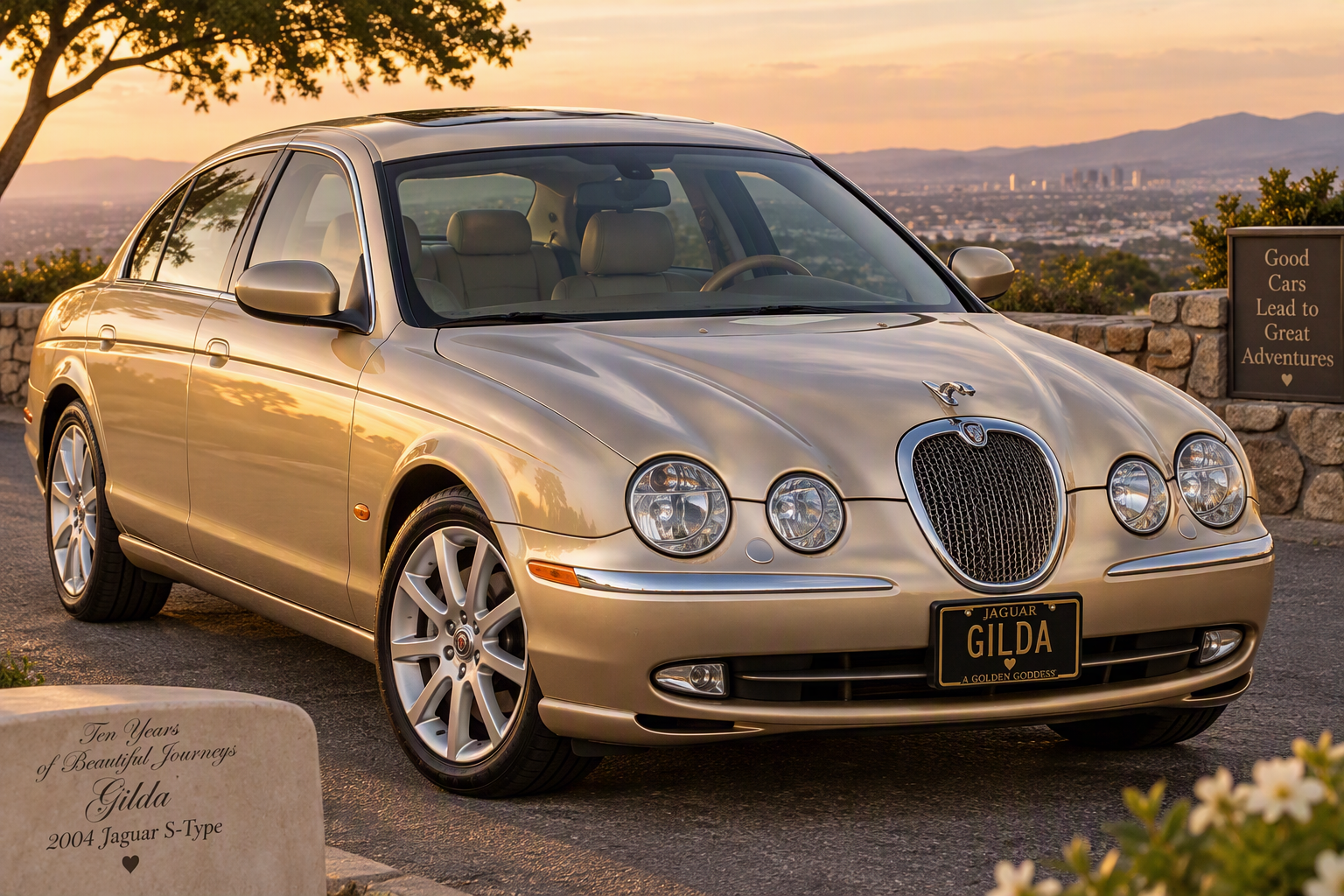
Her name was Gilda; she was two years old. A golden goddess of a car. An S-type Jaguar. No kids to drive around, just me and her. For ten years we ruled. She knew I loved her, and she returned all that love – all the bells and whistles, with a sunroof to boot. She was stunning. Everywhere I went she drew attention. Even when I went to the Starbucks drive-through or McDonald’s, the window attendant commented on how beautiful she was. She drew compliments every time I parked at a store. She glowed. I felt so privileged she was mine. Phyllis will always have my heart, but Gilda reigns supreme.
I gave Gilda up when she became a mechanical nightmare. We had her in the service bay more and more with higher and higher costs. Jaguars are made to be complicated, so everything is expensive to repair or replace. She was an elderly lady with bad joints and a failing heart. I said goodbye to my love. Believe me, it was painful. I mourned for weeks. As retirees on a fixed budget now, we had to look for a more practical ride.
We settled on a Hyundai Sonata. It has a ten-year powertrain warranty and a five-year bumper-to- bumper warranty. At our age, a ten-year warranty looks like a lifetime guarantee. I ordered the car with everything I wanted and in the color RED. I braced for disappointment. To my surprise, I was overjoyed. My Sonata is wonderful. Her name is Miss Scarlet. She greets me when I’m looking for her in the parking lot by sending a signal to my phone if I’m a row or two away. (I’ve lost cars in parking lots many times, so I appreciate her diligence on this matter.) She connects to other apps like GPS, Sirius, and Audible. Ken made the faux pas of calling her Scarlet one day. I had to remind him that, as she was my car, he didn’t know her well enough to be informal. Her name is Miss Scarlet. She is a very comfortable conveyance for four, even five passengers. The first year we had her, we drove from Tucson to New York and back. She’s easy on gas and loves to get out on the open road. I look forward to many more happy years adventuring with Miss Scarlet.
People may not understand why I talk to carrots and blueberries, but Phyllis, Susie, Gilda, LeRoy, and Miss Scarlet certainly do.

