Butterfly Continued

Swallowtail: “In the East, adults fly primarily in late spring and summer, but this butterfly is more common in late summer and fall in the South and Southwest. Where lack of freezing temperatures permit, the female adult may fly continuously. In lowland tropical Mexico, they may be found in any month.” – Encarta

Emerging abruptly from a deep sleep to respond to the insistent tone of his phone, Michael heard, “I miss you, Michael.  I’m lonely for you.  I’m lonely for Moses.”  Her voice, a low purr, curled into his ear and sent blue electric currents crackling through his body. 

“No, Janie, not again,” Michael struggled to keep the groan out of his voice. He got up in the dark from the rumpled king-sized bed and walked into the living room, his phone to his ear.  He couldn’t bear to have her in his bedroom again, even on the phone.  He turned on the lamp and slumped onto the couch.  The cat followed him, stretching and yawning.

“What?  Not again, what?” she asked.

“Do you have any idea what time it is?”

“I don’t know what your clock says, but I know it’s time for me to hear your voice, smell your sweet sweat, touch your warm skin, and roll up next to you in bed.”

“It’s 5 AM.” 

“I want you here with me.  I need to be close to you.  Everything is good, but with you it would be great.”

“Funny, Moses and I had a long talk just last Sunday, and we decided to move on.  We took every trace of you to the dump.”  He reached across the coffee table and turned her smiling photograph onto its face. 

“We can start over.  I’m ready now.  I found the right place.”

“Where are you?”

“I’m in San Diego this week, but the place is Santa Lucia.  It’s a few kilometers south of Puerto Vallarta.

“You must be some kind of witch.  You call just when I’ve reclaimed my life; when I finally decided I can live without you.”

“Oh baby, that’s….”

“No, Janie, I mean it.  I’m not following you anywhere again.  You left Memphis for Canyon, Texas, and I followed. When you suddenly up and left Texas, I followed you to McCall.  When the tall pines of the Idaho woods smothered you, you took off again.  I followed you here to Tucson, and this is where I’m staying.  Trying to keep hold of you is like trying to catch mercury between your fingers.  It’s impossible not to mention dangerous.  I’m done.”

“Do you still have my paintings?”

Michael looked to both sides of the new tin mirror at the intensely colored acrylics. One was of a woman looking through an archway toward distant purple and rose-colored hills, stroking a green cat.  The other showed a naked woman with long black hair astride a vivid scarlet horse galloping across a field of bright orange and blue poppies.

“No,” Michael said.  “I replaced them with seascapes, the calm of crashing blue and gray waves.”

“My pictures might be worth something someday.  I wouldn’t throw them out just yet.  I’m in California for a one-woman show at the Smithson gallery in La Jolla.  I have an agent.  I’m selling prints to tourists in Mexico.  I mean, really selling.  I finally found the place I imagined and have been painting since I was twelve.”

“You found the place with purple mountains, red horses, and green cats?”

“Don’t be obtuse.  Mexico is bursting with colors. And smells and laughter and…I’m home now.  This is what I’ve searched for.  Now all I need is you.  You and Moses.”

Michael looked down at the big gray-striped tomcat that had been weaving in and out of his legs.   Moses sensed he was the topic and flopped down on the top of Michael’s bare feet, his white mittened paws around his ankle, looking up at Michael.

“Moses isn’t interested in more travel.  He told me he likes Tucson. I like Tucson. I’ve got a good job here.”

“You’re a poet, Michael.  You are a poet who writes stupid technical manuals for a company that produces war machines for an oversized, out-of-control fascist government.”

“How do you know I still work at Raytheon?”

“Did you quit?”

“No.”

“There.  Come to Santa Lucia with me.  Poetry will fair drip from your pen.  It’s magical.  It’s cheap to live.  And I’m making money now.  Bring the trailer down.  We’ll park it on the beach.  We’ll eat mangos and shrimp.  We’ll make love on the beach in the afternoon.  We’ll play in the surf.  We will…”

A momentary image of Jane, naked on a beach, nearly scuttled his resolve.  He pulled back with a snap.  “I don’t live in the trailer anymore.  I sold it.  I live in a real house.”

“You bought a house?”

“Well…lease-purchase.”  He squinted out the window to the backyard, where dawn was beginning to streak the sky with pink and gray.  “I have a yard, a saguaro, a lemon tree, and a brick wall.”

“Brick walls enclose tiny brick minds.”

Michael cringed a little.  “If just once you had told me you wanted to move, we could have discussed it.”

“I didn’t need a discussion.  I needed to leave.  You would have planned and plotted. You are so anal.  No sense of adventure.  That’s what’s wrong with your poetry, too.  You need Santa Lucia.  It will break down all that shit in you and set you free.  I was suffocating.  By the time you made an analysis of our situation, I would have been dead.  I didn’t know where I wanted to go…just away.  It took me a while to find Santa Lucia.”

“Two years.  Why did you call now?”

“It’s not two years.”

“Yes, Janie, it is.  You left three Augusts ago, and it’s now September.”

“Clocks and calendars, calendars and clocks, tick tock, tick tock,” she chanted.

“Real world stuff,” he replied.

“Please, please come see me in San Diego, just for a day or two.  I’ll be here this whole week and next weekend.  It’s only a few hours’ drive, or I could pick you up at the airport.”

“Are you still living in the goddess-mobile?”

“Umm-hmm, mostly.  But I have a studio on the second floor of a building in Santa Lucia.  Its balcony overlooks the street, and I can see the ocean.  Some days I paint outside, sometimes inside, depending on the light.  I walk everywhere, so my rig stays parked by the beach.  I’m sorry you sold the trailer.  It worked so well in my daydream.  We won’t both fit in the goddess-mobile long-term.  We need more room than that.  There’s a house not far up the beach from where I park that’s for sale.  I’ll look into it.”

“Don’t bother.  I’m not coming to Mexico.”

“I think you’re being too hasty.  You should at least come for a visit.  A teeny short visit.  Then if you loathe it, you…”

“Hear me out.  I’m not going to Mexico for a week, a day, or a minute.  You can sell any dream to me if I give you enough time.  Your time is up.  I’m staying here.  I’m happy, even proud, that you are selling your paintings.  But you broke that last little piece of my heart when you left this time.  I don’t have one to give you anymore.” 

“There’s a marina too.  We could buy another sailboat like we had on Payette Lake.  Only we’d be warm all the time and could sail every day.”

“You’re not listening.  I don’t care how beautiful it is.  I don’t care how much you want to be with me.  I don’t want to be with you anymore.  I’ve broken the habit.”

“What happened to soulmates and undying love?” Jane asked.  “You promised me you would forever be my family.  Remember all those nights when I had the nightmares without end about when my parents died.  You held me and told me you would never turn away.” 

“You left me, remember?  More than once.”  Michael started to pace the kitchen, dining room, and living room with the phone to his ear.

“I didn’t leave you. I went looking for me, and unfortunately, I was always out of town,” Jane said.  “But now I’m found.  I promise I can stay put now.”

“Your promises aren’t worth much anymore.  You promised that the desert would be your eternal home when you came to Tucson.  Now you’re by the ocean for Christ’s sake,” Michael paused.  “And I don’t speak Spanish.”

“You’ll pick it up.  I did.  It’s so musical, it’s easy.”

“The answer is still no,” Michael said.  “I’m going to hang up now.  Please don’t call me again.  Have a nice life and congratulations on your success.”

Michael ended the call.  He didn’t want it to ring again and, in his heart, prayed it would.

He couldn’t go back to sleep.  It was Saturday, and he planned to play golf with Keith at 10:00.  He fed Moses and let him out for his morning prowl.  He shaved, got into the shower, and washed his hair.  As hot water ran full force over his scalp down his back and legs, he let himself imagine lying beside Jane in the warm white sand with salty waves lapping over them, making love to her in the sunshine.  He thought he heard the phone ring but when he turned off the water, he heard silence.

“Get yourself together, man,” he said aloud.  She’s a figment of your imagination, a phantom.  Just when you think she’s there, she’s gone again.  It’s never going to work out. 

Puerto Vallarta Retreat

Picture prompt: Write a story about this magazine picture. The picture feels like peace. The quiet of a deserted beach on a warm sunny day. The serenity of aloneness. Who is this woman? Why is she so far away from anyone? Does she treasure her aloneness? Is she escaping from her life? What will the remainder of her day hold?

I am reminded of a time when I needed to withdraw to peace and quiet for a while.  It was April 1981, during an energy crisis, recession, and an explosive inflationary period (sound familiar?) with mortgage rates up to 18% (much higher than today). A very tense time for everyone.  I worked for a small homebuilding company. We were having trouble selling our inventory of homes. The carrying costs were mounting, removing any hope of profit and the ability to continue building homes. I had been in some intense negotiations on behalf of my company with a bank that threatened to foreclose on a major loan. We couldn’t continue business without renegotiating the terms of the loan for a year. I was tapped to represent the company by my boss, Rob, who owned the company. Over a period of two weeks, I met with different officers of the bank to discuss our position, our new marketing plans, and the benefits of maintaining our relationship with the bank. It worked. I don’t know how, but I was able to convince them to extend our loan with promises for the future and evidence of our past success.

At the end of negotiations, Rob told me to take some time off. My husband, Ken, knew how frazzled I was and urged me to go away on my own to regroup. He said he could manage our three kids and all their activities for a week. He thought I would go to see my best friend in Atlanta. She was my go-to when I needed a boost. Even though we lived across the country from each other then, we were still as close as we had been as neighbors during our school years.

I thought about it. Michele would be working while I was there. She had a husband and two kids. They were all busy with their lives. I would be an intruder and a needy intruder at that. I decided I couldn’t impose on them in that way. I didn’t call her even though I knew she would have encouraged me to come. Instead, I called our travel agent. Seattle was at its drizzly best. I needed quiet and sunshine.

“Where can I go to sit in the sun; where is it quiet and I can be alone for a week?” I asked.

“Does a beach sound good?”

“I’m not a fan of water, but if it is quiet I’ll try.”

“You can be on the beach without going into the water, you know,” Sheila said. “When do you want to leave?”

“Tomorrow. And it can’t cost too much.”

“Oh, that makes a difference. No planning, eh?”

“No, just a get-away for a week.”

“I can get you on a flight to Puerto Vallarta and an inexpensive but nice hotel on the beach tomorrow morning at 9 am. I’ve been there and can recommend it.”

“Sold,” I said.

When my husband came home from work that evening, he asked if I had talked with Michele.

“No. I’m going to Mexico.”

“What? By yourself?”

“Yes. Sheila said it is a nice place. She’s been there. It is quiet and not too expensive. I will be able to be alone with no agenda. It is perfect. The reservation is made. Will you take me to the airport?”

The next morning, Saturday, he took me to the airport, still apprehensive.

“You will come back, right?”

“Of course. Don’t be silly.”

Saturday: I arrived in Puerto Vallarta and took a taxi to the hotel, Playa Las Palmas.  It was right on the beach, as advertised, in the center of the crescent of Banderas Bay. I could step out of my room and walk a few yards across the pale sand to the startling blue water. I was nearly blinded by the midday sun. What a change from gray, cloudy Seattle. I went to the restaurant to see when dinner was to be served and perused the menu. Lots of fresh seafood. And margaritas. Perfect!  I went to my room to change clothes so I could sit on the beach. I decided to lie down for a few minutes first. I threw myself across the bed and when I woke, it was 9:00 am the next morning. I was still in my traveling clothes. I missed dinner and margaritas. I slept from 3:00pm the day before, 18 hours. I didn’t know anyone could sleep that long.

I called Ken to let him know I’d arrived ok and slept through the afternoon and night. I told him I’d call in a couple of days. This was before cell phones.  I was quite alone. No one could contact me except through the hotel. I called Michele to tell her I had escaped to Mexico. She was in shock too.  I took a shower, changed, and went for breakfast, my first ever Huevos Rancheros; then to the beach. I had a notebook and pen to write my journal and two books to read. That was how I intended to spend my days. There were a few people scattered around the beach. This was not the high season so everyone was spread out. I alternated between the beach and the shade of the cabana/beach cafe all afternoon, reading and writing a little or watching the water and the people.  Beach vendors wandered across the beaches from hotel to hotel selling their wares, colorful handmade wooden toys, beautiful scarves, churros, and locally made pottery among them. Hotel staff would sometimes shoo the vendors away, but they returned each day. I didn’t think they were intrusive or aggressive but they may have bothered others. 

I ate a late lunch at the cabana and talked with two women I had seen on the beach. They were best friends from Minnesota, Betty and Janna, who planned a getaway together to a warm destination every year. We had a nice chat and they asked if I’d like to join them for dinner at 7:00. I agreed. But first, I said I’d go to my room for a little nap. I don’t know why I was still so tired.

Sunday: The next thing I knew, it was 8:00 am.  I slept from 3:00 pm until 8:00 am. I missed dinner again.  I met the two women later that morning. They said they came to my room and knocked several times but no answer. They thought I’d changed my mind and went somewhere else for dinner. They said they were taking a tour to the jungle on the mountain above Puerto Vallarta and asked if I wanted to join them. I declined, needing to be solitary for a while. I spent that day mostly in my room, reading. I walked along the beach a few times but stayed to myself. I had a quiet dinner alone, and then a normal night’s sleep.

Monday: Day three of my adventure put me out on the beach again, soaking up the sunshine. I noticed a boat pulling people into the air with a kite. Parasailing. I’d never heard of such a thing. It looked like so much fun. I asked about it and soon had a reservation for that afternoon. Amazing!! Two crew members picked me up in a small rowboat on the beach and took me to a wooden deck out in deeper water. They hooked me into a sling-type harness.  I launched off the deck pulled by a motorboat – no water involved. It was wonderful. I soared under a big, curved kite around the bay for about twenty minutes. It felt like two minutes. They told me I sailed 250 feet above the water and land.  It was delightful. They landed me softly near the shore in knee-deep water. One of the crew was waiting and helped unhook me from the harness and off they went to take another para-sailor aloft. I talked with some beach sitters who witnessed my ride.  I had a quiet dinner alone and went to sleep.

Tuesday: The next day I decided to go on the jungle tour that the Minnesota ladies told me about. It was a great half-day ride through the mountainous jungle above Puerto Vallarta. We had a small bus or tram that held about twenty people. We were told to be on the lookout for jaguarundi and margay which are small wild cats, but I didn’t see any. There were a few monkeys spying on us from the treetops. I believe they were called spider monkeys.  We saw the place where the movie, Night of the Iguana with Richard Burton, Debra Kerr, and Ava Gardner had been filmed. The tour guide filled us in on gossip from the movie set. It had been filmed nearly twenty years earlier in 1963-64 when Burton and Elizabeth Taylor were having their notorious affair. Lots of gossip.  We saw women washing clothes in a river we crossed. The poverty of the people around Puerto Vallarta was evident. I had dinner that evening with a husband and wife from San Diego who I met on the tour. They told me they were going to a nightclub that night at the edge of the city where it was reported there was a good band and dancing. They asked if I wanted to join them, and I declined. Needing more quiet time.

Wednesday: The following day I walked the beach from my hotel toward town. It took a little over an hour to get up from the beach into the old town. I walked all around looking into churches and shops. I bought a sandwich and soft drink for lunch as I strolled through the village. It was very small, only a few streets. I think the population was around 20,000 give or take, including the surrounding area. Two things that stuck in my mind were the children walking to school and going home in the afternoon. They wore white shirts and dresses. I mean white, white. I don’t remember ever seeing such clean children. The townspeople looked like they were very poor, but their children were impeccably dressed.  After witnessing the women washing clothes in the river, I was surprised at how snowy the clothes were. I guess sunshine had something to do with it. The other thing I noticed was armed police or guards outside banks and other businesses. They weren’t menacing but they were present. It seemed odd in so small a town. Sidewalks were uneven or missing in places. The townspeople that I spoke with were courteous and friendly, few spoke any English so we had interesting conversations with Spanglish and gestures. Those were things I noted in my journal. I walked the entire day and went back to the hotel tired. I’m sure I had dinner but I didn’t note it in my journal.

Thursday: The sixth day I met up with Betty and Janna and agreed to go with them that night to the dance club I heard about two days before. They were leaving the next morning, Friday. I don’t recall what I did during the day, but I’m sure I was either on the beach or in my room reading. That night at 9:00 we took a taxi to the nightclub, a fifteen-minute ride up the mountain out of town. There was a fun salsa band. Several of the local men and women showed us three Americanas how to salsa. The band played contemporary rock and roll tunes as well and everyone danced. I danced with Betty and Janna and whoever asked me and had a grand time. I also drank margaritas until 1:00 in the morning. My two friends left around 11:00 saying they needed to be ready to go to the airport in the morning. I asked someone, maybe the club manager, to get a cab for me, but he said the cabs were done for the night by 12:00. He offered to call a friend. Hmmmm. If I hadn’t had all those margaritas, I’m sure I would have been more judicious. I wouldn’t have stayed longer than my friends. I wouldn’t have been without a ride to my hotel. But here I was. It was pitch black outside. I mean you couldn’t see anything, not even outlines of trees when you were away from the building lights. I didn’t know my way down the mountain to the beach and my hotel on dirt roads. I was stranded. By the way the manager offered a ride, I am sure I was not the first American who made that mistake. I agreed to the ride offered. Two local fellows in a broken-down sedan, no spring in the backseat, came to pick me up. They asked where I wanted to go. I told them and asked how much they charged. They gave me a figure that was reasonable and away we went. They did not speak English with any proficiency, and I don’t speak Spanish, so they talked to each other as I sat mute in the back, praying I’d get home to Seattle in one piece. I did not have to worry. They were very kind young men. They took me directly to my hotel; I paid them and gave them a nice tip that reflected my relief that I hadn’t been kidnapped. I said gracias many times and threw in a merci and a thank you for good measure. They laughed and drove off, having done their good deed for the day.

Friday: The seventh day was my last day. I had somewhat of a headache when I woke up so the day was very low-key. I had a late breakfast and said goodbye to Janna and Betty as they left for the airport. They asked how I got back to the hotel. They told me they were concerned but needed to get back earlier than I wanted to. I assured them that I was well taken care of. The remainder of the day I spent reflecting on my trip. It was meant to be a recovery trip, and I guess it was. I slept more hours in that week than I had in months. I felt ready to resume my everyday life. In fact, I was eager to get home. I met several very nice people; some I talked with in fits and starts through different languages. I tried a new sport. I had only been in the ocean once for a few minutes after my parasail. I ventured into a jungle (albeit with a whole group of travelers) and I walked the beach and town for a day feeling very much at home in the strange environment. My alone time had been interspersed with many people and it all felt perfect.  I guess being completely solitary is not something I can do. I need people. 

Saturday: Ken met me at the airport when I returned. Everyone at home survived my retreat just fine. All was well. I was happy and refreshed. Ready for my next challenge.

Chicago: August 1984 and July 1985

Intro: From June 1984 to September 1985 our family of five plus two dogs traveled around the country in a three-quarter-ton reconfigured cargo maxi van pulling a thirty-one-foot trailer. Our trip began in Bellevue, Washington. We quit our jobs, took our three teenagers out of school, sold our two-story house, packed ourselves into the trailer, and took off on a grand adventure. Our 15-year-old nephew, Wally, accompanied us the first summer (four teens).

We had no cell phones, no computers, no GPS. We were off the grid. We didn’t even have seat belts. We traveled 50,000 miles crisscrossing the U.S. four times. Planning for the trip included library research and correspondence with all the Secretaries of State of each state we intended to visit. I had folders full of information about each state. Needless to say, the teens were not thrilled with the idea of spending fourteen months 24/7 with the old folks and missing a whole year out of school with their friends.


We went to all the contiguous United States, three provinces of Canada, and dipped into Northern Mexico a couple of times. After Christmas, we took a Caribbean cruise stopping at Jamaican, Grand Cayman, and Mexican ports. The objective was to show our kids their country, all the nooks and crannies, all the cultures and quirks, visiting museums, state houses, historical sites like Civil War battlefields, national parks, as well as small towns. We tucked in a few theme parks, and professional sports when a team was in a town we passed through. We endeavored to meet people in each region that make this great land. I am beginning to piece together our stories from letters, journals, photos, and memories. This is a snippet from our journey. These stories are taken from letters and journals written during the trip forty years ago and do not reflect the places as they may be today.


Chicago: August 1984 and July 1985
As we drove around the country we tried to stay on the “blue roads”, so named in the 1982 book by William Least Heat Moon, Blue Highways. It was one of the sources I used to plan our odyssey. That meant we were away from main highways – the red roads, arterials – instead using the minor, less traveled, roads that took us through small-town America. On paper maps – we didn’t have GPS or internet – the blue roads look like the veins of the human body, tiny but necessary for travel and commerce, the lifeblood of the nation. Big cities are very much alike but small towns are unique to their region and citizens. Of course, in order to visit major sites we needed to go into major cities.


We went to Chicago twice, once on an eastbound trip and once again on a westbound stretch. Both visits were too short. Some states we visited twice and some states, like Texas, seemed endless and it took us forever to get across.


Our family first visited Chicago in August 1985. At this point, there were five of us, Ken, me, and our three kids. Our nephew had to return to Bellevue before school started for the year. The closest campground we could find was in a town called Mokena about forty-five minutes south of Chicago proper. We parked our trailer there and ventured into the city. The late August weather was warm and sticky. Everyone wore shorts and short-sleeved shirts, except me. I had on a sundress.

We drove through the city and around the perimeter where we admired the Chicago River and the architecture of the buildings along it. We walked the Magnificent Mile with all the big stores such as Saks Fifth Avenue, and Bloomingdales as well as chic boutiques like Armani, Burdeen’s, and Gucci, none of which we went into. We saw the great Shedd Aquarium in its beautiful building filled with unbelievable beasties, amphibious and seagoing marine life. There are things there you cannot even imagine until you see them; plants that look like animals and animals that look like plants. The intelligent and curious octopi alone are worth a whole day. They interact with the public. I wish every large metropolis with a waterfront would take a lesson from Chicago. They made the lakeside a people-place with parks, museums, a planetarium, beaches, marinas, fountains, and gardens – all for everyone to enjoy. Their waterfront isn’t blocked off by factories, warehouses, or docks – it’s beautiful, clean, and fully accessible.

One of our friends told us we had never eaten real Italian food until we had food in Chicago’s Little Italy. So we set out for some REAL ITALIAN FOOD. Our local guidebook said that the Italian community in Chicago centered on Taylor Street. Consulting the map, we took ourselves to the west side of town. As we toured the neighborhood, we noticed large numbers of citizens loitering around street corners and sitting on stoops. The local occupation appeared to be indolence. There were dozens of boarded-up stores with Italian names even though the people on the streets didn’t appear to be Italian. Countless residences were rundown or abandoned.


While Ken drove, I pointed out Mama Rosa’s, Little Luigi’s, or Georgio’s as possible places for dinner. He shook his head.

“I wouldn’t leave our van on the street in this area,” he said. “I wouldn’t feel safe walking down the street with our family. We’re not eating around here. Look up something else, somewhere else.”

He turned back on Taylor Street toward downtown Chicago. I was not to be deterred. We were going to eat in Little Italy, no matter that the area had undergone a cultural transformation. We passed a restaurant, Bocciola della Rose (Italian for rosebud), with a fenced and gated parking lot. Three prosperous-looking senior citizen couples were entering.

“How about that place? The parking lot is gated and there is an attendant inside the fence. Don’t you think that would be safe?” I begged.
“Ok, we’ll try it.”

We quickly went around the block and returned to the gated parking lot where a young man of Italian descent, Guido, told us he would park our van and watch it until we finished dinner. Smiling from success, we proceeded into the dark narrow little restaurant which had a small bar as you entered the front door.

I led the way and, as the rest of our group appeared through the door, a tiny wizened lady rushed down behind the bar shaking her finger and head at us saying in very broken English, “We no serva the short.” It took three repetitions of this phrase for me to realize that she meant we were improperly dressed for her establishment. Sure enough, looking around we noticed all the men were wearing slacks and shirts with ties, some even had jackets and the women were all in dresses. – NO SHORTS. Imagine our chagrin after coming thousands of miles to eat in Little Italy, then finding its character altered and somewhat intimidating, then finding, with some reservation, a suitable place to eat and being turned away as undesirable. We left to continue our quest for Italian food in the Chicago loop. We ate our spaghetti and meatballs in Miller’s Pub on Wabash Avenue. Good American pub food, highly recommended and they serve shorts.

Our second visit to Chicago was, unfortunately as brief as our first visit the previous August…rush, rush, rush. We were there only a couple of days. We went to the top observation level on the 103rd floor of the world’s tallest building (at that time), the over 1,400 ft. high Sears Tower.


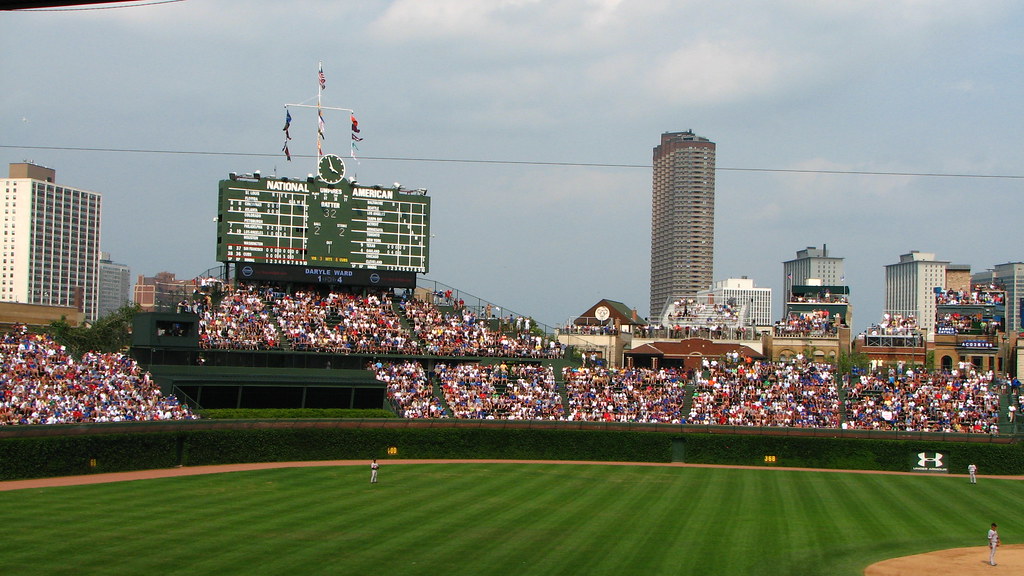
Visiting baseball parks to see professional games was part of the agenda on our trip. On Friday, July 12, 1985, we attended a Cubs vs Dodger game in the best ballpark we’d seen – Wriggly Field – a gorgeous real grass field, ivy covered brick outfield walls, and sunny blue skies. This is the city where fans fought for tradition – no lights at Wriggly. All games were played during the day. (The big business of baseball being what it is, that has changed. Lights were installed in 1988. Night games are played there now.) We stayed around after the game to talk to the winning pitcher, an L.A. Dodger from the Seattle area, Tom Neidenfurer. He won the game 7-4. Our friend Dickie Pederson had gone to school with him in Redmond, Washington and asked us to say hi to him if we crossed paths on our journey.

We returned to the Italian restaurant, Rosebud, which refused us service the previous visit because we wore shorts. This time we were properly attired and were served; cannelloni for Ken, lasagna for me, and spaghetti with meatballs for the kids. We were not disappointed. It’s a classy place with great food and a mellow musical accompaniment. Another evening, we went back to Miller’s Pub on Wabash. The local tavern filled with regulars who consumed large quantities of pasta, wine, and beer, while watching sports on TV had become our favorite, offering more comfort than class.


The next day took us to The Dells in Wisconsin and on to Appleton where my grandmother, Bessie, was born. She left home at nineteen to be a Harvey Girl and travel across the country to Wyoming where she met the love of her life. I wrote about her in my blog post of September, 2023. Travel and adventure run in my blood. I’ll add more stories to our journey as memories bubble up.