Unknown's avatar

About Diana

I'm a writer

Merlyn’s Miracle

It was Merlyn LeRoy VanRune’s birthday.  Merlyn felt every day of his ninety-two years, hell he felt every moment of them. When it was suggested that “getting old isn’t for sissies,” he no longer considered it a joke. He was living proof that to get old was an uphill battle worthy of a warrior.  It was a battle in which he lost ground day by day. Every bone and tendon now had a voice, and they actively proclaimed exactly how much they objected to Merlyn’s lifestyle. If he sat, his back complained, if he walked his hips or knees complained. When he watched TV his eyes blurred sending a message to his brain that they were aggrieved. His dark wavy chestnut hair was still wavy but sparse. The color had turned to pewter. When his daughter suggested they have a birthday party, he petulantly retorted, “Why would I celebrate this creaking body that consistently betrays me? It will only complain more…sending me dispatches via tweaks and snarls.” 

All things considered, Merlyn was in pretty good shape for his age. When he was seventy-five he had kicked the smoking habit at the behest (read constant nagging) of his wife, Trixie.  According to his doctor, he had “the heart of a fifty-year-old”. Doc Winter hadn’t mentioned if the fifty-year-old had other mitigating issues.  His prostate was gone so it didn’t bother him anymore.  He was exactly the right amount of deaf – he only heard what he wanted to hear. His appetite was good – he enjoyed red meat and vegetables, none of that vegan, vegetarian shit. He had one shot of whisky before dinner and one glass of wine with dinner and a small brandy before bed – moderation, always moderation, a word he disdained when he was younger, seemed to fit like a glove now.

Merlyn was a magician when he met Trixie. At the time he had contracted with the Frontier Casino in Las Vegas, he was forty years old and a confirmed bachelor. He was a rolling stone traveling the world doing magic shows. He started out in a sideshow at a circus, then worked in a variety of venues as he perfected his magic act. He performed many times at the Magic Castle in Los Angeles and had been accepted as a member of the exclusive Academy of Magical Arts. Finally, he had a gig in Las Vegas – the big time.

When Merlyn was hired at the Frontier, he needed an assistant and Trixie auditioned for the job. Trixie was twenty-three, long-legged, with a shapely body and the face of an angel. She was a palm reader, fortune teller, and astrologer who practiced magic on the side.  It was love at first sight. They both knew it, but Merlyn tried hard to ignore his feelings. He liked his vagabond life and never entangled himself in romance for more than a week or two. Trixie predicted their marriage the day he hired her.  She said their mating was foretold by the stars and they had no control over the stars. Merlyn, mesmerized by Trixie’s beauty and talent, capitulated.

They were married within a month and performed their act together. Five years later Trixie became pregnant and announced that Merlyn would have to change his profession, settle down, so they could have a stable home for their offspring. It sounded to Merlyn like she was planning a litter. He cringed, balked, and recoiled from the idea. Gently, in her magical way, she told him it was a fact, and he would get used to it.

So Merlyn became a realtor, a salesman of properties in southern California. He was the most successful realtor in Coachella Valley due to his charming salesman patter and the magic he performed for prospective clients. They were enthralled and he sold more homes and land in the area than anyone in history. As his client list grew so did his income. He and Trixie were very wealthy. They built a magical mansion in La Quinta. His business card read “Miracles for Sale”. It was a job he loved until he was eighty-five. The year he retired, Trixie died suddenly of pancreatic cancer after forty-five years of marriage, leaving him alone again. Merlyn was at sixes and sevens. She was the sun he revolved around and the years after her desertion were long and painful. He withdrew more and more into himself.

Their daughter Dora was an only child despite Trixie’s efforts to have more. Dora was married and lived 150 miles away. After retirement, Merlyn didn’t want to be around anyone and even begrudged Dora her monthly visits. Dora was at her wit’s end. Her father had fallen three times in two months. The last time he landed in the hospital with a body full of bruises and a mouth full of curses. His left knee was sprained but hadn’t broken. He could no longer live alone.  When Dora and his doctor insisted he needed to be in a monitored environment, his surly temper turned truculent.

She researched options and found Restview Haven. It was a five-star resort-like retirement community. She knew she couldn’t have him live with her family. Merlyn was a master of negative confrontation over every small thing of which he didn’t approve and he didn’t approve of much. At Restview he would have a luxury apartment with two bedrooms (in case she wanted to stay over a night or two), two bathrooms, a full kitchen, a study and three large walk-in closets, and maid service and laundry service weekly. He could have meals brought to him twice a day if he chose not to mingle with other residents. Someone would check on him first thing in the morning, in the early afternoon, and again in the evening, besides mealtimes.

Merlyn moved into Restview Haven, a move engineered by Dora. He was not happy about it. Now instead of his own company, he was confronted with a plethora of ancients who had even more complaints than he. He withdrew into his own apartment refusing to go to the community dining room for meals. He opted to make his own from a cache of deli meats, rye bread and mustard that was delivered from the market or pizza from Eddie’s Pizza Palace. Dora, tried everything she knew to pull him out of his funk, but his only response was “leave me the hell alone unless you want to be disinherited.”

On this ninety-second birthday, he grudgingly agreed to go to lunch with his daughter, son-in-law, three grandchildren, and great-grandson LeRoy (named for his great-grandpa), age two. Now he was back at Restview. The luncheon celebration was everything he feared it would be, Happy Birthday singing, a tasteless cake that was smeared all over his jacket by the two-year-old, and crummy food. Even his glass of Burgandy tasted bitter.

He decided to sit for a while in the large common room near the lobby to read his newspaper before going up to his apartment. He picked an area in a secluded corner with large potted trees on either side of the overstuffed pastel brocade loveseat where he sat, reading and glancing at people as they came in. He was engrossed in the real estate section of the paper when he felt a presence near him. He looked up to see a boy staring at him shifting from foot to foot.

“Can I help you, young man?” Merlyn inquired. “Aren’t you supposed to be with someone?”

“I’m here with my great-aunt Lula. She’s visiting her sister Lottie. She’s my great-aunt too but she smells. Aunt Lula said I could come down here and sit and wait for her for a while if I didn’t raise a ruckus. I’m not raising a ruckus, and I’d like to sit with you.”

Merlyn sat squarely in the center of the wide loveseat with pieces of his newspaper on either side to discourage anyone from joining him.

“Well, I don’t know. Wouldn’t you rather sit in one of the big chairs in the center of the room, where your aunt can find you?”

“No. I think I’m s’posed to sit with you.” The boy moved the papers all to one side and plunked down on the loveseat next to Merlyn.

“Why me? Who told you that?”

“Jus’ know it,” said the boy. “My name’s Bobby Cox, what’s your name?”

Merlyn looked around the room. People were coming and going and not paying any attention to him or the boy.

“I like that you are an old person and you don’t smell,” Bobby continued. “I’m very sensitive so stuff like that is important. You look interesting and I’d like to talk to you.”

With that somewhat convoluted complement, Merlyn thought he could entertain a few minutes with the boy. If it became insufferable, he could always leave and go to his apartment.

“OK, for a few minutes. How old are you, Bobby?”

“Well, that depends. I’m eight years old now but I’m older in another life, but not as old as you.”

“Another life? How old do you think I am?”

“Oh, probably close to a hundred. But it is just a number. My great-aunt says I am precocious and sometimes beyond my years. I like stayin’ with Aunt Lula. She lives in a big house with lots of collections.”

“Why are you staying with your aunt? Where are your parents?”

“My dad’s a big shot and travels for his job. This time he was going to Swiser-land and Mom wanted to go along but they didn’t want me under their feet. As if. Why would I go under their feet? I stay with Aunt Lula when they go places for more than a week or two. I’ll be with her for a month this time, but I don’t mind. They’ll bring me something from Swiser-land, and maybe take me when I’m older.”

“What kind of collection does your aunt have?”

“She collects trains of all sizes, some really big and some really tiny but they all look like real trains. She collects buttons and keeps them in jars all around the house. She collects glass insulators. Do you know what those are?”

“You mean the glass bulbs that used to sit on top of telephone poles?”

“Yeah, they’re blue or green. I never seen them on telephone poles but that’s what she told me. She has a big glass cabinet of them. And she collects matchbooks from everywhere. Do you know what a matchbook is? It’s a cardboard folder that has rows of cardboardy matches inside and a scratchy place to strike the match. She has them from every city in the world, mostly from restaurants. Some have pretty pictures on the covers, some are very plain, but she can tell me stories about the places where she collected each one. She collects corks from wine bottles and frames them in picture patterns – collage she calls it. She collects stamps from all over the world and writes to people in faraway places so they write back with stamps on the envelopes. And guess what?”

“I can’t begin to guess, Bobby. Tell me.”

“You never told me your name. You have a quarter in your ear.” Bobby reached up behind Merlyn’s ear and produced a quarter.

That was a trick Merlyn had used for his daughter and her friends when they were children. It took him by surprise to have this youngster play it on him.

“You must be a magician. My name is Merlyn.”

“Merlyn is the name of a famous magician. Did you know that?”

“Yes, I do and I’m a magician too.”

“Well, that must be why I’m s’posed to sit with you. Can you show me a trick?”

Merlyn reached into his pocket and pulled out a coin. “I’ll make this coin disappear.”

“Oh. that one. It’s easy. Can you do a harder one?”

“I’ll have to go to my apartment to get something that I can show you.”

“OK.”

Merlyn went to his apartment to get some cards, a pencil, and a rubber band for a couple of easy tricks he could show Bobby.

When he returned Bobby was gone. Merlyn went back to his apartment feeling lighter. The next day he went to the reception room again with his magic kit hoping Bobby would come in with his aunt. After a couple of hours reading his newspaper, he retired to his apartment disappointed.

The following day, there was a knock on his door. He opened it to find Bobby.

“I have to go to the bathroom. D’you have one in here?”

“Of course, come in. How did you find my apartment? Does your aunt know where you are?”

“I told her I’d be with the magician.”

“You go to the bathroom and then we’ll go downstairs to the reception area so she can find you when she wants.” 

“It’s okay if I stay here. She’ll find me.”

“No, I want to be in a public area, so she doesn’t have to hunt for you.” Merlyn wasn’t ready to have anyone, let alone a child, invade his personal space.

Merlyn and Bobby spent an hour downstairs in the same nook where they met. Merlyn showed Bobby some magic tricks. Then the receptionist paged Merlyn to say he had a phone call. His daughter tried his cell phone, but he didn’t have it with him, so she called the main switchboard to track him down and tell him it was important that he call her immediately. Merlyn went upstairs to get his phone. Dora told him she had scheduled an appointment with his orthopedist early the next morning. When he returned downstairs, Bobby was gone.

Merlyn met Bobby three more times that month, always in the downstairs common room in their cozy nook. Bobby shared some of his magic tricks and Merlyn showed him more. Merlyn practiced magic in the common room as he waited for Bobby. Other residents gathered to watch his magical exhibitions. Merlyn began to make friends with his neighbors. His outlook improved, his temper leveled out and his old charm returned. 

Bobby didn’t show up for several weeks. Merlyn asked the residential manager if he could contact Lottie. He didn’t know her last name but maybe it was Cox. He wanted to find out if he could see Bobby again, even if they met somewhere else. Mrs. Binghamton said there was no one named Lottie living at Restview Haven. She tried Carlotta, Charlotte, and other names that could be shortened to Lottie, but no one had heard of Bobby Cox. No one remembered someone named Lula visiting Restview. No one with that name had signed in as a guest. No one remembered a little boy coming or going with an old woman. But magic had returned to Merlyn.
Nine Eleven O’One

I’m sure all Americans who were adults, even children on September 11, 2001 remember the horror of that September day. Ten days later I was on a plane from Tucson to Seattle and the images of buildings toppling and people throwing themselves into the air were fresh in my mind. Could it happen again? When? Where? How would it feel to be the sacrifice to that terror. This is the poem I wrote while on the plane to Seattle. On the twenty-third anniversary, I am wrapped in the emotions I felt that day.

Billowing palisades, pewter airfalls

            Cascade in slow motion

                        Overflowing the fountain of commerce

                                    Gracefull and grotesque

Soft tarnished silver clouds

Enfold futures lost

                        Spewing them

Into a bright Manhattan morning

Elegant plumes tumble gently one over another

            Carrying tattered remnants of lives

                        Ripping spirits from bodies

                                    Turning their shells to ash

Is there a torture more sublime

            Moment by moment terror

                        Smelling the hot acrid breath of death

                                    Approaching their prison in the sky?

Does hope flee quickly

            Or does it leak slowing

                        From the corners of their eyes

                                    As the dusk of life turns to night?

Written September 21, 2001 on a plane from Tucson to Seattle.

Adventure in Avignon

In 1999 my daughter, Shari, and I went on a European excursion. We visited England and Scotland, then took the EuroStar (a train that dives under the English Channel) to France. We are both Francophiles so the very air of France and especially Paris made us giddy. I had been to France previously, and it was exciting to share it with my daughter on her first trip. Our final destination was Barcelona to visit our niece and her husband, Disa and Pedro. After a few days in Paris, we took the Eurail to Avignon intending to drive the rest of the way exploring Provence.

Avignon is an ancient city in southcentral France, walled in by the Romans in the first century and used as a fortress over centuries. It served as the Vatican City for the Popes in the 14th century. The impressive gothic Palais des Papes was the residence of seven successive popes. Avignon is on the banks of the Rhône River with a bridge across the river that became popular in a folk song describing people dancing across the bridge, “Sur La Pont D’Avignon”, a song every French child knows and anyone who studies the language is taught.

Our adventure in Avignon is the set piece of this story. The third day after looking around the city we decided to take in a movie. It was called Drôle de Père in French or Big Daddy in English. We went to the theater, bought our soft drinks and our choice of sugar popcorn, caramel popcorn, salted popcorn, or cheese popcorn. I got salted, Shari chose caramel. We watched the hilarious antics of Adam Sandler trying to impress his girlfriend with “his son”, who was actually the five-year-old son of his friend. It was dubbed in French and watching it made every line even funnier.

After the movie, we returned to our hotel before we went out to see more of Avignon. I checked for my purse. I had put it in the back of the closet. It was gone, stolen from our room. Shari had her purse with her. I didn’t want the whole bulky purse so only took my waist pack with my wallet and passport. Our airline vouchers for the prepaid return tickets home and our prepaid vouchers for the rental car we were going to drive from Avignon to Barcelona were gone.  Personal items including my grandmother’s mother-of-pearl rosary beads were GONE. I was most upset about the rosary beads because it was the only treasure I had that belonged to my beloved grandmother, irreplaceable. But, of course, we were very concerned about our travel vouchers. How were we going to get to Barcelona? Was I going to have to call Pedro in Barcelona to bail us out? How would we return to the States?

Shari has some college French, and I have high school French. Enough for us to limp along in Paris where English is universally used in tourist locations. In smaller towns, there are not as many people who speak or understand English. We went to the hotel concierge and told him of our dilemma.

“Ah, madame, je suis désolée,” he said, “Vous devez vous rendre à la police et faire un rapport.”  (So sorry. You must take yourself to the police to make a report.)

I wanted to say, Monsieur, it must have been an inside job – someone from your staff who had access to our room – but I didn’t have the words nor the inclination to argue with him because I wanted to get to the police as soon as I could.

A police report! Oh my, what would that look like? Visions of American TV shows about police departments, chaos, and disinterested officers taking down statements with a yawn if they didn’t include murder. How would I get across the urgency of our need to recover our paperwork quickly so we could continue our journey? We were expected in Barcelona in five days. Not a lot of time to hang around police stations and wait for someone to take notice. Besides it would all have to be done in French! Oooo-la-la.

Off we went to the address given for the Commissariat de Police. It appeared to be a storefront operation, not a big imposing building. We walked through the glass door, no security. A young man greeted us from behind a glass-topped desk and we did our best to explain to him why we were there. Two or three other uniformed men were in that front office.

“Eh bon, tellement désolé que vous ayez été volé” he calmly said. “Nous pouvons vous aider.” (Ah, good, sorry you were robbed. We can help you.) I felt this was not the first time he’d heard a story like ours.

He ushered us into a glass-enclosed office. He offered us seats in front of the desk. No one was in the office.

This is what we saw: a simple wood desk with nothing on it except a telephone; totally clean, no papers, no files, no pens, nothing; a padded desk chair behind the desk. We sat in two padded folding chairs. A couple of bookshelf units stood against one wall, only a few (I mean three or four) books or notebooks in each unit, the rest bare shelves; no computer, no printer, no file cabinets, no clutter. I began to look around.

I said to Shari, “Do you think this is a real police department? Are we on candid camera? Is this a spoof for foreigners? Where are the criminals waiting to be jailed? Where is the chaos of an active police station? It looks like a movie set before they holler ‘Roll ‘em’. It’s just too quiet to be real.”

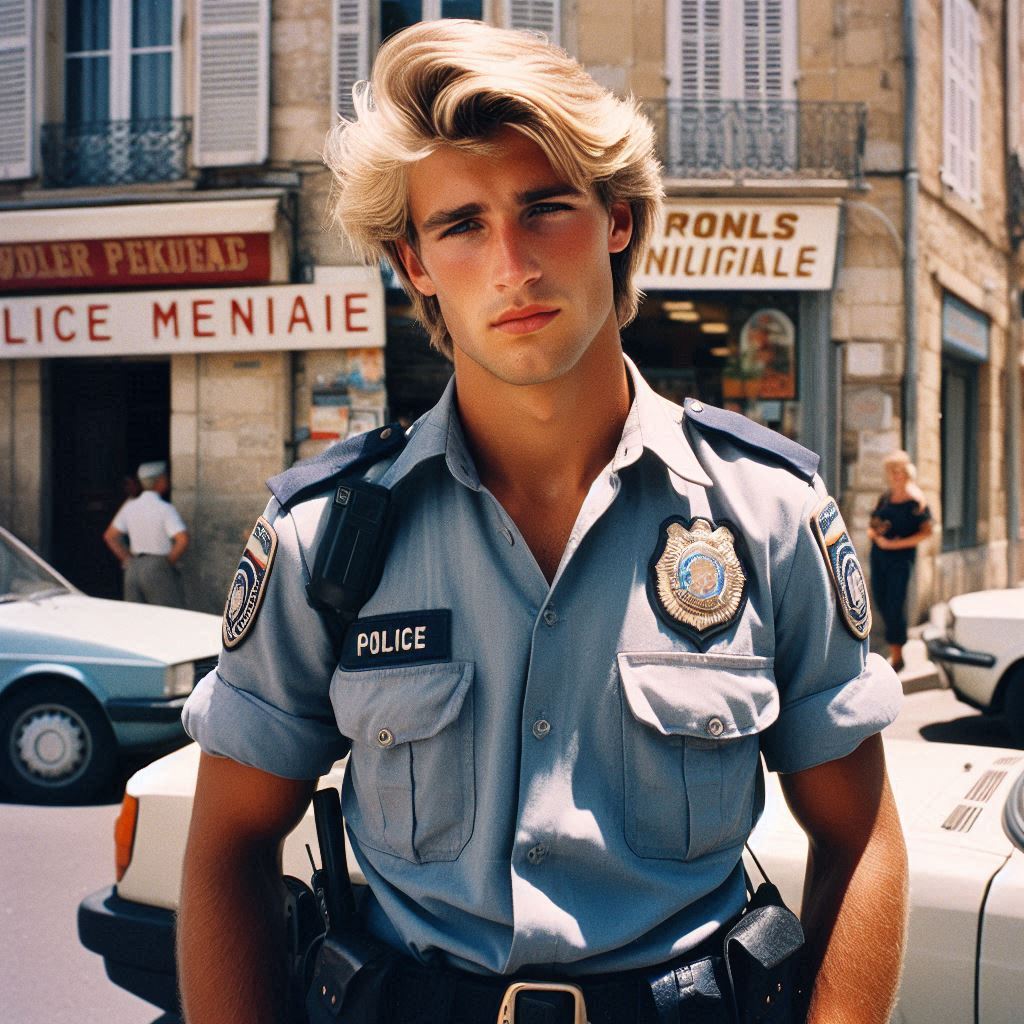
Enter a young man in a uniform – central casting, tall, blond, and beautiful. He smiled and offered a handshake. In halting English he said, “I’m sorry your trip has been interrupted by this mistake.”

“Mistake?” I’m thinking.

“Ce n’est pas un mistake,” I said. “It was a robbery, and we lost all our papers for our trip. We are expected in Barcelona in five days and then we return to the U.S. in a week.”

“Oui, un vol, excusez-moi.” he continued calmly. (Yes, pardon me, a robbery.)

Our discussion went on with him speaking in French with an occasional errant English word and me speaking in English with an occasional fractured French word. Lots of gestures accompanied the conversation. Shari did her best to translate here and there. The policeman seemed to understand everything we told him but was not making any notes or looking for forms. He did ask to see our passports.

Finally, he said he would sign a police report, and we could take it to the rental car agency to get our car. He assured us that it would also be enough evidence to have airline tickets reissued. Not to worry. He was completely unruffled, and matter-of-fact. Wait! Wait! Where was the investigation? Where was the fingerprinting? Where was the drama? Drôle indeed. I wondered if this was some kind of setup, some kind of con to make tourists relax before they laid down a hammer and charged us oodles of dollars to get out of their country.

After all, the French have a universal reputation of being haughty, rude, and nasty to foreigners. That had not been my experience on my previous trip to France, but there is always a first time, and this time was serious. Could we count on their assistance?

A one-page printed report was issued within fifteen minutes. We left the police station, still shaking our heads at what we perceived as the unusual calm we encountered. We went directly to the rental car agency. I explained our situation and showed them the report, preparing for an onslaught of questions and requests for proof beyond the report. They asked to see our passports, then handed me the keys to the car. It took less than ten minutes.

It still felt surreal. To be in a foreign country, being robbed of all our paperwork and still being allowed to rent a car so simply. It takes more effort to rent a car in my hometown.  

Gleefully, we left with our car. It was a Ford KA, a subcompact city car. Too small to be called a KAR – like half of a VW bug. No backseat, it was barely big enough for Shari, me, and two suitcases. We zipped along the freeway and through small towns like a gnat on a summer breeze. It was great to park. We fit anywhere we wanted, almost like a motorcycle. Each time we returned to our parked KA, I was surprised to find it still there. It was so small I could imagine someone coming along and picking it up like a child’s toy.

We stayed another day in Avignon then left for a winding trip through Provence and Occitanie along the southeast coast. We visited the cathedral in Nimes. We stayed a night in a nearly deserted resort town on the Mediterranean, Palavas. It was past the tourist season, being mid September, and all the hotels were closed. One very nice hotelier offered us a room overnight without any services. We were the only ones there. We ate a simple meal in a small restaurant on a canal that led to the Gulf of Lion. Fishing boats were docked along the edge of the canal. We visited the castle in Carcassonne, learning its quaint legend, and stayed in Narbonne; got lost trying to find a public bathroom; looked for carousels in each little French village (they all seemed to have one); and, Shari got to eat at a Mickey D’s in France. We crossed the Spanish border without a border check, arriving in Barcelona safe and sound, welcomed by a round of warm Spanish hugs and kisses from our family. We left Spain on schedule with no issues over airline tickets, just a very small fee. All that is another story or two…

And I Fly

Our writing group writes to a prompt for each meeting. A recent one was the challenge to write an anaphora poem. First I had to look up what an anaphora poem was. Anaphora is a literary device to emphasize meaning or create rhythm in poetry or prose by using a word or phrase repetitively.

It is exemplified by Charles Dickens’ – It was the best of times, it was the worst of times. It was the age of wisdom, it was the age of foolishness, it was the epoch of belief, it was the epoch of incredulity… giving a rhythm to the opening paragraph of Tale of Two Cities.

Or Martin Luther King’s – I have a dream…. repeated nine times in his speech delivering his dream of hope for our nation.

Or William Blake’s poem London: In every cry of every Man, In every infant’s cry of fear, In every voice, in every ban,…

This is my attempt at anaphora.

And I Fly

I fly in dreams

Across landscapes of imagination

Reaching for adventure.

And I fly

I fly across time

Unbounded through memory

Yesterdays as fresh as flowers.

And I fly

I fly with my mind

Examining my interior world

Life an unending mystery.

And I fly

I fly with words

Extending my thoughts

Through story and poem.

And I fly

The Gift I Took for Granted

Walking is prayer. Each day I try to walk for at least an hour and sometimes two hours. During that time I pray, meditate, listen to music or an audiobook. It is MY time to unload my stress, reload my gratitude, and fill my senses with God’s creations. I don’t use it to make plans for my day or my life. It is time for me to be present in each moment, not jump into the future or review the past.

Each walk starts with a prayer. I thank almighty God for giving me a healthy body and the ability to walk. I continue my thanks giving for all the blessings in my life, friends, family, and the beauty of the day. Once in a while one of the characters from a story I’m writing comes to take up space in my head as I amble along. I firmly let them know I’ll get back to them later after I get home but I try to remember what they tell me so I can write it down when I’m back at my desk.

I appreciate the gift of biped perambulating because five years ago I was couch-bound for over three months. I broke both of my ankles (one at a time prolonging recovery time – that’s another story about life lessons) and couldn’t do the simplest thing – walk. As a one-year-old, I learned, as most of us do, to move my body balancing from foot to foot, and took for granted that ability to move myself would always be with me. I was shocked when I couldn’t get up and walk. I used a scooter to get from place to place in the house, but I couldn’t WALK. I began noticing all the people who had walking limitations, using crutches, scooter, cane, staff, and walker. I developed great empathy for them. Until then I really didn’t notice them. I recognize now how hard it is to get oneself up, showered and dressed, and ready for the day when you cannot walk; what willpower it takes to get to the grocery store, to a job or do anything around the house.

I became very jealous of people who walked by or even worse jogged or ran by. Ken would take me for car rides to get me out of the house and I found rage bubble as I saw people walking. It struck me that unless I took myself in hand and made rehab my primary daily activity, I could possibly end up using a walker, cane or God forbid even a wheelchair for the rest of my life. Walking became an obsession.

I walked or jogged as a casual activity for decades never realizing what a gift it was. It was ho-hum, I guess I’ll go for a walk or go running at the track. I have strong legs and can walk miles without aches or pains. Not because of anything I’ve ever done, but because I am blessed with a sturdy body – hearty peasant stock.  I sometimes walked over seven miles around my town, to become familiar with neighborhoods. I hiked many trails around Tucson. Several times I hiked the nine-mile trail loop to the top of Wasson Peak in Saguaro National Park of the Tucson Mountains. I got winded by the 2,000-foot elevation change, but my legs never gave out. I’ve hiked various trails in the Catalina Mountains and the sandy trail at the bottom of Honey Bee Canyon.  I don’t know at what point my legs would get tired. I always feel I can do more, go farther. I haven’t explored my limits.

We built our house at the edge of Vistoso Golf Course so we would have open space behind us. The golf course owner went bankrupt and had to sell the property. Because of the town plan and zoning, it was hard to find a buyer for a defunct golf course. Without significant legal maneuvers, it couldn’t become housing. Finally, the Town of Oro Valley along with the Nature Conservancy group purchased the property as a Nature Preserve. Bonus! Not only would it remain open space but there would not be those annoying golf carts and maintenance vehicles roaming around our backyard.

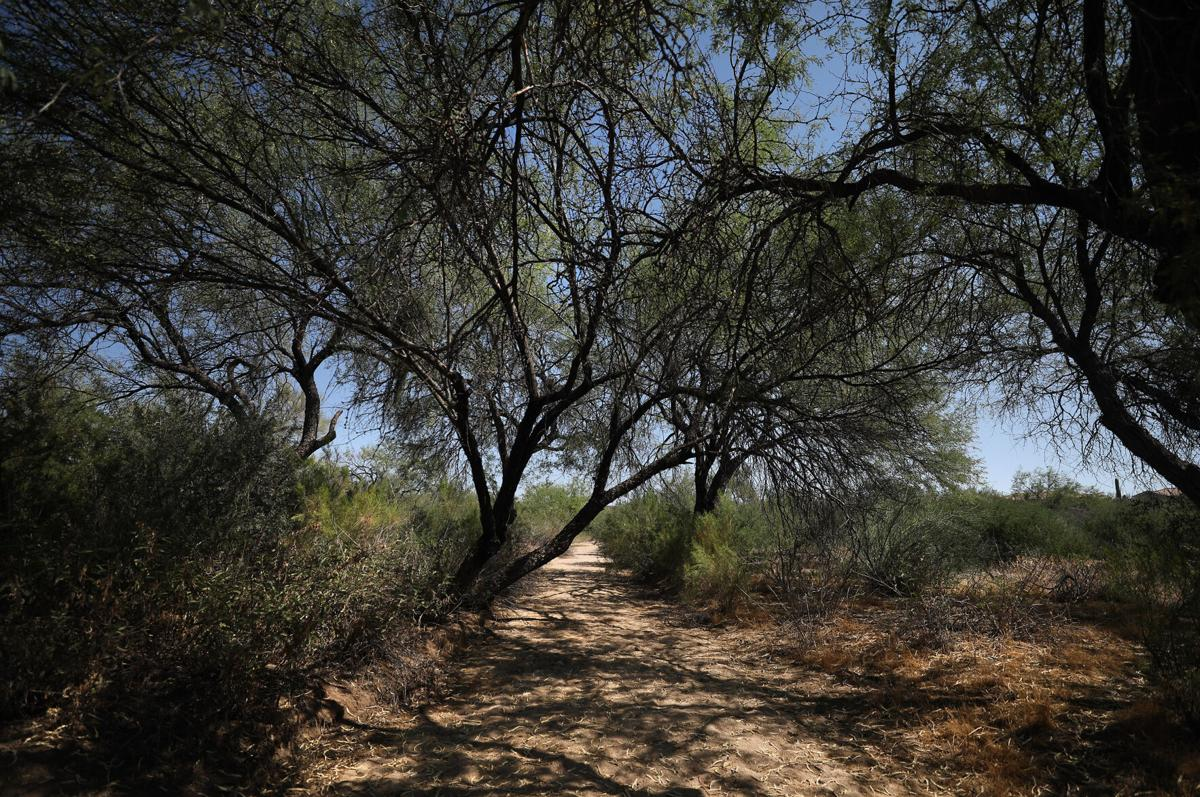
The Preserve is 202 acres with 6.2 miles of concrete trails (former cart paths) and many more miles of dirt trails crisscrossing open spaces. If you stay on the concrete path it takes about two hours to walk the loop. The wonderful thing is you don’t have to stay on the path. You can walk across meadows and through tree-lined washes making your own track. Foot traffic through these open areas has created alternate routes over the past couple of years.

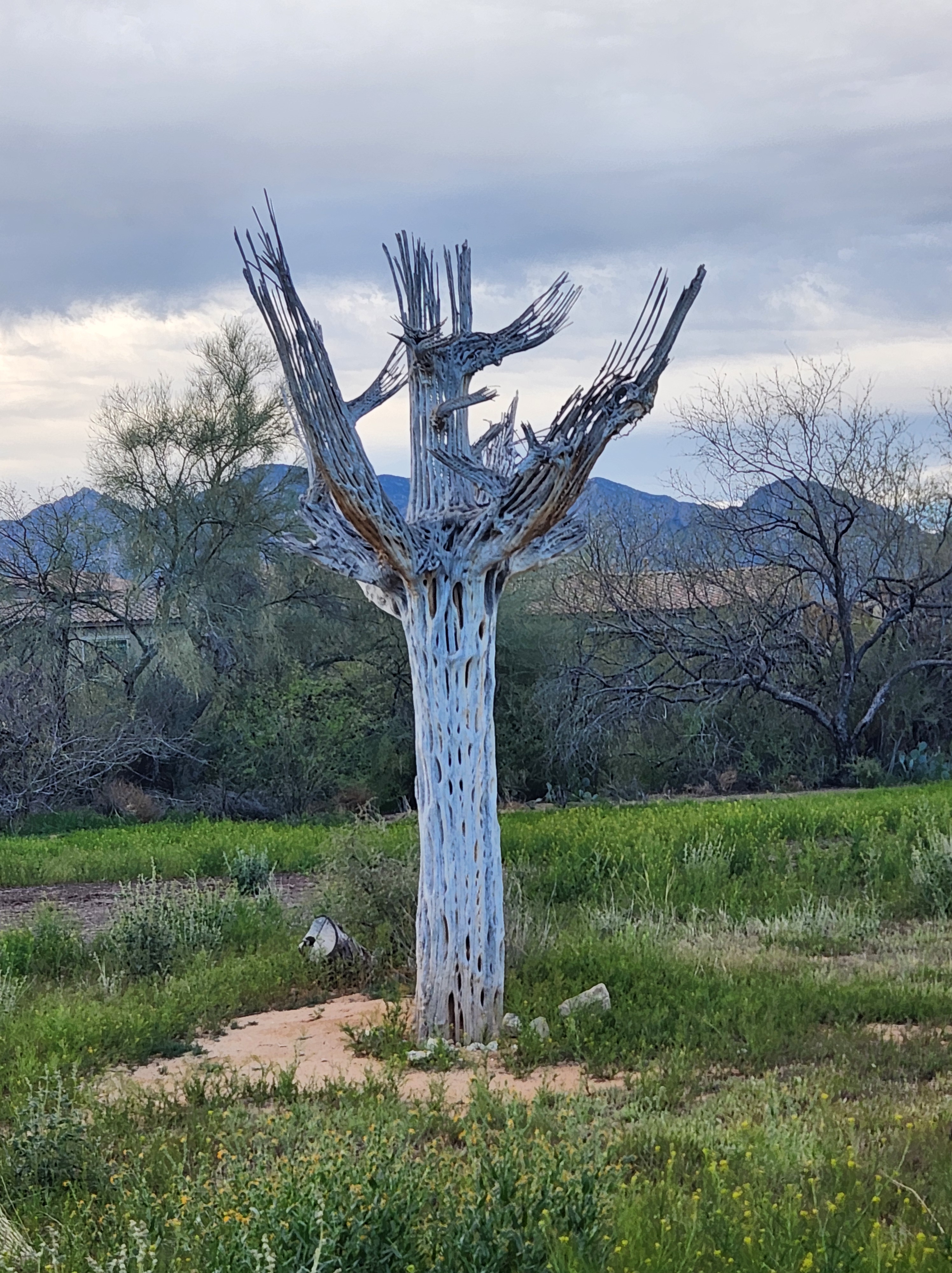
Ghost Saguaro

I am now so familiar with the Preserve that I’ve named each hill along the trail. For example, there is Castle Hill in the foothills of the Tortolita Mountains with a view of a castle-like rock formation. From this elevated part of the trail, you can see the Tucson Mountains to the west and the Catalina’s to the east.  Playground Hill passes the park in the CenterPoint neighborhood; Shady Wash Hill starts from a big shaded wash and climbs to a wide open field; Number Seven Hill where the seventh tee of the old golf course was and the marker remains. Meadow Hill climbs up to a big open meadow where I have seen coyotes romping through tall grass. There are among others, Ghost Saguaro Hill, and Petroglyph Hill. And on and on. I haven’t counted how many hills are on the trail, but I look forward to each one as I come to them on my rambles through the Preserve.    

I walk alone for at least an hour each day. My friend Roxanne walks with me for two hours on Saturday morning. I encounter many of the same people who live in the area and walk the trails daily as I do. We nod, smile, and say good morning, make short comments and observations on the day or the wildlife we see. There are couples, and dog walkers, but most are solitary as am I. A few ride bikes through the Preserve. I feel sorry for them because they whiz by all the beauty and natural wonders so quickly and miss observing the animals entirely. We dress in shorts or sweats depending on the season and t-shirts, and possibly a jacket in the winter, very casual since it is our neighborhood, home is nearby.

There is one group I come across almost every week. I call them the Imports. They are definitely not from the neighborhood. They wear backpacks and look like serious hikers. They have a leader who talks and points as they walk. I think they are part of an ecology group. They start in a close group, but I noticed, when I come across them later on the trail, that they become separated with stragglers sometimes fifty yards behind the leaders.

Wildlife is abundant. In other posts, I’ve listed all the animals that live in my neighborhood. Or rather I recognize that I live in their neighborhood. I’m grateful they haven’t gotten pissed off and left but instead stayed to share the area with us human invaders. Sometimes a deer or javelina will go by our backyard fence and look in at us sitting on the patio. It is as if they are taking a stroll through their environment, and we are the ones behind the bars of our fence like critters in a zoo. Although they are wild things they do not threaten or challenge us. I’ve had coyotes trot alongside me as I walk. They get within about twenty feet and match my pace. They are wary and keep an eye on my movements. I get no sense of threat from them. 

Bobcats don’t come as close when I’m walking but they have slept on our front patio, even on the chaise in our backyard.  Once while holding our two-year-old grandson’s hand I walked to the end of our cul de sac and nearly stumbled over a sleeping bobcat who blended so well with the vegetation that I didn’t see him until he stood up, stretched, and moved away into the wash. A bobcat slept unnoticed in our neighbor’s backyard wooden play structure and only left when the kids in the pool made a big racket and woke him. I know enough to keep a good distance from wild things especially if they have their babies with them. They can be dangerous if they feel threat.

Mostly I see a plethora of bird beings, in all varieties.  Bunnies and lizards/geckos of all shapes and sizes zip here and there in the underbrush or across the trails. Summertime means many of the animals retreat to the mountains and our valley is left with those that don’t travel. When cooler weather begins, the animals show up just as human snowbirds do. But honestly, the animals are more welcome because they don’t clog the streets and byways or crowd the restaurants and library. They add variety to my daily walks. They listen to my prayers.

Chicago: August 1984 and July 1985

Intro: From June 1984 to September 1985 our family of five plus two dogs traveled around the country in a three-quarter-ton reconfigured cargo maxi van pulling a thirty-one-foot trailer. Our trip began in Bellevue, Washington. We quit our jobs, took our three teenagers out of school, sold our two-story house, packed ourselves into the trailer, and took off on a grand adventure. Our 15-year-old nephew, Wally, accompanied us the first summer (four teens).

We had no cell phones, no computers, no GPS. We were off the grid. We didn’t even have seat belts. We traveled 50,000 miles crisscrossing the U.S. four times. Planning for the trip included library research and correspondence with all the Secretaries of State of each state we intended to visit. I had folders full of information about each state. Needless to say, the teens were not thrilled with the idea of spending fourteen months 24/7 with the old folks and missing a whole year out of school with their friends.


We went to all the contiguous United States, three provinces of Canada, and dipped into Northern Mexico a couple of times. After Christmas, we took a Caribbean cruise stopping at Jamaican, Grand Cayman, and Mexican ports. The objective was to show our kids their country, all the nooks and crannies, all the cultures and quirks, visiting museums, state houses, historical sites like Civil War battlefields, national parks, as well as small towns. We tucked in a few theme parks, and professional sports when a team was in a town we passed through. We endeavored to meet people in each region that make this great land. I am beginning to piece together our stories from letters, journals, photos, and memories. This is a snippet from our journey. These stories are taken from letters and journals written during the trip forty years ago and do not reflect the places as they may be today.


Chicago: August 1984 and July 1985
As we drove around the country we tried to stay on the “blue roads”, so named in the 1982 book by William Least Heat Moon, Blue Highways. It was one of the sources I used to plan our odyssey. That meant we were away from main highways – the red roads, arterials – instead using the minor, less traveled, roads that took us through small-town America. On paper maps – we didn’t have GPS or internet – the blue roads look like the veins of the human body, tiny but necessary for travel and commerce, the lifeblood of the nation. Big cities are very much alike but small towns are unique to their region and citizens. Of course, in order to visit major sites we needed to go into major cities.


We went to Chicago twice, once on an eastbound trip and once again on a westbound stretch. Both visits were too short. Some states we visited twice and some states, like Texas, seemed endless and it took us forever to get across.


Our family first visited Chicago in August 1985. At this point, there were five of us, Ken, me, and our three kids. Our nephew had to return to Bellevue before school started for the year. The closest campground we could find was in a town called Mokena about forty-five minutes south of Chicago proper. We parked our trailer there and ventured into the city. The late August weather was warm and sticky. Everyone wore shorts and short-sleeved shirts, except me. I had on a sundress.

We drove through the city and around the perimeter where we admired the Chicago River and the architecture of the buildings along it. We walked the Magnificent Mile with all the big stores such as Saks Fifth Avenue, and Bloomingdales as well as chic boutiques like Armani, Burdeen’s, and Gucci, none of which we went into. We saw the great Shedd Aquarium in its beautiful building filled with unbelievable beasties, amphibious and seagoing marine life. There are things there you cannot even imagine until you see them; plants that look like animals and animals that look like plants. The intelligent and curious octopi alone are worth a whole day. They interact with the public. I wish every large metropolis with a waterfront would take a lesson from Chicago. They made the lakeside a people-place with parks, museums, a planetarium, beaches, marinas, fountains, and gardens – all for everyone to enjoy. Their waterfront isn’t blocked off by factories, warehouses, or docks – it’s beautiful, clean, and fully accessible.

One of our friends told us we had never eaten real Italian food until we had food in Chicago’s Little Italy. So we set out for some REAL ITALIAN FOOD. Our local guidebook said that the Italian community in Chicago centered on Taylor Street. Consulting the map, we took ourselves to the west side of town. As we toured the neighborhood, we noticed large numbers of citizens loitering around street corners and sitting on stoops. The local occupation appeared to be indolence. There were dozens of boarded-up stores with Italian names even though the people on the streets didn’t appear to be Italian. Countless residences were rundown or abandoned.


While Ken drove, I pointed out Mama Rosa’s, Little Luigi’s, or Georgio’s as possible places for dinner. He shook his head.

“I wouldn’t leave our van on the street in this area,” he said. “I wouldn’t feel safe walking down the street with our family. We’re not eating around here. Look up something else, somewhere else.”

He turned back on Taylor Street toward downtown Chicago. I was not to be deterred. We were going to eat in Little Italy, no matter that the area had undergone a cultural transformation. We passed a restaurant, Bocciola della Rose (Italian for rosebud), with a fenced and gated parking lot. Three prosperous-looking senior citizen couples were entering.

“How about that place? The parking lot is gated and there is an attendant inside the fence. Don’t you think that would be safe?” I begged.
“Ok, we’ll try it.”

We quickly went around the block and returned to the gated parking lot where a young man of Italian descent, Guido, told us he would park our van and watch it until we finished dinner. Smiling from success, we proceeded into the dark narrow little restaurant which had a small bar as you entered the front door.

I led the way and, as the rest of our group appeared through the door, a tiny wizened lady rushed down behind the bar shaking her finger and head at us saying in very broken English, “We no serva the short.” It took three repetitions of this phrase for me to realize that she meant we were improperly dressed for her establishment. Sure enough, looking around we noticed all the men were wearing slacks and shirts with ties, some even had jackets and the women were all in dresses. – NO SHORTS. Imagine our chagrin after coming thousands of miles to eat in Little Italy, then finding its character altered and somewhat intimidating, then finding, with some reservation, a suitable place to eat and being turned away as undesirable. We left to continue our quest for Italian food in the Chicago loop. We ate our spaghetti and meatballs in Miller’s Pub on Wabash Avenue. Good American pub food, highly recommended and they serve shorts.

Our second visit to Chicago was, unfortunately as brief as our first visit the previous August…rush, rush, rush. We were there only a couple of days. We went to the top observation level on the 103rd floor of the world’s tallest building (at that time), the over 1,400 ft. high Sears Tower.


Visiting baseball parks to see professional games was part of the agenda on our trip. On Friday, July 12, 1985, we attended a Cubs vs Dodger game in the best ballpark we’d seen – Wriggly Field – a gorgeous real grass field, ivy covered brick outfield walls, and sunny blue skies. This is the city where fans fought for tradition – no lights at Wriggly. All games were played during the day. (The big business of baseball being what it is, that has changed. Lights were installed in 1988. Night games are played there now.) We stayed around after the game to talk to the winning pitcher, an L.A. Dodger from the Seattle area, Tom Neidenfurer. He won the game 7-4. Our friend Dickie Pederson had gone to school with him in Redmond, Washington and asked us to say hi to him if we crossed paths on our journey.

We returned to the Italian restaurant, Rosebud, which refused us service the previous visit because we wore shorts. This time we were properly attired and were served; cannelloni for Ken, lasagna for me, and spaghetti with meatballs for the kids. We were not disappointed. It’s a classy place with great food and a mellow musical accompaniment. Another evening, we went back to Miller’s Pub on Wabash. The local tavern filled with regulars who consumed large quantities of pasta, wine, and beer, while watching sports on TV had become our favorite, offering more comfort than class.


The next day took us to The Dells in Wisconsin and on to Appleton where my grandmother, Bessie, was born. She left home at nineteen to be a Harvey Girl and travel across the country to Wyoming where she met the love of her life. I wrote about her in my blog post of September, 2023. Travel and adventure run in my blood. I’ll add more stories to our journey as memories bubble up.

The “Little Woman” Steps Out

Courage is not the absence of fear but the action in the face of fear.

Courage is being the only one who knows you are afraid.

In the 1960s, the women’s movement was beginning to heat up again after a lull of about thirty years. During the 1880s women’s rights were asserted along with freedom for slaves. That resulted in legislation promoting the equality of women in society. There was a pause in progress during the Depression of the 1930s. Women were actually fired from jobs in order for men to have work. Men were deemed to be more important in the workforce and women were relegated to their “natural place” in the home, tending children and husbands. Then along came WWII, women again became essential in the workforce to keep our economy moving as men were shipped overseas to war. When men came back from war, women were reluctant to cede their place as wage earners. The war of the sexes ensued and the 60s were marked by legislative and social battles along with commentary from both sides staring into the gender gap. 

I, on the other hand, followed the path prescribed by society in those days, a homemaker. Being a mom was what I loved most. The role of stay-at-home wife and mother was the norm and the expectation of women. Married women who worked outside the home were still unusual. The only jobs offered were as teacher, nurse, store clerk, waitress, or secretary. Nothing much was required from me in the wide world except to keep a pleasant home for my husband and raise healthy children.

Where do I fit into the scenario of assertive women? It was accidental. I never considered myself a part of the feminist movement.

Ken worked two jobs for over a year to get the $900 downpayment for our house which cost $16,950. We had a monthly payment of $130 per month for principle, interest, taxes, and insurance – a third of his take-home pay after he quit the second job. It was our first home, a three-bedroom, one-bath, 1,000 sq. ft. mansion. We had two children, a baby and a 2-year-old, at that time. We moved into our house in a small community of Woodinville, Washington near Cottage Lake in December 1967, a neighborhood of one hundred very modest, indistinguishable homes. During the summer of 1968, I noticed some problems in our home. It was under warranty. I notified the builder, Miller Homes, and was virtually patted on the head and told, “There, there those are just normal things to deal with in a new home.” I did not believe them.

Ken said he didn’t believe it either. I called the Fire Department and asked for an inspection. They came out and found several code violations including that the vent over the stove was not connected to the outside. There were insulation, structural, and safety issues. I contacted the builder again with a request for someone to inspect the house and fix the problems. I was ignored. I ruminated on what I, a lowly 22-year-old housewife, could do to make the builder pay attention and fix our warranty problems.

I decided my lone voice was not enough. I typed up a petition of grievance, took the inspection report I had, and went door to door to each of the one hundred homes to ask people to check for problems and to sign the petition if they wanted warranty repairs done. I also told them I was going to picket the nearby new neighborhood where our builder planned a Grand Opening. I asked if anyone would like to go with me. I had 100% of the homeowners sign the petition and four people agreed to come with me on a Saturday to picket with our petitions.

I made signs out of butcher paper and markers for my car and the cars of the other volunteers. “DON’T BUY A LEMON.”  “BUYER BEWARE” “READ THE WARRANTY”. I wasn’t real sure of the law and I didn’t want any sign that named the builder or made direct reference because I didn’t want to be sued. I planned for us to park across the public street from the Grand Opening and stand by our cars with the signed petitions of grievance and the inspection report. I figured we’d attract enough attention that people would come over just to find out what we were complaining about. Maybe it would inform their decision to buy a Miller Home.

On the Saturday of the Grand Opening, all the people who said they’d go with me backed out. My husband was staying home with our two babies. A dilemma. Was I brave enough to go by myself and take the consequences alone? I decided I had to because I promised everyone who signed the petition that there would be action.

I did as planned. A little unsure of myself at first, I wondered what the reaction would be. Most of the people going into or out of the model homes walked across the street to hear what I had to say. I gathered courage from the response of prospective buyers thanking me for the information. After about thirty minutes, the sales manager came over and told me to leave. I declined. I was on a public street and told him he couldn’t make me leave. He said I would face legal action. I still declined, saying our next step was to complain to the State Association of Contractors. Finally, three men came over and said if I would leave, they would take a copy of the petition to the builder. I gave them a copy and left.

On Monday morning, my husband received a call at work. The builder told him to tell me to stop harassing their new home site. Imagine, telling a husband to silence “the little woman” who was making a nuisance of herself. Ken, my very strong, supportive husband, told them I was my own agent and he was not going to say any such thing. He said I had every right to do what I did and would continue until our demands were met. He went further to repeat we would report the builder violations to the State Association of Contractors if they didn’t comply.

The following day a representative of the builder came to our house and, sure enough, a swarm of construction workers went from house to house fixing the warranted problems that had cropped up in the homes. It took a few weeks to complete their tasks, but everyone was finally satisfied. I didn’t have to picket again. Once I knew I wasn’t going to be shot or sued, I enjoyed the attention and the hoopla created among the men. They took me seriously – no more dismissive attitudes.

Monsoons

Late Summer 2024. This is the best time of all in the desert when luxurious rain drenches the parched earth. Rivers and washes flow. The hills and mountainsides turn dark green. In summer most places in the U.S. dry out, the earth turns yellow and brown. But Tucson blooms. The delicate trumpet flowers of Texas Rangers flaunt various shades from the soft lavender of a morning sunrise to deep purple vibrations of a shiny eggplant. Succulent plants flower, pink, orange, red, and white.

Texas Rangers

This is the time I love the most. I have never understood why people head for the north country during summer in the desert. It is absolutely the most glorious time. The desert comes alive. Yes, it is hot, very hot. People don’t stay outside in 103 degree heat just as they don’t stay outside in 15 degree cold. Our hottest month is June and it tapers off through September. Only 50 or 60 out of 365 days are unbearably hot. Those are mercifully interspersed with cooler days of monsoon or mini-soons. We have become soft and civilized. Natives of this land lived and survived outside for generations. We leave an air-conditioned home, get in an air-conditioned car and go to the air-conditioned place of choice. Unbearable days are spent in air-conditioned homes, stores, restaurants, and offices. Movie theaters are kept at icy temperatures requiring a sweater as you watch your favorite stars act up on the screen.

I walk in our nature preserve almost every day, rain or shine, hot or cold. In summer, I set off early before the sun takes full command of the sky. I pause in shady places to examine the trees, meadow, and flowers around me. I come home drenched in sweat but so happy to witness the changes in the desert. In winter, I leave later in the morning and eschew all the shadows to take full advantage of the warm sunshine.

Most humans are comfortable with temps in the 60s. Anything below 80 degrees makes me shiver and requires long underwear. It is not because I have adapted to Southern Arizona. I’ve always been this way. I froze in Seattle for forty years, with temps rarely above the 60s. I’ve come to my comfort zone in Tucson.

Mama Quail with her brood

Bunnies become fat and sassy. Therefore, the coyotes have wonderful feasts and fill out their bellies as well. Plump quail parents shepherd their tiny eggs-on-legs babies across the path. Snakes are out warming their cold blood along paths and walkways. Best to avoid them although most are harmless. We do have the occasional rattler. Happy lizards and geckos of many types skitter through the brush. I stop to take photos of any cooperative critter. Javelina are most amenable to pose for me, so I have scores of javelina family photos.

Funny Bunny posing
Javelina Family

Ooooo – clouds have gathered, thunder booms, the branches of our big mesquite are bowing in the wind outside my window, and fat drops of rain splatter the walkway. The temperature fell from 101 to 78 in 30 minutes and humidity went up from 14% to 51%. I’ll go now to enjoy the show.

Cactus Flowers
Rattle Snake sunning on path
Horny Toad

The Shark and Me

I must confess, I am not a cleaner. My house has been kept tidy for years by an army of lovely women who like to clean, clean, clean. It is very low on my priority list. Since we retired, Ken said it was no longer in our budget to have housecleaners. He stepped up and said he would do it. Now we share some of the tasks because I like to keep the kitchen ship-shape so I can cook, which I love to do.

I recognize that clean is a relative term. One person’s clean may be another person’s squaller. My mother for instance was a clean freak. She loved to clean.  She had a full-time weekday job but it was her passion to spend hours on the weekends keeping things spic and span, washing everything from knickknacks to floors, woodwork and walls, dusting, mopping, etc. She derived great joy from her efforts.

As a young married, I tried to emulate her cleaning regimen but was never able to summon the passion. As our family grew, I drudged through a succession of small abodes in those early years like I was slogging uphill through mud. It never made me happy like it did her. Everything that was cleaned was dirty again within minutes. Ugh, I hated it.

I developed a skin condition called psoriasis. At that point, I was mom to three children under four years old, and with all the diapers (back in the day before paper diapers – everything was washed), kid cleaning, and house cleaning, my skin rebelled. I’m sure it had something to do with my reluctance to clean – a deep psychological kickback. The skin on my arms and legs cracked and bled. They were irritated, itchy, and painful. It began to creep up to my chest and neck. Then along came my knight in shining armor. My doctor pronounced that I was sensitive to dust, household chemicals, rubber gloves, even water used too much would make my delicate skin break out. In short, I was allergic to housework and if I didn’t stop soon the disease would become chronic. Well, I couldn’t stop cleaning my children so it was obvious that I would have to stop cleaning my house. Ken agreed to immediately hire a house cleaner. Within weeks, my skin condition cleared up completely and has never returned.

Ken was good to his word at retirement and shouldered most of the housework. Sixteen years later, Ken had to go into the hospital. It was supposed to be an overnight or maybe two-night stay but turned into three nightmarish weeks. At first with my attention totally on Ken and his physical wellbeing, I ignored the house. I kept the cat boxes changed. I didn’t cook so there was nothing to do in the kitchen. I was home only a few hours at night and that was spent trying to sleep.

I began to notice large clumps of black fur, white fur, brown fur. It is summer. The cats are shedding. I never saw that before because Ken would have the vacuum out whenever anything landed on the floor. I haven’t touched a vacuum in fifty years and hadn’t a clue how to start it. I needed some guidance so I could clear out the fur that was becoming ankle-deep. I imagined that when Ken came home it might be waist high at the rate they were going.

Ken said it was so easy and gave me a rudimentary lesson. I went home, and pulled the vacuum from the closet. That’s when I noticed it was named SHARK. The ominous theme music of JAWS ran through my head. Why was it not named Mrs. Trilby or Mr. Pristine – making one think of helpful servants, not a predatory monster.

Me and Shark had to get acquainted. He is an upright kind of guy, at least three and a half feet tall. In order to get his wheels going he needs to be clicked out of his military posture into a more relaxed sloping position. The problem I had was that his upper part (the heaviest section) when released, wobbles, swirling right or left and back again. He has very little control over his own movements when clicked out of his upright posture. Ken says he weighs about fourteen pounds, but I swear I was wrestling fifty pounds as I tried to get Shark to straighten up, mind my commands, and go in a steady line. He has three levels so he can pound on carpets or glide on tile and something in between. I had a hard time getting the correct setting while keeping his body from spinning around. I was holding the handgrip with two hands, like grasping the dorsal fin of a rampaging Great White as it veered this way and that.

AI-generated picture, not an actual photo

On my first try, I managed to sweep up a clump or two of fur but stopped as I started sweating. It just can’t be that hard. It was late at night, and I was really tired, I reasoned. The next day I tried again and didn’t get much better except I had Shark on the right setting.  Three days later, I left the hospital early (before dark) and got home determined to conquer the damn vacuum. I pulled Shark up to my chair and had a talk with him. I explained that Ken was ill and couldn’t be his partner in the cleaning dance. He would have to accept me and be patient with my clumsy steps. I tried not to blame him since, after all, he is a machine made by some satanic engineer, but it was difficult to keep from crying. I begged his indulgence as I pushed the start button.

It worked. He was rather more accommodating as I went from one room to another. We seemed to have reached détente. I wouldn’t say buddies, but at least noncombatants. The floor was beginning to reappear. Just as I was feeling downright successful, Shark tripped me. He wrapped his cord around my ankle and almost sent me down. I recovered, pulled the cord from the wall socket, and unwrapped my leg.

“Why?” I asked.  “We were getting along so well.”

Shark didn’t look the least bit chagrined. He stood there in that nonchalant posture daring me to blame him for my ineptitude.

“You just wait until Ken gets home. He’ll make you obey.”

I swear Shark shrugged.

DIANA – the magazine

I had so much fun with this idea, that I passed it on as a prompt to our writer’s group. The prompt was to envision yourself as something other than a person. Tell your story as if you were a building, a musical instrument, a machine, or any inanimate object. I chose a magazine.

Diana – the magazine

This magazine has been in print for seventy-eight years and witnessed many important events of the late twentieth and early twenty-first century. The slick glossy cover has transformed over the years. It has a more homey feel now.

The magazine has all the requisite sections including:

an Opinion Section where thoughts about current politics and local events are offered and discussions are welcome;

the Food Section offers luscious recipes of all kinds (the editor reserves the right to modify them at will);

the News Section where the daily events are downloaded and recorded for posterity;

the Puzzle Section where the conundrums of everyday life can be sorted and resolutions proffered;

the People Section is where relationships are explored and developed, gossip is encouraged if it has a positive vibe, and Grandson news is at the top of the page;

a write-in Advice column is active;

a Pet Section includes articles about cats, dogs, horses, guinea pigs, hamsters, rabbits, and bearded dragons. Recently added are articles about wildlife including javalina, coyotes, bobcats, deer, and a variety of birds. We may have to start a new section called Nature;

an Amusement Section contains articles full of unbounded happiness and optimism with lots of laughter and good humor;

during the 1980s and 1990s, the magazine had a robust Travel Section with mainly national and some international reporting. This section has been devoid of recent articles (travel having lost some of its former luster with delays, restrictions, and bullshit), but the management hopes to include more in the future;

the Sport Section contains sailing, skiing, horseback riding, and baseball articles with Baseball reporting the most invigorated at present (basketball news is rejected). Walking, as a sport, developed as physical limitations to the machinery producing the magazine became evident;

the Music Section explores popular music from the 1940s through 1990s, an emphasis on the 1980s, a modicum of present-day composers and singers, with a nod to the classical genre, especially Debussy and Vivaldi; Elvis, Sinatra, Alan Jackson, and Jimmy Buffett are prominent contributors;

a very active Literature Section features interviews with contemporary authors, along with reviews of books old and new, both fiction and nonfiction, and special interest in history. Stories and poems are published in this section;

a Wisdom Section was added in 2000 in acknowledgement of and engendering discussion of all things of a spiritual nature; a response to the natural facts of our human condition as we age;

a supplemental In Memoriam Section is published semi-annually in recognition and appreciation of those who made significant contributions to the magazine over the years but have moved on to a cosmos beyond this.

This magazine was initiated in Wichita, Kansas in 1945 and thrived there under loving development for about twelve years. Then the headquarters moved to Bellevue, Washington for a period of forty years. A co-editor was added in 1964. Then three satellite editors came on board in the late 1960s, adding extra depth and heart to all the articles produced.

When the machinery started locking up due to the cold and damp in the early 1990s, the magazine relocated to Tucson where it is currently ensconced in a more conducive environment. We plan to continue publication for the foreseeable future. The times they are a-changing, and we look forward to an interesting second quarter of the twenty-first century.

This magazine will no longer be featured at the front of the magazine section of the newsstand, taking a more unassuming place for discriminating clientele near the back.   

*photo is AI generated.