Puerto Vallarta Retreat

Picture prompt: Write a story about this magazine picture. The picture feels like peace. The quiet of a deserted beach on a warm sunny day. The serenity of aloneness. Who is this woman? Why is she so far away from anyone? Does she treasure her aloneness? Is she escaping from her life? What will the remainder of her day hold?

I am reminded of a time when I needed to withdraw to peace and quiet for a while.  It was April 1981, during an energy crisis, recession, and an explosive inflationary period (sound familiar?) with mortgage rates up to 18% (much higher than today). A very tense time for everyone.  I worked for a small homebuilding company. We were having trouble selling our inventory of homes. The carrying costs were mounting, removing any hope of profit and the ability to continue building homes. I had been in some intense negotiations on behalf of my company with a bank that threatened to foreclose on a major loan. We couldn’t continue business without renegotiating the terms of the loan for a year. I was tapped to represent the company by my boss, Rob, who owned the company. Over a period of two weeks, I met with different officers of the bank to discuss our position, our new marketing plans, and the benefits of maintaining our relationship with the bank. It worked. I don’t know how, but I was able to convince them to extend our loan with promises for the future and evidence of our past success.

At the end of negotiations, Rob told me to take some time off. My husband, Ken, knew how frazzled I was and urged me to go away on my own to regroup. He said he could manage our three kids and all their activities for a week. He thought I would go to see my best friend in Atlanta. She was my go-to when I needed a boost. Even though we lived across the country from each other then, we were still as close as we had been as neighbors during our school years.

I thought about it. Michele would be working while I was there. She had a husband and two kids. They were all busy with their lives. I would be an intruder and a needy intruder at that. I decided I couldn’t impose on them in that way. I didn’t call her even though I knew she would have encouraged me to come. Instead, I called our travel agent. Seattle was at its drizzly best. I needed quiet and sunshine.

“Where can I go to sit in the sun; where is it quiet and I can be alone for a week?” I asked.

“Does a beach sound good?”

“I’m not a fan of water, but if it is quiet I’ll try.”

“You can be on the beach without going into the water, you know,” Sheila said. “When do you want to leave?”

“Tomorrow. And it can’t cost too much.”

“Oh, that makes a difference. No planning, eh?”

“No, just a get-away for a week.”

“I can get you on a flight to Puerto Vallarta and an inexpensive but nice hotel on the beach tomorrow morning at 9 am. I’ve been there and can recommend it.”

“Sold,” I said.

When my husband came home from work that evening, he asked if I had talked with Michele.

“No. I’m going to Mexico.”

“What? By yourself?”

“Yes. Sheila said it is a nice place. She’s been there. It is quiet and not too expensive. I will be able to be alone with no agenda. It is perfect. The reservation is made. Will you take me to the airport?”

The next morning, Saturday, he took me to the airport, still apprehensive.

“You will come back, right?”

“Of course. Don’t be silly.”

Saturday: I arrived in Puerto Vallarta and took a taxi to the hotel, Playa Las Palmas.  It was right on the beach, as advertised, in the center of the crescent of Banderas Bay. I could step out of my room and walk a few yards across the pale sand to the startling blue water. I was nearly blinded by the midday sun. What a change from gray, cloudy Seattle. I went to the restaurant to see when dinner was to be served and perused the menu. Lots of fresh seafood. And margaritas. Perfect!  I went to my room to change clothes so I could sit on the beach. I decided to lie down for a few minutes first. I threw myself across the bed and when I woke, it was 9:00 am the next morning. I was still in my traveling clothes. I missed dinner and margaritas. I slept from 3:00pm the day before, 18 hours. I didn’t know anyone could sleep that long.

I called Ken to let him know I’d arrived ok and slept through the afternoon and night. I told him I’d call in a couple of days. This was before cell phones.  I was quite alone. No one could contact me except through the hotel. I called Michele to tell her I had escaped to Mexico. She was in shock too.  I took a shower, changed, and went for breakfast, my first ever Huevos Rancheros; then to the beach. I had a notebook and pen to write my journal and two books to read. That was how I intended to spend my days. There were a few people scattered around the beach. This was not the high season so everyone was spread out. I alternated between the beach and the shade of the cabana/beach cafe all afternoon, reading and writing a little or watching the water and the people.  Beach vendors wandered across the beaches from hotel to hotel selling their wares, colorful handmade wooden toys, beautiful scarves, churros, and locally made pottery among them. Hotel staff would sometimes shoo the vendors away, but they returned each day. I didn’t think they were intrusive or aggressive but they may have bothered others. 

I ate a late lunch at the cabana and talked with two women I had seen on the beach. They were best friends from Minnesota, Betty and Janna, who planned a getaway together to a warm destination every year. We had a nice chat and they asked if I’d like to join them for dinner at 7:00. I agreed. But first, I said I’d go to my room for a little nap. I don’t know why I was still so tired.

Sunday: The next thing I knew, it was 8:00 am.  I slept from 3:00 pm until 8:00 am. I missed dinner again.  I met the two women later that morning. They said they came to my room and knocked several times but no answer. They thought I’d changed my mind and went somewhere else for dinner. They said they were taking a tour to the jungle on the mountain above Puerto Vallarta and asked if I wanted to join them. I declined, needing to be solitary for a while. I spent that day mostly in my room, reading. I walked along the beach a few times but stayed to myself. I had a quiet dinner alone, and then a normal night’s sleep.

Monday: Day three of my adventure put me out on the beach again, soaking up the sunshine. I noticed a boat pulling people into the air with a kite. Parasailing. I’d never heard of such a thing. It looked like so much fun. I asked about it and soon had a reservation for that afternoon. Amazing!! Two crew members picked me up in a small rowboat on the beach and took me to a wooden deck out in deeper water. They hooked me into a sling-type harness.  I launched off the deck pulled by a motorboat – no water involved. It was wonderful. I soared under a big, curved kite around the bay for about twenty minutes. It felt like two minutes. They told me I sailed 250 feet above the water and land.  It was delightful. They landed me softly near the shore in knee-deep water. One of the crew was waiting and helped unhook me from the harness and off they went to take another para-sailor aloft. I talked with some beach sitters who witnessed my ride.  I had a quiet dinner alone and went to sleep.

Tuesday: The next day I decided to go on the jungle tour that the Minnesota ladies told me about. It was a great half-day ride through the mountainous jungle above Puerto Vallarta. We had a small bus or tram that held about twenty people. We were told to be on the lookout for jaguarundi and margay which are small wild cats, but I didn’t see any. There were a few monkeys spying on us from the treetops. I believe they were called spider monkeys.  We saw the place where the movie, Night of the Iguana with Richard Burton, Debra Kerr, and Ava Gardner had been filmed. The tour guide filled us in on gossip from the movie set. It had been filmed nearly twenty years earlier in 1963-64 when Burton and Elizabeth Taylor were having their notorious affair. Lots of gossip.  We saw women washing clothes in a river we crossed. The poverty of the people around Puerto Vallarta was evident. I had dinner that evening with a husband and wife from San Diego who I met on the tour. They told me they were going to a nightclub that night at the edge of the city where it was reported there was a good band and dancing. They asked if I wanted to join them, and I declined. Needing more quiet time.

Wednesday: The following day I walked the beach from my hotel toward town. It took a little over an hour to get up from the beach into the old town. I walked all around looking into churches and shops. I bought a sandwich and soft drink for lunch as I strolled through the village. It was very small, only a few streets. I think the population was around 20,000 give or take, including the surrounding area. Two things that stuck in my mind were the children walking to school and going home in the afternoon. They wore white shirts and dresses. I mean white, white. I don’t remember ever seeing such clean children. The townspeople looked like they were very poor, but their children were impeccably dressed.  After witnessing the women washing clothes in the river, I was surprised at how snowy the clothes were. I guess sunshine had something to do with it. The other thing I noticed was armed police or guards outside banks and other businesses. They weren’t menacing but they were present. It seemed odd in so small a town. Sidewalks were uneven or missing in places. The townspeople that I spoke with were courteous and friendly, few spoke any English so we had interesting conversations with Spanglish and gestures. Those were things I noted in my journal. I walked the entire day and went back to the hotel tired. I’m sure I had dinner but I didn’t note it in my journal.

Thursday: The sixth day I met up with Betty and Janna and agreed to go with them that night to the dance club I heard about two days before. They were leaving the next morning, Friday. I don’t recall what I did during the day, but I’m sure I was either on the beach or in my room reading. That night at 9:00 we took a taxi to the nightclub, a fifteen-minute ride up the mountain out of town. There was a fun salsa band. Several of the local men and women showed us three Americanas how to salsa. The band played contemporary rock and roll tunes as well and everyone danced. I danced with Betty and Janna and whoever asked me and had a grand time. I also drank margaritas until 1:00 in the morning. My two friends left around 11:00 saying they needed to be ready to go to the airport in the morning. I asked someone, maybe the club manager, to get a cab for me, but he said the cabs were done for the night by 12:00. He offered to call a friend. Hmmmm. If I hadn’t had all those margaritas, I’m sure I would have been more judicious. I wouldn’t have stayed longer than my friends. I wouldn’t have been without a ride to my hotel. But here I was. It was pitch black outside. I mean you couldn’t see anything, not even outlines of trees when you were away from the building lights. I didn’t know my way down the mountain to the beach and my hotel on dirt roads. I was stranded. By the way the manager offered a ride, I am sure I was not the first American who made that mistake. I agreed to the ride offered. Two local fellows in a broken-down sedan, no spring in the backseat, came to pick me up. They asked where I wanted to go. I told them and asked how much they charged. They gave me a figure that was reasonable and away we went. They did not speak English with any proficiency, and I don’t speak Spanish, so they talked to each other as I sat mute in the back, praying I’d get home to Seattle in one piece. I did not have to worry. They were very kind young men. They took me directly to my hotel; I paid them and gave them a nice tip that reflected my relief that I hadn’t been kidnapped. I said gracias many times and threw in a merci and a thank you for good measure. They laughed and drove off, having done their good deed for the day.

Friday: The seventh day was my last day. I had somewhat of a headache when I woke up so the day was very low-key. I had a late breakfast and said goodbye to Janna and Betty as they left for the airport. They asked how I got back to the hotel. They told me they were concerned but needed to get back earlier than I wanted to. I assured them that I was well taken care of. The remainder of the day I spent reflecting on my trip. It was meant to be a recovery trip, and I guess it was. I slept more hours in that week than I had in months. I felt ready to resume my everyday life. In fact, I was eager to get home. I met several very nice people; some I talked with in fits and starts through different languages. I tried a new sport. I had only been in the ocean once for a few minutes after my parasail. I ventured into a jungle (albeit with a whole group of travelers) and I walked the beach and town for a day feeling very much at home in the strange environment. My alone time had been interspersed with many people and it all felt perfect.  I guess being completely solitary is not something I can do. I need people. 

Saturday: Ken met me at the airport when I returned. Everyone at home survived my retreat just fine. All was well. I was happy and refreshed. Ready for my next challenge.

Bumper Stickers for Life

In December 2008, our grandson, Henry, was born. The light of our life, a joy, a gift. I wholeheartedly love my children and there is something so special about a grandchild. As he grew, I started writing little notes for him in one of my journals. In 2010 I consolidated a few of them in a document on my computer intending to continue collecting my “bumper stickers” as he grew and developed. I shared my thoughts with him along the way when events warranted a little grandmotherly advice. Now on the threshold of manhood and taller than his Grandpa, I decided it would be a good time to deliver these ideas in written form. I chose to write them all in a card/booklet for his 16th birthday. He loves cards – even more than gifts.

Advice to Henry Cooper (age 16 months), March 2010 

“The purpose of life is not to be happy. It is to be useful, honorable, to be compassionate, to have it make some difference that you have lived and lived well… To know that even one life has breathed easier because you have lived. This is to have succeeded.” ~ Ralph Waldo Emerson 

Grandma says:

Pay attention to your Mother. Love her and honor her. She created her world around you. Respect the person she is, the place she made for you, and all she has shared with you. She loves you most.

Respect your Grandpa, love him, and learn from him; especially how to play baseball because he was a pro, you know, and golf because it is his passion, and he will love you even more if you can beat him at it.  Don’t follow too closely his advice on horseracing.  Remember Life Lessons from Grandpa. They will serve you well.

Love your Grandma, because she loves you with all her heart. Put your sweet arms around her and give her butterfly kisses whenever you see her – even after you have grown whiskers, for she will always remember the smooth cheeks of your babyhood. Read her a poem.

If indeed bad things happen and they will, my boy, remember that life is best lived going uphill, scrambling over the rocky humps because when you attain a summit you will have such a beautiful vista and so many great stories to tell, AND there is always another summit to reach for.

Laughter and humor are as essential as air. Laugh with your heart and your belly. Look for the fun in everything, even broccoli. 

Live with your heart open. Fall in love. You are meant to love and be loved. Be deeply, passionately, and lustfully in love. Love gives you the greatest highs.

Gratitude. Be thankful every day for the blessings you have. Don’t compare to anyone else. Be grateful to God and all who are in your life daily. 

Welcome God into your life every day. HE is the reason you are here, and HE will guide you to your best destiny.  Bathe in faith. Talk with God. Put HIM on speed dial. HE ALWAYS listens. HIS answers may be unexpected. HE sometimes says no… like when I ask to win the lottery.

Be of service daily. Even if only holding a door open for someone or offering a smile to someone who looks unhappy. There are so many, many ways to serve and it will add to your happiness as well as to the one you help. Service has a ripple effect.

Make choices with intention. Own your choices.  Inaction is also a choice and, if you don’t choose, you leave it for others to make decisions for your life and you might not like the results. Ask advice, consider options, and then choose your own path.

Listen, learn, and don’t follow the crowd if it is heading off a cliff. Listen to your gut.

Make music a part of each day. Music connects to your spirit, it heals, it moves you, it lifts you.

Never hate.  Hatred corrodes the container that holds it.

Make mistakes, fall down, skin your knees. Perfection doesn’t happen. You will learn best from failure how to be a success. Pain is inevitable and is a great teacher.  Your success is up to you. The harder you work, the stronger you become. The road of life is always under construction.

Hold Happy. Happiness is a choice. It comes from the inside not from anything outside.

Release Anger. Anger hurts you more than your intended target.

Practice Forgiveness. Forgiveness allows you to move on in life without the burden of hate and anger.

Confront fear. Take Chances. Fear and its brother Worry rob you of today, physically, mentally, and emotionally. With Fear and Worry you replace “What’s happening” in the present by borrowing “what might happen” from the future. STAY PRESENT.

Have Faith. Faith is knowing you can meet whatever comes your way with confidence because you have the internal resources to surmount adversity. At the very least you will gain wisdom from navigating through the experience. Overcome adversity and you will be stronger on the other side. YOU have the power.

Be a gentleman. A man’s manners are his portrait. Character is worth more than gold. Your style is your passport in human interaction. You are a male by birth, be a gentleman by choice.

Develop a will of iron and retain your soft heart.

Apologize when you are wrong.  Honor Truth.

Eschew jealousy. It is a poison that generates evil thoughts and deeds.

Don’t complain. Complaining makes you stuck. You are master of your life. Choose a positive attitude toward people and events and move on.

Live your highest dream. Don’t let fear detour you. You will conquer anything when you make it your goal.

Listen. Close your mouth, open your ears. You learn more when you listen.

Be Curious. Learning is a life-long process. Embrace it. Read, read, read. You will NEVER ever know everything. Learn to cook, build, sew – be self-sustaining. Curiosity is the root of all success.

Always put the toilet seat down!

Remember the ONLY constant is CHANGE

Write daily. It clears your thoughts and finds truths. You are the author of your life. Create your own story. Always use spell-check…but making up words is fun too.

Remember Elvis is King!

Be Present.  Life is abundance. Embrace it and you will want for nothing. Whatever you go through in life, there will always be another door you can open.

No drugs. Be responsible. Drive safely.

Don’t judge and don’t worry about others judging you. Be authentic. In a world full of trends, be a classic, be timeless.

Be Patient. But don’t make patience an excuse for inaction.

You are given only one body to take you through decades. Treat it with respect. Listen to what it tells you. Nourish it. Exercise it. Keep it in good order and it won’t let you down.

Boredom is the sign of a lazy mind. Color each day brightly. Your days are numbered, and you will never know what that number is.  Make them count.  Life is not a dress rehearsal, live it moment by moment. 

Don’t be a bystander. Life is an interactive game best played full throttle. Be uniquely you

Look for angels. They appear in many guises. They are everywhere and will help you when you are in need. Sometimes in surprising ways. 

Make friends and keep friends. True friends are the bulwarks that keep the waves of adversity from overwhelming your ship of life. Friends are the memories you will treasure when you are old and the source of great stories.

Find ways to be kind to someone every day. Simple kindness sends ripples of happiness from you to someone who sends it along to someone else, and on and on. Kindness is the true path to peace

Delivered to Henry Cooper on his 16th birthday: December 1, 2024 

Adventure in Avignon

In 1999 my daughter, Shari, and I went on a European excursion. We visited England and Scotland, then took the EuroStar (a train that dives under the English Channel) to France. We are both Francophiles so the very air of France and especially Paris made us giddy. I had been to France previously, and it was exciting to share it with my daughter on her first trip. Our final destination was Barcelona to visit our niece and her husband, Disa and Pedro. After a few days in Paris, we took the Eurail to Avignon intending to drive the rest of the way exploring Provence.

Avignon is an ancient city in southcentral France, walled in by the Romans in the first century and used as a fortress over centuries. It served as the Vatican City for the Popes in the 14th century. The impressive gothic Palais des Papes was the residence of seven successive popes. Avignon is on the banks of the Rhône River with a bridge across the river that became popular in a folk song describing people dancing across the bridge, “Sur La Pont D’Avignon”, a song every French child knows and anyone who studies the language is taught.

Our adventure in Avignon is the set piece of this story. The third day after looking around the city we decided to take in a movie. It was called Drôle de Père in French or Big Daddy in English. We went to the theater, bought our soft drinks and our choice of sugar popcorn, caramel popcorn, salted popcorn, or cheese popcorn. I got salted, Shari chose caramel. We watched the hilarious antics of Adam Sandler trying to impress his girlfriend with “his son”, who was actually the five-year-old son of his friend. It was dubbed in French and watching it made every line even funnier.

After the movie, we returned to our hotel before we went out to see more of Avignon. I checked for my purse. I had put it in the back of the closet. It was gone, stolen from our room. Shari had her purse with her. I didn’t want the whole bulky purse so only took my waist pack with my wallet and passport. Our airline vouchers for the prepaid return tickets home and our prepaid vouchers for the rental car we were going to drive from Avignon to Barcelona were gone.  Personal items including my grandmother’s mother-of-pearl rosary beads were GONE. I was most upset about the rosary beads because it was the only treasure I had that belonged to my beloved grandmother, irreplaceable. But, of course, we were very concerned about our travel vouchers. How were we going to get to Barcelona? Was I going to have to call Pedro in Barcelona to bail us out? How would we return to the States?

Shari has some college French, and I have high school French. Enough for us to limp along in Paris where English is universally used in tourist locations. In smaller towns, there are not as many people who speak or understand English. We went to the hotel concierge and told him of our dilemma.

“Ah, madame, je suis désolée,” he said, “Vous devez vous rendre à la police et faire un rapport.”  (So sorry. You must take yourself to the police to make a report.)

I wanted to say, Monsieur, it must have been an inside job – someone from your staff who had access to our room – but I didn’t have the words nor the inclination to argue with him because I wanted to get to the police as soon as I could.

A police report! Oh my, what would that look like? Visions of American TV shows about police departments, chaos, and disinterested officers taking down statements with a yawn if they didn’t include murder. How would I get across the urgency of our need to recover our paperwork quickly so we could continue our journey? We were expected in Barcelona in five days. Not a lot of time to hang around police stations and wait for someone to take notice. Besides it would all have to be done in French! Oooo-la-la.

Off we went to the address given for the Commissariat de Police. It appeared to be a storefront operation, not a big imposing building. We walked through the glass door, no security. A young man greeted us from behind a glass-topped desk and we did our best to explain to him why we were there. Two or three other uniformed men were in that front office.

“Eh bon, tellement désolé que vous ayez été volé” he calmly said. “Nous pouvons vous aider.” (Ah, good, sorry you were robbed. We can help you.) I felt this was not the first time he’d heard a story like ours.

He ushered us into a glass-enclosed office. He offered us seats in front of the desk. No one was in the office.

This is what we saw: a simple wood desk with nothing on it except a telephone; totally clean, no papers, no files, no pens, nothing; a padded desk chair behind the desk. We sat in two padded folding chairs. A couple of bookshelf units stood against one wall, only a few (I mean three or four) books or notebooks in each unit, the rest bare shelves; no computer, no printer, no file cabinets, no clutter. I began to look around.

I said to Shari, “Do you think this is a real police department? Are we on candid camera? Is this a spoof for foreigners? Where are the criminals waiting to be jailed? Where is the chaos of an active police station? It looks like a movie set before they holler ‘Roll ‘em’. It’s just too quiet to be real.”

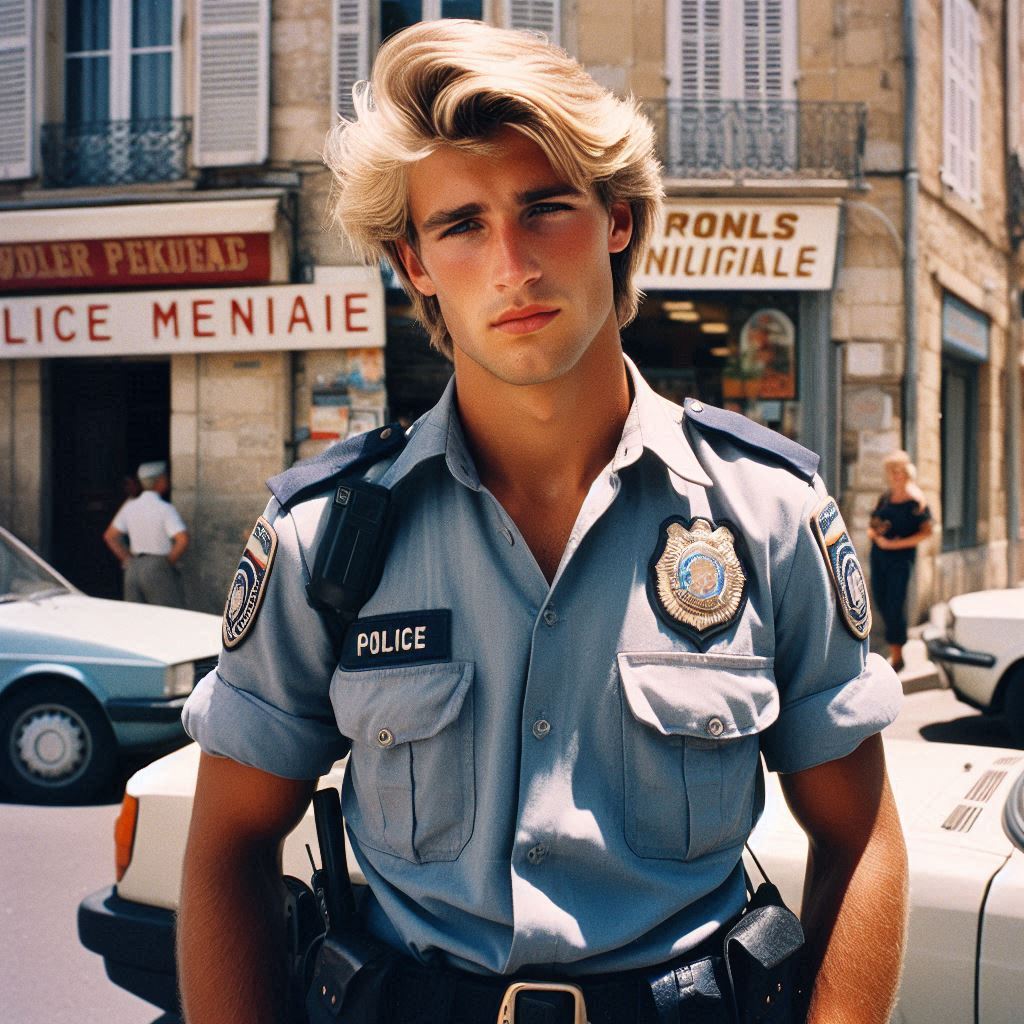
Enter a young man in a uniform – central casting, tall, blond, and beautiful. He smiled and offered a handshake. In halting English he said, “I’m sorry your trip has been interrupted by this mistake.”

“Mistake?” I’m thinking.

“Ce n’est pas un mistake,” I said. “It was a robbery, and we lost all our papers for our trip. We are expected in Barcelona in five days and then we return to the U.S. in a week.”

“Oui, un vol, excusez-moi.” he continued calmly. (Yes, pardon me, a robbery.)

Our discussion went on with him speaking in French with an occasional errant English word and me speaking in English with an occasional fractured French word. Lots of gestures accompanied the conversation. Shari did her best to translate here and there. The policeman seemed to understand everything we told him but was not making any notes or looking for forms. He did ask to see our passports.

Finally, he said he would sign a police report, and we could take it to the rental car agency to get our car. He assured us that it would also be enough evidence to have airline tickets reissued. Not to worry. He was completely unruffled, and matter-of-fact. Wait! Wait! Where was the investigation? Where was the fingerprinting? Where was the drama? Drôle indeed. I wondered if this was some kind of setup, some kind of con to make tourists relax before they laid down a hammer and charged us oodles of dollars to get out of their country.

After all, the French have a universal reputation of being haughty, rude, and nasty to foreigners. That had not been my experience on my previous trip to France, but there is always a first time, and this time was serious. Could we count on their assistance?

A one-page printed report was issued within fifteen minutes. We left the police station, still shaking our heads at what we perceived as the unusual calm we encountered. We went directly to the rental car agency. I explained our situation and showed them the report, preparing for an onslaught of questions and requests for proof beyond the report. They asked to see our passports, then handed me the keys to the car. It took less than ten minutes.

It still felt surreal. To be in a foreign country, being robbed of all our paperwork and still being allowed to rent a car so simply. It takes more effort to rent a car in my hometown.  

Gleefully, we left with our car. It was a Ford KA, a subcompact city car. Too small to be called a KAR – like half of a VW bug. No backseat, it was barely big enough for Shari, me, and two suitcases. We zipped along the freeway and through small towns like a gnat on a summer breeze. It was great to park. We fit anywhere we wanted, almost like a motorcycle. Each time we returned to our parked KA, I was surprised to find it still there. It was so small I could imagine someone coming along and picking it up like a child’s toy.

We stayed another day in Avignon then left for a winding trip through Provence and Occitanie along the southeast coast. We visited the cathedral in Nimes. We stayed a night in a nearly deserted resort town on the Mediterranean, Palavas. It was past the tourist season, being mid September, and all the hotels were closed. One very nice hotelier offered us a room overnight without any services. We were the only ones there. We ate a simple meal in a small restaurant on a canal that led to the Gulf of Lion. Fishing boats were docked along the edge of the canal. We visited the castle in Carcassonne, learning its quaint legend, and stayed in Narbonne; got lost trying to find a public bathroom; looked for carousels in each little French village (they all seemed to have one); and, Shari got to eat at a Mickey D’s in France. We crossed the Spanish border without a border check, arriving in Barcelona safe and sound, welcomed by a round of warm Spanish hugs and kisses from our family. We left Spain on schedule with no issues over airline tickets, just a very small fee. All that is another story or two…

Chicago: August 1984 and July 1985

Intro: From June 1984 to September 1985 our family of five plus two dogs traveled around the country in a three-quarter-ton reconfigured cargo maxi van pulling a thirty-one-foot trailer. Our trip began in Bellevue, Washington. We quit our jobs, took our three teenagers out of school, sold our two-story house, packed ourselves into the trailer, and took off on a grand adventure. Our 15-year-old nephew, Wally, accompanied us the first summer (four teens).

We had no cell phones, no computers, no GPS. We were off the grid. We didn’t even have seat belts. We traveled 50,000 miles crisscrossing the U.S. four times. Planning for the trip included library research and correspondence with all the Secretaries of State of each state we intended to visit. I had folders full of information about each state. Needless to say, the teens were not thrilled with the idea of spending fourteen months 24/7 with the old folks and missing a whole year out of school with their friends.


We went to all the contiguous United States, three provinces of Canada, and dipped into Northern Mexico a couple of times. After Christmas, we took a Caribbean cruise stopping at Jamaican, Grand Cayman, and Mexican ports. The objective was to show our kids their country, all the nooks and crannies, all the cultures and quirks, visiting museums, state houses, historical sites like Civil War battlefields, national parks, as well as small towns. We tucked in a few theme parks, and professional sports when a team was in a town we passed through. We endeavored to meet people in each region that make this great land. I am beginning to piece together our stories from letters, journals, photos, and memories. This is a snippet from our journey. These stories are taken from letters and journals written during the trip forty years ago and do not reflect the places as they may be today.


Chicago: August 1984 and July 1985
As we drove around the country we tried to stay on the “blue roads”, so named in the 1982 book by William Least Heat Moon, Blue Highways. It was one of the sources I used to plan our odyssey. That meant we were away from main highways – the red roads, arterials – instead using the minor, less traveled, roads that took us through small-town America. On paper maps – we didn’t have GPS or internet – the blue roads look like the veins of the human body, tiny but necessary for travel and commerce, the lifeblood of the nation. Big cities are very much alike but small towns are unique to their region and citizens. Of course, in order to visit major sites we needed to go into major cities.


We went to Chicago twice, once on an eastbound trip and once again on a westbound stretch. Both visits were too short. Some states we visited twice and some states, like Texas, seemed endless and it took us forever to get across.


Our family first visited Chicago in August 1985. At this point, there were five of us, Ken, me, and our three kids. Our nephew had to return to Bellevue before school started for the year. The closest campground we could find was in a town called Mokena about forty-five minutes south of Chicago proper. We parked our trailer there and ventured into the city. The late August weather was warm and sticky. Everyone wore shorts and short-sleeved shirts, except me. I had on a sundress.

We drove through the city and around the perimeter where we admired the Chicago River and the architecture of the buildings along it. We walked the Magnificent Mile with all the big stores such as Saks Fifth Avenue, and Bloomingdales as well as chic boutiques like Armani, Burdeen’s, and Gucci, none of which we went into. We saw the great Shedd Aquarium in its beautiful building filled with unbelievable beasties, amphibious and seagoing marine life. There are things there you cannot even imagine until you see them; plants that look like animals and animals that look like plants. The intelligent and curious octopi alone are worth a whole day. They interact with the public. I wish every large metropolis with a waterfront would take a lesson from Chicago. They made the lakeside a people-place with parks, museums, a planetarium, beaches, marinas, fountains, and gardens – all for everyone to enjoy. Their waterfront isn’t blocked off by factories, warehouses, or docks – it’s beautiful, clean, and fully accessible.

One of our friends told us we had never eaten real Italian food until we had food in Chicago’s Little Italy. So we set out for some REAL ITALIAN FOOD. Our local guidebook said that the Italian community in Chicago centered on Taylor Street. Consulting the map, we took ourselves to the west side of town. As we toured the neighborhood, we noticed large numbers of citizens loitering around street corners and sitting on stoops. The local occupation appeared to be indolence. There were dozens of boarded-up stores with Italian names even though the people on the streets didn’t appear to be Italian. Countless residences were rundown or abandoned.


While Ken drove, I pointed out Mama Rosa’s, Little Luigi’s, or Georgio’s as possible places for dinner. He shook his head.

“I wouldn’t leave our van on the street in this area,” he said. “I wouldn’t feel safe walking down the street with our family. We’re not eating around here. Look up something else, somewhere else.”

He turned back on Taylor Street toward downtown Chicago. I was not to be deterred. We were going to eat in Little Italy, no matter that the area had undergone a cultural transformation. We passed a restaurant, Bocciola della Rose (Italian for rosebud), with a fenced and gated parking lot. Three prosperous-looking senior citizen couples were entering.

“How about that place? The parking lot is gated and there is an attendant inside the fence. Don’t you think that would be safe?” I begged.
“Ok, we’ll try it.”

We quickly went around the block and returned to the gated parking lot where a young man of Italian descent, Guido, told us he would park our van and watch it until we finished dinner. Smiling from success, we proceeded into the dark narrow little restaurant which had a small bar as you entered the front door.

I led the way and, as the rest of our group appeared through the door, a tiny wizened lady rushed down behind the bar shaking her finger and head at us saying in very broken English, “We no serva the short.” It took three repetitions of this phrase for me to realize that she meant we were improperly dressed for her establishment. Sure enough, looking around we noticed all the men were wearing slacks and shirts with ties, some even had jackets and the women were all in dresses. – NO SHORTS. Imagine our chagrin after coming thousands of miles to eat in Little Italy, then finding its character altered and somewhat intimidating, then finding, with some reservation, a suitable place to eat and being turned away as undesirable. We left to continue our quest for Italian food in the Chicago loop. We ate our spaghetti and meatballs in Miller’s Pub on Wabash Avenue. Good American pub food, highly recommended and they serve shorts.

Our second visit to Chicago was, unfortunately as brief as our first visit the previous August…rush, rush, rush. We were there only a couple of days. We went to the top observation level on the 103rd floor of the world’s tallest building (at that time), the over 1,400 ft. high Sears Tower.


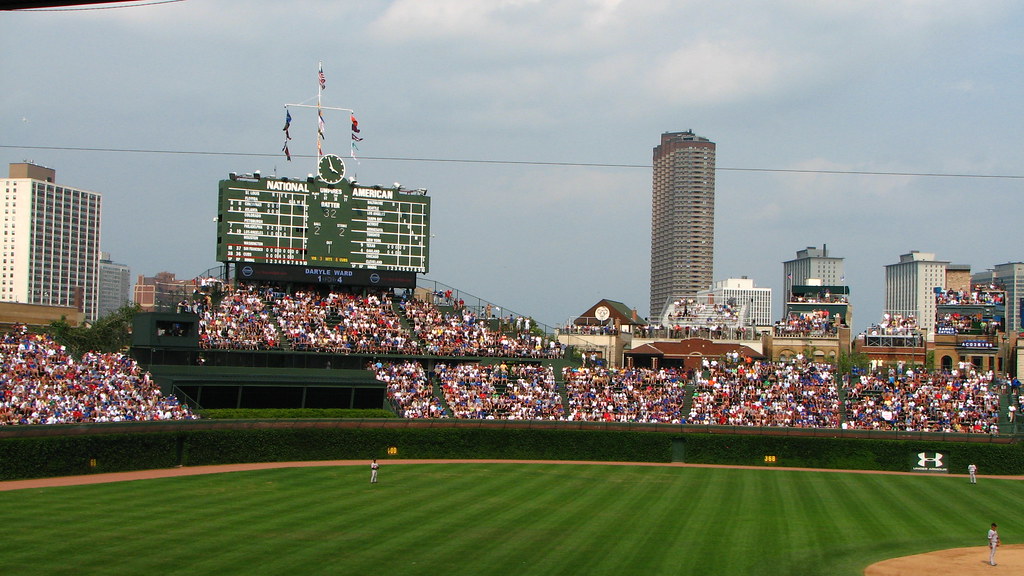
Visiting baseball parks to see professional games was part of the agenda on our trip. On Friday, July 12, 1985, we attended a Cubs vs Dodger game in the best ballpark we’d seen – Wriggly Field – a gorgeous real grass field, ivy covered brick outfield walls, and sunny blue skies. This is the city where fans fought for tradition – no lights at Wriggly. All games were played during the day. (The big business of baseball being what it is, that has changed. Lights were installed in 1988. Night games are played there now.) We stayed around after the game to talk to the winning pitcher, an L.A. Dodger from the Seattle area, Tom Neidenfurer. He won the game 7-4. Our friend Dickie Pederson had gone to school with him in Redmond, Washington and asked us to say hi to him if we crossed paths on our journey.

We returned to the Italian restaurant, Rosebud, which refused us service the previous visit because we wore shorts. This time we were properly attired and were served; cannelloni for Ken, lasagna for me, and spaghetti with meatballs for the kids. We were not disappointed. It’s a classy place with great food and a mellow musical accompaniment. Another evening, we went back to Miller’s Pub on Wabash. The local tavern filled with regulars who consumed large quantities of pasta, wine, and beer, while watching sports on TV had become our favorite, offering more comfort than class.


The next day took us to The Dells in Wisconsin and on to Appleton where my grandmother, Bessie, was born. She left home at nineteen to be a Harvey Girl and travel across the country to Wyoming where she met the love of her life. I wrote about her in my blog post of September, 2023. Travel and adventure run in my blood. I’ll add more stories to our journey as memories bubble up.

The “Little Woman” Steps Out

Courage is not the absence of fear but the action in the face of fear.

Courage is being the only one who knows you are afraid.

In the 1960s, the women’s movement was beginning to heat up again after a lull of about thirty years. During the 1880s women’s rights were asserted along with freedom for slaves. That resulted in legislation promoting the equality of women in society. There was a pause in progress during the Depression of the 1930s. Women were actually fired from jobs in order for men to have work. Men were deemed to be more important in the workforce and women were relegated to their “natural place” in the home, tending children and husbands. Then along came WWII, women again became essential in the workforce to keep our economy moving as men were shipped overseas to war. When men came back from war, women were reluctant to cede their place as wage earners. The war of the sexes ensued and the 60s were marked by legislative and social battles along with commentary from both sides staring into the gender gap. 

I, on the other hand, followed the path prescribed by society in those days, a homemaker. Being a mom was what I loved most. The role of stay-at-home wife and mother was the norm and the expectation of women. Married women who worked outside the home were still unusual. The only jobs offered were as teacher, nurse, store clerk, waitress, or secretary. Nothing much was required from me in the wide world except to keep a pleasant home for my husband and raise healthy children.

Where do I fit into the scenario of assertive women? It was accidental. I never considered myself a part of the feminist movement.

Ken worked two jobs for over a year to get the $900 downpayment for our house which cost $16,950. We had a monthly payment of $130 per month for principle, interest, taxes, and insurance – a third of his take-home pay after he quit the second job. It was our first home, a three-bedroom, one-bath, 1,000 sq. ft. mansion. We had two children, a baby and a 2-year-old, at that time. We moved into our house in a small community of Woodinville, Washington near Cottage Lake in December 1967, a neighborhood of one hundred very modest, indistinguishable homes. During the summer of 1968, I noticed some problems in our home. It was under warranty. I notified the builder, Miller Homes, and was virtually patted on the head and told, “There, there those are just normal things to deal with in a new home.” I did not believe them.

Ken said he didn’t believe it either. I called the Fire Department and asked for an inspection. They came out and found several code violations including that the vent over the stove was not connected to the outside. There were insulation, structural, and safety issues. I contacted the builder again with a request for someone to inspect the house and fix the problems. I was ignored. I ruminated on what I, a lowly 22-year-old housewife, could do to make the builder pay attention and fix our warranty problems.

I decided my lone voice was not enough. I typed up a petition of grievance, took the inspection report I had, and went door to door to each of the one hundred homes to ask people to check for problems and to sign the petition if they wanted warranty repairs done. I also told them I was going to picket the nearby new neighborhood where our builder planned a Grand Opening. I asked if anyone would like to go with me. I had 100% of the homeowners sign the petition and four people agreed to come with me on a Saturday to picket with our petitions.

I made signs out of butcher paper and markers for my car and the cars of the other volunteers. “DON’T BUY A LEMON.”  “BUYER BEWARE” “READ THE WARRANTY”. I wasn’t real sure of the law and I didn’t want any sign that named the builder or made direct reference because I didn’t want to be sued. I planned for us to park across the public street from the Grand Opening and stand by our cars with the signed petitions of grievance and the inspection report. I figured we’d attract enough attention that people would come over just to find out what we were complaining about. Maybe it would inform their decision to buy a Miller Home.

On the Saturday of the Grand Opening, all the people who said they’d go with me backed out. My husband was staying home with our two babies. A dilemma. Was I brave enough to go by myself and take the consequences alone? I decided I had to because I promised everyone who signed the petition that there would be action.

I did as planned. A little unsure of myself at first, I wondered what the reaction would be. Most of the people going into or out of the model homes walked across the street to hear what I had to say. I gathered courage from the response of prospective buyers thanking me for the information. After about thirty minutes, the sales manager came over and told me to leave. I declined. I was on a public street and told him he couldn’t make me leave. He said I would face legal action. I still declined, saying our next step was to complain to the State Association of Contractors. Finally, three men came over and said if I would leave, they would take a copy of the petition to the builder. I gave them a copy and left.

On Monday morning, my husband received a call at work. The builder told him to tell me to stop harassing their new home site. Imagine, telling a husband to silence “the little woman” who was making a nuisance of herself. Ken, my very strong, supportive husband, told them I was my own agent and he was not going to say any such thing. He said I had every right to do what I did and would continue until our demands were met. He went further to repeat we would report the builder violations to the State Association of Contractors if they didn’t comply.

The following day a representative of the builder came to our house and, sure enough, a swarm of construction workers went from house to house fixing the warranted problems that had cropped up in the homes. It took a few weeks to complete their tasks, but everyone was finally satisfied. I didn’t have to picket again. Once I knew I wasn’t going to be shot or sued, I enjoyed the attention and the hoopla created among the men. They took me seriously – no more dismissive attitudes.

The Shark and Me

I must confess, I am not a cleaner. My house has been kept tidy for years by an army of lovely women who like to clean, clean, clean. It is very low on my priority list. Since we retired, Ken said it was no longer in our budget to have housecleaners. He stepped up and said he would do it. Now we share some of the tasks because I like to keep the kitchen ship-shape so I can cook, which I love to do.

I recognize that clean is a relative term. One person’s clean may be another person’s squaller. My mother for instance was a clean freak. She loved to clean.  She had a full-time weekday job but it was her passion to spend hours on the weekends keeping things spic and span, washing everything from knickknacks to floors, woodwork and walls, dusting, mopping, etc. She derived great joy from her efforts.

As a young married, I tried to emulate her cleaning regimen but was never able to summon the passion. As our family grew, I drudged through a succession of small abodes in those early years like I was slogging uphill through mud. It never made me happy like it did her. Everything that was cleaned was dirty again within minutes. Ugh, I hated it.

I developed a skin condition called psoriasis. At that point, I was mom to three children under four years old, and with all the diapers (back in the day before paper diapers – everything was washed), kid cleaning, and house cleaning, my skin rebelled. I’m sure it had something to do with my reluctance to clean – a deep psychological kickback. The skin on my arms and legs cracked and bled. They were irritated, itchy, and painful. It began to creep up to my chest and neck. Then along came my knight in shining armor. My doctor pronounced that I was sensitive to dust, household chemicals, rubber gloves, even water used too much would make my delicate skin break out. In short, I was allergic to housework and if I didn’t stop soon the disease would become chronic. Well, I couldn’t stop cleaning my children so it was obvious that I would have to stop cleaning my house. Ken agreed to immediately hire a house cleaner. Within weeks, my skin condition cleared up completely and has never returned.

Ken was good to his word at retirement and shouldered most of the housework. Sixteen years later, Ken had to go into the hospital. It was supposed to be an overnight or maybe two-night stay but turned into three nightmarish weeks. At first with my attention totally on Ken and his physical wellbeing, I ignored the house. I kept the cat boxes changed. I didn’t cook so there was nothing to do in the kitchen. I was home only a few hours at night and that was spent trying to sleep.

I began to notice large clumps of black fur, white fur, brown fur. It is summer. The cats are shedding. I never saw that before because Ken would have the vacuum out whenever anything landed on the floor. I haven’t touched a vacuum in fifty years and hadn’t a clue how to start it. I needed some guidance so I could clear out the fur that was becoming ankle-deep. I imagined that when Ken came home it might be waist high at the rate they were going.

Ken said it was so easy and gave me a rudimentary lesson. I went home, and pulled the vacuum from the closet. That’s when I noticed it was named SHARK. The ominous theme music of JAWS ran through my head. Why was it not named Mrs. Trilby or Mr. Pristine – making one think of helpful servants, not a predatory monster.

Me and Shark had to get acquainted. He is an upright kind of guy, at least three and a half feet tall. In order to get his wheels going he needs to be clicked out of his military posture into a more relaxed sloping position. The problem I had was that his upper part (the heaviest section) when released, wobbles, swirling right or left and back again. He has very little control over his own movements when clicked out of his upright posture. Ken says he weighs about fourteen pounds, but I swear I was wrestling fifty pounds as I tried to get Shark to straighten up, mind my commands, and go in a steady line. He has three levels so he can pound on carpets or glide on tile and something in between. I had a hard time getting the correct setting while keeping his body from spinning around. I was holding the handgrip with two hands, like grasping the dorsal fin of a rampaging Great White as it veered this way and that.

AI-generated picture, not an actual photo

On my first try, I managed to sweep up a clump or two of fur but stopped as I started sweating. It just can’t be that hard. It was late at night, and I was really tired, I reasoned. The next day I tried again and didn’t get much better except I had Shark on the right setting.  Three days later, I left the hospital early (before dark) and got home determined to conquer the damn vacuum. I pulled Shark up to my chair and had a talk with him. I explained that Ken was ill and couldn’t be his partner in the cleaning dance. He would have to accept me and be patient with my clumsy steps. I tried not to blame him since, after all, he is a machine made by some satanic engineer, but it was difficult to keep from crying. I begged his indulgence as I pushed the start button.

It worked. He was rather more accommodating as I went from one room to another. We seemed to have reached détente. I wouldn’t say buddies, but at least noncombatants. The floor was beginning to reappear. Just as I was feeling downright successful, Shark tripped me. He wrapped his cord around my ankle and almost sent me down. I recovered, pulled the cord from the wall socket, and unwrapped my leg.

“Why?” I asked.  “We were getting along so well.”

Shark didn’t look the least bit chagrined. He stood there in that nonchalant posture daring me to blame him for my ineptitude.

“You just wait until Ken gets home. He’ll make you obey.”

I swear Shark shrugged.

Living and Learning

Every day brings new opportunities to learn. Sometimes they come as bangs on the head, not literally but emotionally. Sometimes they are more gentle, as an answer to a question you didn’t know you had. These past few weeks have brought so many of both kinds that it has been difficult to keep up.

My husband went into the hospital for brain surgery in May. He has Parkinson’s disorder, a complicated and hard-to-diagnose movement and cognitive disorder that, once contracted, is a life-long companion. There are many approaches to living with Parkinson’s. Each person must research and decide what works for them in the daily battle to make life as normal as possible. It is an individual decision, and it is important that family members and others close can buy into the tactics.

Parkinson’s affects more than just its target human. It affects those around them. The natural reaction of a Parkinson’s sufferer is to withdraw. Withdraw from family and friends and the world at large. Not because it is embarrassing to tremble and shake and move like a sloth but because those outward physical symptoms make others uncomfortable. The uncontrollable shaking of limbs can, at first, look funny. Just stop it. The unnatural movement of the head can cause derision because in the world of normal movement, the head and mouth are controlled, and shaking only happens when someone is acting silly. Speech becomes faster, softer, and nearly unintelligible at times. It is as though the tongue swells, the vocal cords become slack, and the brain cannot moderate the pace of words. Communication is difficult. I, as a “second-degree” Parkinson’s sufferer, had a hard time accepting that my husband’s involuntary muscle contractions were going to be a part of everyday life. Ken is a lifelong athlete. From childhood into his 70’s, he participated in sports. Moving and controlling his body has been a hallmark of his existence. He was an elite athlete in school and signed a pro baseball contract with a bonus right after high school. After he was injured and could no longer play pro ball, he continued in amateur athletics, playing baseball, softball, basketball, tennis, golf, etc. He was always on the move, a big strong guy.

My husband lost the use of his right hand a few years ago. He is predominantly right-handed in everything. He couldn’t feed himself using his right hand. He couldn’t do the simplest of tasks, even blow his nose with a tissue, using his right hand. He learned to be more adept with his left hand and eventually that was affected. How is it that a simple task you never think about becomes impossible? Not just difficult, but impossible. His right hand might as well have been cut off. It was useless. More than that it was annoying, moving uncontrolled. The disorder enlarged its landscape to encompass his head, his jaw, his left arm, both legs and feet. By midafternoon every day he was exhausted by the constant uncontrollable movement of his body.

I was amazed at the grace with which he accepted his disorder. He did not display anger or ask “why me?” He worked hard every day to find ways to use his body with its limitations. He continued to do as much as it allowed him to do even though it took much much longer. He assembled two occasional tables I ordered from Amazon that came in pieces. It was a simple thing he would have done in fifteen or twenty minutes but took hours. He had to stop every few minutes to allow his hands to calm down. The concentration on movement exerted to place a screw and turn the screwdriver caused stress that would send him into a tsunami of unintended movement. He was resolute not to let Parkinson’s win. He did it and we have two very nice tables in our family room. An Olympic accomplishment with Parkinson’s. Brave, determined, and persistent are his pronouns.

We have always walked. Well, in younger days we jogged. Just a few years ago we’d go seven miles in a circuit of our neighborhoods. Usually, we walked three miles at least three or four times a week. Ken’s walk became slower and more tortuous. It was hard for him to move his feet. He said they stuck to the ground. His walk became a shuffle and his back became stooped. He still walked our street, about a mile, each day but it became slower and slower. He had to stop several times and his balance was iffy. Of course, falling is a horrible secondary problem that can happen. If he fell, he couldn’t get himself up and I certainly couldn’t lift or move him.

After exhaustive research over a couple of years, Ken decided to have DBS surgery, Deep Brain Stimulation. Two electrodes were placed in either side of his brain connected to a lead that goes into a device implanted subcutaneously in his upper chest. It is sort of like a pacemaker for the heart, but it controls the brain. He had the two-part operation last month. After some weeks of healing, his stimulator was activated a few days ago. It is a success! His tremors have been substantially reduced. His movement is freer. His walking is improved. He is fully able to do daily tasks to take care of himself. He is even back to cleaning out the cat boxes. He is not all that he expects to be and there will be more appointments over the next few months with the neurologist to tweak the settings as his body adapts to the implants. It is another step along the Parkinson’s journey. It is not a cure. There is NO cure for the disorder, but it will allow him to have an extended period of time, several years, with minimal or no outward symptoms.

Along the way, through nearly three weeks of inpatient care, we both learned patience. Not just the word but the actual fact of patience. In the hospital, the very busy staff tried to keep up with requests. Push the button and someone will be in to help you…go to the bathroom, sit up, get back to the chair, get back into bed, get a drink of water, take a pill, etc. The time between the button push and the actual help could extend to what seemed forever. It is called “hospital time”. We learned to honor hospital time. We knew the nurses and techs had more than one patient to attend. My instincts are to “just do it”, whatever was needed, but when I was there, I could get him food and drink and that was about it. I was not allowed to transfer him or help him get up, or take a short walk, because of liability issues. An alarm was put on his bed so if he moved to get up it screeched – jailbreak, jailbreak. The staff took it that he had fallen out of bed and dropped everything to get to him. Not a good look when all he wanted was to get tissue from the table that was too far to reach. Patience.

We are deeply grateful to the talented surgeon, Dr. Julie Pilitsis, and her stalwart team of neurologists (too many to name here) who came up with solutions to the challenges of Ken’s Parkinson brain. We feel blessed that the DBS option was available and worked for him. Thanks to some very dedicated therapists, we also learned the difference between the Parkinson brain and the normal brain. When Ken thought he was talking normally, Parkinson was deceiving him. When he thought he was taking normal steps, Parkinson was deceiving him. He had to realize that his perception was being modified by Parkinson. It was an ah-ha moment for me too. He wasn’t being purposely obstinate when I said to speak up. He thought he was speaking clearly. He is signed up for outpatient therapies, but we are on “insurance time” waiting for a slot to open for him in a month or so.  Until then we have improvised a regimen at home. He wants to recover the strength he lost over the time he was inactive. He is doing physical, speech, and cognitive therapy every day to regain vigor and relearn things we used to take for granted.

Our eight-year journey with Parkinson’s continues.

The Storyteller – A Beginning

Once upon a time…

There was a little girl
Who had a little curl
Right in the middle of her forehead
And when she was good, she was very very Good
And when she was bad, she was Horrid.

That was a rhyme my mother told me many, many times when I was a child. I believe she meant it to describe me. Of course, I think of myself as a totally sweet, big blue-eyed, curly-headed little girl with a streak of adventure. I’d do almost anything on a dare. But I was also kind to animals and did mostly what I was supposed to do. I think the operative word there is “mostly”. I strayed occasionally although not really on purpose. I didn’t INTEND to be naughty. It just sneaked up on me.

I remember very clearly a time when I caused some chaos – unintentionally of course.  I was in first grade, six years old. I walked to school each day with my friend Billy Baird who lived next door. He would come to my door, or I would go to his in the morning and we’d set off together for the three blocks to Woodland Elementary School. One day, I stopped by his house and his mom told me Billy was ill. He had a cold. She asked me to tell our teacher that he would not be at school for a day or two. I was a bit miffed because I had something really important to talk to Billy about. I went to school and when I arrived, a funny thing happened.

My teacher asked why Billy wasn’t with me.

“Well,” says I. “Billy had a terrible accident. He is very sick, has a bad high fever and broke his bones and wouldn’t be coming back to school maybe for the WHOLE year.”

Our teacher was very worried, a reaction I expected. At recess, I repeated the story to other classmates expressing great emotion and concern. They too were curious about what happened. I declined to give any other details, telling them I’d let them know more later. I think I believed I could get some mileage out of that attention if I continued to add to it daily.

After school, I walked home. My nanny gave me my snack and I played outside and all was well until my mother arrived home from work.

“What exactly happened at school today?” her voice was stern and accusatory.
“Ummmm.” I couldn’t think for the life of me why she was mad. “We played skip rope at recess. I got to do double dutch,” I offered.
“What about Billy?”
“He didn’t go to school today. He was sick.” I still wasn’t catching on.
“How sick was he?”

Now a light was dawning.

“Aaaaaa.”
“Did you tell your teacher he was in an accident? Did you tell her he’d be out of school for the rest of the year?”
“Aaaaaa.”

Now remember – this was in olden days before instant communication and cell phones. How in the world did SHE know what I said at school?

“You told a lie, Diana. A whopper. You have to apologize to Billy’s mom, the teacher, and the whole class.”

My knees turned to jelly. My insides churned. “It was just a story.” I stammered.

“It was a lie and many people were concerned”, she repeated. “Your teacher was very upset and after school called Billy’s mom to find out what happened to Billy. Mrs. Baird, called me at work and let me know what you did. Now you have to face up to it and let everyone know you are a liar.”

She marched me next door to tell Billy’s mom I was sorry. Billy stood behind her with a big smirk on his silly face. I stuck my tongue out at him as my mom turned to leave after a brief conversation with Mrs. Baird. I went to bed that night hoping the angels would take me to heaven.

Now I lay me down to sleep
I pray the Lord my soul to keep
If I should die (please, please) before I wake
I pray to God my soul to take.

I survived the night and, with extreme reluctance and a very dry throat, walked to school with my mother to tell the class that I told a story. No, Mom insisted, I lied.

It seemed an injustice to me that my story was more interesting than Billy’s, but I was being punished. After all, I didn’t hurt Billy. He was fine. No harm, no foul. He went back to school the following Monday (I didn’t walk to school with him) and everyone crowded around HIM telling HIM I had lied about his cold. HE was the big deal, not me. It took a few days for the storm to pass. I was shunned by all except my best friend Lois who forgave me instantly. Finally, everyone seemed to forget about it and life continued in its pleasant middle-class suburban way. But the storyteller in me grew and grew. And now I can write stories, and no one can stop me.  Did I learn a lesson? Guess not.

This Old House

My family moved into our home on Burns Avenue in the Riverside District of Wichita Kansas when I was three years old. It was an area between two rivers, the Little Arkansas and the Big Arkansas. The rivers were just a few blocks from us, one to the East and one to the West of our house. To the south, in the fork of the two rivers, is Riverside Park, less than two miles from our house. Our neighborhood was built prior to WWII.  Our house, built in 1940, had grey asbestos shakes and white trim. It was about 900 sq. ft. with two bedrooms, one bathroom, and an unfinished basement.  The detached garage was a few feet behind and to the side of the house. The entire neighborhood of homes had a tree-lined street with sidewalks.  Behind our house was an alley and across the alley was a church.  Sunday morning delivered raucous music, loud singing, and righteous preaching that we could hear from our backyard. Around the corner and down the block on another corner was an IGA grocery store. Across 18th Street from the IGA was a drugstore with a lunch counter where we could get ice cream sodas, a rare but delightful treat. In the other direction around the corner in the middle of the block was a tiny mom-and-pop grocery. The old man would soak toothpicks in cinnamon oil and keep them near the cash register. He gave them to neighborhood kids who stopped by on the way to or from school. We chewed on them as we walked. He also stocked the best penny candy.

One of my best friends moved into the house next door within a few months of our arrival. His name was Billy. He was my age and we hit it off, playing cowboys, hide and seek, and climbing my big backyard tree.  My very best friend, Lois, lived two blocks away on Woodland Avenue. When we were five we all attended Woodland Elementary which was two blocks in the other direction from my house on Salina Avenue. John Marshall Jr. High was three blocks further south. I left after sixth grade and didn’t get to attend John Marshall.

My room was at the back of the house and had two windows. The wallpaper on my wall was white with bouquets of lavender posies and yellow ribbons. My bed resided between the windows and I could see the backyard and my tree. It was an enormous maple tree. I sometimes made a tent over my bed with the open side toward the window and would pretend I was camping.

As soon as I was big enough, I climbed into Old Maple’s comforting branches to spend hours daydreaming or reading. It was well over thirty feet tall and, for a couple of years, I needed help to get up to the fork in the trunk that enabled me to climb higher. I could go far out on the limber bottom branch where I straddled it and bounced, pretending I was riding a horse. Dad built a swing attached to the side of the garage – another place to think and dream.

Our house had arched doorways between rooms except the two bedrooms and the bathroom. In the hall that led to the bedrooms and bathroom was a niche in the wall for the telephone. The living room had a fireplace with a floor-to-ceiling bookcase notched in beside it. The dining room had French doors out to the back porch. The kitchen was long and narrow, and my mother painted it Chinese Red. A window over the sink looked out to the backyard. At the end of the kitchen was an alcove where stairs led to the basement. It also had a side door leading out to the driveway where a honeysuckle vine grew on a tall white trellis.

A story I remember about the phone in the hallway was when I was four, I went swimming with the fishes. My mother ran my bath with nice warm water and bubbles and, before I got in, the phone rang. She went into the hall to answer it and began a conversation with someone. I was buck naked, running around the house. I decided to have company in the tub so I climbed on my little red chair, I got my goldfish bowl from the top of my dresser and dumped the fish with their castle, green ceramic mermaid and algae figures, and shiny rocks into the tub and climbed in. I began chasing the fish around in the tub and Mom heard the commotion. She was not amused. The fish were removed along with their paraphernalia to their bowl with clean water. The tub was emptied and washed out. Then I was tubbed, and scrubbed, and put to bed. I don’t believe the fish lasted through the night.

Another story that involved the phone was when I was six. I refused to clean my room. I put up a tantrum about something that was important to me at the time. My mother was at her wit’s end to get me to comply or at least calm down. She tried threatening and yelling at the same level I did with no positive result. Finally, she became very very quiet. She went to the phone in the hall. She dialed a number. I watched from around the corner to see who she was calling – the police? my Dad?  No, she called the Indians. She put her hand over the receiver and told me she was going to send me back to them since I was acting like them and wouldn’t mind her. I begged her to let me stay and promised to try to be a better girl. She relented and told them over the phone I wouldn’t be going to live with them, at least not that day.

The basement was where Mom’s washing machine resided. We had clotheslines in the backyard to hang clothes to dry.  The brown and white hide of my Dad’s horse Knobby was slung over the top of a folding roll-away bed. I sometimes climbed atop it and with a broom stuck in the crevice for a horse head, I pretended to ride the range on my paint pony. To this day I don’t know why my dad had his old horse pelt at our house. I do remember Mom did not appreciate its sentimental value and when we moved from that house it was left behind – who knows where?

I remember a year when the waters of the rivers rose above flood stage. All the neighbors went to the riverbanks to put sandbags along the edges. Even with that precaution, our basement held a few feet of water. The heartbreaking loss for my mom was the letters she received from my dad when he was overseas in the war. He wrote daily and she saved them in bundles with ribbons around them stored in the basement – until the flood when all were lost.

I loved my house, my neighborhood, and my school. The kids played kick the can, hide and seek, cowboys and Indians, a form of baseball across the front yards and into the street all through the year. In summer we’d roller skate from one end of our block to the other. Of course, in the winter we had snowball fights. The neighbor across the street raised chickens and when he decided to make one or two into their dinner he would let us know. The kids would line up to watch him catch a chicken from the coop, lay its head on an old stump in his backyard, and chop its head off with one mighty blow of a sharp axe. Then he let it go and the body would run around the yard and eventually flop over. A bloodthirsty gang we were.

I was eleven when Dad announced he received a promotion, and we were packing up and moving to Seattle Washington. It meant that when fall rolled around I wouldn’t be able to go to John Marshall Jr. High with all my cronies. The promotion I ached for – to be in Junior High. I was devastated. Mom was elated. She did not like living in Wichita. She was from Denver, a big fashionable city. To her eyes, Wichita was a cow town in the midst of the prairie. She yearned for the more cosmopolitan environs of Seattle. I remember trying to strike a deal with them to stay with my great-grandparents on High Street instead of going to Seattle. They reminded me that even if I did stay behind, I wouldn’t be able to go to school with my friends because my great-grandparents lived across the river about two and a half miles away in a different district. I went with them and met my destiny in Seattle.

The Strangest Job I Ever Had

What was the strangest job you ever had?

In 1965 I became a gas station hostess. My husband signed with the Detroit Tigers Baseball Company in 1963. This was his second season with the Tigers. The previous year he played on minor league teams, the Lakeland Tigers (Lakeland FL) in the Florida State League and then the Cocoa Tigers (Cocoa FL) in the Rookie League. He was assigned to the Syracuse Tigers (Syracuse NY) AAA team in the International League in 1965 so we were in Florida for spring training. He was gone all day at the ball field, and I needed a diversion. I looked for temporary employment since we would be leaving right after spring training.

I answered an ad for a gas station hostess not having a clue what that might entail. I was hired on the spot because…WHO would aspire to be a gas station hostess? Every weekday I dressed in my best, with nylons and high-heeled shoes. I was in full party make-up.  It was late February in Florida, so not as hot as later in the year; but, it was still very humid.

In the 1960s oil companies competed for business by offering perks beyond the full service expected at a gas station. Full service meant that a man or boy would fill the tank with gas, check the oil (add if needed), and wash the windows. Women were rarely hired for that job. In fact, I don’t remember ever seeing a woman working at a gas station in the 50s or 60s. To acquire loyalty, oil companies offered perks such as green stamps, small appliances or other home goods to customers. Green stamps were collectible everywhere. A number of stamps were given depending on the amount of a purchase, then they were glued into a twenty-page book. When the book or books were filled they could be traded in for items from the green stamp catalog according to value. Stamps were valued at 10, 20, or 50 points. Each business determined what dollar amount equated to what green stamp value. Some stations gave more stamps per dollar, thereby gaining customer loyalty. The gas station I worked for decided that entertainment was an avenue to customer loyalty beyond premiums and rewards.

This is an AI representation of what I did. There are no photos of me at that job.

My job was to greet each car as it drove up and offer the customer a menu of goodies. We had green stamps, of course, but we also had toys for the kiddies and small gifts for the homemaker, an apron, a flower vase, a set of cloth napkins, a coffee pot, etc. It was an invitation for men (they were primarily the drivers) to score instant points with the family – no need to collect stamps for months and months. I also offered a paper cup of coffee or a soft drink for the driver.

Some days, they hired a clown – yes, a clown in full regalia from crazy wig, bright baggy costume, to big floppy shoes. His job was to stand at the side of the road to wave customers into our station. If kids were in the car, he would follow it into the service area to entertain with juggling or some crazy stunt while the car was being serviced. The clown’s job was much tougher because he had to be out in the sunshine dancing and waving with breaks a few times an hour. We were both dripping sweat most of the day. We dashed into the station office when we could to stand before the cool of the air conditioner. He didn’t work every weekday but did work on the weekends. When the clown and I worked on the same day we laughed at the implausibility of our jobs and traded stories of the people we met. He was a part-time grocery store worker and an aspiring actor and writer.

I quit or my temp job ended, I can’t remember which, after four weeks. I earned a little money but had a great story to tell. It looked good on my resume – a conversation starter. To this day I have never met anyone else who was a gas station hostess. If you know one, please let me know.