I just read an epistolary novel called The Correspondent by Virginia Evans. It reminded me of other novels of that genre that I read: 84 Charing Cross Road, Frankenstein, and The Guernsey Literary and Potato Peel Pie Society, among them. Letter writing is a long-neglected art of communication. I decided to write a letter to my mother. She died in 2004 and although I was with her almost daily for the last four years of her life, there are still memories to share and things left unsaid.
Dear Mom,
I love you, and I miss you. It’s been over two decades since you left, and I haven’t heard from you, not even a little tweak or shadow.
I remember going to the movie Under the Tuscan Sun about two months after you died. In the movie, Diane Lane walked through an old Italian house when a pigeon flew over and pooped on her head. It made me laugh because I was reminded of the time we were walking across St. Peter’s Square in Vatican City, and a pigeon flew over you and plopped its poop on your forehead. In both instances, everyone around said, “Don’t be upset. That’s a good omen.” I wanted to leave the theater to call you to tell you about it and make sure you saw the movie too. Then I remembered you died. I think that was when I really grasped that you were gone, and I couldn’t share that memory with you again. It hurt. Grief takes so many forms as it comes and goes long after death.
Mother dear, I regret that we had so many years of misunderstandings as I was growing up. I didn’t get you, and you didn’t get me. Fortunately for both of us, Daddy was there to referee. The two of you had different theories on child-rearing. Yours was to set standards and rules and make sure I didn’t deviate from them. Dad’s was to let me make mistakes, take responsibility, learn, and move on. He believed “I’m sorry” was better than “Mother, may I”. I learned from both of you, but of course, gravitated to Daddy’s way of thinking.
It wasn’t until we went to Europe together, I in my thirties and you, at age sixty, that we really talked and got to know each other as adults. I admit I dreaded going alone with you. I thought we’d fight the whole time. You wanted to make reservations in advance for accommodations in every place we stopped, and I wanted to play it by ear and see what turned up. No strings. We compromised; you made reservations in half the cities, and in the remainder, I was responsible for finding our hotel, hostel, or B&B when we arrived. Your choices were lovely hotels; mine were eclectic B&Bs and one very questionable hotel. I apologize once again for the bedbugs. I love being lost in a foreign place, talking with strangers, and finding my way around. You wanted everything planned out to the minute. You started packing a month before we left, with each item of clothing wrapped in its own tissue paper cocoon, and I threw things in a small suitcase the night before. We survived three weeks together and became friends.
As a child and teen, I was always pulling your chain, exploring the outer limits of the rules, as you tried hard to draw me back into line. I’m grateful we had twenty years to make it better, and I know we were great friends when you died. You left an indelible impression on my children. I’m glad they were adults by the time you died. They all have great memories of you. You are a wonderful grandmother.
This morning, as we took our slow walk around the neighborhood, Ken mentioned that he thinks he can make it to our anniversary later this week. He has been a warrior for ten years in a battle with Parkinson’s, a movement disorder that takes his mobility away piece by piece. He is doing a heroic job of staving off the predicted progression, or should I say regression, of the disorder. We celebrate each and every milestone.
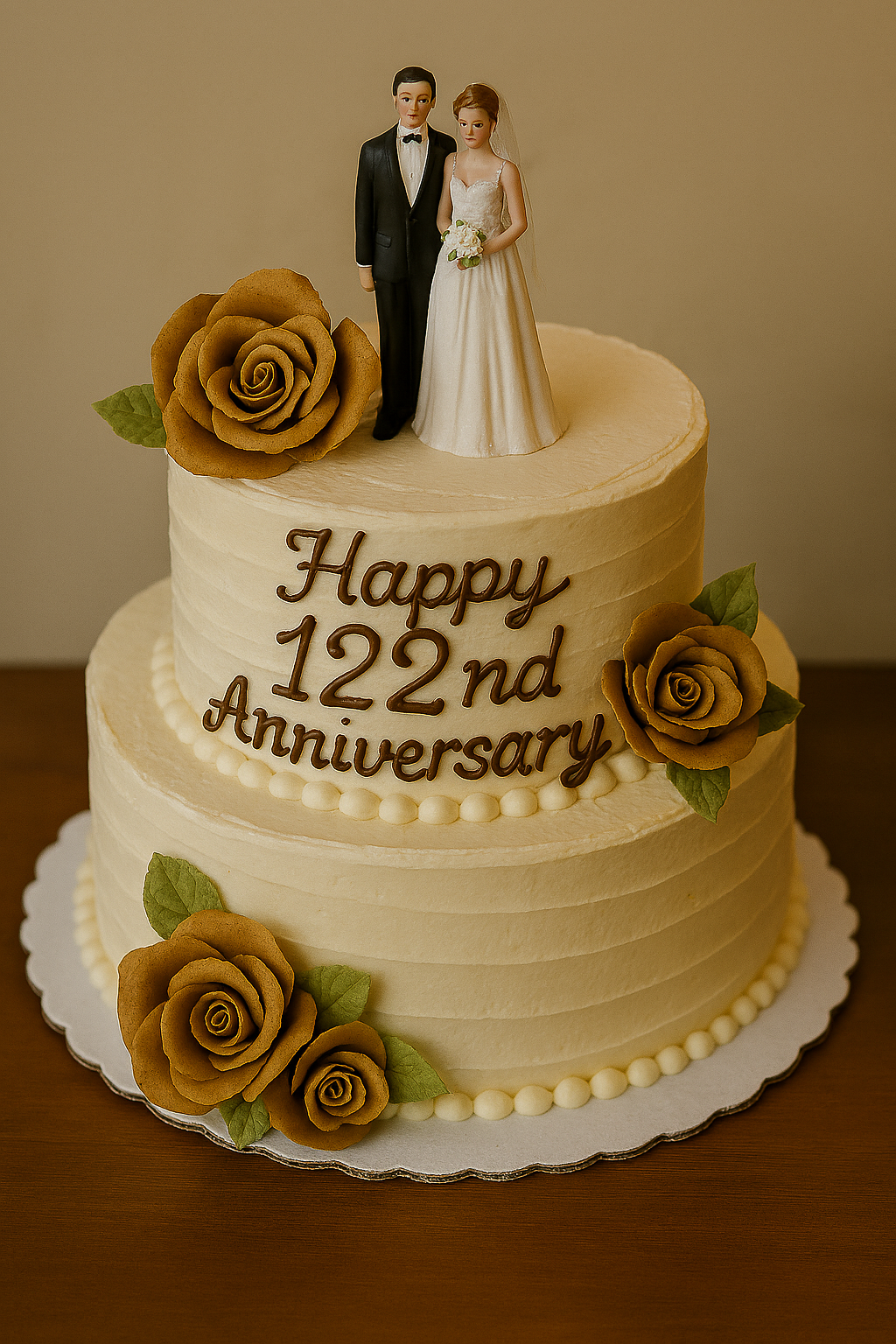
This week will be our 122nd anniversary. Yes. We have had 121 anniversaries so far. We were married sixty-one years ago – twice. Our first marriage, in January, was an elopement before Ken left for spring training in Lakeland, Florida, as a Detroit Tiger rookie. Then, eight months later, in September, when he returned from the baseball season, we were married in church with friends and family as witnesses. We have celebrated twice a year since; thus, it will be our 122nd anniversary. We kept our first wedding a secret until twenty years ago, and that’s another story.
Of course, we went through years of thick and thin, bounty and scarcity, as all long-term relationships do. We raised three kids and countless pets. We were on the brink of divorce at one point, separated for several months. The divorce was unsuccessful; we stayed married another forty-eight years (96 anniversaries) so far.
Chocolate cake with butter cream frosting and peanut butter roses
When first married, we lived simply. I remember peanut butter sandwiches (no jelly) were my lunches at work, sometimes they were dinner too. We lived in apartments in Washington, Florida, and California. Between baseball seasons, we took whatever jobs we could find. Minor league baseball players were only paid during the season, and it was a minimal wage not meant to get one through a year until the next season.
One apartment had a bedroom so small that only a twin-size bed fit. We both slept in that bed, me in the crack next to the wall. Ken was a 200 lb., six-foot-one strapping young fella whose feet hung over the end. He barely fit the bed at all, but we couldn’t imagine sleeping separately. At one time, we lived in a trailer in Florida that had been modified to add bathroom fixtures with a toilet in the living room and a shower in the kitchen. Oh, well – young love doesn’t make note of such inconveniences. We were happy to be together.
In 1966, we would walk with our new baby in a stroller down the hill into town from our suburban apartment to spend $.50 for two ice cream cones. It was an extravagance. We couldn’t drive to town because we couldn’t afford to use the gas in the car that Ken needed to go to work. At that time, gasoline cost less than $.50/gallon. Our two cones were the price of a whole gallon of gas. (Today, gas costs around $3.00/gal, and so does just one ice cream cone – inflation?)
We continued in the American dream to acquire a house with a mortgage and two cars – actually moving in the same city five times. Over the years, the houses became bigger and the cars nicer. Our kids thrived through school and sports, left home for college and lives of their own, and we became empty nesters. During those years, we lived in Bellevue, Washington.
Ken had a career in the home building industry, and after the kids were all in school, I took jobs doing admin work in a variety of companies, including our own. My jobs were mostly time fillers with no career aspirations – a way to make extra money for fun stuff.
One year, we left our jobs, sold our house and furniture, took our kids out of school, and went on a road trip through forty-eight states as well as a few provinces of Canada and Mexican states near the border of the United States. A challenge full of memories I wouldn’t trade for any amount of money.
We had friends, threw great parties, traveled extensively, and did everything we wanted to do. We had a sailboat and cruised the waters and islands of the Pacific Northwest alone together and with friends. We led a very privileged life and still do, but in a more modest way. We are back to simplicity, not quite the peanut butter lunches variety. We moved to Arizona nearly thirty years ago. Our lives are circumscribed by age and lesser abilities, but still full of friends and family. We have an abundance of gratitude for the abundance of our memories and each day we are given.
Happy One-Hundred-Twenty-Second Anniversary, Ken. I love you.
I do not appreciate jewelry, new clothes, furniture, cars, etc. I love to travel. I like to look at those beautiful things, but I don’t want to own them. I would much rather spend a dollar on an experience than on acquisitions. Well, books may be the exception. Give me a trip to someplace, anyplace, and I’m a happy woman. I’ve been fortunate to have traveled a bit in my life, and it is never enough. I want to go, go, go, see, see, see, learn, learn, learn.
One of my earliest memories is a plane trip from Wichita to Denver when I was five years old. Back in those glory days, shortly after the dinosaurs disappeared, a plane trip was fun. Today, I think of it as a laborious task and a necessity in some instances. In 1950, my parents walked me out across the tarmac to the plane, and I was handed over to a gracious stewardess (flight attendant, before the term “flight attendant” was coined) in full uniform and high heels, who treated me like a visiting princess. I was safely delivered to my grandparents at the end of the trip in Denver. Plastic flight wings were awarded to me on each flight, and once I was taken to the cockpit to sit on the captain’s lap and pretend I was flying the plane. There were no lines, no TSA, no restrictions on preflight parental supervision at the departure lounge. I was offered food appropriate for a child, coloring books, and small toys to keep me entertained. The stewardesses were all very kind (no stewards in those days). I was showered with attention. I was usually the only kid on the plane, and for sure, the only solo kid. Unimaginable today – a five-year-old flying alone with no worries. I spent four summers with my grandparents from age five to eight, and all but one of those round trips were by plane.
I learned to love flying then and continued to love it until about twenty years ago. The rigmarole, the security checks, and the hassles, plus the too-small seating, make flying uncomfortable and tedious. Don’t get me wrong, after 9-11, I’m happy there are some rules in place now to prevent disasters. I question, however, the efficacy of TSA after reading some of the reports.
My father was in the Army Air Corps during WWII, and maybe my love of flying was transferred from him. He certainly endorsed my trips by air to visit my grandparents. I’m sure his experiences as a gunner on a B-24 Bomber were not nearly as pleasant as mine on Continental Airlines as a child.
During one of my summers in Colorado, my grandmother and I rode a train from Denver to Cheyenne, Wyoming, to visit some old friends of my grandparents. My grandfather was on the train too, but he was working. He was a brakeman for the Union Pacific. I remember the gold UP pin on the lapel of his jacket. I’m not sure what he did, but he was very impressive in his wool uniform and his flat-top, squared UP cap with Brakeman on it. I felt very special when Grandpa came through the cars to visit with Grandma and me. As I recall, he rode in the caboose of the train, and his job was considered dangerous. His best friend, the one we visited in Wyoming, was also a brakeman and was killed a few years later. Then my grandfather retired.
Since then, I have traveled by train, short distances between European cities and the U.K., never overnight. Even the Eurostar trip through the Chunnel, UNDER the English Channel, from London to Paris was interesting. I was skeptical at first, but it turned out to be enjoyable. We were underwater for less than twenty minutes. Who can’t hold their breath that long?
My three children and I took a train trip from L.A. to San Diego in 1977. Our family rode the Durango–Silverton narrow-gauge train in the Colorado Rockies in 1984. All are very pleasant memories. I’ve longed to take a trip by rail to see parts of our country.
We love road trips. Ken and I will get in the car for a day trip at the drop of a hat. We are not opposed to weeklong trips either. I’ve written before of our family’s fourteen-month 1984-1985 odyssey through the continental United States by van, when we went to every contiguous state at least once, also visiting parts of Canada and Mexico. That is a highlight of my entire life, the trip of a lifetime. We did that before cell phones and Google Maps. All communication was by payphone, and we navigated with AAA TripTiks. Two adults, three kids, and two dogs – we were off the grid. And some prophesied, out of our minds.
Finally, I love boat trips. One of the side excursions during our U.S. odyssey was a 7-day Caribbean cruise. We went to Cozumel, Grand Cayman, and Jamaica. We had a ball. I love ferry rides from Seattle to Victoria or the surrounding islands in Puget Sound.
Later, Ken and I invested in a sailboat and cruised for several years around Puget Sound and the Canadian Gulf Islands. My mother once remarked, “Why are you buying a sailboat? You hate being in water.” My reply was, “That is WHY we’re buying a boat, so I don’t have to be IN the water, I’ll be on it.”
I guess I can throw parasailing, white-water rafting, and skydiving into the travel bucket. Bottom line is, travel, in whatever form, is my go-to expense when I have an extra buck or two. Put me on wheels, wings, or waves, and I’m happy.
Intro: From June 1984 to September 1985 our family of five plus two dogs traveled around the country in a three-quarter-ton reconfigured cargo maxi van pulling a thirty-one-foot trailer. Our trip began in Bellevue, Washington. We quit our jobs, took our three teenagers out of school, sold our two-story house, packed ourselves into the trailer, and took off on a grand adventure. Our 15-year-old nephew, Wally, accompanied us the first summer (four teens).
We had no cell phones, no computers, no GPS. We were off the grid. We didn’t even have seat belts. We traveled 50,000 miles crisscrossing the U.S. four times. Planning for the trip included library research and correspondence with all the Secretaries of State of each state we intended to visit. I had folders full of information about each state. Needless to say, the teens were not thrilled with the idea of spending fourteen months 24/7 with the old folks and missing a whole year out of school with their friends.
We went to all the contiguous United States, three provinces of Canada, and dipped into Northern Mexico a couple of times. After Christmas, we took a Caribbean cruise stopping at Jamaican, Grand Cayman, and Mexican ports. The objective was to show our kids their country, all the nooks and crannies, all the cultures and quirks, visiting museums, state houses, historical sites like Civil War battlefields, national parks, as well as small towns. We tucked in a few theme parks, and professional sports when a team was in a town we passed through. We endeavored to meet people in each region that make this great land. I am beginning to piece together our stories from letters, journals, photos, and memories. This is a snippet from our journey. These stories are taken from letters and journals written during the trip forty years ago and do not reflect the places as they may be today.
Chicago: August 1984 and July 1985 As we drove around the country we tried to stay on the “blue roads”, so named in the 1982 book by William Least Heat Moon, Blue Highways. It was one of the sources I used to plan our odyssey. That meant we were away from main highways – the red roads, arterials – instead using the minor, less traveled, roads that took us through small-town America. On paper maps – we didn’t have GPS or internet – the blue roads look like the veins of the human body, tiny but necessary for travel and commerce, the lifeblood of the nation. Big cities are very much alike but small towns are unique to their region and citizens. Of course, in order to visit major sites we needed to go into major cities.
We went to Chicago twice, once on an eastbound trip and once again on a westbound stretch. Both visits were too short. Some states we visited twice and some states, like Texas, seemed endless and it took us forever to get across.
Our family first visited Chicago in August 1985. At this point, there were five of us, Ken, me, and our three kids. Our nephew had to return to Bellevue before school started for the year. The closest campground we could find was in a town called Mokena about forty-five minutes south of Chicago proper. We parked our trailer there and ventured into the city. The late August weather was warm and sticky. Everyone wore shorts and short-sleeved shirts, except me. I had on a sundress.
We drove through the city and around the perimeter where we admired the Chicago River and the architecture of the buildings along it. We walked the Magnificent Mile with all the big stores such as Saks Fifth Avenue, and Bloomingdales as well as chic boutiques like Armani, Burdeen’s, and Gucci, none of which we went into. We saw the great Shedd Aquarium in its beautiful building filled with unbelievable beasties, amphibious and seagoing marine life. There are things there you cannot even imagine until you see them; plants that look like animals and animals that look like plants. The intelligent and curious octopi alone are worth a whole day. They interact with the public. I wish every large metropolis with a waterfront would take a lesson from Chicago. They made the lakeside a people-place with parks, museums, a planetarium, beaches, marinas, fountains, and gardens – all for everyone to enjoy. Their waterfront isn’t blocked off by factories, warehouses, or docks – it’s beautiful, clean, and fully accessible.
One of our friends told us we had never eaten real Italian food until we had food in Chicago’s Little Italy. So we set out for some REAL ITALIAN FOOD. Our local guidebook said that the Italian community in Chicago centered on Taylor Street. Consulting the map, we took ourselves to the west side of town. As we toured the neighborhood, we noticed large numbers of citizens loitering around street corners and sitting on stoops. The local occupation appeared to be indolence. There were dozens of boarded-up stores with Italian names even though the people on the streets didn’t appear to be Italian. Countless residences were rundown or abandoned.
While Ken drove, I pointed out Mama Rosa’s, Little Luigi’s, or Georgio’s as possible places for dinner. He shook his head.
“I wouldn’t leave our van on the street in this area,” he said. “I wouldn’t feel safe walking down the street with our family. We’re not eating around here. Look up something else, somewhere else.”
He turned back on Taylor Street toward downtown Chicago. I was not to be deterred. We were going to eat in Little Italy, no matter that the area had undergone a cultural transformation. We passed a restaurant, Bocciola della Rose (Italian for rosebud), with a fenced and gated parking lot. Three prosperous-looking senior citizen couples were entering.
“How about that place? The parking lot is gated and there is an attendant inside the fence. Don’t you think that would be safe?” I begged. “Ok, we’ll try it.”
We quickly went around the block and returned to the gated parking lot where a young man of Italian descent, Guido, told us he would park our van and watch it until we finished dinner. Smiling from success, we proceeded into the dark narrow little restaurant which had a small bar as you entered the front door.
I led the way and, as the rest of our group appeared through the door, a tiny wizened lady rushed down behind the bar shaking her finger and head at us saying in very broken English, “We no serva the short.” It took three repetitions of this phrase for me to realize that she meant we were improperly dressed for her establishment. Sure enough, looking around we noticed all the men were wearing slacks and shirts with ties, some even had jackets and the women were all in dresses. – NO SHORTS. Imagine our chagrin after coming thousands of miles to eat in Little Italy, then finding its character altered and somewhat intimidating, then finding, with some reservation, a suitable place to eat and being turned away as undesirable. We left to continue our quest for Italian food in the Chicago loop. We ate our spaghetti and meatballs in Miller’s Pub on Wabash Avenue. Good American pub food, highly recommended and they serve shorts.
Our second visit to Chicago was, unfortunately as brief as our first visit the previous August…rush, rush, rush. We were there only a couple of days. We went to the top observation level on the 103rd floor of the world’s tallest building (at that time), the over 1,400 ft. high Sears Tower.
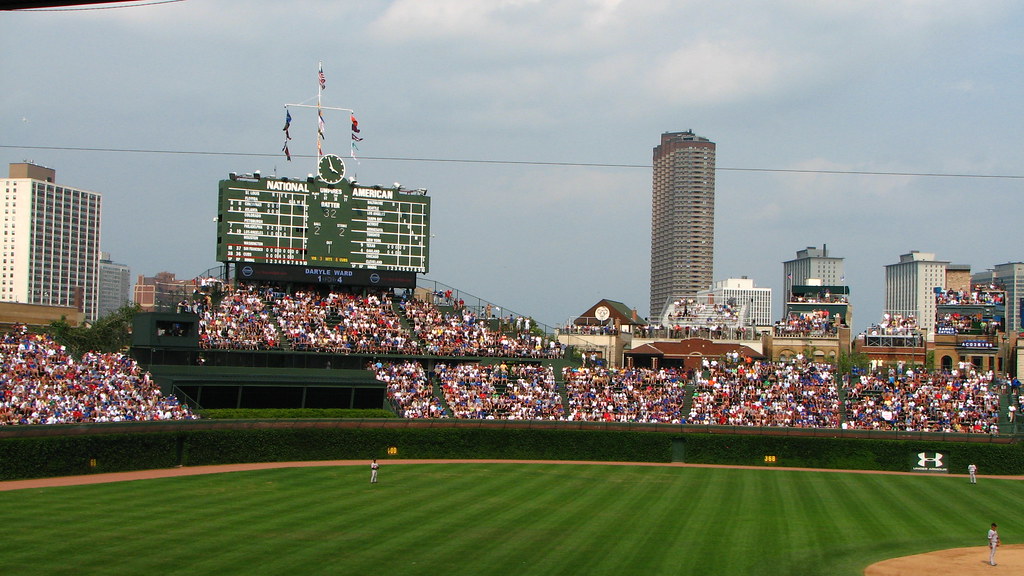
Visiting baseball parks to see professional games was part of the agenda on our trip. On Friday, July 12, 1985, we attended a Cubs vs Dodger game in the best ballpark we’d seen – Wriggly Field – a gorgeous real grass field, ivy covered brick outfield walls, and sunny blue skies. This is the city where fans fought for tradition – no lights at Wriggly. All games were played during the day. (The big business of baseball being what it is, that has changed. Lights were installed in 1988. Night games are played there now.) We stayed around after the game to talk to the winning pitcher, an L.A. Dodger from the Seattle area, Tom Neidenfurer. He won the game 7-4. Our friend Dickie Pederson had gone to school with him in Redmond, Washington and asked us to say hi to him if we crossed paths on our journey.
We returned to the Italian restaurant, Rosebud, which refused us service the previous visit because we wore shorts. This time we were properly attired and were served; cannelloni for Ken, lasagna for me, and spaghetti with meatballs for the kids. We were not disappointed. It’s a classy place with great food and a mellow musical accompaniment. Another evening, we went back to Miller’s Pub on Wabash. The local tavern filled with regulars who consumed large quantities of pasta, wine, and beer, while watching sports on TV had become our favorite, offering more comfort than class.
The next day took us to The Dells in Wisconsin and on to Appleton where my grandmother, Bessie, was born. She left home at nineteen to be a Harvey Girl and travel across the country to Wyoming where she met the love of her life. I wrote about her in my blog post of September, 2023. Travel and adventure run in my blood. I’ll add more stories to our journey as memories bubble up.
This is a writing exercise based on a scene.Prompt scene: A busy small neighborhood café in the 5th arrondissement of Paris. Two old men each alone at his own table ate peacefully by themselves. One picked up fries with delicate fingers as the other spooned an ice cream sundae into his mouth, both protected and seemingly immune from the surge and retreat of customers around them. How long had they been coming here, months or years? Did they know each other, even a little bit? What are their stories?
Gerard walked with purpose past several couples already sipping coffee and nibbling croissants at square tables on the terrace in front of Café Couronne. Gerard was rarely this late to brunch. The café was a short brisk walk from his flat on Rue de Rennes at the intersection of Rue de la Couronne. It opened at 10:00 each weekday. It was nearly 10:20. His table was always inside even during the glorious summer months. Today was one of those soft spring days, with filtered sun, and a cool dampness from the night’s rain. While Gerard loved the Paris sunshine when it appeared, he hated the traffic along Rue de la Couronne. It frustrated his need for quiet as he ate brunch each day. The peace inside the tiny café, only 16 tables, was perfect for contemplation. Martin saw Gerard coming in his gray wool topcoat, with a grey scarf and fedora. He had short gray hair and a conservative mustache. Martin waved to him, pulling out his chair.
Every weekday Gerard occupied the table near the back wall of the café so he could observe without hindrance those who came and went. Martin faithfully served the regular patrons each morning.
and knew his order, plain yogurt, strawberries, or blueberries, depending on the chef’s choice, frites, and strong coffee. He immediately went to collect it from the kitchen. In his seventy-three years, Gerard found routine to be the cornerstone of his existence.
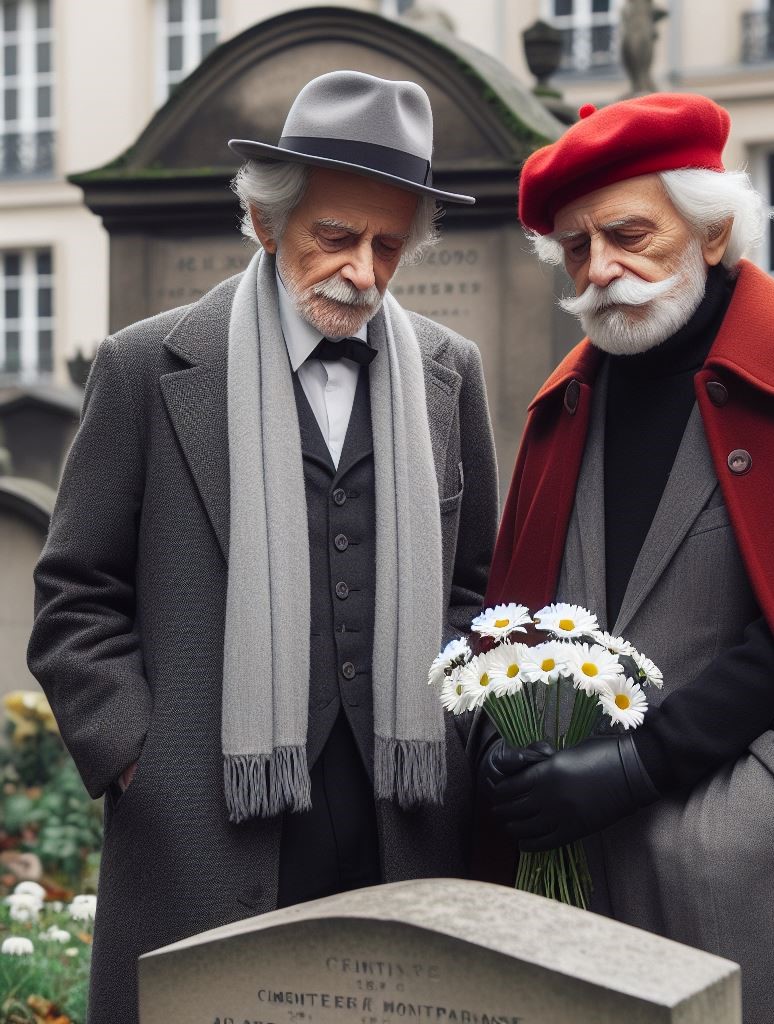
Gerard acknowledged, with a nod, Phillipe as he entered the café. Phillipe always sat at a table smack in the center of the room. In his red cape and beret, he preferred to be the obvious but unapproachable sun around which the other diners and staff revolved throughout the morning. His thick white handlebar mustache accented a face with twinkling eyes. Although they frequented the same café for ten years nearly every day, neither man spoke to the other.
When each man had his order, they settled in to enjoy their respective breakfasts. Gerard finished his yogurt with fruit and picked with delicate fingers at his fries while Phillipe spooned his sundae into his mouth slowly, delicious bite by delicious bite as the world spun inevitably around them.
Martin hurried to Phillipe’s table after delivering Gerard’s breakfast. He placed a steaming pot of green tea along with a large mug on the table and asked after Phillipe’s health. Phillipe was a habitual diner at Café Couronne but not daily. His apartment on the sixth floor of the old Art Nouveau building was a bit further down Le Rue de Rennes from Gerard. Phillipe’s attitude was com ci, com ça. He abhorred routine. At age seventy-six, he was sometimes absent of a morning due to a variety of ailments, heart, back, liver, eye, shoulder, or hips, but he never missed Thursdays. He had come on thirteen consecutive mornings so Martin felt sure he might be due to have a breakdown soon. Phillipe said he was sound this day and looking forward to meeting a friend for a stroll through the Jardin du Luxembourg after his petit dejeuner. “I’ll have a strawberry parfait sundae this morning,” he told Martin.
The two men left the café within ten minutes of each other, Phillipe being the first, stopped at the flower shop down the street from the café and purchased two dozen white daisies. At precisely 12:00 pm the two gentlemen of Paris met at the Rue Guynemer entrance on the northwest side of the Jardin du Luxembourg (6th arrondissement). From there they silently strolled the path past L’Orangerie with its intoxicating citrus smells, then around the green grassy oval in front of the Palais toward their favorite statue. The statue reminded them of her. They took two side-by-side chairs at the edge of the path and quietly spoke of her. After thirty minutes they strolled together to the Cimetière du Montparnasse to stand at her gravesite, privately mourning the woman they both loved.’The two men left the café within ten minutes of each other, Phillipe being the first, stopped at the flower shop down the street from the café and purchased two dozen white daisies. At precisely 12:00 pm the two gentlemen of Paris met at the Rue Guynemer entrance on the northwest side of the Jardin du Luxembourg (6th arrondissement). From there they silently strolled the path past L’Orangerie with its intoxicating citrus smells, then around the green grassy oval in front of the Palais toward their favorite statue. The statue reminded them of her. They took two side-by-side chairs at the edge of the path and quietly spoke of her. After thirty minutes they strolled together to the Cimetière du Montparnasse to stand at her gravesite, privately mourning the woman they both loved.
Gerard loved her first when she was seventeen. A muscular athletic man, he was ten years older than she. She had been an aerialist in the circus where he trained lions, tigers, and bears. She only performed there for two years, but they remained lovers even after she left to study magical arts at Arcane University in Paris. He would take the train from wherever the circus was temporarily situated in Europe to see her when he had a few days off. His hope was to persuade her to marry him and start a farm retreat for old circus animals in the Loire Valley. She finally tired of their long-distance affair. She asked him to stay away. Heartbroken, Gerard married the circus horse trainer on the rebound, and they had thirty-one quarrelsome, combative, marital years. After his wife died, he retired to spend his days in Paris researching butterfly habits and habitats with his true love still very much on his mind.
Phillipe met her when she was twenty-six. He was a professor of alchemy and enchantment at Arcane University. She was his most creative student, inventing unique ideas for magical entertainments. They became lovers within two weeks of her matriculation. She told him of Gerard, her first love, and the dozen or so that followed, but vowed he would be her last. They had happy times writing and producing magic shows for children. Sadly, she died of pneumonia after a mere five years together.
Twenty years went by, Phillipe and Gerard met one day at her grave in the Cimetière du Montparnasse. They eyed each other but didn’t speak. After several chance meetings, a coincidence neither of them questioned, they began a conversation about her. They assumed she intentionally brought them together. As time went by their meetings were formalized every Thursday at 12:00. When they met, they shared stories about how she enriched their lives. Each revealed a different side of her. To Gerard, she was a daring acrobat, lithe and supple, a physical wonder. To Phillipe, she was a cerebral partner with ideas flowing from her inventive mind. It made them feel that she was still with them. They alternated taking flowers to her grave. Occasionally both took flowers when a specific memory was observed by one or the other. After a while, they began eating breakfast at the same café, but never spoke except on Thursday. Their only subject was of her.
Here I am after more than three-quarters of a century looking back at some of the changes that occurred during that lifetime. The biggest technical change is the explosion of personal data devices. I did not get a cell phone until about twenty years ago. I was one of those people who said, “I’ll NEVER have a cell phone!!” I considered them an intrusion. I resisted and resisted. Then it became obvious that a cell phone was a necessary accompaniment to my daily lifestyle.
At the time my mother had moved to Tucson and was in need of close attention. She lived on her own but was in her 80s and had moved from the town where she lived for most of her life, away from lifelong friends and familiar places. She needed contact not only for personal needs and information about how to get around a new town, but also for company. My work took me out of the office, so I was not always available by landline. I believed she would find friends fairly quickly but, in the meantime, I was her social link, her sounding board, her complaint department, her connection to the world.
I discovered I needed a cell phone for business. Ken and I had just started a property management and real estate company and the need for quick exchanges of information became evident. So there I was, a new and reluctant cell phone user.
Looking way back…In the mid-1980s my family of three teenagers, two dogs, my husband and I, left our home in Bellevue Washington to travel the country. We journeyed through the forty-eight contiguous states plus a couple of Canadian Provinces and Mexican states for fourteen months. We took two of our kids out of high school (the third had just graduated). They wanted to keep up their studies while traveling so they could stay up in grade with their friends when we returned. That was accomplished with a study program coordinated by the University of Missouri and Bellevue High School. Correspondence courses were mailed (years before email) to us by the University and then back to the University as they completed each section and results were reported to their high school. All communication was by public phone in phone booths across the country and by mail, snail mail. Lots of postage. We had no cell phone and no computer. We were off the grid so to speak. Amazingly they were able to complete their studies in English, History, Math, and Social Studies – the basics, while learning firsthand about our beautiful country, its regions, its national parks, its varied cultures and languages (English has many nuances), history and geography. We took advantage of public libraries and museums along the way. Being teenagers imprisoned with their parents 24/7 for fourteen months, traveling in a van, living in a travel trailer, was indeed a sentence few would volunteer for. The only “device” they had for entertainment were Walkman cassette players with earphones. Those were revolutionary in that time. It was their means of escape into personal head space. I must give them all credit for their stalwart determination to survive. I’m sure it felt to them akin to traveling by covered wagon across the country. We crisscrossed the country from sea to shining sea four times in our quest to visit every state. How did we manage without a cell phone, GPS, the internet?
My how times have changed. Now the idea of leaving my house without a fully charged cell phone makes me quake with anxiety. What if something breaks down, what if my (fill in the blank) _________, husband, friend, daughter, grandson, needs to talk to me, an emergency, what if I get lost and need direction? What if, what if, what if? I can hardly believe the intense change from being a NEVER-CELLPHONER to being a NEVER-BE- WITHOUT-A-CELLPHONER.
Technology has certainly changed my life. For better?




 wonkagranny